PUBLISHER: Mordor Intelligence | PRODUCT CODE: 2097143

PUBLISHER: Mordor Intelligence | PRODUCT CODE: 2097143
Electric Bus Charging Infrastructure - Market Share Analysis, Industry Trends & Statistics, Growth Forecasts (2026 - 2031)
According to Mordor Intelligence, the electric bus charging infrastructure market size stands at USD 2.38 billion in 2026 and is projected to reach USD 5.64 billion by 2031, reflecting an 18.83% CAGR during the forecast period.
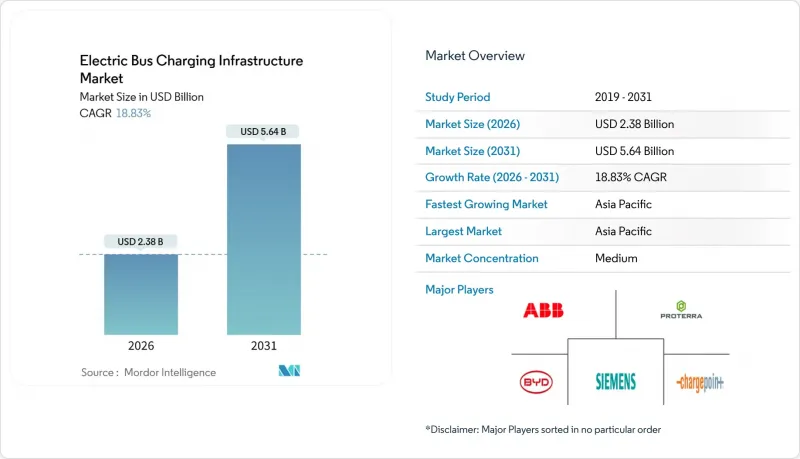
This report is Segmented by Charger Type (Slow Charger and Fast Charger), Charging Type (AC Charging and DC Charging), Connector Type (CHAdeMO, Combined Charging System, and Others), Level of Charging (Level 1 and More), Connectivity (Non-Connected Stations and Connected Stations), and Geography (North America and More). The Market Forecasts are Provided in Terms of Value (USD).
Global Electric Bus Charging Infrastructure Market Trends and Insights
Government Zero-Emission Bus Mandates
Binding purchase requirements introduced in leading regions have eliminated transit agencies' ability to delay electrification. California's Advanced Clean Fleets rule obliges public operators to buy only zero-emission buses from 2029, with complete fleet compliance by 2040. The European Union's revised Clean Vehicles Directive mandates that 100% of new urban buses be zero-emission by 2035. These synchronized mandates create a predictable demand pipeline, enabling utilities and depot contractors to invest in multi-year infrastructure programs.
Falling LFP Battery Prices Below USD 90/kWh (2025)
Lithium-iron-phosphate pack prices dropped below USD 90 per kilowatt-hour in 2025, sharpening the cost advantage of electric buses over diesel on a total cost of ownership basis. More miniature battery packs now suffice for regular duty cycles, which in turn lowers peak charging power requirements and reduces the number of high-capacity chargers per depot. The price trend supports wider adoption by medium-sized agencies in emerging markets that previously faced capital constraints. Operators can now pair 150-kilowatt fast chargers with 250-kilowatt-hour packs and still maintain route flexibility, shortening payback periods to under seven years when fuel and maintenance savings are considered.
Depot Grid-Connection Lead Times >=24 Months
Utility interconnection queues for multi-megawatt depot charging sites have extended to 24 to 36 months in major metropolitan areas, creating a critical bottleneck that delays fleet electrification timelines and forces transit agencies to phase bus procurements. Transit agencies must therefore secure grid connections 2 to 3 years before planned bus deliveries, which complicates procurement processes and increases project risk. Some regions offer expedited pathways for transit electrification projects, but geographical coverage remains limited and heavily oversubscribed.
Other drivers and restraints analyzed in the detailed report include:
- Megawatt Charging System Standard Finalization (2024)
- Depot Smart-Charging Software Cuts Demand Fees 25-40%
- Urban Land Scarcity for >=1 MW Substations
For complete list of drivers and restraints, kindly check the Table Of Contents.
Segment Analysis
Fast chargers held 64.34% of the electric bus charging infrastructure market share in 2025, fueled by agencies that require mid-day top-ups to keep buses on schedule. The segment is projected to advance at a 20.55% CAGR through 2031. Fast-charging hardware, rated at 150-350 kilowatts, enables 80% state of charge in under 60 minutes, allowing vehicles to perform two or three complete cycles per shift. Depot operators optimize capital expenditures by pairing a limited number of fast chargers with a larger pool of slow units dedicated to overnight replenishment.
The economics of fast charging have improved as commercial battery cycle life has extended beyond 4,000 full-equivalent cycles, mitigating concerns about degradation. Bus rapid transit systems benefit most from fast charging, as terminal dwell times of 10-15 minutes accommodate automated pantograph connections that maintain tight headways. Slow chargers, while secondary, still appeal to fleets with generous dwell periods and lower daily mileage.
DC equipment accounted for 72.51% of the electric bus charging infrastructure market size in 2025 and is projected to post a 22.38% CAGR to 2031, reflecting agencies' preference for sub-two-hour turnarounds that keep vehicles on the road. Operators value conversion efficiencies near 95%, which trim energy losses and lower operating expenses. Liquid-cooled cables and sealed cabinets allow continuous high-power delivery even when ambient temperatures exceed 40 °C, preventing thermal derating during summer peaks. Modular architectures let depots start with 150-kilowatt cabinets and add power blocks to reach 600 kilowatts as fleet size grows, so early investments never become stranded.
AC chargers keep a niche where fleets are small, routes are short, and grid upgrades are cost-prohibitive. Units rated 22-43 kilowatts cost significantly less than comparable DC systems, allowing agencies to electrify a five-bus garage for roughly the price of one 350-kilowatt DC dispenser. Existing three-phase wiring, often installed for maintenance workshops, can be reused with minimal modification, shortening project timelines by several months. AC ports also serve as redundancy when DC dispensers undergo maintenance, ensuring buses can still depart on schedule.
Complete Report Scope:
- By Charger Type
- Slow Charger
- Fast Charger
- By Charging Type
- AC Charging
- DC Charging
- By Connector Type
- CHAdeMO
- Combined Charging System (CCS)
- Others
- By Level of Charging
- Level 1
- Level 2
- Level 3
- By Connectivity
- Non-connected Stations
- Connected Stations
- By Geography
- North America
- United States
- Canada
- Rest of North America
- South America
- Brazil
- Argentina
- Rest of South America
- Europe
- United Kingdom
- Germany
- Spain
- Italy
- France
- Russia
- Rest of Europe
- Asia-Pacific
- India
- China
- Japan
- South Korea
- Rest of Asia-Pacific
- Middle East and Africa
- United Arab Emirates
- Saudi Arabia
- Turkey
- Egypt
- South Africa
- Rest of Middle-East and Africa
- North America
Geography Analysis
Asia-Pacific accounted for 41.87% of the electric bus charging infrastructure market share in 2025 and is projected to expand at a 19.81% CAGR through 2031. China's directive to achieve full electric bus penetration in provincial capitals by 2027 is driving rapid depot construction and grid reinforcement. Indian tenders bundle multi-year charging services, transferring capital risk and accelerating private participation. Japan and South Korea offer targeted subsidies to bring regional operators into the electrification fold, while battery-swapping pilots in China test ultra-high utilization models.
South America is forecasted to grow at an 18.22% CAGR, anchored by Brazil's Sao Paulo commitment to electrify over 2,600 buses by 2028 under public-private financing structures. Chile's capital integrates solar arrays with depot chargers to hedge against grid volatility, and Colombia's Bogota system schedules 120 fast chargers across terminal stations to support phased vehicle deployment. Western Asia, led by Saudi Arabia's 1,000-bus tender, is expected to expand at a 17.98% CAGR as part of broader diversification initiatives.
North America and Europe anticipate CAGRs of 13.88% and 13.55% respectively, tempered by 24-36-month grid-connection lead times. California's mandate to purchase zero-emission buses from 2029 brings over 200 transit agencies into the procurement cycle. The European Union's binding 2035 zero-emission target underpins multi-billion-euro subsidy programs. Both regions invest in streamlined permit processes and pre-approved substation upgrades to alleviate interconnection bottlenecks.
- ABB Ltd.
- Siemens AG
- Heliox BV
- ChargePoint Inc.
- Proterra Inc.
- Efacec Power Solutions
- Kempower Oyj
- Alstom SA
- Schneider Electric SE
- Star Charge
- TGOOD Global Ltd.
- Tritium DCFC Ltd.
- EnBW AG
- EVgo Inc.
Additional Benefits:
- The market estimate (ME) sheet in Excel format
- 3 months of analyst support
TABLE OF CONTENTS
1 Introduction
- 1.1 Study Assumptions and Market Definition
- 1.2 Scope of the Study
2 Research Methodology
3 Executive Summary
4 Market Landscape
- 4.1 Market Overview
- 4.2 Market Drivers
- 4.2.1 Government Zero-Emission Bus Mandates
- 4.2.2 Falling LFP Battery Prices Below USD 90/kWh (2025)
- 4.2.3 Megawatt Charging System (MCS) Standard Finalisation (2024)
- 4.2.4 Depot Smart-Charging Software Cuts Demand Fees 25 to 40%
- 4.2.5 Energy-as-a-Service Financing Unlocks Depot CAPEX
- 4.2.6 Battery-Swapping Depots in China Cut Dwell Time to Less than 5 Min
- 4.3 Market Restraints
- 4.3.1 Depot Grid-Connection Lead Times above 24 Months
- 4.3.2 Urban Land Scarcity for 1 MW+ Substations
- 4.3.3 Pantograph Interoperability Gaps (SAE J3105 Variants)
- 4.3.4 Shortage of Certified HV Installers Slows Roll-Outs
- 4.4 Value / Supply-Chain Analysis
- 4.5 Regulatory Landscape
- 4.6 Technological Outlook
- 4.7 Porter's Five Forces
- 4.7.1 Threat of New Entrants
- 4.7.2 Bargaining Power of Suppliers
- 4.7.3 Bargaining Power of Buyers
- 4.7.4 Threat of Substitutes
- 4.7.5 Industry Rivalry
5 Market Size and Growth Forecasts (Value (USD))
- 5.1 By Charger Type
- 5.1.1 Slow Charger
- 5.1.2 Fast Charger
- 5.2 By Charging Type
- 5.2.1 AC Charging
- 5.2.2 DC Charging
- 5.3 By Connector Type
- 5.3.1 CHAdeMO
- 5.3.2 Combined Charging System (CCS)
- 5.3.3 Others
- 5.4 By Level of Charging
- 5.4.1 Level 1
- 5.4.2 Level 2
- 5.4.3 Level 3
- 5.5 By Connectivity
- 5.5.1 Non-connected Stations
- 5.5.2 Connected Stations
- 5.6 By Geography
- 5.6.1 North America
- 5.6.1.1 United States
- 5.6.1.2 Canada
- 5.6.1.3 Rest of North America
- 5.6.2 South America
- 5.6.2.1 Brazil
- 5.6.2.2 Argentina
- 5.6.2.3 Rest of South America
- 5.6.3 Europe
- 5.6.3.1 United Kingdom
- 5.6.3.2 Germany
- 5.6.3.3 Spain
- 5.6.3.4 Italy
- 5.6.3.5 France
- 5.6.3.6 Russia
- 5.6.3.7 Rest of Europe
- 5.6.4 Asia-Pacific
- 5.6.4.1 India
- 5.6.4.2 China
- 5.6.4.3 Japan
- 5.6.4.4 South Korea
- 5.6.4.5 Rest of Asia-Pacific
- 5.6.5 Middle East and Africa
- 5.6.5.1 United Arab Emirates
- 5.6.5.2 Saudi Arabia
- 5.6.5.3 Turkey
- 5.6.5.4 Egypt
- 5.6.5.5 South Africa
- 5.6.5.6 Rest of Middle-East and Africa
- 5.6.1 North America
6 Competitive Landscape
- 6.1 Market Concentration
- 6.2 Strategic Moves
- 6.3 Market Share Analysis
- 6.4 Company Profiles (Includes Global Level Overview, Market Level Overview, Core Segments, Financials as Available, Strategic Information, Market Rank/Share for Key Companies, Products and Services, SWOT Analysis, and Recent Developments)
- 6.4.1 ABB Ltd.
- 6.4.2 Siemens AG
- 6.4.3 Heliox BV
- 6.4.4 ChargePoint Inc.
- 6.4.5 Proterra Inc.
- 6.4.6 Efacec Power Solutions
- 6.4.7 Kempower Oyj
- 6.4.8 Alstom SA
- 6.4.9 Schneider Electric SE
- 6.4.10 Star Charge
- 6.4.11 TGOOD Global Ltd.
- 6.4.12 Tritium DCFC Ltd.
- 6.4.13 EnBW AG
- 6.4.14 EVgo Inc.
7 Market Opportunities and Future Outlook
- 7.1 White-space and Unmet-Need Assessment

