PUBLISHER: Mordor Intelligence | PRODUCT CODE: 2097154

PUBLISHER: Mordor Intelligence | PRODUCT CODE: 2097154
5G in Aviation - Market Share Analysis, Industry Trends & Statistics, Growth Forecasts (2026 - 2031)
According to Mordor Intelligence, the 5G market size In Aviation Industry is expected to grow from USD 3.20 billion in 2025 to USD 4.23 billion in 2026 and is forecast to reach USD 17.05 billion by 2031 at 32.17% CAGR over 2026-2031.
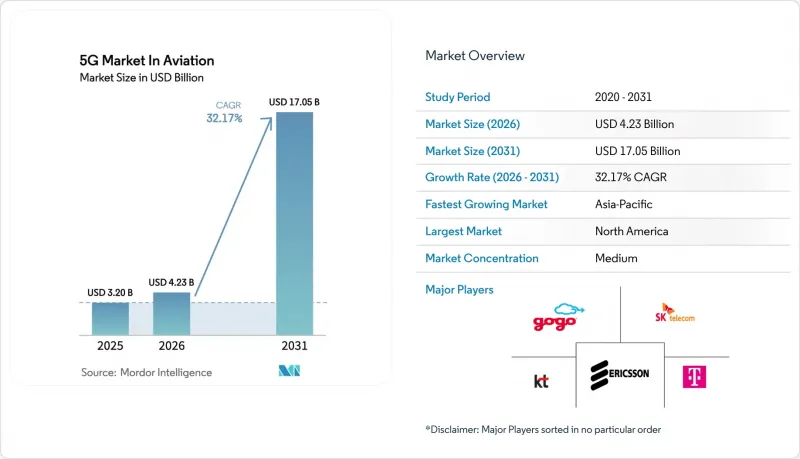
This report is Segmented by Connectivity Type (Ground-To-Ground Communication, Air-To-Ground Communication, and More), Offering (Hardware, Software, and More), Application (Passenger Experience, Airport Operations, and More), Deployment Model (Public 5G Networks, Private 5G Networks, and More), Stakeholder (Airlines, Airports, and More) and Geography. The Market Forecasts are Provided in Terms of Value (USD).
Global 5G in Aviation Market Trends and Insights
Proliferation of IFEC demand
Seventy-seven percent of passengers now rank onboard Wi-Fi as a deciding factor when booking flights, turning connectivity into a core service benchmark. Qatar Airways' 2024 launch of Starlink inflight Wi-Fi delivered peak speeds of 500 Mbit/s, narrowing the technology gap between cabin and ground experiences. Gogo's aviation-specific 5G network, due in 2025, promises consistent 25 Mbps average speeds for business jets, rising to 75-80 Mbps bursts, reshaping cabin entertainment and real-time collaboration.
Airport digital-transformation programs
Airports are shifting from fragmented legacy systems to unified 5G platforms that link thousands of sensors, cameras, and handheld terminals. Frankfurt Airport's private network reduces blind spots caused by metal airframes and supports secure point-of-sale, automated baggage tracking, and real-time video analytics, cutting mishandled-bag incidents and communication latency.
High CAPEX for private 5G network build-out
Airport-wide 5G installations often call for USD 3-10 million outlays, covering ruggedized radios, fiber backhaul, and spectrum-access fees. Alternative models are emerging: Brazil-based Atech offers "ATC-as-a-service," letting navigation service providers tap advanced traffic-management tools without heavy upfront spend, achieving 40% cost savings over traditional projects.
Other drivers and restraints analyzed in the detailed report include:
- Rapid expansion of aviation IoT sensors and edge computing
- National 5G spectrum auctions and aviation testbeds
- Aviation-grade cybersecurity and safety certification hurdles
For complete list of drivers and restraints, kindly check the Table Of Contents.
Segment Analysis
Air-to-ground links commanded 45.40% of the 5G in Aviation Market industry size in 2025, benefiting from established tower infrastructure and immediate passenger-service needs. Air-to-air connectivity, however, is accelerating at a 43.2% CAGR. Direct aircraft-to-aircraft data exchange eliminates ground relays, shaving latency by 65% for collision-avoidance messages and enabling fuel-optimized formation flying. EchoStar's hybrid satellite-5G contracts with Turkish AJet and Delta Airlines show commercial appetite for continuous, route-agnostic coverage.
Moving toward mesh networks marks a profound design shift, replacing hub-and-spoke traffic flows with dynamic peer links. SESAR's 5G-AirSky trials recorded sub-12-millisecond delays, validating readiness for safety-critical messaging
Service contracts spanning radio-planning, rollout, and managed operations held 37.80% of the 5G in Aviation Market industry share in 2025. Yet, software revenues are set for a 33.4% CAGR through 2031 as airlines favor virtual upgrades over hardware swaps. Gogo's 5G protocol-stack emulation lets engineers fine-tune algorithms before airborne installation, preserving capital and accelerating feature releases.
Edge computing and network-slicing tools allow bespoke lanes for air-traffic data, cargo tracking, or passenger streaming without physical network duplication. Eurocontrol's 2024 CNS Evolution Plan projects 15-20% efficiency gains for early adopters that embrace cloud-delivered services and AI-assisted automation.
Complete Report Scope:
- By Connectivity Type
- Ground-to-Ground Communication
- Air-to-Ground Communication
- Air-to-Air Communication
- By Offering
- Hardware
- Software
- Services
- By Application
- Passenger Experience
- In-flight Wi-Fi
- AR/VR Entertainment
- Airport Operations
- Baggage and Cargo Tracking
- Smart Security and Border Control
- Flight Operations
- Real-time Flight Tracking
- Predictive Maintenance Telemetry
- Drone and Urban Air Mobility Operations
- Passenger Experience
- By Deployment Model
- Public 5G Networks
- Private 5G Networks
- Hybrid Networks
- By Stakeholder
- Airlines
- Airports
- MRO Providers
- ANSPs
- OEMs
- Passengers
- By Geography
- North America
- United States
- Canada
- Mexico
- South America
- Brazil
- Argentina
- Rest of South America
- Europe
- Germany
- United Kingdom
- France
- Italy
- Spain
- Russia
- Rest of Europe
- Asia-Pacific
- China
- India
- Japan
- South Korea
- ASEAN
- Rest of Asia Pacific
- Middle East and Africa
- Middle East
- Saudi Arabia
- United Arab Emirates
- Turkey
- Rest of Middle East
- Africa
- South Africa
- Nigeria
- Rest of Africa
- Middle East
- North America
Geography Analysis
North America led the 5G in Aviation Market industry with 36.40% share in 2025, equivalent to USD 1.16 billion. The FAA earmarked USD 43.4 million in 2025 for airport-technology research, reinforcing public-sector commitment to integrated 5G testbeds. Commercial momentum is equally strong: Gogo's planned nationwide aviation-only 5G network will upgrade more than 250 towers and blend licensed and unlicensed spectrum for resilient in-flight coverage.
Asia Pacific is matching the broader 32.17% CAGR, buoyed by national-scale 5G deployments and rising data-center capacity. China's build-out and Hong Kong International Airport's private network showcase position the region as a laboratory for connected ground-service vehicles and dynamic resource allocation. GSMA forecasts 5G will inject USD 130 billion into the regional economy by 2030, with aviation capturing a meaningful share.
Europe positions itself as an innovation hub through coordinated R&D and regulatory alignment. The UK's 5G Innovation Regions program seeds airport pilots, while EASA's Research Agenda 2025 prioritizes performance metrics for ATM ground equipment and spectrum coexistence frameworks vital to 5G deployment.
- Telefonaktiebolaget LM Ericsson
- Nokia Corporation
- Huawei Technologies Co. Ltd
- Deutsche Telekom AG
- SK Telecom Co. Ltd
- KT Corporation
- Gogo LLC
- SmartSky Networks LLC
- AeroMobile Communications Ltd
- Inseego Corp.
- Telia Company AB
- Verizon Communications Inc.
- AT&T Inc.
- ZTE Corporation
- Qualcomm Technologies Inc.
- Panasonic Avionics Corporation
- Thales Group
- Collins Aerospace
- Intelsat S.A.
- Eutelsat Group
Additional Benefits:
- The market estimate (ME) sheet in Excel format
- 3 months of analyst support
TABLE OF CONTENTS
1 INTRODUCTION
- 1.1 Study Assumptions and Market Definition
- 1.2 Scope of the Study
2 RESEARCH METHODOLOGY
3 EXECUTIVE SUMMARY
4 MARKET LANDSCAPE
- 4.1 Market Overview
- 4.2 Market Drivers
- 4.2.1 Proliferation of IFEC (In-flight Entertainment and Connectivity) demand
- 4.2.2 Airport digital-transformation programs
- 4.2.3 Rapid expansion of aviation IoT sensors and edge computing
- 4.2.4 National 5G spectrum auctions and aviation testbeds
- 4.2.5 5G-enabled Advanced Air Mobility corridors
- 4.2.6 Real-time 8K cabin analytics for ancillary-revenue upselling
- 4.3 Market Restraints
- 4.3.1 High CAPEX for private 5G network build-out
- 4.3.2 Aviation-grade cybersecurity and safety certification hurdles
- 4.3.3 Interference risks with radio-altimeters in mmWave bands
- 4.3.4 Limited 5G device refresh cycles in legacy aircraft fleets
- 4.4 Industry Value Chain Analysis
- 4.5 Regulatory Landscape
- 4.6 Technological Outlook
- 4.7 Porter's Five Forces Analysis
- 4.7.1 Bargaining Power of Suppliers
- 4.7.2 Bargaining Power of Consumers
- 4.7.3 Threat of New Entrants
- 4.7.4 Intensity of Competitive Rivalry
- 4.7.5 Threat of Substitutes
- 4.8 5G in Aviation Use Cases
- 4.9 Investment Analysis
5 MARKET SIZE AND GROWTH FORECASTS (VALUE)
- 5.1 By Connectivity Type
- 5.1.1 Ground-to-Ground Communication
- 5.1.2 Air-to-Ground Communication
- 5.1.3 Air-to-Air Communication
- 5.2 By Offering
- 5.2.1 Hardware
- 5.2.2 Software
- 5.2.3 Services
- 5.3 By Application
- 5.3.1 Passenger Experience
- 5.3.1.1 In-flight Wi-Fi
- 5.3.1.2 AR/VR Entertainment
- 5.3.2 Airport Operations
- 5.3.2.1 Baggage and Cargo Tracking
- 5.3.2.2 Smart Security and Border Control
- 5.3.3 Flight Operations
- 5.3.3.1 Real-time Flight Tracking
- 5.3.3.2 Predictive Maintenance Telemetry
- 5.3.4 Drone and Urban Air Mobility Operations
- 5.3.1 Passenger Experience
- 5.4 By Deployment Model
- 5.4.1 Public 5G Networks
- 5.4.2 Private 5G Networks
- 5.4.3 Hybrid Networks
- 5.5 By Stakeholder
- 5.5.1 Airlines
- 5.5.2 Airports
- 5.5.3 MRO Providers
- 5.5.4 ANSPs
- 5.5.5 OEMs
- 5.5.6 Passengers
- 5.6 By Geography
- 5.6.1 North America
- 5.6.1.1 United States
- 5.6.1.2 Canada
- 5.6.1.3 Mexico
- 5.6.2 South America
- 5.6.2.1 Brazil
- 5.6.2.2 Argentina
- 5.6.2.3 Rest of South America
- 5.6.3 Europe
- 5.6.3.1 Germany
- 5.6.3.2 United Kingdom
- 5.6.3.3 France
- 5.6.3.4 Italy
- 5.6.3.5 Spain
- 5.6.3.6 Russia
- 5.6.3.7 Rest of Europe
- 5.6.4 Asia-Pacific
- 5.6.4.1 China
- 5.6.4.2 India
- 5.6.4.3 Japan
- 5.6.4.4 South Korea
- 5.6.4.5 ASEAN
- 5.6.4.6 Rest of Asia Pacific
- 5.6.5 Middle East and Africa
- 5.6.5.1 Middle East
- 5.6.5.1.1 Saudi Arabia
- 5.6.5.1.2 United Arab Emirates
- 5.6.5.1.3 Turkey
- 5.6.5.1.4 Rest of Middle East
- 5.6.5.2 Africa
- 5.6.5.2.1 South Africa
- 5.6.5.2.2 Nigeria
- 5.6.5.2.3 Rest of Africa
- 5.6.5.1 Middle East
- 5.6.1 North America
6 COMPETITIVE LANDSCAPE
- 6.1 Market Concentration
- 6.2 Strategic Moves
- 6.3 Market Share Analysis
- 6.4 Company Profiles (includes Global level Overview, Market level overview, Core Segments, Financials as available, Strategic Information, Market Rank/Share for key companies, Products and Services, and Recent Developments)
- 6.4.1 Telefonaktiebolaget LM Ericsson
- 6.4.2 Nokia Corporation
- 6.4.3 Huawei Technologies Co. Ltd
- 6.4.4 Deutsche Telekom AG
- 6.4.5 SK Telecom Co. Ltd
- 6.4.6 KT Corporation
- 6.4.7 Gogo LLC
- 6.4.8 SmartSky Networks LLC
- 6.4.9 AeroMobile Communications Ltd
- 6.4.10 Inseego Corp.
- 6.4.11 Telia Company AB
- 6.4.12 Verizon Communications Inc.
- 6.4.13 AT&T Inc.
- 6.4.14 ZTE Corporation
- 6.4.15 Qualcomm Technologies Inc.
- 6.4.16 Panasonic Avionics Corporation
- 6.4.17 Thales Group
- 6.4.18 Collins Aerospace
- 6.4.19 Intelsat S.A.
- 6.4.20 Eutelsat Group
7 MARKET OPPORTUNITIES AND FUTURE OUTLOOK
- 7.1 White-space and Unmet-need Assessment

