PUBLISHER: Mordor Intelligence | PRODUCT CODE: 2097159

PUBLISHER: Mordor Intelligence | PRODUCT CODE: 2097159
Almond Ingredients - Market Share Analysis, Industry Trends & Statistics, Growth Forecasts (2026 - 2031)
According to Mordor Intelligence, the almond ingredients market size in 2026 is estimated at USD 16.78 billion, growing from 2025 value of USD 15.4 billion with 2031 projections showing USD 25.77 billion, growing at 8.96% CAGR over 2026-2031.
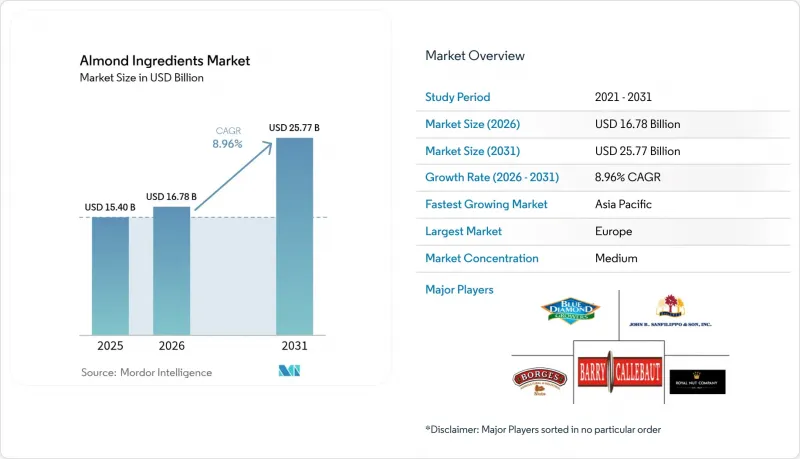
This report is Segmented by Type (Whole Almond, Almond Pieces, Almond Flour, Almond Paste, Almond Milk, Almond Oil, Almond Extract, and Others); Nature (Conventional and Organic); Application (Food and Beverage, Personal Care and Cosmetics, Dietary Supplements, and More); and Geography (North America, Europe, Asia-Pacific, South America, and More). The Market Forecasts are Provided in Terms of Value (USD).
Global Almond Ingredients Market Trends and Insights
Rising demand for plant-based food
Almond protein's complete amino-acid profile and neutral taste allow high inclusion levels in dairy substitutes, meat analogs, and protein bars, and partially defatted almond flour is now approved for up to 80% use in nutritional formulations, according to the FDA. Manufacturers are emphasizing their clean-label positioning and achieving better sensory scores when compared to soy and pea proteins. For example, Anthony markets an almond protein powder, touting it as being crafted from just one ingredient: California-grown almonds. This product is gluten-free, non-GMO, vegan, and devoid of fillers, artificial flavors, or additives. In a similar vein, Blue Diamond Growers, alongside other processors, is ramping up new protein extraction lines, fueling double-digit growth in plant-based categories. This surge in demand has led to heightened procurement activities, prompting orchard expansions beyond U.S. borders to ensure a diversified supply.
Growth of convenient, on-the-go healthy snacking
Urban consumers are increasingly favoring portable, nutrient-dense snacks, leading to a surge in the popularity of value-added almond products like energy bites, protein clusters, and spice-coated kernels. This trend is underscored by rising almond consumption. Data from the US Department of Agriculture reveals that in 2023/2024, per capita almond consumption in the U.S. reached nearly 2.3 pounds, marking the highest level in a decade. Additionally, processors are reaping benefits from broader premium price ranges and heightened retailer acceptance of single-serve packs, especially those that prominently highlight health benefits, fueling the market's expansion. In line with this growing demand for almond-based foods and snacks, players are focused on expanding their almond ingredient lines to cater to the growing demand. For instance, in 2025, Almendras de Andalucia showcased a defatted almond powder, which is a high-protein ingredient suitable for fortified foods and health products.
Availability of lower-priced nut and seed substitutes
Lower-priced substitutes like peanuts, sunflower seeds, and soy nuts are significantly restraining the almond ingredients market. These alternatives provide cost-sensitive food manufacturers and consumers with affordable options that don't drastically compromise on nutritional value or functionality. Often, these substitutes come with reduced raw material costs and exhibit less price volatility. This makes them particularly appealing for large-scale food production, especially in emerging markets with heightened price sensitivity. For example, StatCan reported that in August 2024, the average retail price for peanut butter in Canada was CAD 5.97 per kilogram, down from CAD 6.09 the previous year. Furthermore, some of these substitutes can replicate the texture and binding properties of almonds in specific applications. This allows formulators to uphold product quality while being mindful of ingredient budgets. Such competitive pressures are curtailing the growth of the almond ingredient market.
Other drivers and restraints analyzed in the detailed report include:
- Growing consumer preference for clean label and gluten-free ingredients
- Innovations in food processing and applications
- High price volatility of raw almonds
For complete list of drivers and restraints, kindly check the Table Of Contents.
Segment Analysis
In 2025, Whole Almonds captured a 31.84% share of the almond market, buoyed by their popularity in traditional snacking and as inclusions in baked goods. Meanwhile, Almond Oil emerged as the fastest-growing product, boasting an impressive 10.78% CAGR projected through 2031. This surge is largely attributed to beauty formulators' increasing preference for plant-based emollients, especially those rich in vitamin E and phytosterols. Innovations in roasting and flavoring not only enhance the sensory appeal of almonds but also extend their shelf life, justifying premium price points. In the Asia-Pacific region, rising disposable incomes are driving volume expansion, while European markets are honing in on provenance cues and crafting lower-salt recipes to align with public health objectives. Manufacturers are channeling investments into refining roasting techniques and adopting vacuum-filled packaging, ensuring that crunch and flavor integrity are preserved throughout extended distribution chains. A case in point: Treehouse California Almonds provides bulk offerings of natural, blanched, and roasted whole almonds, available in vacuum-packed 50 lb boxes and 25 lb options-catering perfectly to food manufacturers prioritizing longevity and consistent quality.
Utilizing aqueous extraction lines, producers are minimizing solvent residues, paving the way for cosmetic-grade certifications. These certifications can command prices 3-4 times higher than their edible oil counterparts. The culinary world is also embracing almond oil, drawn by its stable smoke-point and the growing consumer inclination towards premium, mono-unsaturated fats. Almond derivatives like Pieces, Flour, Milk, Paste, and Extract are carving out niche yet lucrative markets. These segments find their sweet spot at the intersection of gluten-free baking, dairy alternatives, and natural flavoring. Each sub-segment capitalizes on almonds' nutritional reputation, fine-tuning aspects like particle size, fat content, and flavor intensity to cater to specific end-use requirements.
Complete Report Scope:
- By Type
- Whole Almond
- Almond Pieces
- Almond Flour
- Almond Paste
- Almond Milk
- Almond Oil
- Almond Extract
- Other Types
- By Nature
- Conventional
- Organic
- By Application
- Food and Beverage
- Bakery and Confectionery
- Dairy and Dairy Alternatives
- Sweet and Savory Snacks
- Beverages
- Other Food and Beverages
- Personal Care and Cosmetics
- Dietary Supplements
- Other Applications
- Food and Beverage
- By Geography
- North America
- United States
- Canada
- Mexico
- Rest of North America
- Europe
- Germany
- United Kingdom
- Italy
- France
- Spain
- Netherlands
- Poland
- Belgium
- Sweden
- Rest of Europe
- Asia-Pacific
- China
- India
- Japan
- Australia
- Indonesia
- South Korea
- Thailand
- Singapore
- Rest of Asia-Pacific
- South America
- Brazil
- Argentina
- Colombia
- Chile
- Peru
- Rest of South America
- Middle East and Africa
- South Africa
- Saudi Arabia
- United Arab Emirates
- Nigeria
- Egypt
- Morocco
- Turkey
- Rest of Middle East and Africa
- North America
Geography Analysis
In 2025, Europe commanded the almond market, accounting for 34.12% of the revenue. This dominance is bolstered by the continent's established consumption habits, Mediterranean culinary traditions, and EU regulations that prioritize clean-label and organic products. European consumers, known for their health-conscious choices, are gravitating towards plant-based, clean-label, organic, and functional foods. This trend dovetails seamlessly with products derived from almonds, including almond milk, flour, butter, and protein. Furthermore, Europe's growing almond production capacity is fueling the market's expansion, reducing the region's dependence on imports. For instance, the USDA Foreign Agricultural Service reported that in 2023-24, Europe emerged as the second-largest almond producer, churning out approximately 147.7 thousand metric tons.
Asia-Pacific is on a rapid ascent, boasting a 10.41% CAGR projected through 2031, largely propelled by China's nut intake, which has seen a twofold increase. Nations such as China, India, Japan, South Korea, and Australia are showing a heightened appetite for nutritious, premium, and functional foods. This shift has catalyzed the integration of almond-based ingredients across various sectors, from plant-based beverages and snacks to bakery items and dairy alternatives. Additionally, the region's burgeoning cosmetics and personal care sectors are tapping into almond oil and extracts, lauding their moisturizing and anti-aging benefits, thus amplifying the demand across multiple industries.
North America, with California at its helm, stands as a powerhouse in global almond output and processing. While domestic consumption remains stable, the region's growth hinges on premiumization and innovative functionalities in products. Both Canada and Mexico are witnessing a gradual shift, with health considerations steering preferences towards unsalted and roasted-no-oil almond varieties. Despite facing challenges like rising water costs and pollination fees, which highlight the significance of initiatives such as the KIND Almond Acres Initiative, growers maintain a competitive edge in exports. Meanwhile, South America is diversifying the landscape, thanks to Chile's expanding orchards and advantageous trade agreements with China. In contrast, the Middle East and Africa markets, while presenting long-term promise, are reliant on factors like increasing disposable incomes and enhanced logistics.
- Blue Diamond Growers
- John B. Sanfilippo and Son Inc.
- Borges Agricultural & Industrial Nuts, S.A
- Royal Nut Company
- Barry Callebaut AG
- Olam International Ltd.
- Bob's Red Mill Natural Foods
- Hodgson Mill Inc.
- Treehouse California Almonds LLC
- Kanegrade Ltd.
- Select Harvests Ltd.
- Harris Woolf Almonds
- Kerry Group plc
- Givaudan SA (Naturex)
- Hines Nut Company
- Valued Natural Foods LLC
- AMS Noshcraft Pvt. Ltd
- Arva Flour Mill
- Drupe Foods India Pvt Ltd.
- SunOpta, Inc.
Additional Benefits:
- The market estimate (ME) sheet in Excel format
- 3 months of analyst support
TABLE OF CONTENTS
1 INTRODUCTION
- 1.1 Study Assumptions and Market Definition
- 1.2 Scope of the Study
2 RESEARCH METHODOLOGY
3 EXECUTIVE SUMMARY
4 MARKET LANDSCAPE
- 4.1 Market Overview
- 4.2 Market Drivers
- 4.2.1 Rising demand for plant-based food
- 4.2.2 Growth of convenient, on-the-go healthy snacking
- 4.2.3 Growing consumer preference for clean label and gluten-free ingredients in processed foods
- 4.2.4 Expansion of lactose-free and vegan dairy alternatives
- 4.2.5 Increasing use of almonds in fortified and functional food products
- 4.2.6 Innovations in Food Processing and Applications
- 4.3 Market Restraints
- 4.3.1 Availability of lower-priced nut and seed substitutes
- 4.3.2 High price volatility of raw almonds
- 4.3.3 Allergen concerns regarding almonds
- 4.3.4 Water-intensive cultivation
- 4.4 Supply-Chain Analysis
- 4.5 Regulatory Landscape
- 4.6 Technological Outlook
- 4.7 Porter's Five Forces
- 4.7.1 Threat of New Entrants
- 4.7.2 Bargaining Power of Buyers
- 4.7.3 Bargaining Power of Suppliers
- 4.7.4 Threat of Substitutes
- 4.7.5 Competitive Rivalry
5 MARKET SIZE AND GROWTH FORECASTS
- 5.1 By Type
- 5.1.1 Whole Almond
- 5.1.2 Almond Pieces
- 5.1.3 Almond Flour
- 5.1.4 Almond Paste
- 5.1.5 Almond Milk
- 5.1.6 Almond Oil
- 5.1.7 Almond Extract
- 5.1.8 Other Types
- 5.2 By Nature
- 5.2.1 Conventional
- 5.2.2 Organic
- 5.3 By Application
- 5.3.1 Food and Beverage
- 5.3.1.1 Bakery and Confectionery
- 5.3.1.2 Dairy and Dairy Alternatives
- 5.3.1.3 Sweet and Savory Snacks
- 5.3.1.4 Beverages
- 5.3.1.5 Other Food and Beverages
- 5.3.2 Personal Care and Cosmetics
- 5.3.3 Dietary Supplements
- 5.3.4 Other Applications
- 5.3.1 Food and Beverage
- 5.4 By Geography
- 5.4.1 North America
- 5.4.1.1 United States
- 5.4.1.2 Canada
- 5.4.1.3 Mexico
- 5.4.1.4 Rest of North America
- 5.4.2 Europe
- 5.4.2.1 Germany
- 5.4.2.2 United Kingdom
- 5.4.2.3 Italy
- 5.4.2.4 France
- 5.4.2.5 Spain
- 5.4.2.6 Netherlands
- 5.4.2.7 Poland
- 5.4.2.8 Belgium
- 5.4.2.9 Sweden
- 5.4.2.10 Rest of Europe
- 5.4.3 Asia-Pacific
- 5.4.3.1 China
- 5.4.3.2 India
- 5.4.3.3 Japan
- 5.4.3.4 Australia
- 5.4.3.5 Indonesia
- 5.4.3.6 South Korea
- 5.4.3.7 Thailand
- 5.4.3.8 Singapore
- 5.4.3.9 Rest of Asia-Pacific
- 5.4.4 South America
- 5.4.4.1 Brazil
- 5.4.4.2 Argentina
- 5.4.4.3 Colombia
- 5.4.4.4 Chile
- 5.4.4.5 Peru
- 5.4.4.6 Rest of South America
- 5.4.5 Middle East and Africa
- 5.4.5.1 South Africa
- 5.4.5.2 Saudi Arabia
- 5.4.5.3 United Arab Emirates
- 5.4.5.4 Nigeria
- 5.4.5.5 Egypt
- 5.4.5.6 Morocco
- 5.4.5.7 Turkey
- 5.4.5.8 Rest of Middle East and Africa
- 5.4.1 North America
6 COMPETITIVE LANDSCAPE
- 6.1 Market Concentration
- 6.2 Strategic Moves
- 6.3 Market Share Analysis
- 6.4 Company Profiles (includes Global level Overview, Market level overview, Core Segments, Financials as available, Strategic Information, Market Rank/Share for key companies, Products and Services, and Recent Developments)
- 6.4.1 Blue Diamond Growers
- 6.4.2 John B. Sanfilippo and Son Inc.
- 6.4.3 Borges Agricultural & Industrial Nuts, S.A
- 6.4.4 Royal Nut Company
- 6.4.5 Barry Callebaut AG
- 6.4.6 Olam International Ltd.
- 6.4.7 Bob's Red Mill Natural Foods
- 6.4.8 Hodgson Mill Inc.
- 6.4.9 Treehouse California Almonds LLC
- 6.4.10 Kanegrade Ltd.
- 6.4.11 Select Harvests Ltd.
- 6.4.12 Harris Woolf Almonds
- 6.4.13 Kerry Group plc
- 6.4.14 Givaudan SA (Naturex)
- 6.4.15 Hines Nut Company
- 6.4.16 Valued Natural Foods LLC
- 6.4.17 AMS Noshcraft Pvt. Ltd
- 6.4.18 Arva Flour Mill
- 6.4.19 Drupe Foods India Pvt Ltd.
- 6.4.20 SunOpta, Inc.
7 MARKET OPPORTUNITIES AND FUTURE OUTLOOK

