
PUBLISHER: Mordor Intelligence | PRODUCT CODE: 2097160

PUBLISHER: Mordor Intelligence | PRODUCT CODE: 2097160
Tyrosine Kinase Inhibitors - Market Share Analysis, Industry Trends & Statistics, Growth Forecasts (2026 - 2031)
According to Mordor Intelligence, the tyrosine kinase inhibitors market size is expected to grow from USD 67.33 billion in 2025 to USD 72.66 billion in 2026 and is forecast to reach USD 106.28 billion by 2031 at 7.91% CAGR over 2026-2031.
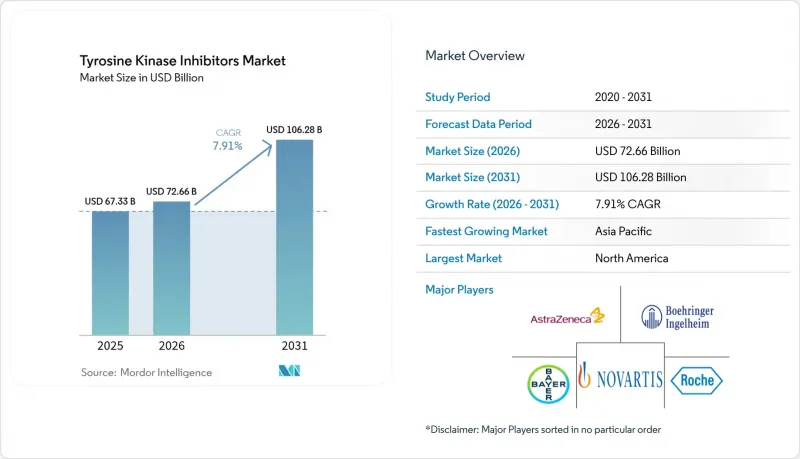
This report is Segmented by Target Receptor (BCR-ABL, EGFR, VEGFR, ALK, BTK, Others), Application (CML, NSCLC, and More), Generation (First, Second, Third, Fourth & Next-Gen), Route of Administration (Oral, Intravenous), Distribution Channel (Hospital, Retail, Online Pharmacies), and Geography (North America, Europe, and More). The Market Forecasts are Provided in Terms of Value (USD).
Global Tyrosine Kinase Inhibitors Market Trends and Insights
Rising Incidence of TKI-Amenable Cancers
Roughly 30% of solid tumors now reveal actionable kinase alterations through next-generation sequencing, widening the eligible patient pool for targeted therapy. Improved profiling uncovers rare drivers such as ROS1 fusions and MET exon 14 skipping, which Chinese regulators addressed by approving taletrectinib in June 2025. Aging populations and smoking prevalence push lung and liver cancer cases higher across Asia, while comprehensive genomic screening identifies candidates for existing regimens and spotlights novel targets.
Favorable Reimbursement & Guideline Inclusion
Value-based pricing frameworks in the United States, Europe, and Japan reward long-term health outcomes rather than unit sales, translating guideline upgrades directly into payer coverage. The 2024 NCCN update named several TKI combinations as preferred first-line therapies, triggering automatic formulary adoption by U.S. insurers. Japan now grants 5-10% price premiums for fast-tracked oncology drugs, incentivizing rapid market entry and offsetting development risk.
High Therapy Cost & Value-Based Pricing Pressure
Payers now demand real-world cost-effectiveness beyond trial endpoints, placing risk on manufacturers to deliver outcome guarantees. Some European HTA bodies denied premium pricing for new agents lacking robust comparative evidence. Biosimilar entry adds downward pressure, possibly constraining R&D budgets for next-generation projects when return-on-investment thresholds tighten.
Other drivers and restraints analyzed in the detailed report include:
- Patent Cliffs Enabling Generic TKIs
- Oral Formulations Boosting Patient Adherence
- Emergence of Resistance Mutations
For complete list of drivers and restraints, kindly check the Table Of Contents.
Segment Analysis
EGFR inhibitors contributed 37.85% of 2025 revenue due to their central role in biomarker-defined lung cancer. Recent conditional approval of Tagrisso for unresectable Stage III EGFR-mutated NSCLC further enlarged the eligible population. Meanwhile, BTK inhibitors registered an 8.78% CAGR as agents like pirtobrutinib moved into mantle cell lymphoma and exploratory solid-tumor studies. The tyrosine kinase inhibitors market size for BTK therapies is projected to add USD 3.82 billion by 2031. Competitive dynamics now pivot on tackling resistance; fourth-generation EGFR and non-covalent BTK scaffolds aim to sustain long-term control. Portfolio broadening also extends to VEGFR and ALK franchises, but their growth trails the BTK surge.
EGFR developers focus on combination regimens with immunotherapy, while BTK pipelines test tissue-agnostic designs compatible with FDA guidance released in 2025. Novel KAT6A and RET fusions illustrate discovery breadth, often seeded by AI screening. As companion diagnostics spread, target-specific uptake will mirror testing availability, reinforcing EGFR and BTK leadership yet allowing niche kinases to emerge.
Non-small cell lung cancer retained 42.10% revenue in 2025, supported by mature testing pathways and multiple approved regimens. Yet hepatocellular carcinoma displays the fastest 9.01% CAGR to 2031 as kinase-focused therapies outperform systemic standards, drawing developers to liver oncology. The tyrosine kinase inhibitors market share within HCC is expected to surpass 8% by 2031 as biomarkers expand eligibility. Breast and renal cancers continue stable demand through CDK4/6 and VEGF pathways, while basket trials test inhibitors across mutation-defined cohorts.
NSCLC strategy now segments patients by EGFR, ALK, ROS1, and MET alterations, enabling personalized first-line choices. HCC growth benefits from improved surveillance in hepatitis-driven geographies and better understanding of kinase biology. Basket designs may blur organ-based lines, letting rare tumors access targeted agents sooner.
Complete Report Scope:
- By Target Receptor
- BCR-ABL
- EGFR
- VEGFR
- ALK
- BTK
- Others
- By Application / Indication
- Chronic Myeloid Leukemia (CML)
- Non-Small Cell Lung Cancer (NSCLC)
- Breast Cancer
- Renal Cell Carcinoma
- Hepatocellular Carcinoma
- Other Solid Tumors
- By Generation
- First Generation
- Second Generation
- Third Generation
- Fourth & Next-Gen
- By Route of Administration
- Oral
- Intravenous
- By Distribution Channel
- Hospital Pharmacies
- Retail Pharmacies
- Online Pharmacies
- By Geography
- North America
- United States
- Canada
- Mexico
- Europe
- Germany
- United Kingdom
- France
- Italy
- Spain
- Rest of Europe
- Asia-Pacific
- China
- India
- Japan
- South Korea
- Australia
- Rest of Asia-Pacific
- South America
- Brazil
- Argentina
- Rest of South America
- Middle East and Africa
- GCC
- South Africa
- Rest of Middle East and Africa
- North America
Geography Analysis
North America held 37.90% of 2025 global revenue, reflecting advanced diagnostics, favorable coverage, and strong clinical-trial pipelines. The United States leads approvals, aided by accelerated review programs and large oncology budgets. Canada's alignment with FDA decisions, seen in Tagrisso's conditional 2025 nod, accelerates binational launches. Mexico gains through regional manufacturing and generic uptake, widening access to established regimens.
Asia-Pacific records a 10.74% CAGR, powered by China's swift approvals under NMPA's priority pathways and Japan's price-premium policy for innovative medicines. India lifts volumes through government insurance expansion and domestic API capacity, while South Korea and Australia maintain high per-capita spending on precision oncology. Rising incomes and urbanization generate sustainable demand, and local companies increasingly co-develop agents for regional mutations.
Europe shows steady growth anchored in centralized EMA approvals yet tempered by country-level cost reviews. Germany and the United Kingdom swiftly integrate successful phase III data into reimbursement, whereas Spain and Italy apply stricter budget tests. Outcomes-based agreements spread, aligning insurer payments with real-world effectiveness. The continent also shapes global standards through scientific advice to foreign sponsors.
- Novartis
- Pfizer
- AstraZeneca
- Bristol-Myers Squibb
- Roche
- Johnson & Johnson
- Bayer
- Boehringer Ingelheim Intl. GmbH
- Merck
- Eli Lilly and Company
- Takeda Pharmaceuticals
- Abbvie
- BeiGene Ltd.
- Amgen
- Gilead Sciences
- Regeneron Pharmaceuticals
- Sanofi
- Exelixis
- Blueprint Medicines Corp.
- Astellas Pharma
Additional Benefits:
- The market estimate (ME) sheet in Excel format
- 3 months of analyst support
TABLE OF CONTENTS
1 Introduction
- 1.1 Study Assumptions & Market Definition
- 1.2 Scope of the Study
2 Research Methodology
3 Executive Summary
4 Market Landscape
- 4.1 Market Overview
- 4.2 Market Drivers
- 4.2.1 Rising incidence of TKI-amenable cancers
- 4.2.2 Favourable reimbursement & guideline inclusion
- 4.2.3 Patent cliffs enabling generic TKIs
- 4.2.4 Oral formulations boosting patient adherence
- 4.2.5 AI-driven kinase modelling accelerating pipelines
- 4.3 Market Restraints
- 4.3.1 High therapy cost & value-based pricing pressure
- 4.3.2 Emergence of resistance mutations
- 4.3.3 Cardiovascular toxicities prompting label warnings
- 4.4 Supply-Chain Analysis
- 4.5 Regulatory Landscape
- 4.6 Technological Outlook
- 4.7 Porter's Five Forces Analysis
- 4.7.1 Threat of New Entrants
- 4.7.2 Bargaining Power of Suppliers
- 4.7.3 Bargaining Power of Buyers
- 4.7.4 Threat of Substitutes
- 4.7.5 Competitive Rivalry
5 Market Size & Growth Forecasts (value, USD)
- 5.1 By Target Receptor
- 5.1.1 BCR-ABL
- 5.1.2 EGFR
- 5.1.3 VEGFR
- 5.1.4 ALK
- 5.1.5 BTK
- 5.1.6 Others
- 5.2 By Application / Indication
- 5.2.1 Chronic Myeloid Leukemia (CML)
- 5.2.2 Non-Small Cell Lung Cancer (NSCLC)
- 5.2.3 Breast Cancer
- 5.2.4 Renal Cell Carcinoma
- 5.2.5 Hepatocellular Carcinoma
- 5.2.6 Other Solid Tumors
- 5.3 By Generation
- 5.3.1 First Generation
- 5.3.2 Second Generation
- 5.3.3 Third Generation
- 5.3.4 Fourth & Next-Gen
- 5.4 By Route of Administration
- 5.4.1 Oral
- 5.4.2 Intravenous
- 5.5 By Distribution Channel
- 5.5.1 Hospital Pharmacies
- 5.5.2 Retail Pharmacies
- 5.5.3 Online Pharmacies
- 5.6 By Geography
- 5.6.1 North America
- 5.6.1.1 United States
- 5.6.1.2 Canada
- 5.6.1.3 Mexico
- 5.6.2 Europe
- 5.6.2.1 Germany
- 5.6.2.2 United Kingdom
- 5.6.2.3 France
- 5.6.2.4 Italy
- 5.6.2.5 Spain
- 5.6.2.6 Rest of Europe
- 5.6.3 Asia-Pacific
- 5.6.3.1 China
- 5.6.3.2 India
- 5.6.3.3 Japan
- 5.6.3.4 South Korea
- 5.6.3.5 Australia
- 5.6.3.6 Rest of Asia-Pacific
- 5.6.4 South America
- 5.6.4.1 Brazil
- 5.6.4.2 Argentina
- 5.6.4.3 Rest of South America
- 5.6.5 Middle East and Africa
- 5.6.5.1 GCC
- 5.6.5.2 South Africa
- 5.6.5.3 Rest of Middle East and Africa
- 5.6.1 North America
6 Competitive Landscape
- 6.1 Market Concentration
- 6.2 Market Share Analysis
- 6.3 Company Profiles (includes Global level Overview, Market level overview, Core Segments, Financials as available, Strategic Information, Market Rank/Share for key companies, Products & Services, and Recent Developments)
- 6.3.1 Novartis AG
- 6.3.2 Pfizer Inc.
- 6.3.3 AstraZeneca plc
- 6.3.4 Bristol-Myers Squibb Co.
- 6.3.5 Roche Holding AG
- 6.3.6 Johnson & Johnson
- 6.3.7 Bayer AG
- 6.3.8 Boehringer Ingelheim Intl. GmbH
- 6.3.9 Merck & Co., Inc.
- 6.3.10 Eli Lilly and Company
- 6.3.11 Takeda Pharmaceutical Co. Ltd.
- 6.3.12 AbbVie Inc.
- 6.3.13 BeiGene Ltd.
- 6.3.14 Amgen Inc.
- 6.3.15 Gilead Sciences Inc.
- 6.3.16 Regeneron Pharmaceuticals Inc.
- 6.3.17 Sanofi SA
- 6.3.18 Exelixis Inc.
- 6.3.19 Blueprint Medicines Corp.
- 6.3.20 Astellas Pharma Inc.
7 Market Opportunities & Future Outlook
- 7.1 White-space & Unmet-need Assessment

