PUBLISHER: Mordor Intelligence | PRODUCT CODE: 2097164

PUBLISHER: Mordor Intelligence | PRODUCT CODE: 2097164
Infection Control - Market Share Analysis, Industry Trends & Statistics, Growth Forecasts (2026 - 2031)
According to Mordor Intelligence, the infection control market size is expected to grow from USD 102.36 billion in 2025 to USD 108.89 billion in 2026 and is forecast to reach USD 148.37 billion by 2031 at 6.38% CAGR over 2026-2031.
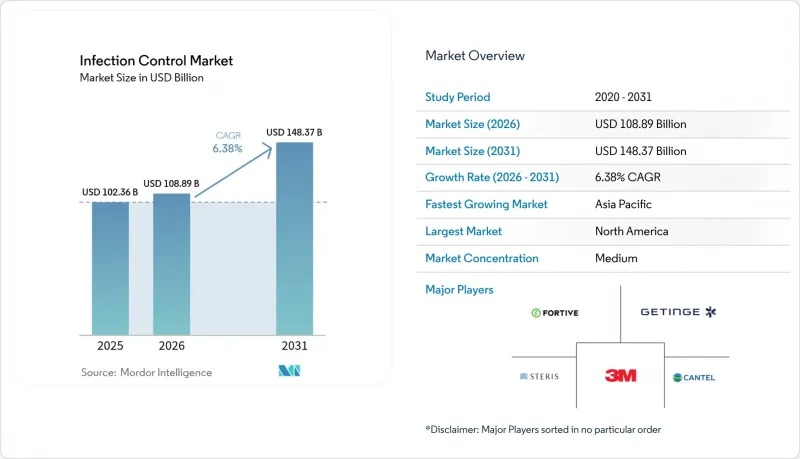
This report Segments the Industry Into Products and Services (Sterilization Products and Services, Cleaning and Disinfection Products, and More), Service Delivery Mode (In-House Infection Control and Contract Infection Control), End User (Hospitals and Clinics, Ambulatory Surgery Centers, and More), and Geography (North America, Europe, and More). The Market Forecasts are Provided in Terms of Value (USD).
Global Infection Control Market Trends and Insights
Stringent Global HAI-Reduction Targets & Reimbursement Penalties
CMS value-based purchasing now links reimbursements to infection metrics, including catheter-associated urinary tract infections and central line-associated bloodstream infections. California and other states mirror these incentives, prompting hospital boards to budget for new sterilizers and data-analytics tools. Facilities that fell short during the COVID-19 disruption report a renewed focus on policy-compliant equipment upgrades. Medium-term pressure remains elevated as the Transforming Episode Accountability Model begins in 2026, making infection control performance essential for revenue integrity.
Procedure Volume Surge From Chronic & Geriatric Disease Burden
Inpatient discharges are projected to climb to 31 million while outpatient volumes rise to 5.82 billion procedures by 2034. Orthopedic, spine, and gastroenterology procedures increasingly migrate to ambulatory centers, requiring advanced sterilizers capable of rapid cycles. China's pathway toward RMB 205 trillion in health outlays by 2030 mirrors this structural procedure expansion. Longer life expectancy and multimorbidity raise infection risk, reinforcing the commercial case for predictive surveillance platforms that identify high-risk patients pre-operatively.
Safety & Liability Concerns Around Reprocessed Instruments
Complex lumened devices are prone to incomplete decontamination, raising malpractice exposure. Multidrug-resistant Klebsiella strains with biocide tolerance have already surfaced in hospital outbreaks. Updated ANSI/AAMI ST24 guidance demands rigorous performance validation, yet many facilities delay upgrades for budget reasons, sustaining litigation risk.
Other drivers and restraints analyzed in the detailed report include:
- Outsourcing Boom in Contract Sterilization Services
- Rapid Adoption of Low-Temperature & Plasma Sterilizers
- Capital-Intensive Nature of Advanced Sterilization Equipment
For complete list of drivers and restraints, kindly check the Table Of Contents.
Segment Analysis
Sterilization products and services controlled 42.10% infection control market share in 2025. Heat sterilizers continue to anchor budgets because of entrenched staff familiarity, yet low-temperature hydrogen-peroxide plasma units are posting double-digit placement growth within tertiary centers. The infection control market size for this segment is forecast to reach USD 62.47 billion by 2031, advancing at a pace aligned with overall industry CAGR. Contract sterilization providers, leveraging scale, invest in multi-modal processing lines that individual hospitals struggle to fund. Protective barriers, the fastest-growing area, increasingly incorporate compostable substrates to satisfy ESG audits, even as hospitals audit glove and gown burn rates to ensure pandemic-era stockpiles remain current.
Cleaning chemicals face potent headwinds from antimicrobial resistance. Laboratories confirm that 80% of multidrug-resistant Pseudomonas isolates defeat standard QAC solutions, prompting formulators to explore quaternary phosphonium molecules with broader kill spectrums. Automated endoscope reprocessors with leak-testing and traceability modules are gaining mindshare because manual flushing cannot consistently navigate intricate device channels. Overall, product strategists are prioritizing sterilization throughput, eco-toxicity, and real-time compliance analytics.
Complete Report Scope:
- By Products & Services
- Sterilization Products & Services
- Sterilization Equipment
- Heat Sterilization Equipment
- Low-Temperature Sterilization Equipment
- Radiation Sterilization Equipment
- Chemical Sterilization Equipment
- UV & Ozone Sterilization Equipment
- Contract Sterilization Services
- Consumables & Accessories
- Sterilization Equipment
- Cleaning & Disinfection Products
- Disinfectants
- Hand Disinfectants
- Surface Disinfectants
- Skin Disinfectants
- Instrument Disinfectants
- Cleaning & Disinfection Equipment
- Consumables & Accessories
- Disinfectants
- Protective Barriers
- Surgical Drapes
- Surgical Gowns
- Gloves
- Masks & Respirators
- Other Protective Barriers
- Other Infection Control Products
- Sterilization Products & Services
- By Service Delivery Mode
- In-house Infection Control
- Contract Infection Control
- By End-User
- Hospitals and Clinics
- Ambulatory Surgery Centers
- Medical Device Companies
- Pharmaceutical and Biologics Manufacturers
- Life-Science and Food-Processing Facilities
- Other End-Users
- Geography
- North America
- United States
- Canada
- Mexico
- Europe
- Germany
- United Kingdom
- France
- Italy
- Spain
- Rest of Europe
- Asia-Pacific
- China
- Japan
- India
- Australia
- South Korea
- Rest of Asia-Pacific
- Middle East and Africa
- GCC
- South Africa
- Rest of Middle East and Africa
- South America
- Brazil
- Argentina
- Rest of South America
- North America
Geography Analysis
North America accounted for 38.95% infection control market revenue in 2025. The region adopts innovations early, spurred by CMS reimbursement structures and a dense network of ASC facilities needing fast sterilizer cycles. U.S. policy shifts, such as the FY 2025 IPPS rule, embed infection metrics into broader quality reporting, intensifying hospital spending on predictive analytics platforms.
Europe follows closely, guided by medical-device directives that integrate carbon-footprint scoring into product approvals. Hospitals weigh reusable barrier programs against infection risk, leading to pilot projects pairing reusable gowns with plasma sterilization cabinets to maintain efficacy. Infection control market size in Europe is expected to approach USD 39.1 billion by 2031.
Asia-Pacific delivers the fastest 6.85% CAGR. China's pathway toward RMB 205 trillion in health spending drives new hospital construction and bulk procurement of EtO and hydrogen-peroxide lines. India's National Quality Assurance Standards now mandate central sterile services departments in district hospitals, stimulating equipment tenders. Japan's aging population pushes device reprocessing volumes, while South-East Asian private hospital chains outsource sterilization to regional hubs.
The Middle East and Africa invest in flagship medical cities with central sterile processing designed to Joint Commission standards, though fragmented smaller clinics still rely on tabletop autoclaves. In South America, public-sector infection-control budgets grow alongside universal-health-coverage rollouts, creating mixed demand for premium and mid-tier equipment.
- 3M
- STERIS
- Getinge
- Ecolab
- Fortive
- Sotera Health (Sterigenics, Nordion)
- Cantel Medical
- Belimed
- MMM Group
- MELAG Medizintechnik
- Halyard Health
- Kimberly-Clark Professional
- Reckitt Benckiser Group
- Metrex Research
- Pal International
- PDI Healthcare
- Germitec
- ASP Johnson & Johnson
- Cardinal Health
- Eppendorf
Additional Benefits:
- The market estimate (ME) sheet in Excel format
- 3 months of analyst support
TABLE OF CONTENTS
1 Introduction
- 1.1 Study Assumptions & Market Definition
- 1.2 Scope of the Study
2 Research Methodology
3 Executive Summary
4 Market Landscape
- 4.1 Market Overview
- 4.2 Market Drivers
- 4.2.1 Stringent Global HAI-reduction Targets and Reimbursement Penalties
- 4.2.2 Procedure Volume Surge from Chronic and Geriatric Disease Burden
- 4.2.3 Outsourcing Boom in Contract Sterilization Services
- 4.2.4 Rapid Adoption of Low-temperature and Plasma Sterilizers
- 4.2.5 AI-driven Infection-surveillance Platforms Winning Hospital RFPs
- 4.2.6 Green-chemistry Mandates Favouring Ozone and Peracetic-acid Systems
- 4.3 Market Restraints
- 4.3.1 Safety and Liability Concerns around Reprocessed Instruments
- 4.3.2 Capital-intensive Nature of Advanced Sterilization Equipment
- 4.3.3 Increasing Antimicrobial-resistance Reduces Disinfectant Efficacy
- 4.3.4 ESG Pressure against Single-use Protective Barriers
- 4.4 Supply-Chain Analysis
- 4.5 Regulatory Landscape
- 4.6 Technological Outlook
- 4.7 Porter's Five Forces Analysis
- 4.7.1 Threat of New Entrants
- 4.7.2 Bargaining Power of Buyers
- 4.7.3 Bargaining Power of Suppliers
- 4.7.4 Threat of Substitutes
- 4.7.5 Intensity of Competitive Rivalry
5 Market Size & Growth Forecasts (Value-USD)
- 5.1 By Products & Services
- 5.1.1 Sterilization Products & Services
- 5.1.1.1 Sterilization Equipment
- 5.1.1.1.1 Heat Sterilization Equipment
- 5.1.1.1.2 Low-Temperature Sterilization Equipment
- 5.1.1.1.3 Radiation Sterilization Equipment
- 5.1.1.1.4 Chemical Sterilization Equipment
- 5.1.1.1.5 UV & Ozone Sterilization Equipment
- 5.1.1.2 Contract Sterilization Services
- 5.1.1.3 Consumables & Accessories
- 5.1.1.1 Sterilization Equipment
- 5.1.2 Cleaning & Disinfection Products
- 5.1.2.1 Disinfectants
- 5.1.2.1.1 Hand Disinfectants
- 5.1.2.1.2 Surface Disinfectants
- 5.1.2.1.3 Skin Disinfectants
- 5.1.2.1.4 Instrument Disinfectants
- 5.1.2.2 Cleaning & Disinfection Equipment
- 5.1.2.3 Consumables & Accessories
- 5.1.2.1 Disinfectants
- 5.1.3 Protective Barriers
- 5.1.3.1 Surgical Drapes
- 5.1.3.2 Surgical Gowns
- 5.1.3.3 Gloves
- 5.1.3.4 Masks & Respirators
- 5.1.3.5 Other Protective Barriers
- 5.1.4 Other Infection Control Products
- 5.1.1 Sterilization Products & Services
- 5.2 By Service Delivery Mode
- 5.2.1 In-house Infection Control
- 5.2.2 Contract Infection Control
- 5.3 By End-User
- 5.3.1 Hospitals and Clinics
- 5.3.2 Ambulatory Surgery Centers
- 5.3.3 Medical Device Companies
- 5.3.4 Pharmaceutical and Biologics Manufacturers
- 5.3.5 Life-Science and Food-Processing Facilities
- 5.3.6 Other End-Users
- 5.4 Geography
- 5.4.1 North America
- 5.4.1.1 United States
- 5.4.1.2 Canada
- 5.4.1.3 Mexico
- 5.4.2 Europe
- 5.4.2.1 Germany
- 5.4.2.2 United Kingdom
- 5.4.2.3 France
- 5.4.2.4 Italy
- 5.4.2.5 Spain
- 5.4.2.6 Rest of Europe
- 5.4.3 Asia-Pacific
- 5.4.3.1 China
- 5.4.3.2 Japan
- 5.4.3.3 India
- 5.4.3.4 Australia
- 5.4.3.5 South Korea
- 5.4.3.6 Rest of Asia-Pacific
- 5.4.4 Middle East and Africa
- 5.4.4.1 GCC
- 5.4.4.2 South Africa
- 5.4.4.3 Rest of Middle East and Africa
- 5.4.5 South America
- 5.4.5.1 Brazil
- 5.4.5.2 Argentina
- 5.4.5.3 Rest of South America
- 5.4.1 North America
6 Competitive Landscape
- 6.1 Market Concentration
- 6.2 Market Share Analysis
- 6.3 Company Profiles
- 6.3.1 3M
- 6.3.2 STERIS plc
- 6.3.3 Getinge AB
- 6.3.4 Ecolab Inc.
- 6.3.5 Fortive (Advanced Sterilization Products)
- 6.3.6 Sotera Health (Sterigenics, Nordion)
- 6.3.7 Cantel Medical
- 6.3.8 Belimed AG
- 6.3.9 MMM Group
- 6.3.10 MELAG Medizintechnik
- 6.3.11 Halyard Health
- 6.3.12 Kimberly-Clark Professional
- 6.3.13 Reckitt Benckiser
- 6.3.14 Metrex Research
- 6.3.15 Pal International
- 6.3.16 PDI Healthcare
- 6.3.17 Germitec
- 6.3.18 ASP Johnson & Johnson
- 6.3.19 Cardinal Health
- 6.3.20 Eppendorf AG
7 Market Opportunities & Future Outlook
- 7.1 White-space & Unmet-Need Assessment

