PUBLISHER: Mordor Intelligence | PRODUCT CODE: 2097181

PUBLISHER: Mordor Intelligence | PRODUCT CODE: 2097181
COVID-19 Safety and Prevention Products - Market Share Analysis, Industry Trends & Statistics, Growth Forecasts (2026 - 2031)
According to Mordor Intelligence, the COVID-19 safety and prevention products market size is expected to grow from USD 7.18 billion in 2025 to USD 7.67 billion in 2026 and is forecast to reach USD 10.68 billion by 2031 at 6.85% CAGR over 2026-2031.
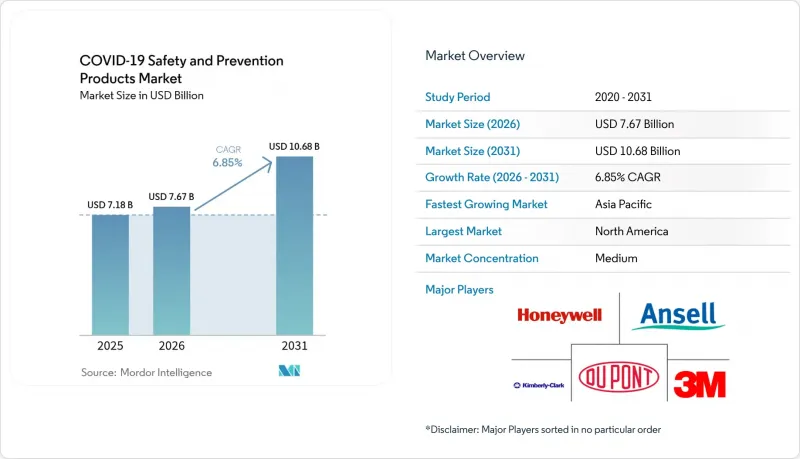
This report is Segmented by Product Type (Temperature Devices, Ventilators, and More), End-User (Hospitals and Clinics, Long-Term Care Facilities, and More), Distribution Channel (Direct Institutional Procurement, Retail Pharmacies and Drug Stores, Online/E-commerce, and Specialized PPE Distributors), and Geography. The Market Forecasts are Provided in Terms of Value (USD).
Global COVID-19 Safety and Prevention Products Market Trends and Insights
Rising Global Stockpiling Mandates by Governments
Strategic reserves increasingly include connected detection equipment rather than only basic masks and gloves. The U.S. Strategic National Stockpile distributed 2.3 million PPE pieces in 2024 and now maintains an inventory worth USD 8 billion as it modernizes warehouse monitoring systems. Finland allocated EUR 242 million (USD 273 million) from European Union funds to create the continent's largest CBRN reserve, illustrating how smaller nations leverage multilateral financing for advanced readiness. Similar initiatives in Australia and Canada emphasize shelf-stable, sensor-equipped products, creating multiyear, volume-driven demand pipelines. Consequently, the safety and prevention products market gains a predictable baseline of institution-led orders that smooths cyclical swings in discretionary industrial spending. Suppliers offering modular packaging, cloud-based tracking, and predictive analytics are favored for replenishment contracts.
Shift Toward Reusable and Biodegradable PPE
Corporate net-zero goals prompt procurement teams to scrutinize single-use disposables, encouraging the switch to fabric-based respirators, compostable gowns, and recycled-content face shields. DuPont reports extending the service life of Tyvek(R), Nomex(R), and Kevlar(R) garments through closed-loop recycling programs. Start-ups such as AmorSui and EcoTextura target hospitals seeking lower waste volumes without compromising barrier properties. Evolving landfill regulations in Europe impose differential fees on mixed plastic disposal, indirectly raising the cost of legacy polypropylene items. Larger manufacturers invest in biopolymer R&D and secure green-energy certificates to protect pricing power, whereas smaller firms face higher compliance costs. Over time, circular design features move from marketing differentiator to minimum tender requirement, deepening the safety and prevention products market penetration of eco-efficient formats.
Declining Pandemic-Specific Demand Post-Vaccine Roll-out
Mask mandates and fever-screen checkpoints have eased in most public spaces, triggering inventory reductions at hospitals and universities. Commodity-grade items experience oversupply, forcing spot-price discounts that compress margins. Yet redeployment of protection protocols into transport hubs and warehousing offsets a share of lost healthcare volume. Growth shifts toward specialized formats-smart respirators, firefighting hoods, cooling vests-that satisfy long-standing industrial hazards. Manufacturers once reliant on high-volume, low-differentiation masks must pivot toward technology-enhanced offerings or exit the safety and prevention products market.
Other drivers and restraints analyzed in the detailed report include:
- Integration of IoT-Enabled Compliance Monitoring Systems
- Expansion of E-commerce B2B Procurement Platforms
- Raw-Material Price Volatility for Melt-Blown Polypropylene
For complete list of drivers and restraints, kindly check the Table Of Contents.
Segment Analysis
UV-C disinfection devices represent the fastest-growing product group, expanding at a 8.95% CAGR as institutions prioritize continuous surface and air sanitization. Hospitals, schools, and commercial buildings retrofit HVAC systems with UV-C arrays that deactivate airborne pathogens within milliseconds. Sensor-based activation, remote monitoring dashboards, and predictive bulb replacement schedules differentiate premium units, steering procurement toward integrated platforms rather than standalone lamps. Protective face masks retain leadership with a 34.12% share of the safety and prevention products market in 2025, though volume migrates from single-use melt-blown models to reusable respirators embedded with filtration performance chips and communication microphones. Temperature-screening devices, including handheld infrared thermometers and networked thermal cameras, gain modest traction as enterprises integrate them with access-control systems. Ventilators register stable orders due to ongoing critical-care infrastructure investments in emerging markets. Gloves shift toward nitrile formulations for chemical resistance and allergy mitigation, while medical gowns adopt breathable laminates derived from bio-based polymers. Smart helmets for mining and construction integrate gas sensors and heads-up displays, showcasing the convergence of PPE and operational technology. These advancements collectively enlarge the safety and prevention products market size for multi-function protective ecosystems.
Complete Report Scope:
- By Product Type
- Temperature Devices
- Infrared Thermometers
- Thermal Imagers
- Ventilators
- Invasive/Mechanical Ventilators
- Non-invasive Ventilators
- Isolation Chambers
- Protective Face Masks
- Cloth-Based Masks
- Surgical Masks
- Respirators
- US Filter Class
- N-Series
- P-Series
- R-Series
- European Filter Class
- FFP1
- FFP2
- FFP3
- US Filter Class
- Hand Sanitizers and Disinfectants
- Gel
- Foam
- Liquid
- Wipes
- Spray
- Gloves
- Rubber
- PVC
- Poly Chloroprene
- Nitrile
- Medical Gowns and Coveralls
- Isolation
- Surgical
- Disposable
- Re-usable
- Other PPE (Face Shields, Goggles, Head and Shoe Covers)
- UV-C Disinfection Devices
- Temperature Devices
- By End-user
- Hospitals and Clinics
- Long-Term Care Facilities
- Industrial and Manufacturing Sites
- Individual /Household
- Educational Institutions
- Transportation and Logistics
- Other End-users
- By Distribution Channel
- Direct Institutional Procurement
- Retail Pharmacies and Drug Stores
- Online/E-commerce
- Specialized PPE Distributors
- By Geography
- North America
- United States
- Canada
- Mexico
- South America
- Brazil
- Argentina
- Chile
- Rest of South America
- Europe
- Germany
- United Kingdom
- France
- Italy
- Spain
- Russia
- Rest of Europe
- Asia-Pacific
- China
- India
- Japan
- South Korea
- Singapore
- Malaysia
- Australia
- Rest of Asia-Pacific
- Middle East and Africa
- Middle East
- United Arab Emirates
- Saudi Arabia
- Turkey
- Rest of Middle East
- Africa
- South Africa
- Nigeria
- Rest of Africa
- Middle East
- North America
Geography Analysis
North America maintained a 36.45% revenue share in 2025, bolstered by the USD 8 billion U.S. Strategic National Stockpile and OSHA's updated Hazard Communication Standard. Government frameworks emphasize AI-enabled tracking and tamper-evident packaging, which favors suppliers with sensor integration capabilities. Venture investment strengthens the regional innovation pipeline; for example, Protex AI secured USD 36 million to refine computer-vision safety analytics. Raw-material cost swings and maturing pandemic inventory temper single-use PPE volume, yet growth persists in smart garments and cloud analytics subscriptions, keeping the safety and prevention products market expansion steady.
Asia-Pacific represents the fastest-growing region at a 9.1% CAGR by 2031. Singapore's combustible-dust and machinery rules, effective January 2025, Malaysia's OSHA Amendment Act 2022, and Australia's ratification of ILO Convention 187 collectively harmonize standards and stimulate replacement cycles. Regional manufacturers leverage proximity to electronics supply chains to embed sensors cost-effectively, while tariff pressures coax some production lines toward Vietnam and India. Adoption varies: high-income districts integrate full IoT suites, whereas emerging economies prioritize basic compliance at minimal cost. Still, multilateral infrastructure projects finance modern safety inventories, enlarging the safety and prevention products market size across tier-2 cities.
Europe prioritizes circular economy legislation and ESG-aligned procurement. Finland's EUR 242 million CBRN reserve funded by the EU underscores strategic stockpiling ambitions. Waste-reduction mandates push buyers toward biodegradable masks and reusable coveralls, creating pricing headroom for innovation leaders. Eastern European factories modernize under EU cohesion funds, adopting smart welding helmets and gas-sensing wearables. Divergent fiscal positions mean adoption rates are uneven, yet procurement guidelines converge on lifecycle assessments, reinforcing demand for connected PPE solutions throughout the safety and prevention products market.
- 3M Company
- Honeywell International Inc.
- DuPont de Nemours, Inc.
- Kimberly-Clark Corporation
- Ansell Limited
- Cardinal Health Inc.
- Reckitt Benckiser Group plc
- The Procter & Gamble Company
- Medtronic plc
- Koninklijke Philips N.V.
- ResMed Inc.
- Smiths Medical (ICU Medical)
- Lakeland Industries, Inc.
- Alpha Pro Tech, Ltd.
- Dynarex Corporation
- UV-Concepts Inc.
- Medicom Group
- Molnlycke Health Care AB
- SHIELD Scientific BV
- Shandong Yuyuan Latex Gloves Co., Ltd.
- Guangzhou Pidegree Medical Technology Co., Ltd.
- Sterisets International BV
- Microgen Hygiene Pvt. Ltd.
- Dragerwerk AG & Co. KGaA
- ILC Dover LP
Additional Benefits:
- The market estimate (ME) sheet in Excel format
- 3 months of analyst support
TABLE OF CONTENTS
1 INTRODUCTION
- 1.1 Study Assumptions and Market Definition
- 1.2 Scope of the Study
2 RESEARCH METHODOLOGY
3 EXECUTIVE SUMMARY
4 MARKET LANDSCAPE
- 4.1 Market Overview
- 4.2 Market Drivers
- 4.2.1 Rising global stockpiling mandates by governments
- 4.2.2 Shift toward reusable and biodegradable PPE
- 4.2.3 Integration of IoT-enabled compliance monitoring systems
- 4.2.4 Expansion of e-commerce B2B procurement platforms
- 4.2.5 Surge in corporate ESG-linked procurement of low-carbon PPE
- 4.2.6 Growth in public-health emergency funds beyond COVID-19
- 4.3 Market Restraints
- 4.3.1 Declining pandemic-specific demand post-vaccine roll-out
- 4.3.2 Raw-material price volatility for melt-blown polypropylene
- 4.3.3 Regulatory crack-downs on sub-standard imports
- 4.3.4 Environmental disposal challenges and evolving waste rules
- 4.4 Industry Value Chain Analysis
- 4.5 Regulatory Landscape
- 4.6 Technological Outlook
- 4.7 Industry Attractiveness - Porter's Five Forces Analysis
- 4.7.1 Threat of New Entrants
- 4.7.2 Bargaining Power of Buyers
- 4.7.3 Bargaining Power of Suppliers
- 4.7.4 Threat of Substitutes
- 4.7.5 Intensity of Competitive Rivalry
- 4.8 Impact of Macroeconomic Factors on the Market
5 MARKET SIZE AND GROWTH FORECASTS (VALUES)
- 5.1 By Product Type
- 5.1.1 Temperature Devices
- 5.1.1.1 Infrared Thermometers
- 5.1.1.2 Thermal Imagers
- 5.1.2 Ventilators
- 5.1.2.1 Invasive/Mechanical Ventilators
- 5.1.2.2 Non-invasive Ventilators
- 5.1.3 Isolation Chambers
- 5.1.4 Protective Face Masks
- 5.1.4.1 Cloth-Based Masks
- 5.1.4.2 Surgical Masks
- 5.1.4.3 Respirators
- 5.1.4.3.1 US Filter Class
- 5.1.4.3.1.1 N-Series
- 5.1.4.3.1.2 P-Series
- 5.1.4.3.1.3 R-Series
- 5.1.4.3.2 European Filter Class
- 5.1.4.3.2.1 FFP1
- 5.1.4.3.2.2 FFP2
- 5.1.4.3.2.3 FFP3
- 5.1.4.3.1 US Filter Class
- 5.1.5 Hand Sanitizers and Disinfectants
- 5.1.5.1 Gel
- 5.1.5.2 Foam
- 5.1.5.3 Liquid
- 5.1.5.4 Wipes
- 5.1.5.5 Spray
- 5.1.6 Gloves
- 5.1.6.1 Rubber
- 5.1.6.2 PVC
- 5.1.6.3 Poly Chloroprene
- 5.1.6.4 Nitrile
- 5.1.7 Medical Gowns and Coveralls
- 5.1.7.1 Isolation
- 5.1.7.2 Surgical
- 5.1.7.3 Disposable
- 5.1.7.4 Re-usable
- 5.1.8 Other PPE (Face Shields, Goggles, Head and Shoe Covers)
- 5.1.9 UV-C Disinfection Devices
- 5.1.1 Temperature Devices
- 5.2 By End-user
- 5.2.1 Hospitals and Clinics
- 5.2.2 Long-Term Care Facilities
- 5.2.3 Industrial and Manufacturing Sites
- 5.2.4 Individual /Household
- 5.2.5 Educational Institutions
- 5.2.6 Transportation and Logistics
- 5.2.7 Other End-users
- 5.3 By Distribution Channel
- 5.3.1 Direct Institutional Procurement
- 5.3.2 Retail Pharmacies and Drug Stores
- 5.3.3 Online/E-commerce
- 5.3.4 Specialized PPE Distributors
- 5.4 By Geography
- 5.4.1 North America
- 5.4.1.1 United States
- 5.4.1.2 Canada
- 5.4.1.3 Mexico
- 5.4.2 South America
- 5.4.2.1 Brazil
- 5.4.2.2 Argentina
- 5.4.2.3 Chile
- 5.4.2.4 Rest of South America
- 5.4.3 Europe
- 5.4.3.1 Germany
- 5.4.3.2 United Kingdom
- 5.4.3.3 France
- 5.4.3.4 Italy
- 5.4.3.5 Spain
- 5.4.3.6 Russia
- 5.4.3.7 Rest of Europe
- 5.4.4 Asia-Pacific
- 5.4.4.1 China
- 5.4.4.2 India
- 5.4.4.3 Japan
- 5.4.4.4 South Korea
- 5.4.4.5 Singapore
- 5.4.4.6 Malaysia
- 5.4.4.7 Australia
- 5.4.4.8 Rest of Asia-Pacific
- 5.4.5 Middle East and Africa
- 5.4.5.1 Middle East
- 5.4.5.1.1 United Arab Emirates
- 5.4.5.1.2 Saudi Arabia
- 5.4.5.1.3 Turkey
- 5.4.5.1.4 Rest of Middle East
- 5.4.5.2 Africa
- 5.4.5.2.1 South Africa
- 5.4.5.2.2 Nigeria
- 5.4.5.2.3 Rest of Africa
- 5.4.5.1 Middle East
- 5.4.1 North America
6 COMPETITIVE LANDSCAPE
- 6.1 Market Concentration
- 6.2 Strategic Moves
- 6.3 Market Share Analysis
- 6.4 Company Profiles (includes Global level Overview, Market level overview, Core Segments, Financials as available, Strategic Information, Market Rank/Share for key companies, Products and Services, and Recent Developments)
- 6.4.1 3M Company
- 6.4.2 Honeywell International Inc.
- 6.4.3 DuPont de Nemours, Inc.
- 6.4.4 Kimberly-Clark Corporation
- 6.4.5 Ansell Limited
- 6.4.6 Cardinal Health Inc.
- 6.4.7 Reckitt Benckiser Group plc
- 6.4.8 The Procter & Gamble Company
- 6.4.9 Medtronic plc
- 6.4.10 Koninklijke Philips N.V.
- 6.4.11 ResMed Inc.
- 6.4.12 Smiths Medical (ICU Medical)
- 6.4.13 Lakeland Industries, Inc.
- 6.4.14 Alpha Pro Tech, Ltd.
- 6.4.15 Dynarex Corporation
- 6.4.16 UV-Concepts Inc.
- 6.4.17 Medicom Group
- 6.4.18 Molnlycke Health Care AB
- 6.4.19 SHIELD Scientific BV
- 6.4.20 Shandong Yuyuan Latex Gloves Co., Ltd.
- 6.4.21 Guangzhou Pidegree Medical Technology Co., Ltd.
- 6.4.22 Sterisets International BV
- 6.4.23 Microgen Hygiene Pvt. Ltd.
- 6.4.24 Dragerwerk AG & Co. KGaA
- 6.4.25 ILC Dover LP
7 MARKET OPPORTUNITIES AND FUTURE TRENDS
- 7.1 White-Space and Unmet-Need Assessment

