
PUBLISHER: Mordor Intelligence | PRODUCT CODE: 2097207

PUBLISHER: Mordor Intelligence | PRODUCT CODE: 2097207
Asia-Pacific Automotive Lubricants - Market Share Analysis, Industry Trends & Statistics, Growth Forecasts (2026 - 2031)
According to Mordor Intelligence, Asia-Pacific automotive lubricants market size in 2026 is estimated at 10.09 Billion Liters, growing from 2025 value of 9.95 Billion Liters with 2031 projections showing 10.79 Billion Liters, growing at 1.35% CAGR over 2026-2031.
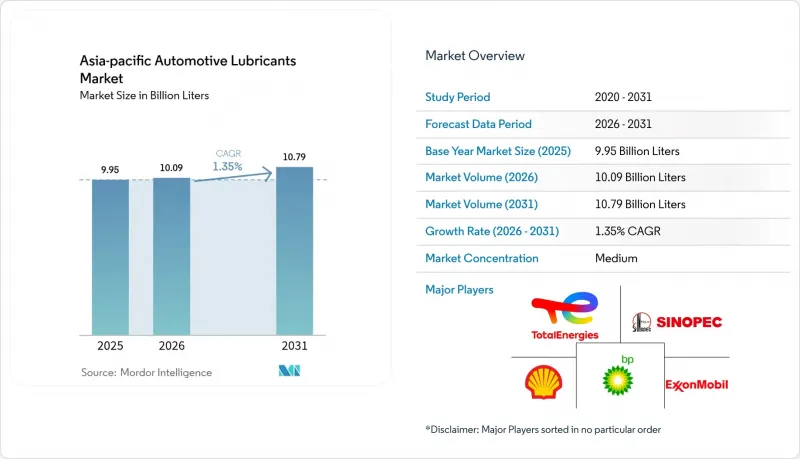
This report is Segmented by Product Type (Automotive Engine Oil, Manual Transmission Fluids, Automatic Transmission Fluids, and More), Vehicle Type (Passenger Vehicles, Commercial Vehicles, and Two-Wheelers), and Geography (China, India, South Korea, Thailand, Indonesia, Malaysia, Philippines, Vietnam, Uzbekistan, and More). The Market Forecasts are Provided in Terms of Volume (Litres).
Asia-Pacific Automotive Lubricants Market Trends and Insights
Rapid Expansion of Passenger-Car Parc
Passenger-car ownership continues to rise in emerging economies, driving demand for lubricants even as the adoption of battery-electric vehicles (BEVs) accelerates. India sold 4.2 million passenger vehicles in fiscal 2024, representing an 8.4% year-over-year increase that pushed the national car parc to surpass 38 million units. Indonesia rebounded to 1.06 million light-vehicle sales in 2024, while motorcycle registrations surpassed 6.8 million units, underscoring the significant role of two-wheeler oil consumption. Vietnam's parc expanded at a rate of 12.3% annually as disposable incomes rose and public-transport capacity lagged. With an average vehicle age of over nine years across these markets, aftermarket drain events remain frequent, sustaining the Asia-Pacific Automotive Lubricants Market despite the risk of EV substitution. ISO 14001 certifications adopted by regional workshops further steer buyers toward branded, low-emission lubes that meet environmental audits.
OEM "Fill-for-Life" Mandates Boosting Lubricant Quality
Automakers are increasingly specifying drain intervals of 15,000 km or more under warranty, forcing blenders to upgrade the base-stock quality and additive durability. Toyota's Global Outstanding Assessment program demands 150,000-km fluid life under JASO GLV-2, effectively locking out Group I feedstocks from factory fill. Hyundai's Smartstream engines in India require 0W-20 oils that can withstand sump temperatures exceeding 120°C without viscosity shear, resulting in the widespread use of poly-alpha-olefin boosters. Honda's Earth Dreams powertrains require API SP Resource Conserving approval and low phosphorus to protect catalytic converters. These stringent OEM rules set a quality baseline that cascades through the aftermarket, elevating the Asia-Pacific Automotive Lubricants Market toward synthetics that command higher margins.
Battery-EV Penetration Lowering Lube Demand/Vehicle
Pure battery cars need up to 80% fewer lubricants by volume than internal combustion vehicles, eroding per-unit demand. China reached 35.7% BEV share in 2024, supported by BYD and Tesla output surpassing 8 million units. Japan's purchase subsidy of JPY 850,000 boosted national BEV sales to 3.2% in 2024, despite hybrid vehicles' dominance. South Korea achieved an 8.8% BEV share in 2024, as Hyundai inaugurated the IONIQ 6 sedan. The shift siphons engine oil, though residual ICE fleets require higher-grade synthetics to compensate for extended service intervals, partially offsetting volume loss in the Asia-Pacific Automotive Lubricants Market.
Other drivers and restraints analyzed in the detailed report include:
- Rising Demand for High-Performance Synthetic Lubes
- Explosive Growth of E-Scooter Delivery Fleets
- Volatile Base-Oil Pricing Squeezing Margins
For complete list of drivers and restraints, kindly check the Table Of Contents.
Segment Analysis
Automotive engine oil accounted for 66.10% of the Asia-Pacific Automotive Lubricants Market size in 2025; however, automatic transmission fluid is expected to register the fastest growth trajectory of 1.56% through 2031. Engine oil demand is concentrated in India, Indonesia, and rural China, where ICE vehicles remain prevalent. However, viscosity migration to 0W-20 and 0W-16 boosts the synthetic share and price realization. Rising adoption of turbo-gasoline particulate filters drives mid-SAPS chemistry, fostering demand for higher-margin Group III+ blends. Aftermarket workshops increasingly upsell semi-synthetic 5W-30 lines to small-car owners seeking warranty-compliant options.
ATF advances on the back of CVT and dual-clutch gearbox penetration, surpassing 60% in new Japanese and Korean passenger cars. Honda's CVT-equipped City and HR-V models utilize proprietary HMMF fluids, which have anti-shudder durability exceeding 240 hours at 150°C. Nissan's X-Tronic CVT platforms across ASEAN prescribe NS-3 spec oils that command a 40% premium over Dexron VI fluids. As ATF drain intervals extend to 100,000 km, total liter growth stays moderate, but revenue gains outstrip volume. Manual-transmission oil and brake-fluid segments plateau, while automotive greases see modest uptake for wheel-bearing relubrication in heavy-duty trucks. Product-mix evolution underpins value growth inside the Asia-Pacific Automotive Lubricants Market.
Complete Report Scope:
- By Resin Type
- Passenger Car Motor Oil (PCMO)
- 0W-XX
- 5W-XX
- 10W-XX
- 15W-XX
- Monogrades
- Other Grades
- Heavy Duty Motor Oil (HDMO)
- 0W-XX
- 5W-XX
- 10W-XX
- 15W-XX
- Monogrades
- Other Grades
- Motorcycle Engine Oil (MCO)
- 0W-XX
- 5W-XX
- 10W-XX
- 15W-XX
- Monogrades
- Other Grades
- Passenger Car Motor Oil (PCMO)
- By Base Stock
- Mineral
- Synthetic
- Semi-Synthetic
- Bio-Based
- By Geography
- China
- India
- Pakistan
- Bangladesh
- Japan
- South Korea
- Taiwan
- Australia
- Malaysia
- Indonesia
- Thailand
- Vietnam
- Rest of Asia-Pacific
List of Companies Covered in this Report:
- Shell plc
- Exxon Mobil Corporation
- BP p.l.c.
- TotalEnergies
- Chevron Corporation
- China Petroleum Corporation
- CNPC
- Indian Oil Corporation Limited
- ENEOS Corporation
- FUCHS
- Motul
- PT Pertamina
- PTT LUBRICANTS
- Idemitsu Kosan Co.
- Gulf Oil International
- Repsol
- Lukoil Lubricants
- SK Enmove co.Ltd.
- Bharat Petroleum Corporation
Additional Benefits:
- The market estimate (ME) sheet in Excel format
- 3 months of analyst support
TABLE OF CONTENTS
1 Introduction
- 1.1 Study Assumptions and Market Definition
- 1.2 Scope of the Study
2 Research Methodology
3 Executive Summary
4 Market Landscape
- 4.1 Market Overview
- 4.2 Market Drivers
- 4.2.1 ICE (Internal Combustion Engine) parc still expanding in emerging ASEAN
- 4.2.2 OEM factory-fill tie-ups with lube majors
- 4.2.3 Tightening APAC fuel-economy standards
- 4.2.4 Surge in ride-hailing motor-hours
- 4.2.5 Electrified two-wheeler range-extender hybrids
- 4.3 Market Restraints
- 4.3.1 Electronic Vehicle penetration in China passenger cars
- 4.3.2 Longer OEM drain-interval specifications
- 4.3.3 Government push for bio-lubricants
- 4.4 Value Chain and Distribution Channel Analysis
- 4.5 Porter's Five Forces
- 4.5.1 Threat of New Entrants
- 4.5.2 Bargaining Power of Suppliers
- 4.5.3 Bargaining Power of Buyers
- 4.5.4 Threat of Substitutes
- 4.5.5 Industry Rivalry
- 4.6 Regulatory Framework
- 4.7 Automotive Industry Trends
5 Market Size and Growth Forecasts (Volume)
- 5.1 By Resin Type
- 5.1.1 Passenger Car Motor Oil (PCMO)
- 5.1.1.1 0W-XX
- 5.1.1.2 5W-XX
- 5.1.1.3 10W-XX
- 5.1.1.4 15W-XX
- 5.1.1.5 Monogrades
- 5.1.1.6 Other Grades
- 5.1.2 Heavy Duty Motor Oil (HDMO)
- 5.1.2.1 0W-XX
- 5.1.2.2 5W-XX
- 5.1.2.3 10W-XX
- 5.1.2.4 15W-XX
- 5.1.2.5 Monogrades
- 5.1.2.6 Other Grades
- 5.1.3 Motorcycle Engine Oil (MCO)
- 5.1.3.1 0W-XX
- 5.1.3.2 5W-XX
- 5.1.3.3 10W-XX
- 5.1.3.4 15W-XX
- 5.1.3.5 Monogrades
- 5.1.3.6 Other Grades
- 5.1.1 Passenger Car Motor Oil (PCMO)
- 5.2 By Base Stock
- 5.2.1 Mineral
- 5.2.2 Synthetic
- 5.2.3 Semi-Synthetic
- 5.2.4 Bio-Based
- 5.3 By Geography
- 5.3.1 China
- 5.3.2 India
- 5.3.3 Pakistan
- 5.3.4 Bangladesh
- 5.3.5 Japan
- 5.3.6 South Korea
- 5.3.7 Taiwan
- 5.3.8 Australia
- 5.3.9 Malaysia
- 5.3.10 Indonesia
- 5.3.11 Thailand
- 5.3.12 Vietnam
- 5.3.13 Rest of Asia-Pacific
6 Competitive Landscape
- 6.1 Market Concentration
- 6.2 Strategic Moves
- 6.3 Market Share (%)**/Ranking Analysis
- 6.4 Company Profiles (includes Global level Overview, Market level overview, Core Segments, Financials as available, Production Capacity, Strategic Information, Market Rank/Share for key companies, Products and Services, and Recent Developments)
- 6.4.1 Shell plc
- 6.4.2 Exxon Mobil Corporation
- 6.4.3 BP p.l.c.
- 6.4.4 TotalEnergies
- 6.4.5 Chevron Corporation
- 6.4.6 China Petroleum Corporation
- 6.4.7 CNPC
- 6.4.8 Indian Oil Corporation Limited
- 6.4.9 ENEOS Corporation
- 6.4.10 FUCHS
- 6.4.11 Motul
- 6.4.12 PT Pertamina
- 6.4.13 PTT LUBRICANTS
- 6.4.14 Idemitsu Kosan Co.
- 6.4.15 Gulf Oil International
- 6.4.16 Repsol
- 6.4.17 Lukoil Lubricants
- 6.4.18 SK Enmove co.Ltd.
- 6.4.19 Bharat Petroleum Corporation
7 Market Opportunities and Future Outlook
- 7.1 White-space and Unmet-need Assessment
8 Key Strategic Questions for CEOs

