
PUBLISHER: Mordor Intelligence | PRODUCT CODE: 2097215

PUBLISHER: Mordor Intelligence | PRODUCT CODE: 2097215
Cancer Profiling - Market Share Analysis, Industry Trends & Statistics, Growth Forecasts (2026 - 2031)
According to Mordor Intelligence, cancer profiling market size in 2026 is estimated at USD 14.03 billion, growing from 2025 value of USD 12.64 billion with 2031 projections showing USD 23.67 billion, growing at 11.03% CAGR over 2026-2031.
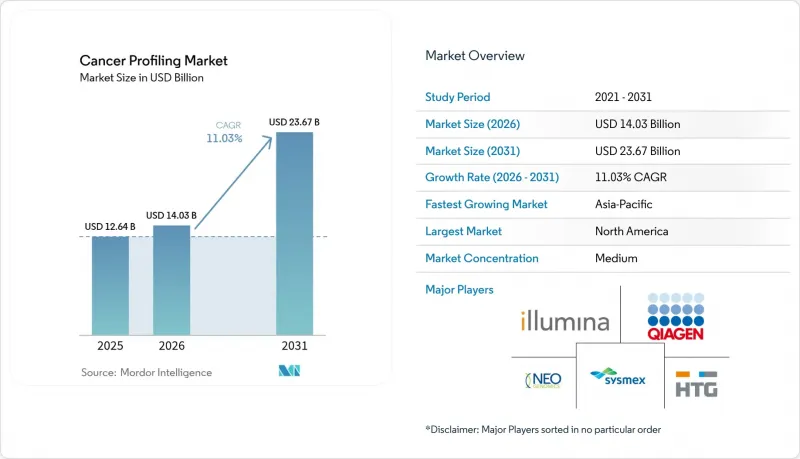
This report Segments the Industry Into by Product and Services (Instruments, Consumables, Other Product and Services), by Technology (Immunoassays, Next Generation Sequencing, Other Technologies), by Cancer Type (Breast Cancer, Lung Cancer, Other Cancer Types), by Biomarker Type (Genetic Biomarkers, Protein Biomarkers, Other Biomarker Types), and Geography (North America, Europe, Asia-Pacific, and More).
Global Cancer Profiling Market Trends and Insights
Precision-oncology reimbursement expansion in North America
Medicare's 2025 decision to reimburse Guardant Reveal for colorectal-cancer MRD surveillance has set a precedent that commercial payers and European health systems are already referencing. Coverage now extends beyond binary yes/no determinations and is anchored in alternative payment models that reward long-term clinical value. Accountable-care frameworks encourage oncologists to integrate genomic evidence earlier, thereby boosting panel utilization rates and solidifying North America's influence on the cancer profiling market.
Multi-omics sequencing cost decline in Asia-Pacific
Rapid price compression for comprehensive sequencing is lowering the economic barrier for community hospitals in China, Japan, and South Korea. Bulk purchasing programs and local manufacturing agreements have cut per-sample costs, making pan-cancer blood tests viable in public insurance schemes. Regional consortia are adopting value-assessment frameworks that weigh societal savings from avoiding ineffective therapies, propelling double-digit growth across the cancer profiling market.
Data-interoperability gaps across hospital information systems
Disparate laboratory information systems and electronic health records limit the flow of structured genomic data. Rural US physicians record lower interoperability scores, and similar fragmentation is evident in Latin America and Southeast Asia. The resulting data silos slow multidisciplinary decision-making, hinder AI-driven analytics, and temper the growth velocity of the cancer profiling market until standardized data-exchange protocols gain wider traction.
Other drivers and restraints analyzed in the detailed report include:
- Pharma-CDx co-development partnerships for targeted therapies
- Rise of liquid-biopsy MRD monitoring
- Shortage of molecular pathologists in mid-tier oncology centers
For complete list of drivers and restraints, kindly check the Table Of Contents.
Segment Analysis
Consumables captured 52.47% of the cancer profiling market share in 2025, underlining the steady, repeat-purchase model that sustains laboratories and reagent suppliers. This dominance rests on assay kits, reagents, and sample-prep materials that keep instruments running and enable both legacy and next-generation workflows. Continuous product refreshes-such as QIAGEN's QIAseq panels covering more than 700 genes-boost performance while trimming hands-on time, reinforcing consumables' pull on the cancer profiling market. As the global installed base of sequencing and PCR systems widens, every incremental test run enlarges the cancer profiling market size flowing through reagent channels and strengthens vendor lock-in.
Services are advancing at a 13.88% CAGR to 2031, reflecting rising demand for integrated testing, bioinformatics, and clinical reporting. Eurofins Scientific's 4.7% organic growth in 2024, led by Clinical Diagnostics and BioPharma units, illustrates how specialized providers translate complex data into actionable results for hospitals and drug developers. Instrument suppliers continue to invest heavily in software and analytics-Thermo Fisher Scientific allocated USD 1.3 billion to R&D in 2024, much of it aimed at precision-medicine tools that simplify genomic data interpretation. Artificial-intelligence engines that now surpass physicians in diagnosing complex cases, as reported by Stanford's 2025 AI Index, are being embedded into reporting platforms to speed turnaround and reduce variability. These dynamics position service and software providers as critical partners for laboratories that lack in-house bioinformatics capacity, further diversifying revenue streams within the cancer profiling industry.
Next-generation sequencing (NGS) contributed 35.78% of the cancer profiling market size in 2025 and continues to expand at a 13.68% CAGR. High-throughput instruments such as NovaSeq X have cut cost-per-gigabase figures, enabling large gene panels that capture complex mutational signatures. Long-read sequencers from Pacific Biosciences and Oxford Nanopore are gaining foothold for structural-variant detection, while mass-spectrometry workflows complement genomic assays with protein-level insights. Immunoassays and PCR remain valuable for rapid single-gene testing in community settings, yet their shares are gradually eroding as hospitals migrate toward unified NGS pipelines. Competitive differentiation increasingly rests on bioinformatics usability, sample-throughput flexibility, and the ability to integrate genomic, transcriptomic, and methylation signals within a single-report framework, reinforcing NGS as the engine of innovation within the cancer profiling market.
Despite its ascendancy, NGS adoption still faces capital-investment hurdles in smaller centers. Vendors are countering with benchtop systems and reagent-rental agreements that spread costs over reagent volumes. Cloud-based secondary analysis pipelines reduce on-premises IT needs, opening NGS access to mid-income countries. This democratization underpins steady expansion of the cancer profiling market, even as competing modalities jostle for niche applications.
Genetic alterations accounted for 43.92% of cancer profiling market share in 2025, affirming their entrenched role in therapy selection for EGFR, ALK, BRAF, and beyond. AI-enhanced variant-calling algorithms now achieve sub-1% allelic-fraction sensitivity, boosting confidence in low-tumor-purity samples. Liquid-biopsy analytes-ctDNA, exosomes, and fragmentomics-are set to outpace at a 14.32% CAGR as reimbursement widens and analytical sensitivity improves.
Integrated cfDNA-RNA panels are entering clinical workflows, melding mutational and expression signals to refine actionable calls. Protein and metabolic markers remain central to prognosis and immuno-oncology stratification, with spatial proteomics platforms mapping tumor microenvironments in three dimensions. Circulating-tumor-cell enumeration is progressing through microfluidic enrichment and AI-guided morphometric scoring but still awaits broad clinical acceptance. Together these biomarker classes create complementary datasets that serve the expanding evidence needs of the cancer profiling market.
Complete Report Scope:
- By Product & Service
- Instruments
- Consumables
- Services
- Software & Bioinformatics
- By Technology
- Immunoassays
- Next-Generation Sequencing (NGS)
- Polymerase Chain Reaction (PCR)
- In-situ Hybridization (ISH)
- Microarrays
- Mass Spectrometry
- Other Technologies
- By Biomarker Type
- Genetic Biomarkers
- Protein Biomarkers
- Metabolic Biomarkers
- Circulating Tumor Cells (CTCs)
- Exosomal & cfDNA Biomarkers
- Other Biomarker Types
- By Cancer Type
- Breast Cancer
- Lung Cancer
- Colorectal Cancer
- Prostate Cancer
- Melanoma
- Other Cancer Types
- By Sample Type
- Tissue-based Samples
- Liquid Biopsy (Blood)
- Urine & Other Biofluids
- By Application
- Diagnostics
- Prognosis & Risk Assessment
- Treatment Selection & Monitoring
- Research Applications
- Screening & Early Detection
- By End User
- Hospitals & Reference Laboratories
- Academic & Research Institutes
- Pharmaceutical & Biotechnology Companies
- Contract Research Organizations
- By Geography
- North America
- United States
- Canada
- Mexico
- Europe
- Germany
- United Kingdom
- France
- Italy
- Spain
- Rest of Europe
- Asia-Pacific
- China
- Japan
- India
- Australia
- South Korea
- Rest of Asia-Pacific
- Middle East & Africa
- GCC
- South Africa
- Rest of Middle East & Africa
- South America
- Brazil
- Argentina
- Rest of South America
- North America
Geography Analysis
North America's 44.73% position reflects mature reimbursement, high EHR penetration in urban centers, and a robust innovation pipeline. Medicare coverage for both tissue and liquid MRD assays catalyzes uptake, even as rural interoperability gaps slow uniform access. Canada and Mexico trail but benefit from cross-border clinical trials that subsidize testing.
Europe holds second place, buoyed by Genomics England, Germany's national molecular tumor boards, and France's Plan France Medecine Genomique. Implementation of pan-European health-technology assessments starting 2025 will harmonize value dossiers, potentially compressing time-to-reimbursement for new assays. Eastern European uptake lags due to funding bottlenecks, yet EU cohesion projects are addressing these disparities, thereby widening the cancer profiling market footprint.
Asia-Pacific records the fastest growth at 14.01% CAGR as China's domestic NGS manufacturers scale capacity and Japan integrates tumor boards within public insurance. South Korea pilots AI-assisted multi-omics panels, while India's private networks roll out low-cost gene bundles alongside tele-oncology consultations. Workforce shortages remain acute, but regional governments are funding molecular-pathology fellowships, underscoring long-run commitment to the cancer profiling market.
- Roche
- Illumina
- QIAGEN
- Guardant Health
- Caris Life Sciences
- Thermo Fisher Scientific
- Agilent Technologies
- Bio-Rad Laboratories
- Exact Sciences Corp.
- HTG Molecular Diagnostics
- NanoString Technologies
- NeoGenomics Laboratories
- Predictive Oncology
- Sysmex
- ArcherDX (Invitae)
- Foundation Medicine
- BGI
- PerkinElmer
- Oxford Nanopore Technologies
- Siemens Healthineers
- Menarini
- Pacific Biosciences of California
- 10x Genomics
- PathAI Inc.
Additional Benefits:
- The market estimate (ME) sheet in Excel format
- 3 months of analyst support
TABLE OF CONTENTS
1 Introduction
- 1.1 Study Assumptions & Market Definition
- 1.2 Scope of the Study
2 Research Methodology
3 Executive Summary
4 Market Landscape
- 4.1 Market Overview
- 4.2 Market Drivers
- 4.2.1 Precision-Oncology Reimbursement Expansion in North America
- 4.2.2 Rapid Cost Decline of Multi-omics Sequencing Platforms in Asia-Pacific
- 4.2.3 Pharma-CDx Co-development Partnerships for Targeted Therapies
- 4.2.4 Rise of Liquid-Biopsy Based Minimal Residual Disease (MRD) Monitoring
- 4.2.5 National Genomic Medicine Initiatives in Europe (e.g., Genomics England)
- 4.3 Market Restraints
- 4.3.1 Limited Availability of Matched Tumor-Normal Samples in Emerging Markets
- 4.3.2 Data-Interoperability Gaps Across Hospital LIS / EMR Systems
- 4.3.3 Shortage of Molecular Pathologists in Mid-tier Oncology Centers
- 4.3.4 High Up-front CAPEX for Fully-Automated NGS Workflows
- 4.4 Value / Supply-Chain Analysis
- 4.5 Regulatory Outlook
- 4.6 Technological Outlook
- 4.7 Porter's Five Forces Analysis
- 4.7.1 Threat of New Entrants
- 4.7.2 Bargaining Power of Buyers/Consumers
- 4.7.3 Bargaining Power of Suppliers
- 4.7.4 Threat of Substitute Products
- 4.7.5 Intensity of Competitive Rivalry
5 Market Size & Growth Forecasts (Value)
- 5.1 By Product & Service
- 5.1.1 Instruments
- 5.1.2 Consumables
- 5.1.3 Services
- 5.1.4 Software & Bioinformatics
- 5.2 By Technology
- 5.2.1 Immunoassays
- 5.2.2 Next-Generation Sequencing (NGS)
- 5.2.3 Polymerase Chain Reaction (PCR)
- 5.2.4 In-situ Hybridization (ISH)
- 5.2.5 Microarrays
- 5.2.6 Mass Spectrometry
- 5.2.7 Other Technologies
- 5.3 By Biomarker Type
- 5.3.1 Genetic Biomarkers
- 5.3.2 Protein Biomarkers
- 5.3.3 Metabolic Biomarkers
- 5.3.4 Circulating Tumor Cells (CTCs)
- 5.3.5 Exosomal & cfDNA Biomarkers
- 5.3.6 Other Biomarker Types
- 5.4 By Cancer Type
- 5.4.1 Breast Cancer
- 5.4.2 Lung Cancer
- 5.4.3 Colorectal Cancer
- 5.4.4 Prostate Cancer
- 5.4.5 Melanoma
- 5.4.6 Other Cancer Types
- 5.5 By Sample Type
- 5.5.1 Tissue-based Samples
- 5.5.2 Liquid Biopsy (Blood)
- 5.5.3 Urine & Other Biofluids
- 5.6 By Application
- 5.6.1 Diagnostics
- 5.6.2 Prognosis & Risk Assessment
- 5.6.3 Treatment Selection & Monitoring
- 5.6.4 Research Applications
- 5.6.5 Screening & Early Detection
- 5.7 By End User
- 5.7.1 Hospitals & Reference Laboratories
- 5.7.2 Academic & Research Institutes
- 5.7.3 Pharmaceutical & Biotechnology Companies
- 5.7.4 Contract Research Organizations
- 5.8 By Geography
- 5.8.1 North America
- 5.8.1.1 United States
- 5.8.1.2 Canada
- 5.8.1.3 Mexico
- 5.8.2 Europe
- 5.8.2.1 Germany
- 5.8.2.2 United Kingdom
- 5.8.2.3 France
- 5.8.2.4 Italy
- 5.8.2.5 Spain
- 5.8.2.6 Rest of Europe
- 5.8.3 Asia-Pacific
- 5.8.3.1 China
- 5.8.3.2 Japan
- 5.8.3.3 India
- 5.8.3.4 Australia
- 5.8.3.5 South Korea
- 5.8.3.6 Rest of Asia-Pacific
- 5.8.4 Middle East & Africa
- 5.8.4.1 GCC
- 5.8.4.2 South Africa
- 5.8.4.3 Rest of Middle East & Africa
- 5.8.5 South America
- 5.8.5.1 Brazil
- 5.8.5.2 Argentina
- 5.8.5.3 Rest of South America
- 5.8.1 North America
6 Competitive Landscape
- 6.1 Market Concentration
- 6.2 Strategic Moves
- 6.3 Market Share Analysis
- 6.4 Company Profiles (includes Global level Overview, Market level overview, Core Segments, Financials as available, Strategic Information, Market Rank/Share for key companies, Products & Services, and Recent Developments)
- 6.4.1 F. Hoffmann-La Roche Ltd
- 6.4.2 Illumina Inc.
- 6.4.3 QIAGEN N.V.
- 6.4.4 Guardant Health Inc.
- 6.4.5 Caris Life Sciences
- 6.4.6 Thermo Fisher Scientific
- 6.4.7 Agilent Technologies
- 6.4.8 Bio-Rad Laboratories
- 6.4.9 Exact Sciences Corp.
- 6.4.10 HTG Molecular Diagnostics
- 6.4.11 NanoString Technologies
- 6.4.12 NeoGenomics Laboratories
- 6.4.13 Predictive Oncology
- 6.4.14 Sysmex Corporation
- 6.4.15 ArcherDX (Invitae)
- 6.4.16 Foundation Medicine
- 6.4.17 BGI Genomics
- 6.4.18 PerkinElmer Inc.
- 6.4.19 Oxford Nanopore Technologies
- 6.4.20 Siemens Healthineers
- 6.4.21 Menarini Silicon Biosystems
- 6.4.22 Pacific Biosciences of California
- 6.4.23 10x Genomics
- 6.4.24 PathAI Inc.
7 Market Opportunities & Future Outlook
- 7.1 White-space & Unmet-Need Assessment

