PUBLISHER: Mordor Intelligence | PRODUCT CODE: 2097217

PUBLISHER: Mordor Intelligence | PRODUCT CODE: 2097217
Healthcare Staffing - Market Share Analysis, Industry Trends & Statistics, Growth Forecasts (2026 - 2031)
According to Mordor Intelligence, the healthcare staffing market size is expected to grow from USD 45.24 billion in 2025 to USD 48.16 billion in 2026 and is forecast to reach USD 65.82 billion by 2031 at 6.45% CAGR over 2026-2031.
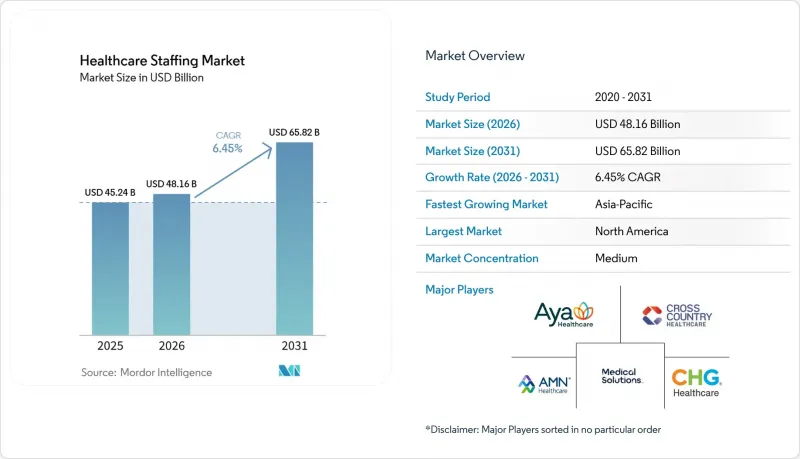
This report is Segmented by Service (Travel Nurse Staffing, Per-Diem Nurse Staffing, and More), End-User (Hospitals, Ambulatory Surgical Centers, and More), Profession (Nursing Professionals, and More), Delivery Mode (On-Site Staffing, Remote/Tele-staffing), and Geography (North America, Europe, Asia-Pacific, Middle East & Africa, South America). The Market Forecasts are Provided in Terms of Value (USD).
Global Healthcare Staffing Market Trends and Insights
Aging Population and Rising Healthcare Demand
Surging longevity deepens care intensity: the United States will see adults aged 65 and older jump from 62 million to 84 million by 2045, while centenarians worldwide quadruple during the same horizon. Older adults over 85 consume triple the care resources of the 65-74 group, driving continuous requisitions for nurses, therapists, and home-care aides. The Bureau of Labor Statistics projects 1.8 million new healthcare jobs each year to 2035, magnifying the recruitment burden. Rural systems, constrained by declining permanent-hire pipelines, collaborate with staffing firms to maintain service lines, particularly in critical-access hospitals. Retirements inside the clinician workforce intensify the gap, pushing agencies to expand international sourcing and cross-training programs.
Increasing Healthcare Expenditure Worldwide
Healthcare spending's share of gross domestic product, led by the United States at a projected 19.7% of GDP by 2032, reinforces the resource pool available for outsourced labor even amid cost-containment scrutiny. Medicare outlays are rising 7.4% annually, spurring providers to balance revenue capture against escalating wage pressures. In contrast, the World Health Organization notes a decline in average per-capita public health spending after pandemic-era surges, prompting systems to toggle between permanent and contingent staff to ride fiscal cycles. Temporary staffing contracts enable administrators to flex supply without locking long-term expense, safeguarding service continuity under budget ceilings.
Persistent Shortage of Qualified Healthcare Professionals
The global deficit could exceed 10 million clinicians by 2030, with the United States alone lacking 195,400 nurses and up to 86,000 physicians in the same window. Education pipelines cannot expand rapidly enough, despite increased nursing school seats. Forty-three US states reported permanent provider closures in rural zones during 2024, underlining maldistribution challenges. International recruitment offers partial relief yet raises ethical questions about draining scarce talent from emerging economies and layers compliance complexity onto agency operations.
Other drivers and restraints analyzed in the detailed report include:
- Growing Adoption of Temporary Staffing Models for Cost Optimization
- Technological Advancements in Recruitment Platforms and Workforce Analytics
- Volatility In Hospital Budgets and Reimbursement Rates
For complete list of drivers and restraints, kindly check the Table Of Contents.
Segment Analysis
Travel nurse staffing retained 44.55% revenue in 2025 despite a correction from the 2022 pandemic peak. The segment declined from USD 42.7 billion to USD 25.6 billion, and average bill rates fell to USD 106.78. Analysts expect the healthcare staffing market size for travel nurses to level near USD 19.18 billion in 2026, signaling a new equilibrium as hospitals emphasize local float pools. Locum tenens, meanwhile, is pacing at 8.12% CAGR, buoyed by enduring physician shortages and flexible scheduling preferences. Nearly 52,000 doctors practiced as locums in 2024, filling emergency, psychiatry, and primary-care gaps. AI-enabled matching speeds credentialing and curbs idle time, strengthening agency economics across both service lines.
Demand for allied health professionals also rises as imaging, laboratory, and rehabilitation volumes expand, aided by broader scope-of-practice regulations. Per-diem nurse pools continue supporting weekend and surge demands where full-time hires would under-utilize capacity. Overall, each service tier now leans on advanced analytics to forecast site-level needs, enhancing utilization and client satisfaction while anchoring long-term growth trajectories inside the healthcare staffing market.
Hospitals retained 41.88% of 2025 revenue, reflecting their status as the largest employer group. Yet federal minimum staffing mandates and reimbursement headwinds push administrators toward cost-efficient roster models, including integrated MSP partnerships. Ambulatory surgery centers expand staffing needs as procedure migration to outpatient settings persists. Skilled-nursing and rehab units confront elevated vacancy rates, with 21% downsizing beds in the past year.
Home-health agencies represent the fastest-growing end-user at 9.05% CAGR to 2031. CMS's 2025 home-health payment refresh ties reimbursement more tightly to patient acuity, incentivizing agencies with robust nurse and therapist pools. Investment in AI scheduling and remote patient monitoring boosts productivity, attracting private-equity capital targeting roll-up plays. Value-based care penalties on readmissions further propel referral volumes into the home setting, reinforcing the home-health contribution to the healthcare staffing market.
Complete Report Scope:
- By Service
- Travel Nurse Staffing
- Per-Diem Nurse Staffing
- Locum Tenens Staffing
- Allied Healthcare Staffing
- By End-user
- Hospitals
- Ambulatory Surgical Centers
- Long-term Care & Rehab Facilities
- Home-Health Agencies
- By Profession
- Nursing Professionals
- Physicians & Advanced Practitioners
- Allied Health Professionals
- Non-clinical/Administrative
- By Delivery Mode
- On-site Staffing
- Remote/Tele-staffing
- Geography
- North America
- United States
- Canada
- Mexico
- Europe
- Germany
- United Kingdom
- France
- Italy
- Spain
- Rest of Europe
- Asia-Pacific
- China
- Japan
- India
- Australia
- South Korea
- Rest of Asia-Pacific
- Middle East & Africa
- GCC
- South Africa
- Rest of Middle East & Africa
- South America
- Brazil
- Argentina
- Rest of South America
- North America
Geography Analysis
North America dominated the healthcare staffing market with 38.10% revenue in 2025. Robust infrastructure, intricate reimbursement frameworks, and entrenched MSP ecosystems sustain consistent contingent labor utilization. The American Hospital Association warns that workforce gaps could near 100,000 critical workers by 2028, a reality steering hospitals toward technology-enabled vendors and pushing further consolidation. Canada and Mexico present incremental opportunities yet require navigation of distinct licensure and bilingual expectations. Market analysts anticipate a 20% contraction in premium travel nursing within the region as systems pivot to permanent hiring and local float pools, yet overall contingent demand remains resilient due to mandate-driven minimum staffing thresholds.
Europe faces a projected deficit of 1.8 million healthcare workers, with physician density as low as 2.4 per 1,000 residents in some member states. The European Commission has earmarked EUR 65 billion for workforce upskilling and mobility programs to blunt the shortage impact. Germany alone may require 500,000 additional nurses by 2030, spurring cross-border recruitment and English-language training incentives. Post-Brexit immigration hurdles complicate UK workforce planning, but the National Health Service continues to rely on international nurses and locum doctors to sustain service levels. Digital credentialing platforms accelerate onboarding yet face fragmented data standards across jurisdictions, tempering the near-term acceleration of the healthcare staffing market size in Europe.
Asia-Pacific is the fastest-growing territory at 7.32% CAGR, propelled by infrastructure investment and rising chronic-disease prevalence. Japan projects a shortage of nearly 1 million health workers by 2040, prompting bilateral agreements to attract Indonesian and Filipino nurses. Australia is easing restrictions on overseas medical recruitment, though ethical considerations arise around talent drain from lower-income neighbors. India's burgeoning private hospital sector seeks specialized nurses and allied professionals, yet retention is challenged by competitive salaries in Gulf and North American markets. While regulation, licensure variability, and salary differentials temper velocity, demographic momentum positions Asia-Pacific as a crucial growth lever for the healthcare staffing market.
- Adecco Group
- AMN Healthcare
- Aya Healthcare
- CHG Healthcare, Inc.
- Medical Solutions
- Cross Country Healthcare
- Maxim Healthcare
- LHC Group
- Envision Healthcare
- TeamHealth
- Jackson Healthcare
- LocumTenens.com
- Syneos Health
- HealthTrust Workforce Solutions
- Supplemental Health Care
- Fastaff / U.S. Nursing
- Trusted Health
- Barton Associates
- Medicus Healthcare Solutions
- Triage Staffing
Additional Benefits:
- The market estimate (ME) sheet in Excel format
- 3 months of analyst support
TABLE OF CONTENTS
1 Introduction
- 1.1 Study Assumptions & Market Definition
- 1.2 Scope of the Study
2 Research Methodology
3 Executive Summary
4 Market Landscape
- 4.1 Market Overview
- 4.2 Market Drivers
- 4.2.1 Aging Population and Rising Healthcare Demand
- 4.2.2 Increasing Healthcare Expenditure Worldwide
- 4.2.3 Growing Adoption of Temporary Staffing Models for Cost Optimization
- 4.2.4 Technological Advancements in Recruitment Platforms and Workforce Analytics
- 4.2.5 Regulatory Push for Quality Care and Staffing Compliance
- 4.2.6 Expansion of Home Healthcare and Outpatient Services
- 4.3 Market Restraints
- 4.3.1 Persistent Shortage of Qualified Healthcare Professionals
- 4.3.2 Volatility in Hospital Budgets and Reimbursement Rates
- 4.3.3 Complex Regulatory and Credentialing Requirements
- 4.3.4 Rising Competition and Price Pressures Among Staffing Agencies
- 4.4 Regulatory Landscape
- 4.5 Porter's Five Forces Analysis
- 4.5.1 Threat of New Entrants
- 4.5.2 Bargaining Power of Buyers
- 4.5.3 Bargaining Power of Suppliers
- 4.5.4 Threat of Substitutes
- 4.5.5 Intensity of Competitive Rivalry
5 Market Size & Growth Forecasts (Value, USD)
- 5.1 By Service
- 5.1.1 Travel Nurse Staffing
- 5.1.2 Per-Diem Nurse Staffing
- 5.1.3 Locum Tenens Staffing
- 5.1.4 Allied Healthcare Staffing
- 5.2 By End-user
- 5.2.1 Hospitals
- 5.2.2 Ambulatory Surgical Centers
- 5.2.3 Long-term Care & Rehab Facilities
- 5.2.4 Home-Health Agencies
- 5.3 By Profession
- 5.3.1 Nursing Professionals
- 5.3.2 Physicians & Advanced Practitioners
- 5.3.3 Allied Health Professionals
- 5.3.4 Non-clinical/Administrative
- 5.4 By Delivery Mode
- 5.4.1 On-site Staffing
- 5.4.2 Remote/Tele-staffing
- 5.5 Geography
- 5.5.1 North America
- 5.5.1.1 United States
- 5.5.1.2 Canada
- 5.5.1.3 Mexico
- 5.5.2 Europe
- 5.5.2.1 Germany
- 5.5.2.2 United Kingdom
- 5.5.2.3 France
- 5.5.2.4 Italy
- 5.5.2.5 Spain
- 5.5.2.6 Rest of Europe
- 5.5.3 Asia-Pacific
- 5.5.3.1 China
- 5.5.3.2 Japan
- 5.5.3.3 India
- 5.5.3.4 Australia
- 5.5.3.5 South Korea
- 5.5.3.6 Rest of Asia-Pacific
- 5.5.4 Middle East & Africa
- 5.5.4.1 GCC
- 5.5.4.2 South Africa
- 5.5.4.3 Rest of Middle East & Africa
- 5.5.5 South America
- 5.5.5.1 Brazil
- 5.5.5.2 Argentina
- 5.5.5.3 Rest of South America
- 5.5.1 North America
6 Competitive Landscape
- 6.1 Market Concentration
- 6.2 Market Share Analysis
- 6.3 Company Profiles (includes Global level Overview, Market level overview, Core Business Segments, Financials, Headcount, Key Information, Market Rank, Market Share, Products and Services, and analysis of Recent Developments)
- 6.3.1 Adecco Group
- 6.3.2 AMN Healthcare
- 6.3.3 Aya Healthcare
- 6.3.4 CHG Healthcare, Inc.
- 6.3.5 Medical Solutions
- 6.3.6 Cross Country Healthcare
- 6.3.7 Maxim Healthcare Group
- 6.3.8 LHC Group
- 6.3.9 Envision Healthcare
- 6.3.10 TeamHealth
- 6.3.11 Jackson Healthcare
- 6.3.12 LocumTenens.com
- 6.3.13 Syneos Health
- 6.3.14 HealthTrust Workforce Solutions
- 6.3.15 Supplemental Health Care
- 6.3.16 Fastaff / U.S. Nursing
- 6.3.17 Trusted Health
- 6.3.18 Barton Associates
- 6.3.19 Medicus Healthcare Solutions
- 6.3.20 Triage Staffing
7 Market Opportunities & Future Outlook
- 7.1 White-space & Unmet-need Assessment

