PUBLISHER: Mordor Intelligence | PRODUCT CODE: 2097226

PUBLISHER: Mordor Intelligence | PRODUCT CODE: 2097226
South America Organic Baby Food - Market Share Analysis, Industry Trends & Statistics, Growth Forecasts (2026 - 2031)
According to Mordor Intelligence, the South America organic baby food market is expected to grow from USD 1.04 billion in 2025 to USD 1.11 billion in 2026 and is forecast to reach USD 1.53 billion by 2031 at 6.63% CAGR over 2026-2031.
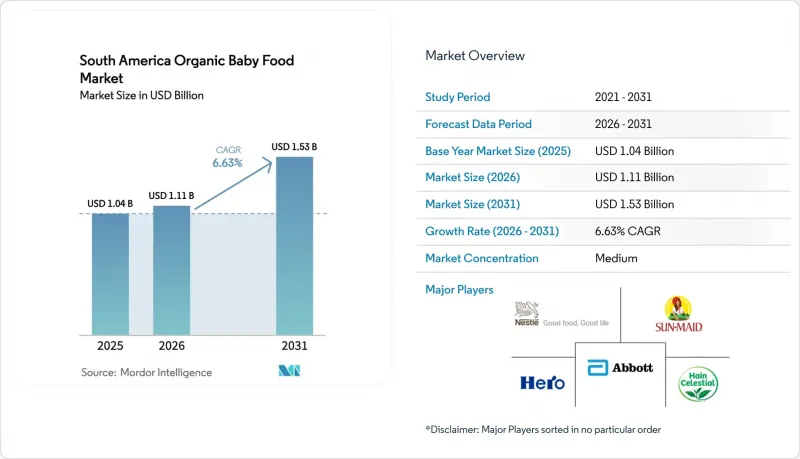
This report Segments the Industry by Product Type (Milk Formula, Dried Baby Food and More); by Age Group (0-6 Months, 6-12 Months, and More); by Distribution Channel (Supermarkets/Hypermarkets, Convenience/Grocery Stores, and More); and by Geography (Brazil, Argentina, Chile, Colombia, and More). The Market Forecasts are Provided in Terms of Value (USD).
South America Organic Baby Food Market Trends and Insights
Rising Middle-class Demand for Clean-label Infant Nutrition
In Brazil and Argentina, the rapidly expanding middle class is driving a major shift in the organic baby food market. Parents are increasingly favoring products devoid of artificial ingredients, preservatives, and pesticides. As a result, there's a notable surge in demand for premium organic offerings. With rising incomes, middle-class families are more willing to spend on what they view as safer, higher-quality nutrition for their children. Parents are becoming more ingredient-savvy, prompting brands to simplify formulations and use familiar, transparent ingredients.Social media parenting groups are amplifying this shift, sharing tips and ingredient insights that help normalize organic choices across diverse income groups. Furthermore, government initiatives promoting organic farming and sustainable practices in both countries are expected to support the growth of the organic baby food market during the forecast period.
Awareness Regarding Nutrition Labeling Promoting Demand
In South America, as parents sharpen their skills in deciphering ingredient lists and nutritional data, the organic baby food market is witnessing a surge. Stricter labeling regulations, particularly in Brazil and Chile, have fostered a more transparent marketplace, where the clear indication of products free from artificial additives and pesticide residues has become a key competitive advantage. Tighter labeling laws in Brazil and Chile are driving a new level of transparency, helping parents easily spot the differences between organic and conventional options. A 2024 study found that parents who understand nutrition labeling are nearly three times more likely to choose organic products for their babies. This trend is especially evident among first-time parents, who, with heightened vigilance towards allergens and contaminants, gravitate towards certified organic products boasting clear and thorough labeling. Additionally, the rising prevalence of health-conscious lifestyles and increasing disposable incomes in the region are further fueling the demand for organic baby food. Manufacturers are responding by going beyond basic compliance, providing greater visibility into how ingredients are sourced and processed a move that resonates strongly with today's informed parents.
Limited Regional Organic Raw-material Supply Raising Cogs for Milks and Cereals
In South America, manufacturers of milk formulas and cereals grapple with rising costs, largely due to a persistent shortage of certified organic raw materials. While organic agriculture is on the rise in the region, it still falls short of meeting the surging demand. This shortfall compels producers to either turn to costly imports or navigate the intricate process of establishing local supply chains. Brazil and Argentina feel the brunt of this challenge, as the shift to organic farming faces hurdles like steep certification costs, a dearth of technical know-how, and insufficient policy backing. Some companies are turning to vertical integration by forging direct ties with farmers and offering technical support to bolster organic farming practices and work towards a steadier supply chain. However, these initiatives demand hefty upfront investments and patience, as immediate supply boosts aren't guaranteed. Consequently, manufacturers must balance short-term challenges with the promise of long-term gains in South America's shifting organic market landscape.
Other drivers and restraints analyzed in the detailed report include:
- Fast Expansion of Online Baby Specialty Retailers
- Growing Participation of Women in Workforce Boosting Demand for Ready-to-eat Organic Purees
- Constrained Cold-chain Logistics in Rural Andes Limiting Shelf Life of Fresh Purees
For complete list of drivers and restraints, kindly check the Table Of Contents.
Segment Analysis
In 2025, the milk formula segment secures a commanding 80.45% share of the South American organic baby food market. Its prominence is anchored in its pivotal role in infant nutrition, especially for households unable to breastfeed. Established players, leveraging strong brand equity, have adeptly positioned organic formulations as premium, price-worthy alternatives. Manufacturers find themselves at a crossroads, balancing the scarce availability of organic dairy inputs with the imperative to provide comprehensive dietary profiles vital for infant growth. Recent innovations spotlight hypoallergenic organic formulations, a response to the surging food sensitivities in infants, birthing premium subsegments that boast elevated margins.
Though the prepared baby food segment currently holds a smaller share, it's poised to be the market's growth catalyst, eyeing a robust CAGR of 7.02% from 2026 to 2031. A rising maternal workforce and shifting feeding practices fuel this surge. Manufacturers are at the forefront of innovation, crafting organic purees that not only echo homemade textures and flavors but also infuse indigenous superfoods, resonating with health-conscious parents. The allure of convenience further propels the segment's momentum. As parents juggle busy schedules, the demand for nutritious, ready-to-eat options aligned with values of clean ingredients and sustainability has surged.
Complete Report Scope:
- By Product Type
- Milk Formula
- Prepared Baby Food
- Dried Baby Food
- By Age Group
- 0 - 6 Months
- 6 - 12 Months
- 12 - 24 Months
- More than 24 Months
- By Distribution Channel
- Supermarkets/Hypermarkets
- Convenience/Grocery Stores
- Baby Specialty Stores
- Pharmacies/Drugstores
- Online Retail Stores
- By Geography
- Brazil
- Argentina
- Chile
- Colombia
- Peru
- Rest of South America
List of Companies Covered in this Report:
- Nestle S.A.
- Danone S.A.
- Abbott Laboratories
- The Hain Celestial Group, Inc.
- The Hero Group
- HiPP GmbH & Co. Vertrieb KG
- Baby Roo Food Trade Eireli (Papapa)
- Unilever Plc (Mae Terra)
- Natuzinho
- Sun-Maid Growers of California
- Cerebelly Inc.
- Else Nutrition Holdings Inc.
- Little Spoon Inc.
- Da Vovo Healthy Products Industry Ltd.
- Reckitt Benckiser Group plc (Mead Johnson Nutrition)
- Baby Gourmet Foods Inc.
- Kekoa Foods
- Neptune Wellness Solutions (Sprout Organics)
- Valley Crops Ltd (Little Inca)
- Nature's Path Organic Foods (Love Child)
Additional Benefits:
- The market estimate (ME) sheet in Excel format
- 3 months of analyst support
TABLE OF CONTENTS
1 INTRODUCTION
- 1.1 Study Assumptions and Market Definition
- 1.2 Scope of the Study
2 RESEARCH METHODOLOGY
3 EXECUTIVE SUMMARY
4 MARKET LANDSCAPE
- 4.1 Market Overview
- 4.2 Market Drivers
- 4.2.1 Rising middle-class demand for clean-label infant nutrition
- 4.2.2 Awareness regarding nutrition labeling promoting demand
- 4.2.3 Fast expansion of online baby specialty retailers
- 4.2.4 Growing participation of women in workforce boosting demand for ready-to-eat organic purees
- 4.2.5 Growing popularity of plant-based diets influencing baby food choices.
- 4.2.6 Rise in e-commerce platforms facilitating easy access to organic baby food.
- 4.3 Market Restraints
- 4.3.1 Limited regional organic raw-material supply raising cogs for milks and cereals
- 4.3.2 Constrained cold-chain logistics in rural andes limiting shelf life of fresh purees
- 4.3.3 Shorter shelf life of organic products leading to potential wastage.
- 4.3.4 Regulatory hurdles and certifications can be time-consuming and costly for producers
- 4.4 Consumer Behavior Analysis
- 4.5 Regulatory or Technological Outlook
- 4.6 Porter's Five Forces
- 4.6.1 Threat of New Entrants
- 4.6.2 Bargaining Power of Buyers/Consumers
- 4.6.3 Bargaining Power of Suppliers
- 4.6.4 Threat of Substitute Products
- 4.6.5 Intensity of Competitive Rivalry
5 MARKET SIZE AND GROWTH FORECASTS (VALUE)
- 5.1 By Product Type
- 5.1.1 Milk Formula
- 5.1.2 Prepared Baby Food
- 5.1.3 Dried Baby Food
- 5.2 By Age Group
- 5.2.1 0 - 6 Months
- 5.2.2 6 - 12 Months
- 5.2.3 12 - 24 Months
- 5.2.4 More than 24 Months
- 5.3 By Distribution Channel
- 5.3.1 Supermarkets/Hypermarkets
- 5.3.2 Convenience/Grocery Stores
- 5.3.3 Baby Specialty Stores
- 5.3.4 Pharmacies/Drugstores
- 5.3.5 Online Retail Stores
- 5.4 By Geography
- 5.4.1 Brazil
- 5.4.2 Argentina
- 5.4.3 Chile
- 5.4.4 Colombia
- 5.4.5 Peru
- 5.4.6 Rest of South America
6 COMPETITIVE LANDSCAPE
- 6.1 Market Concentration
- 6.2 Strategic Moves
- 6.3 Market Share Analysis
- 6.4 Company Profiles (includes Global-level Overview, Market-level Overview, Core Segments, Financials as available, Strategic Information, Market Rank/Share, Products and Services, Recent Developments)
- 6.4.1 Nestle S.A.
- 6.4.2 Danone S.A.
- 6.4.3 Abbott Laboratories
- 6.4.4 The Hain Celestial Group, Inc.
- 6.4.5 The Hero Group
- 6.4.6 HiPP GmbH & Co. Vertrieb KG
- 6.4.7 Baby Roo Food Trade Eireli (Papapa)
- 6.4.8 Unilever Plc (Mae Terra)
- 6.4.9 Natuzinho
- 6.4.10 Sun-Maid Growers of California
- 6.4.11 Cerebelly Inc.
- 6.4.12 Else Nutrition Holdings Inc.
- 6.4.13 Little Spoon Inc.
- 6.4.14 Da Vovo Healthy Products Industry Ltd.
- 6.4.15 Reckitt Benckiser Group plc (Mead Johnson Nutrition)
- 6.4.16 Baby Gourmet Foods Inc.
- 6.4.17 Kekoa Foods
- 6.4.18 Neptune Wellness Solutions (Sprout Organics)
- 6.4.19 Valley Crops Ltd (Little Inca)
- 6.4.20 Nature's Path Organic Foods (Love Child)
7 MARKET OPPORTUNITIES AND FUTURE OUTLOOK

