PUBLISHER: Mordor Intelligence | PRODUCT CODE: 2097231

PUBLISHER: Mordor Intelligence | PRODUCT CODE: 2097231
Lifestyle-Related Disease Supplements - Market Share Analysis, Industry Trends & Statistics, Growth Forecasts (2026 - 2031)
According to Mordor Intelligence, the lifestyle-related disease supplements market size is expected to grow from USD 58.34 billion in 2025 to USD 62.62 billion in 2026 and is forecast to reach USD 89.22 billion by 2031 at 7.35% CAGR over 2026-2031.
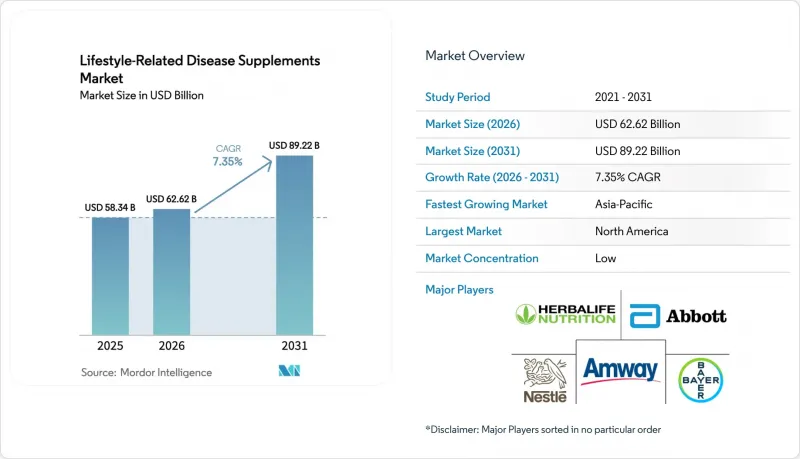
This report is Segmented by Product Type (Heart-Health Supplements, Digestive-Health Supplements, Weight-Management Supplements, and More), Form (Powder, Capsules, Softgels, Gummies, and Effervescent Tablets), Distribution Channel (Supermarkets/Hypermarkets, Specialty/Drug Stores, Online Retail Stores, and More), and Geography. The Market Forecasts are Given in Terms of Value (USD).
Global Lifestyle-Related Disease Supplements Market Trends and Insights
Shift towards preventive healthcare
Globally, government healthcare policies are shifting focus from reactive treatments to preventive care, reshaping how consumers approach and adopt supplements. The World Health Organization's push for the prevention of non-communicable diseases has spurred national health strategies, highlighting nutritional supplements as a cost-effective means to alleviate healthcare burdens. This shift is particularly evident in developed nations, where aging populations are challenging traditional healthcare systems. In response, policymakers are increasingly promoting preventive measures, including dietary supplements. Surveys reveal that 75% of Americans now turn to dietary supplements, with a striking 91% deeming them essential for health maintenance, as reported by the Council for Responsible Nutrition. This underscores a cultural shift: supplements are evolving from optional wellness aids to essential components of healthcare. Moreover, this trend isn't limited to individual choices; employers are now weaving supplement benefits into their workplace wellness initiatives, bolstering institutional demand and fueling market growth. Recognizing the preventive role of supplements, regulatory bodies in various regions, including the FDA, are offering clearer guidelines on health claims, further solidifying this perspective.
Rising incidence of lifestyle-related diseases
Health authorities project a significant rise in diabetes prevalence by 2045, underscoring the growing market for targeted nutritional interventions amid a global surge in lifestyle-related diseases. For instance, NHS Digital, a division of NHS England, reported that between 2023 and 2024, over 3.5 million individuals in England were diagnosed with type 2 diabetes, while nearly 277,000 had type 1. As urbanization sweeps through developing nations, it's ushering in sedentary lifestyles and a penchant for processed foods, mirroring health issues once seen only in the West. This shift fuels a growing demand for supplements that target metabolic health, heart function, and weight management. Today's consumers are not just looking for any solution; they're gravitating towards evidence-backed formulations that target specific biomarkers linked to chronic diseases. With the advent of continuous glucose monitoring and similar health tech, individuals can now monitor their body's reactions to supplements. This real-time feedback not only reinforces their purchasing decisions but also propels market growth. Moreover, as healthcare providers increasingly endorse specific supplements for prediabetic and metabolic syndrome management, they're not just validating these products but also broadening their appeal beyond the conventional wellness market.
Regulatory challenges and inconsistencies
Global markets' divergent regulatory frameworks complicate compliance, hindering market expansion and inflating operational costs for supplement manufacturers. Companies face distinct approval processes, labeling mandates, and health claim substantiation standards across various jurisdictions. Agencies such as Singapore's Health Sciences Authority, Japan's Ministry of Health, Labour and Welfare, and India's Food Safety and Standards Authority uphold varied classification systems for the same products. These regulatory inconsistencies pose challenges, especially for novel ingredients and innovative formulations. Here, approval timelines and evidence requirements differ markedly between markets, leading to delayed product launches and diminished returns on research and development investments. The absence of unified international standards not only hampers cross-border trade but also curtails economies of scale in manufacturing and marketing. Recent regulatory shifts in the Asia-Pacific markets present a mixed bag of opportunities and challenges. For instance, while India rolls out new health supplement regulations, it simultaneously restricts certain botanical ingredients, leaving manufacturers eyeing regional expansion in a state of uncertainty.
Other drivers and restraints analyzed in the detailed report include:
- An aging global population
- Innovation in product formulation
- Consumer skepticism regarding claims
For complete list of drivers and restraints, kindly check the Table Of Contents.
Segment Analysis
In 2025, weight-management supplements hold a dominant 26.72% market share, underscoring the global obesity crisis and a growing consumer demand for formulations that promote healthy weight maintenance. This segment's leadership is bolstered by its widespread appeal across demographics and its alignment with broader wellness aspirations, such as energy enhancement, metabolic health, and cardiovascular well-being. Digestive-health supplements are on a robust growth path, projected to expand at an 8.45% CAGR through 2031. This surge is fueled by burgeoning research highlighting the gut-brain connection and the importance of microbiome diversity, underscoring the pivotal role of digestive wellness in overall health. Meanwhile, heart-health supplements are reaping benefits from an aging population and the prevalent threat of cardiovascular diseases. At the same time, brain-health supplements are resonating with younger audiences, particularly those pursuing cognitive boosts and stress relief. Data from the Centers for Disease Control and Prevention indicates that in 2024, approximately 3% of U.S. adults reported a prior heart attack diagnosis from a health professional.
Bone and joint-health supplements cater to a stable market, driven by the needs of an aging demographic. However, they grapple with competition from functional foods and alternative therapies, which deliver similar benefits through varied means. The category labeled "other lifestyle-focused supplements" is gaining traction, encompassing niches like sleep aids, stress relief, and immune boosters. These reflect shifting consumer health priorities and the challenges of modern living. Furthermore, product innovation is reshaping the landscape. Multi-functional supplements are emerging, blending ingredients for weight management, digestive health, and energy support. This trend not only addresses diverse consumer needs in one package but also opens avenues for premium market positioning and share growth.
Complete Report Scope:
- By Product Type
- Heart-Health Supplements
- Bone & Joint-Health Supplements
- Digestive-Health Supplements
- Brain-Health Supplements
- Weight-Management Supplements
- Other Lifestyle-Focused Supplements
- By Form
- Powder
- Capsules
- Softgels
- Gummies
- Effervescent Tablets
- By Distribution Channel
- Supermarkets/Hypermarkets
- Specialty/Drug Stores
- Online Retail Stores
- Other Distribution Channels
- By Geography
- North America
- United States
- Canada
- Mexico
- Rest of North America
- South America
- Brazil
- Argentina
- Colombia
- Chile
- Rest of South America
- Europe
- United Kingdom
- Germany
- France
- Italy
- Spain
- Russia
- Sweden
- Belgium
- Poland
- Netherlands
- Rest of Europe
- Asia-Pacific
- China
- Japan
- India
- Thailand
- Singapore
- Indonesia
- South Korea
- Australia
- New Zealand
- Rest of Asia-Pacific
- Middle East and Africa
- United Arab Emirates
- South Africa
- Saudi Arabia
- Nigeria
- Egypt
- Morocco
- Turkey
- Rest of Middle East and Africa
- North America
Geography Analysis
In 2025, North America commanded a 31.85% share of the lifestyle-related disease supplements market. This dominance is bolstered by a deep-rooted supplement culture, strong direct-selling networks, and the favorable DSHEA regulations that expedite product turnover. Furthermore, physicians routinely recommend omega-3 fatty acids, vitamin D, and probiotics in electronic medical records, thereby solidifying their everyday use. Marketing strategies have evolved, now emphasizing longevity and metabolic vitality over individual nutrients, ensuring sustained consumer engagement.
Europe's unwavering demand is bolstered by stringent regulations that foster consumer trust. In 2024, the European Food Safety Authority's Ingredient Correction Process streamlined dossier reviews by 15%, enhancing the availability of products across borders. While Latin America and the Middle East & Africa boast a burgeoning urban middle class, challenges like fragmented logistics and income disparities temper their growth. Notably, e-commerce leaders in South America are investing in cold-chain solutions for temperature-sensitive probiotics, indicating an impending surge in the market.
Asia-Pacific is on a trajectory with an 8.20% CAGR projected through 2031, positioning it as a pivotal arena. In nations like China, India, and across Southeast Asia, swift urbanization, expanded insurance coverage, and public health initiatives targeting diabetes are driving the demand. Traditional practices, such as Ayurveda and Traditional Chinese Medicine, are melding with modern supplementation, leading to innovative formulations that marry age-old botanicals with contemporary delivery methods. To bolster domestic production and lessen import dependence, governments are rolling out incentives like tax breaks and expedited approvals for facilities adhering to international Good Manufacturing Practice standards.
- Abbott Laboratories
- Bayer AG
- Amway Corp.
- Nestle S.A.
- Herbalife Nutrition
- Otsuka Holdings
- Swanson Health Products
- Mega Lifesciences
- Nordic Naturals
- NOW Health Group
- GNC Holdings
- The Bountiful Company
- Glanbia PLC
- Danone S.A.
- Pfizer Inc.
- Unilever PLC
- Pharmavite
- Blackmores Ltd.
- DSM-Firmenich
- Lonza Capsugel
- Sirio Pharma
Additional Benefits:
- The market estimate (ME) sheet in Excel format
- 3 months of analyst support
TABLE OF CONTENTS
1 INTRODUCTION
- 1.1 Study Assumptions and Market Definition
- 1.2 Scope of the Study
2 RESEARCH METHODOLOGY
3 EXECUTIVE SUMMARY
4 MARKET LANDSCAPE
- 4.1 Market Overview
- 4.2 Market Drivers
- 4.2.1 Shift towards preventive healthcare
- 4.2.2 Rising incidence of lifestyle-related diseases
- 4.2.3 Aging global population
- 4.2.4 Innovation in product formulation
- 4.2.5 Increased focus on mental wellness
- 4.2.6 Shift towards natural and plant-based supplements
- 4.3 Market Restraints
- 4.3.1 Availability of substitute products
- 4.3.2 Regulatory challenges and inconsistencies
- 4.3.3 Potential for side effects and drug interactions
- 4.3.4 Consumer skepticism regarding claims
- 4.4 Consumer Behaviour Analysis
- 4.5 Regulatory Landscape
- 4.6 Technological Outlook
- 4.7 Porter's Five Forces
- 4.7.1 Threat of New Entrants
- 4.7.2 Bargaining Power of Buyers
- 4.7.3 Bargaining Power of Suppliers
- 4.7.4 Threat of Substitutes
- 4.7.5 Competitive Rivalry
5 MARKET SIZE AND GROWTH FORECASTS (VALUE)
- 5.1 By Product Type
- 5.1.1 Heart-Health Supplements
- 5.1.2 Bone & Joint-Health Supplements
- 5.1.3 Digestive-Health Supplements
- 5.1.4 Brain-Health Supplements
- 5.1.5 Weight-Management Supplements
- 5.1.6 Other Lifestyle-Focused Supplements
- 5.2 By Form
- 5.2.1 Powder
- 5.2.2 Capsules
- 5.2.3 Softgels
- 5.2.4 Gummies
- 5.2.5 Effervescent Tablets
- 5.3 By Distribution Channel
- 5.3.1 Supermarkets/Hypermarkets
- 5.3.2 Specialty/Drug Stores
- 5.3.3 Online Retail Stores
- 5.3.4 Other Distribution Channels
- 5.4 By Geography
- 5.4.1 North America
- 5.4.1.1 United States
- 5.4.1.2 Canada
- 5.4.1.3 Mexico
- 5.4.1.4 Rest of North America
- 5.4.2 South America
- 5.4.2.1 Brazil
- 5.4.2.2 Argentina
- 5.4.2.3 Colombia
- 5.4.2.4 Chile
- 5.4.2.5 Rest of South America
- 5.4.3 Europe
- 5.4.3.1 United Kingdom
- 5.4.3.2 Germany
- 5.4.3.3 France
- 5.4.3.4 Italy
- 5.4.3.5 Spain
- 5.4.3.6 Russia
- 5.4.3.7 Sweden
- 5.4.3.8 Belgium
- 5.4.3.9 Poland
- 5.4.3.10 Netherlands
- 5.4.3.11 Rest of Europe
- 5.4.4 Asia-Pacific
- 5.4.4.1 China
- 5.4.4.2 Japan
- 5.4.4.3 India
- 5.4.4.4 Thailand
- 5.4.4.5 Singapore
- 5.4.4.6 Indonesia
- 5.4.4.7 South Korea
- 5.4.4.8 Australia
- 5.4.4.9 New Zealand
- 5.4.4.10 Rest of Asia-Pacific
- 5.4.5 Middle East and Africa
- 5.4.5.1 United Arab Emirates
- 5.4.5.2 South Africa
- 5.4.5.3 Saudi Arabia
- 5.4.5.4 Nigeria
- 5.4.5.5 Egypt
- 5.4.5.6 Morocco
- 5.4.5.7 Turkey
- 5.4.5.8 Rest of Middle East and Africa
- 5.4.1 North America
6 COMPETITIVE LANDSCAPE
- 6.1 Market Concentration
- 6.2 Strategic Moves
- 6.3 Market Share Analysis
- 6.4 Company Profiles (includes Global level Overview, Market level overview, Core Segments, Financials as available, Strategic Information, Market Rank/Share for key companies, Products and Services, and Recent Developments)
- 6.4.1 Abbott Laboratories
- 6.4.2 Bayer AG
- 6.4.3 Amway Corp.
- 6.4.4 Nestle S.A.
- 6.4.5 Herbalife Nutrition
- 6.4.6 Otsuka Holdings
- 6.4.7 Swanson Health Products
- 6.4.8 Mega Lifesciences
- 6.4.9 Nordic Naturals
- 6.4.10 NOW Health Group
- 6.4.11 GNC Holdings
- 6.4.12 The Bountiful Company
- 6.4.13 Glanbia PLC
- 6.4.14 Danone S.A.
- 6.4.15 Pfizer Inc.
- 6.4.16 Unilever PLC
- 6.4.17 Pharmavite
- 6.4.18 Blackmores Ltd.
- 6.4.19 DSM-Firmenich
- 6.4.20 Lonza Capsugel
- 6.4.21 Sirio Pharma
7 MARKET OPPORTUNITIES AND FUTURE OUTLOOK

