
PUBLISHER: Mordor Intelligence | PRODUCT CODE: 2097245

PUBLISHER: Mordor Intelligence | PRODUCT CODE: 2097245
5G MVNO - Market Share Analysis, Industry Trends & Statistics, Growth Forecasts (2026 - 2031)
According to Mordor Intelligence, 5G MVNO market size in 2026 is estimated at USD 13.98 billion, growing from 2025 value of USD 13.30 billion with 2031 projections showing USD 17.89 billion, growing at 5.08% CAGR over 2026-2031.
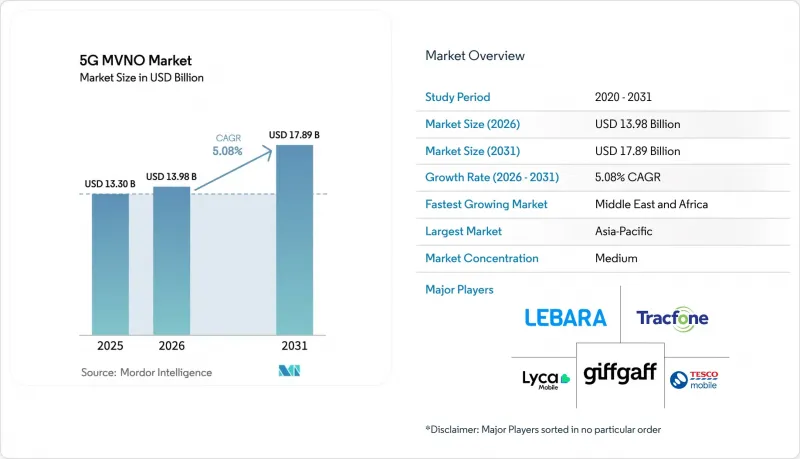
This report is Segmented by Subscriber Type (Enterprise, and Consumer), Operational Model (Resellers/Light/ Brand MVNO, Service Operator, and Full MVNO), Application (M2M/IoT Connectivity, and More), Industry Vertical (Manufacturing, Healthcare, and More), Network Technology (Standalone 5G, and Non-Standalone 5G), and Geography. The Market Forecasts are Provided in Terms of Value (USD) and Volume (Subscribers).
Global 5G MVNO Market Trends and Insights
Rising Enterprise IoT Connectivity Demand
Manufacturing, logistics, and healthcare operators are deploying private 5G networks for real-time process control and predictive analytics, creating a USD 2 billion addressable pool for IoT-centric MVNOs. Average revenue per enterprise connection now stands at USD 15-25, roughly double consumer ARPU, because customers pay premiums for guaranteed latency and robust security. Edge-computing tie-ins further lift switching costs, helping MVNOs retain accounts longer than the prepaid handset cycle.
Regulatory Push for Wholesale 5G Access
Canada's CRTC, the European Commission, and regulators in South Korea require cost-plus wholesale pricing that lets virtual operators buy 5G capacity without punitive volume commitments. These rules flatten entry barriers, foster price competition, and oblige facilities-based carriers to share network slicing functions, positioning MVNOs to sell differentiated enterprise packages.
Scarcity of Affordable 5G-Only Handsets
Entry-level 5G devices are still priced 40-60% higher than equivalent 4G models, constraining consumer uptake in price-sensitive markets where MVNOs seldom subsidize hardware. Component shortages continue to amplify this hurdle, forcing virtual brands to depend on refurbished stock or BYOD campaigns that slow net-add growth.
Other drivers and restraints analyzed in the detailed report include:
- eSIM-Enabled Global Roaming Propositions
- Cost-Efficient B2C Data Bundles in Developed Markets
- High 5G Wholesale Spectrum Fees
For complete list of drivers and restraints, kindly check the Table Of Contents.
Segment Analysis
The enterprise slice represented 66.72% of the total 5G MVNO market share in 2025 because industrial clients demand secure private networks, IoT connectivity, and service-level agreements. This premium segment underpins predictable cash flows and has spurred NTT Data and Eurofiber to co-launch fully managed private 5G bundles. Consumer lines, however, are projected to outpace enterprises at 8.52% CAGR owing to cheaper entry-level handsets and data bundles. As volumes scale, the consumer slice will remain below the enterprise share but will sustain overall subscriber momentum in the 5G MVNO market.
Enterprise contracts enable MVNOs to offer edge-compute addons, cybersecurity monitoring, and vertical apps that temper margin pressure. Meanwhile, consumer brands rely on digital self-care apps, eSIM onboarding, and multi-month prepaid plans that shrink acquisition costs. This hybrid approach helps operators diversify revenue as handset affordability gradually broadens the consumer base.
Reseller and light MVNO structures continued to hold 52.10% revenue in 2025, but the full MVNO cohort is expanding at 16.45% CAGR as control over billing and service orchestration becomes essential for network-slice monetization. Owning a core permits differentiated quality-of-service, faster tariff tweaks, and direct API exposure for enterprise clients, raising switching barriers and justifying premium pricing within the 5G MVNO market.
Service-operator hybrids that outsource the radio link yet keep customer management rank between the two extremes, offering an upgrade bridge for resellers that lack capital for a full core. Consolidation is likely because integrated players negotiate lower wholesale rates and can invest in edge-cloud innovation, creating a structural advantage that erodes the long tail of niche brand resellers.
Complete Report Scope:
- By Subscriber Type
- Enterprise
- Consumer
- By Operational Model
- Resellers/Light/ Brand MVNO
- Service Operator
- Full MVNO
- By Application
- M2M/IoT Connectivity
- Telecom Service Solutions
- Bundled Quad-play Solutions
- Retail Discount Solutions
- Media and Entertainment
- Roaming-Only Solutions
- B2B Data (APN, FWA, SD-WAN)
- Private-5G Campus Solutions
- By Industry Vertical
- Manufacturing
- Healthcare
- Transportation and Logistics
- Retail and eCommerce
- Energy and Utilities
- By Network Technology
- Standalone 5G
- Non-Standalone 5G
- By Geography
- North America
- United States
- Canada
- Mexico
- South America
- Brazil
- Argentina
- Rest of South America
- Europe
- United Kingdom
- Germany
- France
- Italy
- Spain
- Russia
- Rest of Europe
- Asia-Pacific
- China
- Japan
- South Korea
- India
- Australia and New Zealand
- Indonesia
- Malaysia
- Thailand
- Vietnam
- Philippines
- Rest of Asia-Pacific
- Middle East and Africa
- Middle East
- Saudi Arabia
- UAE
- Israel
- Turkey
- Africa
- South Africa
- Nigeria
- Kenya
- Rest of Africa
- Middle East
- North America
Geography Analysis
Asia-Pacific claimed 35.55% global revenue in 2025, fueled by mandatory wholesale access in Japan and South Korea and surging enterprise digitization across manufacturing and smart-city projects. China's enormous factory base drives demand for private 5G, while India's prepaid boom broadens the consumer segment with digital-only plans and rapid eSIM uptake. Cross-border roaming hubs in the Greater Bay Area let MVNOs provide unified service portals for multinational enterprises.
The Middle East and Africa are the fastest-growing territories at a 7.42% CAGR through 2031. Gulf energy giants deploy private networks for upstream operations, and regulators in Nigeria and South Africa now license multiple MVNOs to widen competition. Falling handset prices, government cloud initiatives, and new subsea cables buoy the 5G MVNO market outlook across the region.
North America and Europe exhibit stable but slower growth. The United States benefits from T-Mobile's open-MVNO stance and FCC pressure for wholesale parity, whereas the Canadian CRTC mandates lifted entry prospects in 2025. The European Union's spectrum-sharing directives enable newcomers to integrate slicing and edge computing in cross-border enterprise deals, elevating differentiation beyond basic mobile broadband.
- TracFone Wireless, Inc. (Verizon Value, Inc.)
- Lycamobile USA Inc.
- US Mobile, Inc.
- Sky UK Limited
- BT Group plc
- OCN Mobile(NTT Docomo)
- Tesco Mobile Ltd
- Japan Communications Inc.
- Truphone (TP Global Operations Limited)
- Google Fi Wireless (Google LLC)
- Cubic Telecom Limited
- Boost Mobile (Boost SubscriberCo L.L.C.)
- Virgin Media UK Limited
- Lebara Limited
- Giffgaff Limited
- Mint Mobile, LLC
- Koodo Mobile (Telus Communications Inc.)
- Ting Mobile (DISH Wireless L.L.C.)
Additional Benefits:
- The market estimate (ME) sheet in Excel format
- 3 months of analyst support
TABLE OF CONTENTS
1 INTRODUCTION
- 1.1 Study Assumptions and Market Definition
- 1.2 Scope of the Study
2 RESEARCH METHODOLOGY
3 EXECUTIVE SUMMARY
4 MARKET LANDSCAPE
- 4.1 Market Overview
- 4.2 Market Drivers
- 4.2.1 Rising enterprise IoT connectivity demand
- 4.2.2 Regulatory push for wholesale 5G access
- 4.2.3 eSIM-enabled global roaming propositions
- 4.2.4 Cost-efficient B2C data bundles in developed markets
- 4.2.5 AI-driven micro-segmentation profitability
- 4.2.6 Private-network MVNOs for industrial campuses
- 4.3 Market Restraints
- 4.3.1 Scarcity of affordable 5G-only handsets
- 4.3.2 High 5G wholesale spectrum fees
- 4.3.3 National security scrutiny of roaming-only MVNOs
- 4.3.4 Edge-cloud skill gap within MVNO IT teams
- 4.4 Industry Value Chain Analysis
- 4.5 Regulatory Landscape
- 4.6 Porter's Five Forces Analysis
- 4.6.1 Bargaining Power of Suppliers
- 4.6.2 Bargaining Power of Buyers
- 4.6.3 Threat of New Entrants
- 4.6.4 Threat of Substitutes
- 4.6.5 Competitive Rivalry
- 4.7 Assessment of Macroeconomic Factors on the Market
5 MARKET SIZE AND GROWTH FORECASTS (VALUE)
- 5.1 By Subscriber Type
- 5.1.1 Enterprise
- 5.1.2 Consumer
- 5.2 By Operational Model
- 5.2.1 Resellers/Light/ Brand MVNO
- 5.2.2 Service Operator
- 5.2.3 Full MVNO
- 5.3 By Application
- 5.3.1 M2M/IoT Connectivity
- 5.3.2 Telecom Service Solutions
- 5.3.3 Bundled Quad-play Solutions
- 5.3.4 Retail Discount Solutions
- 5.3.5 Media and Entertainment
- 5.3.6 Roaming-Only Solutions
- 5.3.7 B2B Data (APN, FWA, SD-WAN)
- 5.3.8 Private-5G Campus Solutions
- 5.4 By Industry Vertical
- 5.4.1 Manufacturing
- 5.4.2 Healthcare
- 5.4.3 Transportation and Logistics
- 5.4.4 Retail and eCommerce
- 5.4.5 Energy and Utilities
- 5.5 By Network Technology
- 5.5.1 Standalone 5G
- 5.5.2 Non-Standalone 5G
- 5.6 By Geography
- 5.6.1 North America
- 5.6.1.1 United States
- 5.6.1.2 Canada
- 5.6.1.3 Mexico
- 5.6.2 South America
- 5.6.2.1 Brazil
- 5.6.2.2 Argentina
- 5.6.2.3 Rest of South America
- 5.6.3 Europe
- 5.6.3.1 United Kingdom
- 5.6.3.2 Germany
- 5.6.3.3 France
- 5.6.3.4 Italy
- 5.6.3.5 Spain
- 5.6.3.6 Russia
- 5.6.3.7 Rest of Europe
- 5.6.4 Asia-Pacific
- 5.6.4.1 China
- 5.6.4.2 Japan
- 5.6.4.3 South Korea
- 5.6.4.4 India
- 5.6.4.5 Australia and New Zealand
- 5.6.4.6 Indonesia
- 5.6.4.7 Malaysia
- 5.6.4.8 Thailand
- 5.6.4.9 Vietnam
- 5.6.4.10 Philippines
- 5.6.4.11 Rest of Asia-Pacific
- 5.6.5 Middle East and Africa
- 5.6.5.1 Middle East
- 5.6.5.1.1 Saudi Arabia
- 5.6.5.1.2 UAE
- 5.6.5.1.3 Israel
- 5.6.5.1.4 Turkey
- 5.6.5.2 Africa
- 5.6.5.2.1 South Africa
- 5.6.5.2.2 Nigeria
- 5.6.5.2.3 Kenya
- 5.6.5.2.4 Rest of Africa
- 5.6.5.1 Middle East
- 5.6.1 North America
6 COMPETITIVE LANDSCAPE
- 6.1 Market Concentration
- 6.2 Strategic Moves
- 6.3 Market Share Analysis
- 6.4 Company Profiles {(includes Global level Overview, Market level overview, Core Segments, Financials as available, Strategic Information, Market Rank/Share for key companies, Products and Services, and Recent Developments)}
- 6.4.1 TracFone Wireless, Inc. (Verizon Value, Inc.)
- 6.4.2 Lycamobile USA Inc.
- 6.4.3 US Mobile, Inc.
- 6.4.4 Sky UK Limited
- 6.4.5 BT Group plc
- 6.4.6 OCN Mobile(NTT Docomo)
- 6.4.7 Tesco Mobile Ltd
- 6.4.8 Japan Communications Inc.
- 6.4.9 Truphone (TP Global Operations Limited)
- 6.4.10 Google Fi Wireless (Google LLC)
- 6.4.11 Cubic Telecom Limited
- 6.4.12 Boost Mobile (Boost SubscriberCo L.L.C.)
- 6.4.13 Virgin Media UK Limited
- 6.4.14 Lebara Limited
- 6.4.15 Giffgaff Limited
- 6.4.16 Mint Mobile, LLC
- 6.4.17 Koodo Mobile (Telus Communications Inc.)
- 6.4.18 Ting Mobile (DISH Wireless L.L.C.)
7 MARKET OPPORTUNITIES AND FUTURE OUTLOOK
- 7.1 White-space and Unmet-need Assessment

