
PUBLISHER: Mordor Intelligence | PRODUCT CODE: 2100737

PUBLISHER: Mordor Intelligence | PRODUCT CODE: 2100737
Indonesia Telecom MNO - Market Share Analysis, Industry Trends & Statistics, Growth Forecasts (2026 - 2031)
According to Mordor Intelligence, the Indonesia telecom MNO market size was valued at USD 13.74 billion in 2025 and estimated to grow from USD 14.42 billion in 2026 to reach USD 18.37 billion by 2031, at a CAGR of 4.95% during the forecast period (2026-2031).
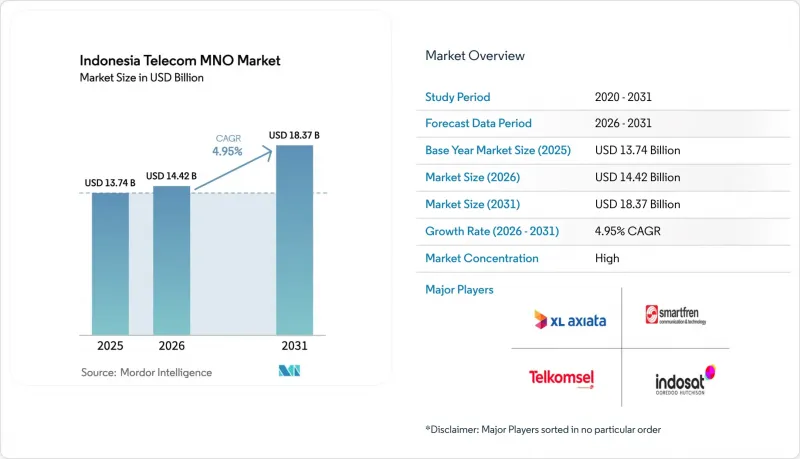
This report is Segmented by Services (Voice Services, Data and Messaging Services, and OTT and Pay TV Services). The Market Forecasts are Provided in Terms of Value (USD) and Volume (Subscribers).
Indonesia Telecom MNO Market Trends and Insights
Explosive mobile data consumption fueled by video and gaming apps
Telkom Indonesia recorded 127.1 million mobile broadband users in 2023 with data traffic of 17.9 million TB, confirming that video-centric habits now anchor revenue decisions. Disney+ Hotstar captured 70% of paid streaming subscriptions, while Netflix held 46%, pushing average smartphone users to consume high-definition content on 4G and emerging 5G networks. XL Axiata logged 19% traffic spikes during peak holidays, with East Lombok surging 34% and Malioboro tourism zones up 115%. Operators now prioritize capacity upgrades to avoid congestion and to support gaming applications that demand latency below 40 ms. The Indonesia telecom MNO market sees sustained data monetization as premium bundles pair generous quotas with low-latency assurance, creating upsell potential even in a price-sensitive prepaid base.
Nationwide 4G and 5G rollout reaching outer islands
Telkomsel already covers 97% of the population through 247,472 base stations, and its 5G speeds reach 64.3 Mbps, almost four times faster than 4G. The government mandates commercial 5G presence in 29 cities by 2025, supported by the Palapa Ring fiber backbone that reduces backhaul bottlenecks. Expanded mid-band spectrum will enable operators to deliver enterprise-grade service for smart ports, mining automation, and logistics corridors in Sulawesi and Kalimantan. With private LTE and 5G networks forecast to reach USD 7.4 billion globally by 2027, Indonesian carriers target dedicated slices for factories and oil rigs where wired links remain impractical. Improved network quality translates into stronger customer experience scores, reinforcing willingness to pay for elevated tiers.
Persistent price competition suppressing ARPU
Indonesian prepaid users still focus on affordability, keeping blended ARPU well below the Asia-Pacific average of USD 10.5 despite heavier data usage. Tariff wars in 2023 shaved effective yields even as traffic grew, compelling Smartfren to hike data prices by 10% to restore margins, a move only partly matched by rivals. The pending XL Axiata-Smartfren merger should raise market discipline, promising USD 300-400 million in annual cost savings that offset revenue pressure. Nevertheless, over-the-top players such as WhatsApp, which cut business messaging fees by up to 97%, continue to erode legacy voice and SMS income. Sustained promotional intensity will keep the Indonesia telecom MNO market chasing volume over price increases in the near term.
Other drivers and restraints analyzed in the detailed report include:
- Fixed-mobile convergence bundles lifting household ARPU
- Government-led Palapa Ring and Nusantara fiber backbone projects
- Fragmented spectrum and high reserve prices
For complete list of drivers and restraints, kindly check the Table Of Contents.
Segment Analysis
Data and Internet Services accounted for 53.92% of Indonesia telecom MNO market revenue in 2025, underscoring a structural pivot from legacy voice lines. Voice still holds 20.62% with a 5.11% CAGR through VoLTE adoption, proving carrier-grade call quality has residual appeal even under OTT pressure. IoT and M2M claim 5.75% share, and operators expect triple-digit device growth by 2028 as automotive, banking, and utilities fleets connect to XL Axiata's IoT Connectivity+ platform. OTT and PayTV services sit at 5.43%, with Disney+ Hotstar's 70% slice highlighting direct streaming traction. The remainder 14.28% comes from wholesale, roaming, and varied digital services that ride a cloud market expanding at 25% CAGR to USD 0.8 billion in 2023.
Investment priorities favor packet-core upgrades and edge computing nodes that keep latency below 20 ms for mobile gaming and industrial automation. Private LTE pilots in ports and mining sites help validate returns ahead of broad 5G monetization. Revenue diversification flows from cybersecurity bundles and data-center colocation designed for enterprises complying with Indonesia's data-sovereignty law. With fixed-mobile convergence gaining momentum, operators bundle fiber with unlimited mobile data and streaming content, reinforcing household stickiness and reducing churn within the Indonesia telecom MNO market.
Complete Report Scope:
- Overall Telecom Revenue and ARPU
- Service Type
- Voice Services
- Data and Internet Services
- Messaging Services
- IoT and M2M Services
- OTT and PayTV Services
- Other Services (VAS, Roaming And International Services, Enterprise And Wholesale Services, etc.)
- End-user
- Enterprises
- Consumer
List of Companies Covered in this Report:
- Telkomsel
- Indosat Ooredoo Hutchison
- XL Axiata
- Smartfren
Additional Benefits:
- The market estimate (ME) sheet in Excel format
- 3 months of analyst support
TABLE OF CONTENTS
1 INTRODUCTION
- 1.1 Study Assumptions and Market Definition
- 1.2 Scope of the Study
2 RESEARCH METHODOLOGY
3 EXECUTIVE SUMMARY
4 Market Landscape
- 4.1 Market Overview
- 4.2 Regulatory And Policy Framework
- 4.3 Spectrum Landscape And Competitive Holdings
- 4.4 Telecom Industry Ecosystem
- 4.5 Macroeconomic And External Drivers
- 4.6 Porter's Five Forces
- 4.6.1 Competitive Rivalry
- 4.6.2 Threat of New Entrants
- 4.6.3 Bargaining Power of Suppliers
- 4.6.4 Bargaining Power of Buyers
- 4.6.5 Threat of Substitutes
- 4.7 Key MNO KPIs (2020-2025)
- 4.7.1 Unique Mobile Subscribers And Penetration Rate
- 4.7.2 Mobile Internet Users And Penetration Rate
- 4.7.3 SIM Connections by Access Technology And Penetration
- 4.7.4 Cellular IoT / M2M Connections
- 4.7.5 Broadband Connections (Mobile And Fixed)
- 4.7.6 ARPU (Average Revenue Per User)
- 4.7.7 Average Data Usage per Subscription (GB/month)
- 4.8 Market Drivers
- 4.8.1 Explosive mobile data consumption fuelled by video And gaming apps
- 4.8.2 Nationwide 4G/5G rollout reaching outer islands
- 4.8.3 Fixed-mobile convergence bundles lifting household ARPU
- 4.8.4 Government-led Palapa Ring And Nusantara fiber backbone projects
- 4.8.5 Hyperscale data-centre interconnect demand under Indonesia PDP law
- 4.8.6 LEO-satellite backhaul enabling remote-area enterprise IoT
- 4.9 Market Restraints
- 4.9.1 Persistent price competition suppressing ARPU
- 4.9.2 Fragmented spectrum And high reserve prices
- 4.9.3 Right-of-way permit delays slowing fiber rollout
- 4.9.4 Shortage of 5G RF planning talent outside Java
- 4.10 Technological Outlook
- 4.11 Analysis of key business models in Telecom
- 4.12 Analysis of Pricing Models and Pricing
5 MARKET SIZE AND GROWTH FORECASTS (VALUE)
- 5.1 Overall Telecom Revenue and ARPU
- 5.2 Service Type
- 5.2.1 Voice Services
- 5.2.2 Data and Internet Services
- 5.2.3 Messaging Services
- 5.2.4 IoT and M2M Services
- 5.2.5 OTT and PayTV Services
- 5.2.6 Other Services (VAS, Roaming And International Services, Enterprise And Wholesale Services, etc.)
- 5.3 End-user
- 5.3.1 Enterprises
- 5.3.2 Consumer
6 COMPETITIVE LANDSCAPE
- 6.1 Market Concentration
- 6.2 Strategic Moves and Investments by key vendors, 2023-2025
- 6.3 Market share analysis for MNOs, 2024
- 6.4 MNO snapshot (subscribers, churn rate, ARPU, etc.)
- 6.5 Company Profiles* of MNOs (Includes Business Overview | Service Portfolio | Financials | Business Strategy and Recent Developments | SWOT Analysis)
- 6.5.1 Telkomsel
- 6.5.2 Indosat Ooredoo Hutchison
- 6.5.3 XL Axiata
- 6.5.4 Smartfren
7 MARKET OPPORTUNITIES AND FUTURE OUTLOOK
- 7.1 White-space And Unmet-Need Assessment

