PUBLISHER: Mordor Intelligence | PRODUCT CODE: 2097263

PUBLISHER: Mordor Intelligence | PRODUCT CODE: 2097263
White Sugar - Market Share Analysis, Industry Trends & Statistics, Growth Forecasts (2026 - 2031)
According to Mordor Intelligence, the global white sugar market size is expected to grow from USD 68.56 billion in 2025 to USD 72.62 billion in 2026 and is forecast to reach USD 97.73 billion by 2031, at a 6.12% CAGR over 2026-2031.
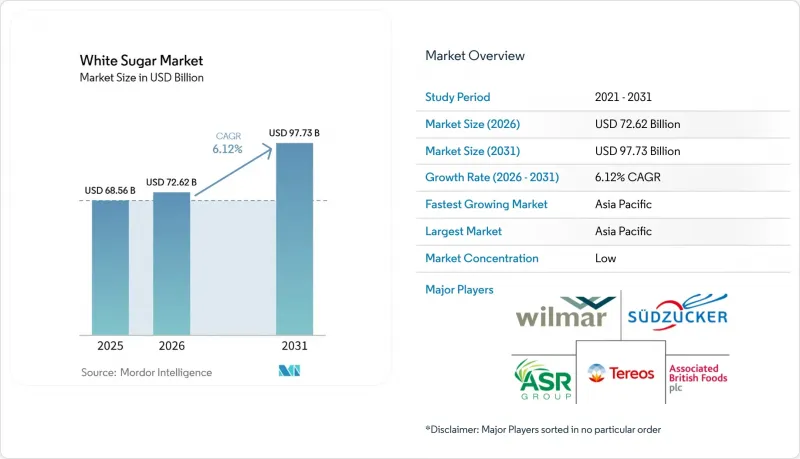
This report is Segmented by Source (Cane Sugar and Beet Sugar), by Form (Granulated, Powdered, and Liquid White Sugar), by End-User Industry (Processed Food and Beverage Industry, Industrial Uses (Non-Food Applications), Household/Retail, and Foodservice), and by Geography (North America, South America, Europe, Asia-Pacific, and Middle East and Africa). The Market Forecasts are Provided in Terms of Value (USD).
Global White Sugar Market Trends and Insights
Rising demand from processed food and beverage manufacturing
White sugar demand is primarily supported by its critical role in processed food and beverage manufacturing. Long-term supply contracts and stringent quality specifications make it a key input for industrial buyers. Growth in packaged categories, including biscuits, dairy, confectionery, and flavored beverages, continues to drive stable procurement volumes, with limited impact from evolving consumer health preferences. According to the International Food Information Council, snacking behavior in the United States supports this trend, with 30% of consumers snacking at least once daily, 28% snacking twice daily, and 12% snacking three or more times daily. These consumption patterns maintain steady demand for sugar as a formulation ingredient. Major refiners identify beverage producers, bakers, and confectionery manufacturers as their most reliable customers, underscoring the strength of this demand base. In addition, the widening premium between commodity-grade and food-grade sugar during periods of supply tightness encourages refiners to expand high-purity output capacity, reinforcing white sugar's position as a strategic input across global food and beverage value chains.
Strong demand from foodservice and quick-service restaurant expansion
Growth in foodservice demand and quick-service restaurant (QSR) expansion is becoming a key driver of the global white sugar market, as organized foodservice channels account for a larger share of consumption. Compared with retail channels, QSR procurement models typically include sugar in multi-category contracts with approved suppliers, supporting volume visibility and pricing stability. The National Restaurant Association's 2026 outlook is expected to indicate resilient dining demand despite margin pressures, reinforcing sugar's role in foodservice growth. In Asia, QSR chains are expanding rapidly into secondary and tertiary cities, creating broad-based demand that remains largely independent of health-driven consumption trends in developed markets due to slower recipe reformulation and strict product standards. This trend makes foodservice-linked sugar volumes less price-sensitive than retail demand, giving refiners and traders a more dependable procurement base and strengthening sugar's position as a core ingredient across global foodservice value chains.
Growing consumer shift toward reduced-sugar and sugar-free products
Changing consumption patterns are creating a key restraint for the global white sugar market, as consumers increasingly shift toward reduced-sugar and sugar-free products, gradually weakening retail demand even as industrial procurement remains resilient. This trend is most evident in high-income markets, where health-conscious consumers increasingly prefer zero-calorie sweeteners and reformulated products. At the same time, evolving labeling regulations are prompting packaged goods manufacturers to adapt their product portfolios in advance of changing consumer preferences. In Latin America, mandatory front-of-pack labeling frameworks are accelerating product reformulation. In Europe, refiners are reporting higher demand for specialty sugars and substitutes, along with declining per capita consumption of conventional white sugar. As a result, growth opportunities are narrowing in retail-facing channels, increasing the market's reliance on industrial and foodservice demand as more stable volume drivers. For market participants, this shift highlights the need to optimize the customer mix and secure long-term supply agreements with industrial buyers to offset structural headwinds in consumer-facing segments.
Other drivers and restraints analyzed in the detailed report include:
- Growing consumption of sugar-sweetened beverages
- Technological advancement in sugar processing
- Increasing sugar taxes and regulatory measures on sweetened foods and beverages
For complete list of drivers and restraints, kindly check the Table Of Contents.
Segment Analysis
By source, cane sugar remained the leading category in the global white sugar market, accounting for 74.47% of the total share in 2025. Favorable tropical growing conditions supported its market position, while cane processors benefit from the operational flexibility to allocate output across raw sugar, refined white sugar, and ethanol based on prevailing market conditions. Brazil, India, and Thailand are expanding their white sugar export capacity. Brazil's rising share of refined exports indicates a strategic shift toward higher-value products. This established market position is expected to keep cane sugar central to global supply, supported by its cost efficiency and ability to optimize production portfolios in response to changing demand.
Beet sugar is projected to be the fastest-growing category, registering a CAGR of 7.12% through 2031. New investments in Egypt, Turkiye, the United States, and China are supporting expansion, as these countries increase cultivation to meet rising domestic demand. Structural challenges in Europe, including land-use competition, regulatory restrictions on plant-protection products, and margin pressure, are limiting recovery and widening the cost gap with cane-origin producers. Despite these headwinds, expansion in emerging markets is expected to sustain beet sugar's growth trajectory, positioning it as the strongest growth contributor during the forecast period.
Complete Report Scope:
- By Source
- Cane Sugar
- Beet Sugar
- By Form
- Granulated
- Powdered
- Liquid
- By End-User Industry
- Processed Food and Beverage Industry
- Industrial Uses (Non-food applications)
- Household/Retail
- Foodservice
- By Geography
- North America
- United States
- Canada
- Mexico
- Rest of North America
- Europe
- Germany
- United Kingdom
- Italy
- France
- Spain
- Netherlands
- Poland
- Belgium
- Sweden
- Rest of Europe
- Asia-Pacific
- China
- India
- Japan
- Australia
- Indonesia
- South Korea
- Thailand
- Singapore
- Rest of Asia-Pacific
- South America
- Brazil
- Argentina
- Columbia
- Chile
- Peru
- Rest of South America
- Middle East and Africa
- South Africa
- Saudi Arabia
- United Arab Emirates
- Nigeria
- Egypt
- Morocco
- Turkey
- Rest of Middle East and Africa
- North America
Geography Analysis
Asia-Pacific was the largest regional category in the global white sugar market, holding a 38.67% share in 2025 and expected to register a CAGR of 7.89% through 2031. India and China support the region's leadership, with industrial buyers driving demand and dual-origin production structures improving supply resilience. Indonesia's increasing reliance on imports highlights the gap between domestic supply and growth in food processing. Overall, demographic momentum, industrial expansion, and infrastructure development position Asia-Pacific as the structural center of global demand.
North America is expected to be the fastest-growing region, registering a compound annual growth rate of 7.92% through 2031, supported by structurally supply-constrained market dynamics. Industrial food and beverage demand continues to exceed domestic production, creating a sustained import requirement that supports predictable procurement for large buyers. Declining beet sugar output has increased reliance on imports, while major capital investments, such as American Sugar Refining Group's new refinery in Louisiana, indicate confidence in long-term demand. In contrast, Europe faces structural challenges. Consecutive high-yield beet campaigns have created surplus stocks, reducing prices and prompting capacity rationalization. French cooperative Tereos has projected a 9% decline in sugar beet planting for the 2025 season, further tightening continental output and increasing pressure on European refiners.
South America and the Middle East and Africa add further complexity to the global landscape. Brazil, the critical swing supplier, is shifting toward higher-value refined exports, strengthening its role as a global price-setter. In Africa, Nigeria's refinery expansion highlights the focus on import substitution, while South Africa's industry restructuring reflects a shift toward diversified cane-based value chains. Meanwhile, Gulf Cooperation Council markets are moderating beverage-channel demand through tiered excise frameworks. Together, these regions show how trade flows, regulatory changes, and industrial diversification are reshaping the balance of global white sugar supply and demand.
- ASR (American Sugar Refining, Inc. )
- Sudzucker AG
- Tereos Group
- Wilmar International Ltd.
- Associated British Foods plc
- Nordzucker Holding AG
- Zilor Energia e Alimentos
- Mitr Phol Group
- Louis Dreyfus Company
- Cargill Inc. (Sugar Trading)
- Cristal Union
- Sao Martinho S.A.
- Thai Roong Ruang Sugar Group
- Shree Renuka Sugars Ltd.
- EID-Parry (India) Ltd.
- Buriram Sugar Public Company Limited
- Guangzhou HUATANG Co.,Ltd.
- COFCO Corporation Limited
- Mitsui & Co., Ltd.
- JG Summit Holdings, Inc.
Additional Benefits:
- The market estimate (ME) sheet in Excel format
- 3 months of analyst support
TABLE OF CONTENTS
1 INTRODUCTION
- 1.1 Study Assumptions and Market Definition
- 1.2 Scope of the Study
2 RESEARCH METHODOLOGY
3 EXECUTIVE SUMMARY
4 MARKET LANDSCAPE
- 4.1 Market Overview
- 4.2 Market Drivers
- 4.2.1 Rising Demand from Processed Food and Beverage Manufacturing
- 4.2.2 Strong Demand from Foodservice and Quick-Service Restaurant Expansion
- 4.2.3 Growing consumption of sugar-sweetened beverages
- 4.2.4 Strong demand from pharmaceutical syrups and nutraceutical formulations
- 4.2.5 Technological Advancement in Sugar Processing
- 4.2.6 Rising household consumption of packaged white sugar in emerging economies
- 4.3 Market Restraints
- 4.3.1 Growing Consumer Shift Toward Reduced-Sugar and Sugar-Free Products
- 4.3.2 Increasing Sugar Taxes and Regulatory Measures on Sweetened Foods and Beverages
- 4.3.3 Volatility in Sugarcane and Sugar Beet Production Due to Climate Change
- 4.3.4 Trade Restrictions, Export Controls, and Import Tariffs Disrupting Global Supply
- 4.4 Technological Outlook
- 4.5 Regulatory Outlook
- 4.6 Porter's Five Forces
- 4.6.1 Threat of New Entrants
- 4.6.2 Bargaining Power of Buyers/Consumers
- 4.6.3 Bargaining Power of Suppliers
- 4.6.4 Threat of Substitute Products
- 4.6.5 Intensity of Competitive Rivalry
5 MARKET SIZE AND GROWTH FORECASTS (VALUE AND VOLUME)
- 5.1 By Source
- 5.1.1 Cane Sugar
- 5.1.2 Beet Sugar
- 5.2 By Form
- 5.2.1 Granulated
- 5.2.2 Powdered
- 5.2.3 Liquid
- 5.3 By End-User Industry
- 5.3.1 Processed Food and Beverage Industry
- 5.3.2 Industrial Uses (Non-food applications)
- 5.3.3 Household/Retail
- 5.3.4 Foodservice
- 5.4 By Geography
- 5.4.1 North America
- 5.4.1.1 United States
- 5.4.1.2 Canada
- 5.4.1.3 Mexico
- 5.4.1.4 Rest of North America
- 5.4.2 Europe
- 5.4.2.1 Germany
- 5.4.2.2 United Kingdom
- 5.4.2.3 Italy
- 5.4.2.4 France
- 5.4.2.5 Spain
- 5.4.2.6 Netherlands
- 5.4.2.7 Poland
- 5.4.2.8 Belgium
- 5.4.2.9 Sweden
- 5.4.2.10 Rest of Europe
- 5.4.3 Asia-Pacific
- 5.4.3.1 China
- 5.4.3.2 India
- 5.4.3.3 Japan
- 5.4.3.4 Australia
- 5.4.3.5 Indonesia
- 5.4.3.6 South Korea
- 5.4.3.7 Thailand
- 5.4.3.8 Singapore
- 5.4.3.9 Rest of Asia-Pacific
- 5.4.4 South America
- 5.4.4.1 Brazil
- 5.4.4.2 Argentina
- 5.4.4.3 Columbia
- 5.4.4.4 Chile
- 5.4.4.5 Peru
- 5.4.4.6 Rest of South America
- 5.4.5 Middle East and Africa
- 5.4.5.1 South Africa
- 5.4.5.2 Saudi Arabia
- 5.4.5.3 United Arab Emirates
- 5.4.5.4 Nigeria
- 5.4.5.5 Egypt
- 5.4.5.6 Morocco
- 5.4.5.7 Turkey
- 5.4.5.8 Rest of Middle East and Africa
- 5.4.1 North America
6 COMPETITIVE LANDSCAPE
- 6.1 Market Concentration
- 6.2 Strategic Moves
- 6.3 Market Share Analysis
- 6.4 Company Profiles (includes Global-level Overview, Market-level Overview, Core Segments, Financials (if available), Strategic Information, Market Rank/Share, Products and Services, Recent Developments)
- 6.4.1 ASR (American Sugar Refining, Inc. )
- 6.4.2 Sudzucker AG
- 6.4.3 Tereos Group
- 6.4.4 Wilmar International Ltd.
- 6.4.5 Associated British Foods plc
- 6.4.6 Nordzucker Holding AG
- 6.4.7 Zilor Energia e Alimentos
- 6.4.8 Mitr Phol Group
- 6.4.9 Louis Dreyfus Company
- 6.4.10 Cargill Inc. (Sugar Trading)
- 6.4.11 Cristal Union
- 6.4.12 Sao Martinho S.A.
- 6.4.13 Thai Roong Ruang Sugar Group
- 6.4.14 Shree Renuka Sugars Ltd.
- 6.4.15 EID-Parry (India) Ltd.
- 6.4.16 Buriram Sugar Public Company Limited
- 6.4.17 Guangzhou HUATANG Co.,Ltd.
- 6.4.18 COFCO Corporation Limited
- 6.4.19 Mitsui & Co., Ltd.
- 6.4.20 JG Summit Holdings, Inc.
7 MARKET OPPORTUNITIES AND FUTURE OUTLOOK

