PUBLISHER: Mordor Intelligence | PRODUCT CODE: 2097284

PUBLISHER: Mordor Intelligence | PRODUCT CODE: 2097284
Productivity Apps - Market Share Analysis, Industry Trends & Statistics, Growth Forecasts (2025 - 2030)
According to Mordor Intelligence, the productivity apps market size stands at USD 11.96 billion in 2025 and is forecast to reach USD 18.09 billion by 2030, translating into an 8.63% CAGR during 2025-2030.
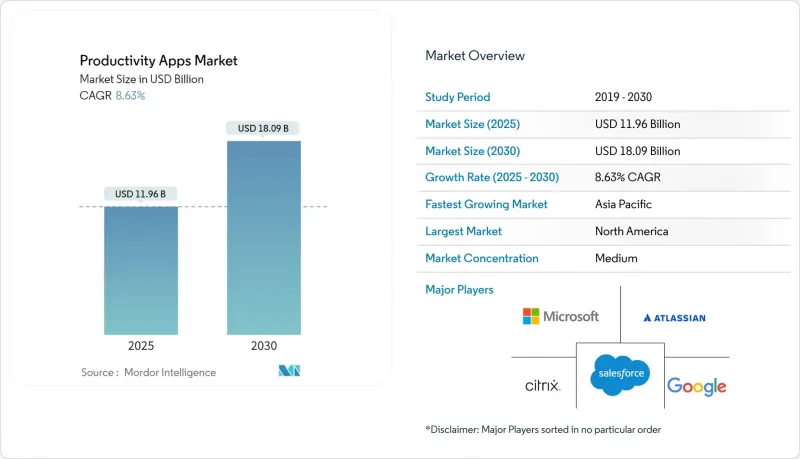
This report is Segmented by Type (Project Management Software, Team Collaboration Software, and More), Platform (Web/Desktop, Mobile, and More), Organization Size (Large Enterprises, and SMEs), End-User Industry (IT and Telecom, BFSI, Healthcare and Life Sciences, and More), and Geography. The Market Forecasts are Provided in Terms of Value (USD).
Global Productivity Apps Market Trends and Insights
Rising Remote and Hybrid Work Models
Cross-border online work volumes have climbed 30% since the pandemic, signalling a long-term step-change in collaboration needs. Executives increasingly accept that distributed work is permanent even while office mandates persist, which sustains procurement of secure cloud suites that bridge physical and virtual workspaces. Technology roadmaps now include asynchronous messaging, shared canvases and workflow engines that remove time-zone friction. Demand is particularly pronounced across India and other emerging talent hubs that rely on global freelancing to remain competitive. Enterprises therefore continue to rebuild digital workplaces around integration-first architectures that can orchestrate conversations, files and analytics.
Integration of AI and Automation for Workflow Efficiency
More than 20% of workplace applications are expected to embed AI-driven personalisation by 2028, putting predictive task automation at the heart of software selection. Enterprise spending on ChatGPT licences ballooned 600% year-on-year, confirming that mainstream buyers now test generative AI beyond pilots. Manufacturers illustrate the payoff, where early rollout pain gives way to a productivity J-curve that later accelerates throughput and uptime. Yahoo Japan's decision to mandate generative AI for all 11,000 employees underscores how large organisations convert pilot learnings into full-scale operating models. Policy researchers also observe positive labour-productivity effects provided firms invest simultaneously in upskilling and secure data pipelines.
Data Security and Privacy Concerns in Cloud Apps
The share of security incidents linked to AI tools jumped to 40% in 2025 from 27% in 2023, underscoring how fast innovation outpaces governance. Firms must layer zero-trust principles and content-filtering over every productivity workflow because sensitive data now travels through text generation, summarisation and searchable transcript modules. For regulated industries, contractual addenda such as HIPAA Business Associate Agreements become mandatory before AI features can go live. Over-permissioned access and hallucinated content heighten risk, forcing additional review cycles that slow roll-outs. Consequently, buyers increasingly favour vendors that publish transparent security roadmaps and third-party audit attestations.
Other drivers and restraints analyzed in the detailed report include:
- No-code/Low-code Extensibility Marketplaces
- Proliferation of Cloud Computing and SaaS Delivery
- Digital Burnout Reducing End-User Adoption
For complete list of drivers and restraints, kindly check the Table Of Contents.
Segment Analysis
Project management maintained a 22.5% productivity apps market share in 2024, reflecting its entrenched role in orchestrating complex, cross-functional initiatives. Demand remains buoyant as enterprises scale agile practices and require Gantt, Kanban and risk-tracking features that feed executive dashboards. Nonetheless, automation & integration platforms are setting the growth pace with a 9.2% CAGR to 2030 as organisations pivot from manual task capture to event-driven workflow orchestration. The shift is visible in rising API call volumes and adoption of trigger-based rules that hand off repetitive actions to bots, freeing managers for higher-order planning. Collaboration suites that blend chat, whiteboarding and project timelines also gain traction, eroding the legacy divide between work execution and communication. Note-taking tools evolve toward AI-powered knowledge bases that summarise meeting outcomes and surface reusable snippets, lowering search friction. Digital whiteboards such as Miro - now serving 200,000 customers - exemplify how visual canvases fill the creativity gap left by virtual meetings. Focus-management apps continue to emerge, driven by wellbeing initiatives and policy pressure to mitigate digital overload. Collectively, these dynamics reinforce a dual-track market in which structured project governance coexists with lightweight automation layers that adapt workflows in real time.
Web/desktop deployments still capture 66.5% of productivity apps market value in 2024 because enterprises historically standardised on browser-centric suites that integrate with corporate identity stacks. Yet mobile installations are accelerating at 10.0% CAGR through 2030, buoyed by the fact that employees pick up their phones roughly 150 times per day. Mobility has shifted from mere convenience to necessity as frontline staff and managers alike expect parity of features across devices. Low-code rapid-mobile development fills talent shortages by letting domain specialists assemble micro-apps without Objective-C or Kotlin expertise. Browser extensions and progressive web apps further blur boundaries, letting knowledge workers resume sessions across laptop, tablet and smartphone without losing context. Despite growth, mobile faces challenges such as battery drain from continuous video calls and the need for containerised data models that meet enterprise security standards on personal devices. Vendors that provide adaptive layouts, offline editing and biometric sign-on are best positioned to capture the upswing. Meanwhile, cross-platform SDKs ensure that a single codebase can target multiple form factors, shortening release cycles and reducing fragmentation.
Complete Report Scope:
- By Type
- Project Management Software
- Team Collaboration Software
- Note-Taking and Documentation
- Time Tracking and Scheduling
- Focus and Distraction Management Tools
- Automation and Integration Platforms
- Digital Whiteboarding
- Other Types
- By Platform
- Web / Desktop
- Mobile (iOS and Android)
- Cross-platform / Browser Extensions
- By Organization Size
- Large Enterprises
- Small and Medium Enterprises (SMEs)
- By End-User Industry
- IT and Telecom
- BFSI
- Healthcare and Life Sciences
- Education
- Manufacturing
- Retail and E-commerce
- Media and Entertainment
- Government and Public Sector
- Other End-User Industries
- By Geography
- North America
- United States
- Canada
- Mexico
- Europe
- Germany
- United Kingdom
- France
- Italy
- Spain
- Rest of Europe
- Asia-Pacific
- China
- Japan
- India
- South Korea
- Australia
- Rest of Asia-Pacific
- South America
- Brazil
- Argentina
- Rest of South America
- Middle East and Africa
- Saudi Arabia
- United Arab Emirates
- South Africa
- Egypt
- Rest of Middle East and Africa
- North America
Geography Analysis
North America preserved 38.1% of global spending in 2024 because of mature cloud infrastructure, continuous innovation funding and high per-capita licence counts. United States multinationals lead adoption of AI copilots and low-code automation, using them to rationalise sprawling application portfolios. Canada follows through federal programmes that subsidise SME digitisation, while Mexico benefits from near-shoring trends that require cross-border project orchestration. Growth moderates slightly as large enterprises approach saturation in core communication modules and turn their focus to integration quality and security posture. Regulatory scrutiny of AI content generation also drives cautious rollout of generative features, particularly in healthcare and public-sector accounts.
Asia-Pacific registers the fastest expansion at 9.6% CAGR for 2025-2030, fuelled by demographic scale, rapid smartphone penetration and aggressive government digital agendas. India and Indonesia illustrate how cloud collaboration empowers exporters of IT services and back-office process outsourcing. Chinese manufacturers integrate productivity dashboards with MES and ERP to accelerate smart-factory goals, while Japan's service companies formalise generative-AI playbooks like Yahoo Japan's all-employee mandate. The result is a layered market where home-grown SaaS providers co-exist with global entrants, each tailoring offerings to local language, compliance and payment preferences. Investors inject capital into vertical-specialist start-ups, further broadening software choice for enterprise buyers.
Europe contributes a sizeable opportunity base yet realises a slower trajectory because only 15% of digital-transformation projects have fully implemented target capabilities. Enterprises expect a 38% productivity lift once rollouts mature but cite skills shortages and fragmented regulatory regimes as chief obstacles. The bloc nevertheless reports 100 million additional digital consumers since 2019, signalling downstream demand. Nordic and Benelux countries outperform on uptake of AI-driven automation, whereas Southern Europe lags due to smaller average company size and constrained IT budgets. Beyond the core regions, South America and the Middle East & Africa constitute emerging frontiers where improved fibre connectivity and cloud data-centre launches gradually lower adoption barriers, creating long-run tailwinds for vendors able to localise pricing and support.
- Microsoft Corporation
- Google LLC
- Atlassian Corporation PLC
- Salesforce Inc. (Slack)
- Zoom Video Communications Inc.
- Asana Inc.
- Monday.com Ltd.
- Smartsheet Inc.
- Trello, Inc.
- Notion Labs Inc.
- Evernote Corporation
- Doist Ltd. (Todoist)
- Mango Technologies, Inc. (ClickUp)
- Zoho Corporation
- Basecamp LLC
- Dropbox Inc.
- Formagrid, Inc. (Airtable)
- TeamViewer AG
- Citrix Systems Inc. (GoTo)
- ProofHub LLC
Additional Benefits:
- The market estimate (ME) sheet in Excel format
- 3 months of analyst support
TABLE OF CONTENTS
1 INTRODUCTION
- 1.1 Study Assumptions and Market Definition
- 1.2 Scope of the Study
2 RESEARCH METHODOLOGY
3 EXECUTIVE SUMMARY
4 MARKET LANDSCAPE
- 4.1 Market Overview
- 4.2 Market Drivers
- 4.2.1 Rising remote and hybrid work models
- 4.2.2 Proliferation of cloud computing and SaaS delivery
- 4.2.3 Integration of AI and automation for workflow efficiency
- 4.2.4 Demand for cross-platform collaboration suites
- 4.2.5 No-code/low-code extensibility marketplaces
- 4.2.6 Digital well-being metrics boosting focus-oriented apps
- 4.3 Market Restraints
- 4.3.1 Data security and privacy concerns in cloud apps
- 4.3.2 Subscription fatigue and cost sensitivity among SMEs
- 4.3.3 API rate-limit and interoperability challenges
- 4.3.4 Digital burnout reducing end-user adoption
- 4.4 Industry Value Chain Analysis
- 4.5 Technological Outlook
- 4.6 Porter's Five Forces Analysis
- 4.6.1 Threat of New Entrants
- 4.6.2 Bargaining Power of Suppliers
- 4.6.3 Bargaining Power of Buyers
- 4.6.4 Threat of Substitutes
- 4.6.5 Competitive Rivalry
5 MARKET SIZE AND GROWTH FORECASTS (VALUE)
- 5.1 By Type
- 5.1.1 Project Management Software
- 5.1.2 Team Collaboration Software
- 5.1.3 Note-Taking and Documentation
- 5.1.4 Time Tracking and Scheduling
- 5.1.5 Focus and Distraction Management Tools
- 5.1.6 Automation and Integration Platforms
- 5.1.7 Digital Whiteboarding
- 5.1.8 Other Types
- 5.2 By Platform
- 5.2.1 Web / Desktop
- 5.2.2 Mobile (iOS and Android)
- 5.2.3 Cross-platform / Browser Extensions
- 5.3 By Organization Size
- 5.3.1 Large Enterprises
- 5.3.2 Small and Medium Enterprises (SMEs)
- 5.4 By End-User Industry
- 5.4.1 IT and Telecom
- 5.4.2 BFSI
- 5.4.3 Healthcare and Life Sciences
- 5.4.4 Education
- 5.4.5 Manufacturing
- 5.4.6 Retail and E-commerce
- 5.4.7 Media and Entertainment
- 5.4.8 Government and Public Sector
- 5.4.9 Other End-User Industries
- 5.5 By Geography
- 5.5.1 North America
- 5.5.1.1 United States
- 5.5.1.2 Canada
- 5.5.1.3 Mexico
- 5.5.2 Europe
- 5.5.2.1 Germany
- 5.5.2.2 United Kingdom
- 5.5.2.3 France
- 5.5.2.4 Italy
- 5.5.2.5 Spain
- 5.5.2.6 Rest of Europe
- 5.5.3 Asia-Pacific
- 5.5.3.1 China
- 5.5.3.2 Japan
- 5.5.3.3 India
- 5.5.3.4 South Korea
- 5.5.3.5 Australia
- 5.5.3.6 Rest of Asia-Pacific
- 5.5.4 South America
- 5.5.4.1 Brazil
- 5.5.4.2 Argentina
- 5.5.4.3 Rest of South America
- 5.5.5 Middle East and Africa
- 5.5.5.1 Saudi Arabia
- 5.5.5.2 United Arab Emirates
- 5.5.5.3 South Africa
- 5.5.5.4 Egypt
- 5.5.5.5 Rest of Middle East and Africa
- 5.5.1 North America
6 COMPETITIVE LANDSCAPE
- 6.1 Market Concentration
- 6.2 Strategic Moves
- 6.3 Market Share Analysis
- 6.4 Company Profiles (includes Global level Overview, Market level overview, Core Segments, Financials as available, Strategic Information, Market Rank/Share for key companies, Products and Services, and Recent Developments)
- 6.4.1 Microsoft Corporation
- 6.4.2 Google LLC
- 6.4.3 Atlassian Corporation PLC
- 6.4.4 Salesforce Inc. (Slack)
- 6.4.5 Zoom Video Communications Inc.
- 6.4.6 Asana Inc.
- 6.4.7 Monday.com Ltd.
- 6.4.8 Smartsheet Inc.
- 6.4.9 Trello, Inc.
- 6.4.10 Notion Labs Inc.
- 6.4.11 Evernote Corporation
- 6.4.12 Doist Ltd. (Todoist)
- 6.4.13 Mango Technologies, Inc. (ClickUp)
- 6.4.14 Zoho Corporation
- 6.4.15 Basecamp LLC
- 6.4.16 Dropbox Inc.
- 6.4.17 Formagrid, Inc. (Airtable)
- 6.4.18 TeamViewer AG
- 6.4.19 Citrix Systems Inc. (GoTo)
- 6.4.20 ProofHub LLC
7 MARKET OPPORTUNITIES AND FUTURE OUTLOOK
- 7.1 White Space and Unmet Need Assessment

