PUBLISHER: Mordor Intelligence | PRODUCT CODE: 2122999

PUBLISHER: Mordor Intelligence | PRODUCT CODE: 2122999
Business Productivity Software - Market Share Analysis, Industry Trends & Statistics, Growth Forecasts (2026 - 2031)
According to Mordor Intelligence, the business productivity software market size stood at USD 110.36 billion in 2026 and is projected to reach USD 195.56 billion by 2031, reflecting a 12.12% CAGR over the forecast period.
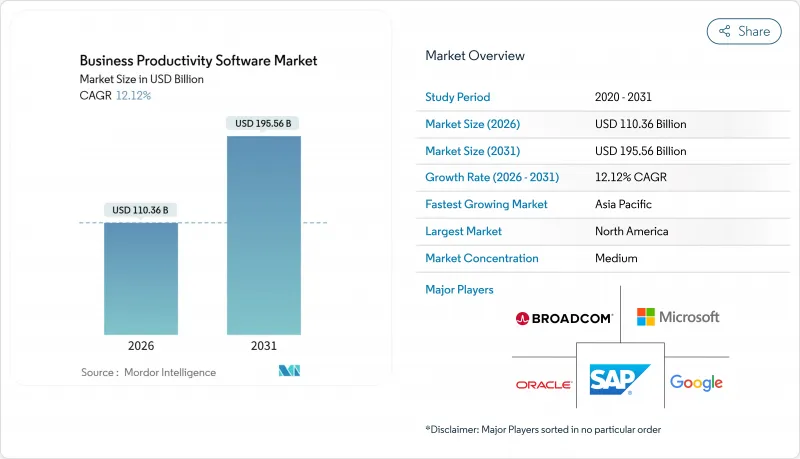
This report is Segmented by Deployment (On-Premise, and Cloud), Organisation Size (Large Enterprises, and Small and Medium Enterprises), End-User Industry (BFSI, Telecommunications and IT, and More), Solution Type (Content Collaboration and Document Management, Communication and Unified Communications, and More), and Geography. The Market Forecasts are Provided in Terms of Value (USD).
Global Business Productivity Software Market Trends and Insights
Cloud-First SaaS Adoption Across Line-of-Business Apps
Organizations continue to retire on-premises infrastructure in favor of SaaS solutions that deliver continuous feature updates, elastic capacity, and integrated security. Microsoft disclosed USD 136 billion in commercial cloud revenue in 2024, underscoring the scale of enterprises' workload shifts. Financial institutions see SaaS as a pathway to meet digital operational resilience obligations without overhauling internal data center controls. Standardized cloud security frameworks such as ISO/IEC 27017 shorten vendor due diligence cycles, further accelerating procurement. As hyperscalers bundle compute-intensive AI services into subscription tiers, the total cost of ownership gap relative to on-premises deployments widens. Migration patterns increasingly favor lift-and-shift for collaboration workloads first, followed by phased retirement of legacy content management systems once data-classification hurdles are cleared.
Proliferation of Gen-AI Copilots Embedded in Productivity Suites
Generative-AI assistants have moved from pilot projects to core interfaces that streamline everyday tasks. Microsoft 365 Copilot reached general availability in late 2023, offering context-aware drafting, summarization, and analysis across Outlook, Teams, and Word. Google answered with Gemini for Workspace in early 2024, embedding multimodal models into Gmail and Docs. Early adopters report 25-30% time savings on routine correspondence, though usage is highest among knowledge workers in finance and legal professions. The European Union AI Act classifies in-workplace AI as high-risk, driving vendors to incorporate transparency and human-oversight features by design. As competition centers on model quality and latency, hyperscalers are investing in GPU capacity, giving cloud-native suites a performance edge that standalone point solutions struggle to match.
Cyber-Sovereignty Laws Restricting Cross-Border Data Residency
Governments now mandate local storage of citizen data, forcing vendors to replicate infrastructure and fragmenting global architectures. China's personal information protection law bars cross-border transfers without security assessments. Russia requires in-country hosting for personal data, compelling foreign providers to partner with domestic clouds. India's draft digital personal data protection bill is poised to impose similar restrictions. These rules inflate costs, reduce economies of scale, and can delay rollout of new AI features until local compliance reviews finish.
Other drivers and restraints analyzed in the detailed report include:
- Hybrid-Work Tooling Mandates in Global Compliance Standards
- Vertical-Specific Low-Code Work Platforms for Frontline Workers
- Rising SaaS Sprawl Driving Consolidation Fatigue and License Rationalization
For complete list of drivers and restraints, kindly check the Table Of Contents.
Segment Analysis
Cloud-based offerings accounted for 71.31% share of the business productivity software market in 2025, capturing the majority of new spending as enterprises prioritize agility and predictable operating costs. This dominance is expected to extend, with the category projected to log a 13.12% CAGR through 2031. Vendors capitalize by embedding compute-intensive AI copilots that rely on hyperscale GPU infrastructure unavailable in most private data centers. Compliance readiness also favors managed SaaS, as frameworks such as FedRAMP authorize approved clouds for United States federal workloads.
Hybrid models serve as a stepping stone, allowing organizations to keep latency-sensitive or classified workloads on-premises while shifting collaboration suites to the cloud.
Large enterprises represented 52.36% share of the business productivity software market in 2025 revenue, reflecting complex global rollouts and multiyear support contracts. Yet SMEs are forecast to grow at 14.23% through 2031, outpacing their larger counterparts. Usage-based billing aligns costs with actual utilization, enabling smaller firms to scale seats incrementally without heavy upfront licensing outlays. In high-growth regions such as India and Vietnam, many SMEs are adopting productivity suites as their first enterprise IT investment, bypassing legacy servers entirely.
Mid-market organizations face distinct needs, often seeking vertical templates that cut configuration effort. Salesforce Industry Clouds pre-bundle regulatory workflows, shortening deployment from months to weeks. Price-sensitive buyers are also gravitating toward bundled suites from Zoho that integrate CRM, project management, and collaboration at lower per-user rates. As competition intensifies, vendors differentiate through AI-powered automation and embedded analytics rather than pure feature count.
Complete Report Scope:
- By Deployment
- On-Premise
- Cloud
- By Organisation Size
- Large Enterprises
- Small and Medium Enterprises
- By End-User Industry
- BFSI
- Telecommunications and IT
- Manufacturing
- Media, Entertainment and Publishing
- Transportation and Logistics
- Retail and E-commerce
- Healthcare and Life Sciences
- Government and Public Sector
- Other End-User Industries (Education, Utilities)
- By Solution Type
- Content Collaboration and Document Management
- Communication and Unified Communications
- Project, Work and Task Management
- Business Intelligence and Analytics
- Low-Code / No-Code Automation
- Digital Asset and Creative Tools
- Security and Compliance Add-ons
- By Geography
- North America
- United States
- Canada
- Mexico
- Europe
- Germany
- United Kingdom
- France
- Italy
- Spain
- Russia
- Rest of Europe
- Asia Pacific
- China
- Japan
- India
- South Korea
- ASEAN
- Australia and New Zealand
- Rest of Asia Pacific
- South America
- Brazil
- Argentina
- Rest of South America
- Middle East
- Saudi Arabia
- United Arab Emirates
- Turkey
- Rest of Middle East
- Africa
- South Africa
- Nigeria
- Rest of Africa
- North America
Geography Analysis
North America controlled 39.87% of 2025 revenue, underpinned by high software budgets and mature cloud ecosystems in the business productivity software market. Federal zero-trust mandates accelerated the adoption of identity-centric security models, prompting agencies to migrate to suites offering continuous authorization. Canada's public sector standardized on Microsoft 365 GCC High for protected-class data, demonstrating how national regulations reinforce vendor lock-in. Hyperscaler competition keeps pricing competitive, but feature velocity favors incumbents that invest in proprietary AI accelerators.
Europe advances steadily as the digital operational resilience act multiplies cybersecurity and incident-response requirements for financial services. Germany, France, and the United Kingdom deploy certification schemes that streamline public procurement of secure clouds. Russia's localization law fragments the region, opening share for domestic vendors able to host data in-country. Nordic and Eastern European markets adopt SaaS as part of broader digital-sovereignty agendas, often favoring European cloud operators that guarantee local processing.
Asia Pacific is the fastest-growing region at a 14.83% CAGR, propelled by sovereign-cloud initiatives in India, Singapore, and Japan that require national data residency. China enforces strict localization via the personal information protection law, prompting hyperscalers to pair with Alibaba Cloud and Tencent Cloud for joint offerings. Australia and New Zealand maintain robust adoption as regulators update information-security standards to include SaaS controls. Emerging markets in South America, the Middle East, and Africa post double-digit expansion from a small base, although currency volatility and connectivity gaps temper near-term upside.
- Microsoft Corporation
- Google LLC
- Oracle Corporation
- Broadcom Inc. (Symantec)
- SAP SE
- Salesforce Inc.
- IBM Corporation
- VMware Inc.
- Amazon Web Services Inc.
- Atlassian Corporation
- ServiceNow Inc.
- Adobe Inc.
- Monday.com Ltd.
- Asana Inc.
- Zoho Corporation
- Citrix Systems Inc.
- Dropbox Inc.
- Smartsheet Inc.
- Slack Technologies LLC
- AppScale Systems Inc.
Additional Benefits:
- The market estimate (ME) sheet in Excel format
- 3 months of analyst support
TABLE OF CONTENTS
1 INTRODUCTION
- 1.1 Study Assumptions and Market Definition
- 1.2 Scope of the Study
2 RESEARCH METHODOLOGY
3 EXECUTIVE SUMMARY
4 MARKET LANDSCAPE
- 4.1 Market Overview
- 4.2 Market Drivers
- 4.2.1 Cloud-First Saas Adoption Across Line-Of-Business Apps
- 4.2.2 Proliferation Of Gen-Ai Copilots Embedded In Productivity Suites
- 4.2.3 Hybrid-Work Tooling Mandates In Global Compliance Standards
- 4.2.4 Vertical-Specific Low-Code Work Platforms For Frontline Workers
- 4.2.5 Ecosystem Shift To Usage-Based Pricing Unlocking Smb Upgrade Cycles
- 4.2.6 Zero-Friction Api-First Extensibility Ecosystems For Cross-Suite Workflows
- 4.3 Market Restraints
- 4.3.1 Cyber-Sovereignty Laws Restricting Cross-Border Data Residency
- 4.3.2 Rising Saas Sprawl Driving Consolidation Fatigue And Licence Rationalisation
- 4.3.3 Scarcity Of Integration Talent Delaying Complex Workflow Roll-Outs
- 4.3.4 Generative-Ai Model Opacity Triggering Enterprise Risk-Control Freezes
- 4.4 Industry Value Chain Analysis
- 4.5 Technological Outlook
- 4.6 Porter's Five Forces Analysis
- 4.6.1 Bargaining Power of Suppliers
- 4.6.2 Bargaining Power of Buyers
- 4.6.3 Threat of New Entrants
- 4.6.4 Threat of Substitutes
- 4.6.5 Intensity of Competitive Rivalry
- 4.7 Impact of Macroeconomic Factors on the Market
5 MARKET SIZE AND GROWTH FORECASTS (VALUE)
- 5.1 By Deployment
- 5.1.1 On-Premise
- 5.1.2 Cloud
- 5.2 By Organisation Size
- 5.2.1 Large Enterprises
- 5.2.2 Small and Medium Enterprises
- 5.3 By End-User Industry
- 5.3.1 BFSI
- 5.3.2 Telecommunications and IT
- 5.3.3 Manufacturing
- 5.3.4 Media, Entertainment and Publishing
- 5.3.5 Transportation and Logistics
- 5.3.6 Retail and E-commerce
- 5.3.7 Healthcare and Life Sciences
- 5.3.8 Government and Public Sector
- 5.3.9 Other End-User Industries (Education, Utilities)
- 5.4 By Solution Type
- 5.4.1 Content Collaboration and Document Management
- 5.4.2 Communication and Unified Communications
- 5.4.3 Project, Work and Task Management
- 5.4.4 Business Intelligence and Analytics
- 5.4.5 Low-Code / No-Code Automation
- 5.4.6 Digital Asset and Creative Tools
- 5.4.7 Security and Compliance Add-ons
- 5.5 By Geography
- 5.5.1 North America
- 5.5.1.1 United States
- 5.5.1.2 Canada
- 5.5.1.3 Mexico
- 5.5.2 Europe
- 5.5.2.1 Germany
- 5.5.2.2 United Kingdom
- 5.5.2.3 France
- 5.5.2.4 Italy
- 5.5.2.5 Spain
- 5.5.2.6 Russia
- 5.5.2.7 Rest of Europe
- 5.5.3 Asia Pacific
- 5.5.3.1 China
- 5.5.3.2 Japan
- 5.5.3.3 India
- 5.5.3.4 South Korea
- 5.5.3.5 ASEAN
- 5.5.3.6 Australia and New Zealand
- 5.5.3.7 Rest of Asia Pacific
- 5.5.4 South America
- 5.5.4.1 Brazil
- 5.5.4.2 Argentina
- 5.5.4.3 Rest of South America
- 5.5.5 Middle East
- 5.5.5.1 Saudi Arabia
- 5.5.5.2 United Arab Emirates
- 5.5.5.3 Turkey
- 5.5.5.4 Rest of Middle East
- 5.5.6 Africa
- 5.5.6.1 South Africa
- 5.5.6.2 Nigeria
- 5.5.6.3 Rest of Africa
- 5.5.1 North America
6 COMPETITIVE LANDSCAPE
- 6.1 Market Concentration
- 6.2 Strategic Moves
- 6.3 Market Share Analysis
- 6.4 Company Profiles (includes Global level Overview, Market level overview, Core Segments, Financials as available, Strategic Information, Market Rank/Share for key companies, Products and Services, Recent Developments)
- 6.4.1 Microsoft Corporation
- 6.4.2 Google LLC
- 6.4.3 Oracle Corporation
- 6.4.4 Broadcom Inc. (Symantec)
- 6.4.5 SAP SE
- 6.4.6 Salesforce Inc.
- 6.4.7 IBM Corporation
- 6.4.8 VMware Inc.
- 6.4.9 Amazon Web Services Inc.
- 6.4.10 Atlassian Corporation
- 6.4.11 ServiceNow Inc.
- 6.4.12 Adobe Inc.
- 6.4.13 Monday.com Ltd.
- 6.4.14 Asana Inc.
- 6.4.15 Zoho Corporation
- 6.4.16 Citrix Systems Inc.
- 6.4.17 Dropbox Inc.
- 6.4.18 Smartsheet Inc.
- 6.4.19 Slack Technologies LLC
- 6.4.20 AppScale Systems Inc.
7 MARKET OPPORTUNITIES AND FUTURE OUTLOOK
- 7.1 White-space and Unmet-need Assessment

