PUBLISHER: Mordor Intelligence | PRODUCT CODE: 2097310

PUBLISHER: Mordor Intelligence | PRODUCT CODE: 2097310
Big Data Analytics in the Manufacturing Industry - Market Share Analysis, Industry Trends & Statistics, Growth Forecasts (2025 - 2030)
According to Mordor Intelligence, the big data analytics in the manufacturing industry market stood at USD 7.30 billion in 2025 and is forecast to reach USD 14.30 billion by 2030, registering a 14.40% CAGR.
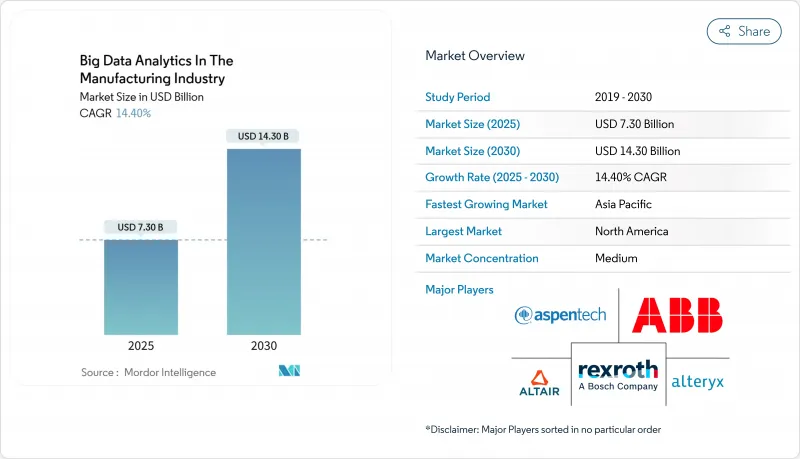
This report is Segmented by Component (Software and Services), Deployment Mode (On-Premise, Cloud, and Edge/Fog), Analytics Type (Descriptive Analytics, and More), Data Type (Structured, and More), Application (Quality Management, and More), End-User Industry (Automotive, Semiconductor and Electronics, and More), and Geography. The Market Forecasts are Provided in Terms of Value (USD).
Insights and Trends of Big Data Analytics Market in the Manufacturing Industry
Evolving Technology-Centric Value Chain
Manufacturers are pivoting from discrete automation islands toward unified, asset-centric data fabrics that stitch engineering, production, and after-sales insights into one continuous loop. Siemens' 2024 launch of the Simatic Automation Workstation lets plants replace fixed hardware PLCs with containerized software logic, unifying IT and operational technology while lowering changeover time. Automotive early adopter Ford demonstrated software-defined assembly cells that swap vehicle variants in minutes instead of hours, reducing tooling inventory and enabling bespoke production runs. Such integration fuels predictive maintenance programs that stretch equipment life and defer large capital outlays. Simultaneously, circular-economy mandates are nudging OEMs to capture lifecycle data for remanufacturing revenue, turning analytics platforms into profit centers rather than cost items.
Rapid Industrial Automation Led by Industry 4.0
Asia-Pacific factories are spearheading full-scale Industry 4.0 rollouts as wage inflation compresses traditional cost advantages. Hyundai's Chennai plant reported a 5% cut in unplanned maintenance hours after fitting AI-ready smart sensors across machining centers. India's national Manufacturing 4.0 roadmap projects productivity gains of 1.4% each year and savings equivalent to 749 billion work-hours once 64% of repetitive tasks are automated. Similar momentum in Vietnam and Thailand underscores a regional shift from labor-arbitrage toward technology-arbitrage, spawning demand for cloud-native analytics suites that orchestrate thousands of cyber-physical assets while satisfying export-market traceability norms.
Lack of Awareness and Cyber-Security Concerns
Manufacturing ranked as the most-attacked vertical in 2024, accounting for 68% of all industrial cyber incidents. Average breach costs touched USD 4.88 million, prompting board-level caution toward cloud or remote connectivity projects. One-third of plant executives cite fear of exposing operational technology (OT) networks as the primary reason for delaying analytics deployments. Vendors respond with zero-trust architectures, encrypted data pockets, and sovereign-cloud instances, yet many small plants still view cybersecurity budgets as discretionary.
Other drivers and restraints analyzed in the detailed report include:
- Growing Proliferation of IIoT-Enabled Edge Analytics
- Rise of Digital Twins Driving Data Granularity
- Shortage of Data-Science Talent with Domain Expertise
For complete list of drivers and restraints, kindly check the Table Of Contents.
Segment Analysis
Software kept its 68.8% revenue lead in 2024, anchored by historians, data-integration hubs, and AI platforms embedded within the big data analytics in the manufacturing industry market. Yet services will grow fastest at 16.2% CAGR as factories seek domain specialists to stitch these tools into legacy MES and SCADA stacks. Consulting engagements now span value-stream mapping, sensor placement, and model governance, reflecting recognition that out-of-the-box software cannot deliver sustainable value alone. Managed services for digital twin upkeep and predictive algorithms are gaining traction under outcome-based pricing, especially among tier-2 suppliers lacking analytics headcount.
A telling indicator is multiyear transformation deals where service revenue exceeds license fees by the third contract year. Systems integrators bundle cybersecurity hardening, edge-node orchestration, and continuous model monitoring, reducing total integration risk. Vendors quick to offer co-innovation labs and joint proof-of-concept funding are capturing wallet share as customers move from single-use pilot projects to plant-wide rollouts.
On-premise deployments retained a 52.6% share in 2024, cementing their role for deterministic control and intellectual-property protection within the big data analytics in the manufacturing industry market. However, cloud-native deployments will rise 16.7% annually on the back of elastic GPU availability for complex model training. Most manufacturers are converging on hybrid topologies: latency-sensitive workloads run on edge servers or local micro-data centers, while long-horizon planning and cross-site benchmarking run in regional clouds. This architecture offers the best of both-local autonomy and global coordination.
Cloud providers, meanwhile, introduce sector-specific regions with compliance templates such as ITAR or GxP, easing regulatory qualms in aerospace and pharmaceuticals. Simultaneously, cloud-delivered low-code AI pipelines shrink model-development cycles, encouraging smaller plants to migrate test-and-learn experiments to off-premise sandboxes before back-hauling distilled inference engines to edge gateways.
Complete Report Scope:
- By Component
- Software
- Data Management and Integration Platforms
- Advanced Analytics Platforms
- Services
- Professional Services
- Managed Services
- Software
- By Deployment Mode
- On-premise
- Cloud
- Edge/Fog
- By Analytics Type
- Descriptive Analytics
- Diagnostic Analytics
- Predictive Analytics
- Prescriptive Analytics
- By Data Type
- Structured
- Unstructured
- Semi-Structured
- By Application
- Quality Management
- Condition Monitoring
- Predictive Maintenance
- Inventory and Supply-chain Optimization
- Energy Management
- Production Planning and Scheduling
- Process Optimization
- By End-user Industry
- Automotive
- Semiconductor and Electronics
- Aerospace and Defense
- Food and Beverage
- Chemicals and Materials
- Pharmaceuticals and Life Sciences
- Heavy Machinery and Equipment
- Other End-user Industries
- By Geography
- North America
- United States
- Canada
- Mexico
- South America
- Brazil
- Argentina
- Chile
- Rest of South America
- Europe
- Germany
- United Kingdom
- France
- Italy
- Spain
- Rest of Europe
- Asia-Pacific
- China
- Japan
- India
- South Korea
- Australia
- Singapore
- Malaysia
- Rest of Asia-Pacific
- Middle East and Africa
- Middle East
- Saudi Arabia
- United Arab Emirates
- Turkey
- Rest of Middle East
- Africa
- South Africa
- Nigeria
- Rest of Africa
- Middle East
- North America
Geography Analysis
North America dominated the big data analytics in the manufacturing industry market with 38.8% revenue share in 2024. U.S. aerospace, chemicals, and heavy-equipment makers continue to pilot edge AI for zero-defect programs, while Canadian miners adopt energy-optimization analytics to offset carbon-pricing schemes. Mexico's export-oriented auto assemblers deploy real-time SPC dashboards to meet OEM just-in-time mandates, cementing the region's high-value manufacturing position.
Asia-Pacific is poised for the quickest expansion, recording a forecast 15.2% CAGR to 2030. India's Manufacturing 4.0 policy offers tax credits on connected machinery, spurring adoption even among tier-3 suppliers. Chinese smart-factory subsidies accelerate 5G and edge rollouts, letting factories run closed-loop quality control off private networks. Japan applies analytics to precision machining, where micron-level deviations jeopardize reputation. Singapore and Malaysia, meanwhile, brand themselves as analytics hubs, hosting regional IIoT sandboxes tied to semiconductor giants.
Europe remains a stronghold courtesy of Germany's Industrie 4.0 leadership and stringent sustainability directives. Bosch earmarked EUR 2.5 billion for AI over three years, channeling funds into plant-wide digital twins that curb scrap and energy usage. UK manufacturers post-Brexit leverage analytics for productivity offsets, whereas Italian luxury-goods workshops employ computer vision for artisanal quality checks. Nordic foundries use real-time emissions dashboards to meet EU carbon border adjustment proposals, showcasing analytics' role in regulatory agility.
- ABB Ltd.
- Alteryx Inc.
- Altair Engineering Inc. (RapidMiner)
- Aspen Technology Inc.
- Bosch Rexroth AG
- Databricks Inc.
- Fujitsu Ltd.
- GE Digital (General Electric Co.)
- Hitachi Vantara LLC
- Honeywell International Inc.
- IBM Corporation
- KNIME AG
- Microsoft Corporation
- Oracle Corporation
- Palantir Technologies Inc.
- PTC Inc.
- QlikTech International AB
- Rockwell Automation Inc.
- SAP SE
- SAS Institute Inc.
- Schneider Electric SE
- Siemens Digital Industries Software
- TIBCO Software Inc. (Cloud Software Group)
- Toshiba Digital Solutions Corporation
Additional Benefits:
- The market estimate (ME) sheet in Excel format
- 3 months of analyst support
TABLE OF CONTENTS
1 INTRODUCTION
- 1.1 Study Assumptions and Market Definition
- 1.2 Scope of the Study
2 RESEARCH METHODOLOGY
3 EXECUTIVE SUMMARY
4 MARKET LANDSCAPE
- 4.1 Market Overview
- 4.2 Market Drivers
- 4.2.1 Evolving Technology, Asset and Engineering-oriented Value Chain
- 4.2.2 Rapid Industrial Automation led by Industry 4.0
- 4.2.3 Growing Proliferation of IIoT-enabled Edge Analytics
- 4.2.4 Rise of Digital Twins Driving Data Granularity
- 4.2.5 Smart-Sensor Adoption Generating High-Frequency Time-Series Data
- 4.2.6 OEM-led Monetization of Production Data-as-a-Service
- 4.3 Market Restraints
- 4.3.1 Lack of Awareness and Cyber-security Concerns
- 4.3.2 Shortage of Data-Science Talent with Domain Expertise
- 4.3.3 Legacy Equipment Producing Non-standardized Data Formats
- 4.3.4 Rising Cloud Egress Costs for Petabyte-scale Machine Data
- 4.4 Value Chain Analysis
- 4.5 Regulatory Landscape
- 4.6 Technological Outlook
- 4.7 Porter's Five Forces Analysis
- 4.7.1 Bargaining Power of Suppliers
- 4.7.2 Bargaining Power of Buyers
- 4.7.3 Threat of New Entrants
- 4.7.4 Threat of Substitutes
- 4.7.5 Intensity of Competitive Rivalry
- 4.8 Impact of Macroeconomic Factors on the Market
5 MARKET SIZE AND GROWTH FORECASTS (VALUES)
- 5.1 By Component
- 5.1.1 Software
- 5.1.1.1 Data Management and Integration Platforms
- 5.1.1.2 Advanced Analytics Platforms
- 5.1.2 Services
- 5.1.2.1 Professional Services
- 5.1.2.2 Managed Services
- 5.1.1 Software
- 5.2 By Deployment Mode
- 5.2.1 On-premise
- 5.2.2 Cloud
- 5.2.3 Edge/Fog
- 5.3 By Analytics Type
- 5.3.1 Descriptive Analytics
- 5.3.2 Diagnostic Analytics
- 5.3.3 Predictive Analytics
- 5.3.4 Prescriptive Analytics
- 5.4 By Data Type
- 5.4.1 Structured
- 5.4.2 Unstructured
- 5.4.3 Semi-Structured
- 5.5 By Application
- 5.5.1 Quality Management
- 5.5.2 Condition Monitoring
- 5.5.3 Predictive Maintenance
- 5.5.4 Inventory and Supply-chain Optimization
- 5.5.5 Energy Management
- 5.5.6 Production Planning and Scheduling
- 5.5.7 Process Optimization
- 5.6 By End-user Industry
- 5.6.1 Automotive
- 5.6.2 Semiconductor and Electronics
- 5.6.3 Aerospace and Defense
- 5.6.4 Food and Beverage
- 5.6.5 Chemicals and Materials
- 5.6.6 Pharmaceuticals and Life Sciences
- 5.6.7 Heavy Machinery and Equipment
- 5.6.8 Other End-user Industries
- 5.7 By Geography
- 5.7.1 North America
- 5.7.1.1 United States
- 5.7.1.2 Canada
- 5.7.1.3 Mexico
- 5.7.2 South America
- 5.7.2.1 Brazil
- 5.7.2.2 Argentina
- 5.7.2.3 Chile
- 5.7.2.4 Rest of South America
- 5.7.3 Europe
- 5.7.3.1 Germany
- 5.7.3.2 United Kingdom
- 5.7.3.3 France
- 5.7.3.4 Italy
- 5.7.3.5 Spain
- 5.7.3.6 Rest of Europe
- 5.7.4 Asia-Pacific
- 5.7.4.1 China
- 5.7.4.2 Japan
- 5.7.4.3 India
- 5.7.4.4 South Korea
- 5.7.4.5 Australia
- 5.7.4.6 Singapore
- 5.7.4.7 Malaysia
- 5.7.4.8 Rest of Asia-Pacific
- 5.7.5 Middle East and Africa
- 5.7.5.1 Middle East
- 5.7.5.1.1 Saudi Arabia
- 5.7.5.1.2 United Arab Emirates
- 5.7.5.1.3 Turkey
- 5.7.5.1.4 Rest of Middle East
- 5.7.5.2 Africa
- 5.7.5.2.1 South Africa
- 5.7.5.2.2 Nigeria
- 5.7.5.2.3 Rest of Africa
- 5.7.5.1 Middle East
- 5.7.1 North America
6 COMPETITIVE LANDSCAPE
- 6.1 Market Concentration
- 6.2 Strategic Moves
- 6.3 Market Share Analysis
- 6.4 Company Profiles (includes Global level Overview, Market level overview, Core Segments, Financials, Strategic Information, Market Rank/Share, Products and Services, Recent Developments)
- 6.4.1 ABB Ltd.
- 6.4.2 Alteryx Inc.
- 6.4.3 Altair Engineering Inc. (RapidMiner)
- 6.4.4 Aspen Technology Inc.
- 6.4.5 Bosch Rexroth AG
- 6.4.6 Databricks Inc.
- 6.4.7 Fujitsu Ltd.
- 6.4.8 GE Digital (General Electric Co.)
- 6.4.9 Hitachi Vantara LLC
- 6.4.10 Honeywell International Inc.
- 6.4.11 IBM Corporation
- 6.4.12 KNIME AG
- 6.4.13 Microsoft Corporation
- 6.4.14 Oracle Corporation
- 6.4.15 Palantir Technologies Inc.
- 6.4.16 PTC Inc.
- 6.4.17 QlikTech International AB
- 6.4.18 Rockwell Automation Inc.
- 6.4.19 SAP SE
- 6.4.20 SAS Institute Inc.
- 6.4.21 Schneider Electric SE
- 6.4.22 Siemens Digital Industries Software
- 6.4.23 TIBCO Software Inc. (Cloud Software Group)
- 6.4.24 Toshiba Digital Solutions Corporation
7 INVESTMENT ANALYSIS
8 MARKET OPPORTUNITIES AND FUTURE OUTLOOK
- 8.1 White-space and Unmet-Need Assessment

