
PUBLISHER: Mordor Intelligence | PRODUCT CODE: 2097311

PUBLISHER: Mordor Intelligence | PRODUCT CODE: 2097311
Serial Device Server - Market Share Analysis, Industry Trends & Statistics, Growth Forecasts (2026 - 2031)
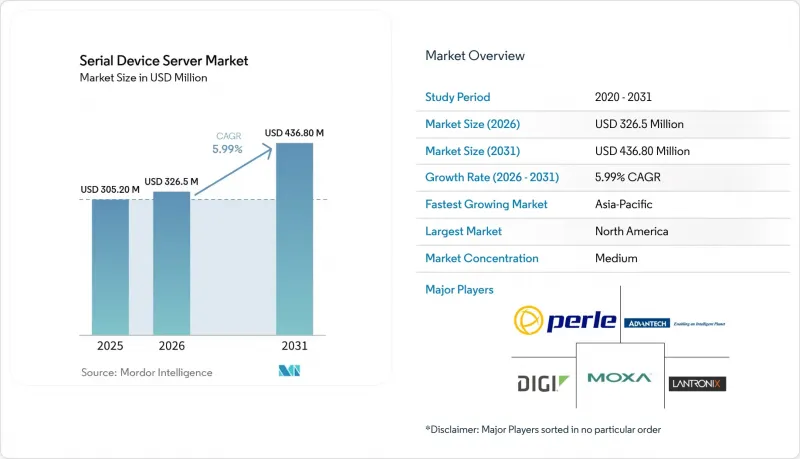
According to Mordor Intelligence, the serial device server market size is expected to increase from USD 326.50 million in 2026 to USD 436.80 million by 2031, growing at a CAGR of 5.99% over 2026-2031.
This report is Segmented by Port Count (1-Port, 2-Port, 4-Port, and More), Connectivity Type (Wired Ethernet, Wireless Wi-Fi, and More), Serial Protocol Support (RS-232, RS-422, RS-485, and Multi-Protocol), Form Factor (DIN-Rail Mount, Rack-Mount, and More), Industry Vertical (Industrial Automation, Energy and Utilities, and More), and Geography. The Market Forecasts are Provided in Terms of Value (USD).
Global Serial Device Server Market Trends and Insights
Rising Adoption of Industry 4.0 And IIoT
Manufacturers chasing real-time analytics must surface data locked inside decades-old PLCs and drives. Serial device servers preserve installed wiring while adding IP connectivity, preventing costly downtime from wholesale controller swaps. Multi-port models reduce switch counts, simplify topology, and deliver unified management, a critical step toward the higher productivity lift associated with full Industry 4.0 rollouts. Adoption is most intense in China and India, where pre-Ethernet machinery dominates, and in Germany and Italy, where energy-efficiency directives demand granular machine telemetry.
Transition From Serial To Ethernet Networks
Utilities and rail operators are decommissioning proprietary serial SCADA links in favor of Ethernet for bandwidth, standard management, and encrypted traffic. During migration, substation cabinets packed with RTUs still speak RS-485, making robust serial-to-Ethernet gateways indispensable. North American utilities expedite upgrades to comply with NERC-CIP, while European railways integrate legacy interlocking with IP-based train control systems. Ruggedized gateways with dual power feeds and wide temperature tolerances receive preference as cabinets often sit outdoors.
Shift Toward Natively Ethernet-Enabled Industrial Devices
Greenfield automation projects now specify controllers, drives, and sensors with built-in Ethernet-APL or EtherNet/IP, eliminating the need for conversion altogether. Shorter hardware refresh cycles in the United States and Germany accelerate this drift, cutting replacement demand for standalone gateways. Vendors respond by embedding edge compute and protocol-translation scripts to stay relevant, yet the headwind persists.
Other drivers and restraints analyzed in the detailed report include:
- Demand For Remote Device Management And Predictive Maintenance
- OT-Cyber-Security Compliance Boosting Secure Gateways
- Price Sensitivity In Emerging Economies
For complete list of drivers and restraints, kindly check the Table Of Contents.
Segment Analysis
High-density chassis are replacing fleets of single-purpose boxes. In 2025, the 4-port tier accounted for 25.81% of revenue, while the 32-port-plus category is projected to post a 7.80% CAGR through 2031. Operators consolidate serial endpoints to cut rack units and streamline cabling. The 8-port class accounted for a significant share of the market in mid-sized control rooms, whereas 2-port gateways served remote wells or kiosks. Uptake of the 16-port tier in utilities remains steady as substations modernize gradually.
A parallel drive for remote configuration favors models with hot-swappable power and dual Ethernet uplinks. As firmware tools mature, a single technician can reassign ports from RS-232 to RS-485 without site visits, a critical advantage for multinationals managing thousands of cabinets. Hence, the serial device server market continues to gravitate toward flexible, high-density hardware that shrinks footprint and man-hours alike.
Wired Ethernet remained dominant, accounting for significant revenue in 2025, while Cellular/ LTE options are expanding at a 9.20% CAGR. Utilities that monitor distributed energy resources use CAT-M and NB-IoT variants when fiber is unavailable. Wi-Fi accounted for a significant share of the market, especially on temporary lines at hospitals or exhibition centers. Serial-over-USB modules are used in fanless edge computers that need compact all-in-one cards.
The most profitable niche is dual-mode cellular plus Ethernet, allowing failover paths that satisfy stringent uptime contracts. Gateway makers now pre-install carrier eSIMs, speeding deployment in hard-to-reach geographies. As private 5G campuses proliferate, suppliers that field gateways certified for band n77 gain early access to smart factory budgets, strengthening the long-run outlook for cellular SKUs within the serial device server market.
Complete Report Scope:
- By Port Count
- 1-Port
- 2-Port
- 4-Port
- 8-Port
- 16-Port
- 32-Port and Above
- By Connectivity Type
- Wired Ethernet
- Wireless (Wi-Fi)
- Cellular / LTE
- Serial-over-USB
- By Serial Protocol Support
- RS-232
- RS-422
- RS-485
- Multi-protocol (MEI)
- By Form Factor
- DIN-Rail Mount
- Rack-mount
- Embedded / Board-Level
- Panel Mount
- By Industry Vertical
- Industrial Automation
- Energy and Utilities
- Transportation and Logistics
- Retail and POS
- Healthcare and Medical Devices
- Building Automation and HVAC
- Other Industry Verticals
- By Geography
- North America
- United States
- Canada
- Mexico
- Europe
- Germany
- United Kingdom
- France
- Italy
- Rest of Europe
- Asia-Pacific
- China
- Japan
- India
- South Korea
- Rest of Asia-Pacific
- Middle East and Africa
- South America
- North America
Geography Analysis
Asia-Pacific led with 30.56% revenue in 2025 and will likely climb at 9.30% CAGR as China retrofits brownfield factories and India rolls out smart-city infrastructure. Low-cost domestic brands bundle protocol conversion apps with hardware, expanding adoption across tier-2 cities. Japanese robotics cells and Korean fabs, meanwhile, prize low-latency gateways with deterministic scheduling.
North America accounted for a significant share of revenue in 2025 and is projected to grow in the market. NERC-CIP enforcement drives bulk purchases by utilities, while freight carriers connect J1939 buses through certified cellular servers for real-time routing. United States component maker expansions in Illinois and Mexico reveal optimism in the domestic supply chain for the serial device server market.
Europe captured a significant share of revenue in 2025 and is set to grow at a significant CAGR. Building-automation retrofits gain pace as the EU Energy Performance of Buildings Directive demands transparent energy data. Rail modernization across Germany, France, and Spain integrates legacy signal boxes into IP backbones, fueling multi-port DIN-rail sales. Middle East and Africa together posted a high share, buoyed by Gulf oil patch LTE projects and South African grid upgrades.
- Moxa Inc.
- Digi International Inc.
- Lantronix Inc.
- Advantech Co., Ltd.
- Perle Systems Ltd.
- Pepperl+Fuchs SE (Comtrol)
- Sealevel Systems Inc.
- Westermo Network Technologies AB
- 3onedata Co., Ltd.
- Cisco Systems, Inc.
- HMS Networks AB
- ATEN International Co., Ltd.
- Tibbo Technology Inc.
- ACKSYS Communications & Systems
- EtherWAN Systems, Inc.
- B+B SmartWorx Inc.
- Kyland Technology Co., Ltd.
- ORing Industrial Networking Corp.
- ICP DAS Co., Ltd.
- SENA Technologies Inc.
- Omron Corporation
Additional Benefits:
- The market estimate (ME) sheet in Excel format
- 3 months of analyst support
TABLE OF CONTENTS
1 INTRODUCTION
- 1.1 Study Assumptions and Market Definition
- 1.2 Scope of the Study
2 RESEARCH METHODOLOGY
3 EXECUTIVE SUMMARY
4 MARKET LANDSCAPE
- 4.1 Market Overview
- 4.2 Market Drivers
- 4.2.1 Rising Adoption Of Industry 4.0 And IIoT In Manufacturing Plants
- 4.2.2 Need For Legacy Equipment Connectivity In Brown-Field Projects
- 4.2.3 Transition From Serial To Ethernet Networks In Utilities And Transport
- 4.2.4 Demand For Remote Device Management And Predictive Maintenance
- 4.2.5 OT-Cyber-Security Compliance Boosting Demand For Secure Serial Servers
- 4.2.6 Edge-AI Inference Requiring Deterministic Serial Data Gateways
- 4.3 Market Restraints
- 4.3.1 Shift Toward Natively Ethernet-Enabled Industrial Devices
- 4.3.2 Price Sensitivity In Emerging Economies
- 4.3.3 Scarcity Of IPv6-Ready Firmware In Installed Base
- 4.3.4 Radio-Spectrum Limits On Wireless Device Servers In Dense Cities
- 4.4 Industry Supply Chain Analysis
- 4.5 Regulatory Landscape
- 4.6 Technological Outlook
- 4.7 Porter's Five Forces Analysis
- 4.7.1 Threat of New Entrants
- 4.7.2 Bargaining Power of Suppliers
- 4.7.3 Bargaining Power of Buyers
- 4.7.4 Threat of Substitutes
- 4.7.5 Competitive Rivalry
5 MARKET SIZE AND GROWTH FORECASTS (VALUE)
- 5.1 By Port Count
- 5.1.1 1-Port
- 5.1.2 2-Port
- 5.1.3 4-Port
- 5.1.4 8-Port
- 5.1.5 16-Port
- 5.1.6 32-Port and Above
- 5.2 By Connectivity Type
- 5.2.1 Wired Ethernet
- 5.2.2 Wireless (Wi-Fi)
- 5.2.3 Cellular / LTE
- 5.2.4 Serial-over-USB
- 5.3 By Serial Protocol Support
- 5.3.1 RS-232
- 5.3.2 RS-422
- 5.3.3 RS-485
- 5.3.4 Multi-protocol (MEI)
- 5.4 By Form Factor
- 5.4.1 DIN-Rail Mount
- 5.4.2 Rack-mount
- 5.4.3 Embedded / Board-Level
- 5.4.4 Panel Mount
- 5.5 By Industry Vertical
- 5.5.1 Industrial Automation
- 5.5.2 Energy and Utilities
- 5.5.3 Transportation and Logistics
- 5.5.4 Retail and POS
- 5.5.5 Healthcare and Medical Devices
- 5.5.6 Building Automation and HVAC
- 5.5.7 Other Industry Verticals
- 5.6 By Geography
- 5.6.1 North America
- 5.6.1.1 United States
- 5.6.1.2 Canada
- 5.6.1.3 Mexico
- 5.6.2 Europe
- 5.6.2.1 Germany
- 5.6.2.2 United Kingdom
- 5.6.2.3 France
- 5.6.2.4 Italy
- 5.6.2.5 Rest of Europe
- 5.6.3 Asia-Pacific
- 5.6.3.1 China
- 5.6.3.2 Japan
- 5.6.3.3 India
- 5.6.3.4 South Korea
- 5.6.3.5 Rest of Asia-Pacific
- 5.6.4 Middle East and Africa
- 5.6.5 South America
- 5.6.1 North America
6 COMPETITIVE LANDSCAPE
- 6.1 Market Concentration
- 6.2 Strategic Moves
- 6.3 Market Share Analysis
- 6.4 Company Profiles (includes Global level Overview, Market level overview, Core Segments, Financials as available, Strategic Information, Market Rank/Share for key companies, Products and Services, and Recent Developments)
- 6.4.1 Moxa Inc.
- 6.4.2 Digi International Inc.
- 6.4.3 Lantronix Inc.
- 6.4.4 Advantech Co., Ltd.
- 6.4.5 Perle Systems Ltd.
- 6.4.6 Pepperl+Fuchs SE (Comtrol)
- 6.4.7 Sealevel Systems Inc.
- 6.4.8 Westermo Network Technologies AB
- 6.4.9 3onedata Co., Ltd.
- 6.4.10 Cisco Systems, Inc.
- 6.4.11 HMS Networks AB
- 6.4.12 ATEN International Co., Ltd.
- 6.4.13 Tibbo Technology Inc.
- 6.4.14 ACKSYS Communications & Systems
- 6.4.15 EtherWAN Systems, Inc.
- 6.4.16 B+B SmartWorx Inc.
- 6.4.17 Kyland Technology Co., Ltd.
- 6.4.18 ORing Industrial Networking Corp.
- 6.4.19 ICP DAS Co., Ltd.
- 6.4.20 SENA Technologies Inc.
- 6.4.21 Omron Corporation
7 MARKET OPPORTUNITIES AND FUTURE OUTLOOK
- 7.1 White-space and Unmet-Need Assessment

