PUBLISHER: Mordor Intelligence | PRODUCT CODE: 2097316

PUBLISHER: Mordor Intelligence | PRODUCT CODE: 2097316
Biomass Solid Fuel - Market Share Analysis, Industry Trends & Statistics, Growth Forecasts (2025 - 2030)
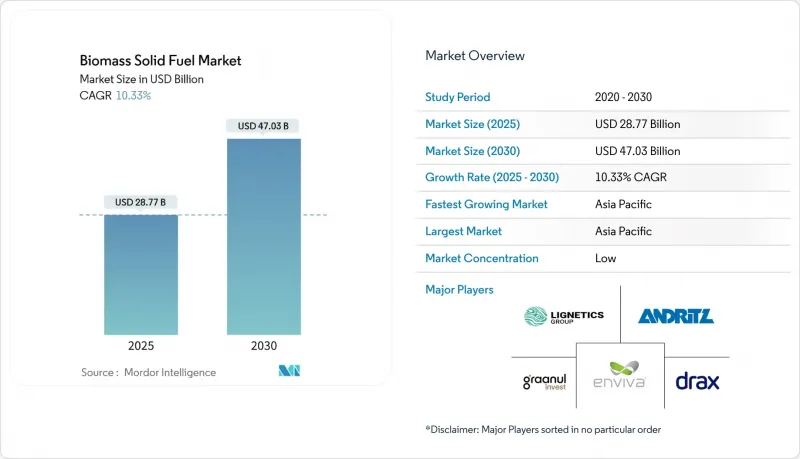
According to Mordor Intelligence, the biomass solid fuel market size is estimated at USD 28.77 billion in 2025, and is expected to reach USD 47.03 billion by 2030, at a CAGR of 10.33% during the forecast period (2025-2030).
This report is Segmented by Type (Wood Pellets, Briquettes, Sawdust and Wood Chips, and More), Application (Residential Heating, Commercial and Institutional Heating, Industrial Heat Generation, and More), End User (Households, Small and Medium Commercial, Large Industrial, and Utilities and IPPs), and Geography (North America, Europe, Asia-Pacific, South America, and Middle East and Africa).
Global Biomass Solid Fuel Market Trends and Insights
Rapid Decarbonization Mandates in the EU Heating Sector
Member states must reach 42.5% renewable energy in final consumption by 2030, and heating is the fastest lever to pull. Austria logged 19,181 new pellet-boiler installations during early 2024, with subsidies meeting 75% of capital cost, up to EUR 18,000 per unit. Germany mirrors this policy, offering up to 70% subsidy coverage, though potential political shifts may revise terms after 2025. The revised cascading principle under RED III gives material uses priority over energy, forcing utilities to compete for premium-grade pellets. Supply chains are pivoting toward lower-cost Brazilian imports that undercut Baltic shipments by more than USD 50 per tonne on a delivered basis. Facing these economics, Utilities are favoring long-term offtake deals to lock in certified volumes at predictable prices.
Expansion of Industrial Coal-to-Biomass Conversions
Power firms are pushing co-firing blends from 10% toward full fuel substitution, avoiding stranded-asset risks. Babcock & Wilcox retrofitted a Michigan plant to run on woody biomass and integrated carbon capture, targeting net-negative 550,000 tCO2 annually.Hanwha Energy's planned combined-heat-and-power switch in South Korea underlines broader Asian uptake even as subsidy cuts loom. Steam-explosion pretreatment boosts calorific value, letting pulverized units burn biomass without extensive mill upgrades. The upfront engineering costs favor incumbent utilities that own fuel-handling systems, widening the moat against smaller entrants.
Feedstock Competition with Panelboard & Pulp Industries
Panelboard mills offer premium pricing for fine sawdust, diverting up to 15% of residue that would otherwise feed pellet lines. Advanced mills marketed by ANDRITZ process mixed species efficiently, sharpening competition. Kraft pulp plants upgrading into biorefineries extract lignin, ethanol, and green chemicals, enabling higher margins than commodity energy pellets. In the United States, the forest-products sector contributed USD 24.1 billion in 2024 output, giving it negotiating muscle for feedstock. Pellet producers must therefore secure longer rotation contracts or co-locate capacity near secondary harvest residues to sidestep bidding wars.
Other drivers and restraints analyzed in the detailed report include:
- Carbon-Neutral Corporate Procurement Programs
- Maritime Demand for Torrefied Pellets as Drop-In Bunker Fuel
- Sustainability & Land-Use Scrutiny by NGOs and Financiers
For complete list of drivers and restraints, kindly check the Table Of Contents.
Segment Analysis
Wood pellets dominate the biomass solid fuel market, but torrefied variants headline growth. The segment commanded a 60.8% share in 2024, while torrefied and black pellets will post a 21.4% CAGR to 2030. Steam-explosion densification raises durability and reduces freight expenditure by 30%, spurring uptake among utilities that need coal-substitute grindability. Briquettes retain a niche in European households where existing stoves favor larger formats. Agricultural-residue pellets, abundant in Southeast Asia, struggle with variable ash content that complicates quality certification. Despite this, rising palm-kernel exports suggest a path for standardized grading systems to unlock latent volumes. Torrefied fuels meet maritime energy-density thresholds, positioning suppliers that build capacity now to capture bunker-fuel demand once FuelEU Maritime rules start. The biomass solid fuel market size for torrefied products is forecast to rise from USD 2.02 billion in 2024 to USD 5.35 billion by 2030.
The torrefaction process records up to 96% thermal efficiency, creating a near-coal calorific value without sulfur emissions. Investors favor plants that integrate torrefaction and pelletizing to minimize double-handling costs, while end users require pellets with >97% durability. The agricultural-residue subsegment benefits from lower feedstock prices yet faces silo-storage challenges due to higher potassium content that elevates slagging risks. Supplier differentiation rests on testing protocols that assure combustion stability in pulverized boilers.
Complete Report Scope:
- By Type
- Wood Pellets
- Briquettes
- Sawdust and Wood Chips
- Agricultural Residue Pellets
- Torrefied Pellets and Black Pellets
- Others (e.g., Char-briquettes, Coconut-shell pellets)
- By Application
- Residential Heating
- Commercial and Institutional Heating
- Industrial Heat Generation
- Utility-scale Power Generation
- CHP (Combined Heat and Power)
- By End User
- Households
- Small and Medium Commercial
- Large Industrial
- Utilities and IPPs
- By Geography
- North America
- United States
- Canada
- Mexico
- Europe
- United Kingdom
- Germany
- France
- Spain
- Nordic Countries
- Russia
- Rest of Europe
- Asia-Pacific
- China
- India
- Japan
- South Korea
- ASEAN Countries
- Australia and New Zealand
- Rest of Asia-Pacific
- South America
- Brazil
- Argentina
- Colombia
- Rest of South America
- Middle East and Africa
- United Arab Emirates
- Saudi Arabia
- South Africa
- Egypt
- Rest of Middle East and Africa
- North America
Geography Analysis
Asia-Pacific held a 38.1% share in 2024 and is projected to expand at a 11.2% CAGR. Japan's palm-kernel shell imports hit 670,000 t in March 2025, while wood-pellet inflows grew 29% year-on-year to 685,000 t as new units such as the 46 MW Imari plant came online. South Korea's December 2024 subsidy rollback curtails new projects, but retrofits already in construction continue under grandfathered terms. China aims for 58 million t of standard-coal-equivalent biomass by 2030, focusing on agricultural residues. Indonesia, Malaysia, and Thailand are scaling exports, yet mounting deforestation scrutiny may prompt stricter feedstock audits.
Europe enforces the world's most stringent sustainability screens. Pellet consumption slipped 1.2% in 2023 to 24.5 million t after a mild winter, but residential boiler subsidies cushioned the decline. Austria's record installations underline policy potency in stimulating demand. Finland and Sweden face resource-allocation clashes as cascading use principles prioritize timber for material applications over energy. From 2026, tighter RED III rules require producers to demonstrate forest-biomass compliance, likely spurring supply diversification outside the Baltic region.
North America dominates export supply, shipping 8.87 million t in 2024, up 3% year-on-year. Domestic consumption dipped 14%, reflecting cheaper natural-gas prices and mild winters. Drax's USD 12.5 billion investment plan for US plants could redirect tonnage inward, shifting the biomass solid fuel market equilibrium toward tighter global seaborne balances. USA Bioenergy's long-dated supply deal for a USD 2.8 billion sustainable-aviation-fuel complex locks in 2.2 million t of feedstock, shrinking export availability but raising in-region value capture.
- Enviva Inc.
- Drax Group plc
- Andritz AG
- AS Graanul Invest
- Pinnacle Renewable Energy
- Lignetics, Inc.
- Pacific BioEnergy Corp.
- Westervelt Renewable Energy
- Fram Renewable Fuels
- German Pellets GmbH
- Abellon CleanEnergy
- Georgia Biomass, LLC
- CM Biomass Partners
- Zilkha Biomass Energy
- EcoPellets Tasmania
- Stora Enso Oyj (Biomaterials div.)
- Land Energy Girvan Ltd
- Asia Biomass Co., Ltd.
- Polkky Oy (Pellet business)
- La Societe Generale des Granules (Sogenor)
Additional Benefits:
- The market estimate (ME) sheet in Excel format
- 3 months of analyst support
TABLE OF CONTENTS
1 Introduction
- 1.1 Study Assumptions & Market Definition
- 1.2 Scope of the Study
2 Research Methodology
3 Executive Summary
4 Market Landscape
- 4.1 Market Overview
- 4.2 Market Drivers
- 4.2.1 Rapid decarbonisation mandates in the EU heating sector
- 4.2.2 Expansion of industrial co-firing projects in coal-to-biomass conversions
- 4.2.3 Carbon-neutral corporate procurement programmes (RE100, SBTi)
- 4.2.4 Maritime demand for torrefied pellets as drop-in bunker fuel
- 4.2.5 Abundant sawmill residue supply in SE-Asia driving export volumes
- 4.2.6 Commercialisation of steam-explosion densification cutting logistics cost
- 4.3 Market Restraints
- 4.3.1 Feedstock competition with panelboard & pulp industries
- 4.3.2 Sustainability & land-use scrutiny by NGOs and financiers
- 4.3.3 EU RED III tightening forest-biomass criteria from 2026
- 4.3.4 Rising insurance premiums for pellet-plant fire/explosion risk
- 4.4 Supply-Chain Analysis
- 4.5 Regulatory Landscape
- 4.6 Technological Outlook
- 4.7 Porter's Five Forces
- 4.7.1 Threat of New Entrants
- 4.7.2 Bargaining Power of Suppliers
- 4.7.3 Bargaining Power of Buyers
- 4.7.4 Threat of Substitutes
- 4.7.5 Competitive Rivalry
5 Market Size & Growth Forecasts
- 5.1 By Type
- 5.1.1 Wood Pellets
- 5.1.2 Briquettes
- 5.1.3 Sawdust and Wood Chips
- 5.1.4 Agricultural Residue Pellets
- 5.1.5 Torrefied Pellets and Black Pellets
- 5.1.6 Others (e.g., Char-briquettes, Coconut-shell pellets)
- 5.2 By Application
- 5.2.1 Residential Heating
- 5.2.2 Commercial and Institutional Heating
- 5.2.3 Industrial Heat Generation
- 5.2.4 Utility-scale Power Generation
- 5.2.5 CHP (Combined Heat and Power)
- 5.3 By End User
- 5.3.1 Households
- 5.3.2 Small and Medium Commercial
- 5.3.3 Large Industrial
- 5.3.4 Utilities and IPPs
- 5.4 By Geography
- 5.4.1 North America
- 5.4.1.1 United States
- 5.4.1.2 Canada
- 5.4.1.3 Mexico
- 5.4.2 Europe
- 5.4.2.1 United Kingdom
- 5.4.2.2 Germany
- 5.4.2.3 France
- 5.4.2.4 Spain
- 5.4.2.5 Nordic Countries
- 5.4.2.6 Russia
- 5.4.2.7 Rest of Europe
- 5.4.3 Asia-Pacific
- 5.4.3.1 China
- 5.4.3.2 India
- 5.4.3.3 Japan
- 5.4.3.4 South Korea
- 5.4.3.5 ASEAN Countries
- 5.4.3.6 Australia and New Zealand
- 5.4.3.7 Rest of Asia-Pacific
- 5.4.4 South America
- 5.4.4.1 Brazil
- 5.4.4.2 Argentina
- 5.4.4.3 Colombia
- 5.4.4.4 Rest of South America
- 5.4.5 Middle East and Africa
- 5.4.5.1 United Arab Emirates
- 5.4.5.2 Saudi Arabia
- 5.4.5.3 South Africa
- 5.4.5.4 Egypt
- 5.4.5.5 Rest of Middle East and Africa
- 5.4.1 North America
6 Competitive Landscape
- 6.1 Market Concentration
- 6.2 Strategic Moves (M&A, Partnerships, PPAs)
- 6.3 Market Share Analysis (Market Rank/Share for key companies)
- 6.4 Company Profiles (includes Global level Overview, Market level overview, Core Segments, Financials as available, Strategic Information, Products & Services, and Recent Developments)
- 6.4.1 Enviva Inc.
- 6.4.2 Drax Group plc
- 6.4.3 Andritz AG
- 6.4.4 AS Graanul Invest
- 6.4.5 Pinnacle Renewable Energy
- 6.4.6 Lignetics, Inc.
- 6.4.7 Pacific BioEnergy Corp.
- 6.4.8 Westervelt Renewable Energy
- 6.4.9 Fram Renewable Fuels
- 6.4.10 German Pellets GmbH
- 6.4.11 Abellon CleanEnergy
- 6.4.12 Georgia Biomass, LLC
- 6.4.13 CM Biomass Partners
- 6.4.14 Zilkha Biomass Energy
- 6.4.15 EcoPellets Tasmania
- 6.4.16 Stora Enso Oyj (Biomaterials div.)
- 6.4.17 Land Energy Girvan Ltd
- 6.4.18 Asia Biomass Co., Ltd.
- 6.4.19 Polkky Oy (Pellet business)
- 6.4.20 La Societe Generale des Granules (Sogenor)
7 Market Opportunities & Future Outlook
- 7.1 White-space & Unmet-need Assessment

