PUBLISHER: Mordor Intelligence | PRODUCT CODE: 2097319

PUBLISHER: Mordor Intelligence | PRODUCT CODE: 2097319
Synchronous Generator - Market Share Analysis, Industry Trends & Statistics, Growth Forecasts (2026 - 2031)
According to Mordor Intelligence, the synchronous generator market size is expected to increase from USD 5.58 billion in 2025 to USD 5.89 billion in 2026 and reach USD 7.74 billion by 2031, growing at a CAGR of 5.25% over 2026-2031.
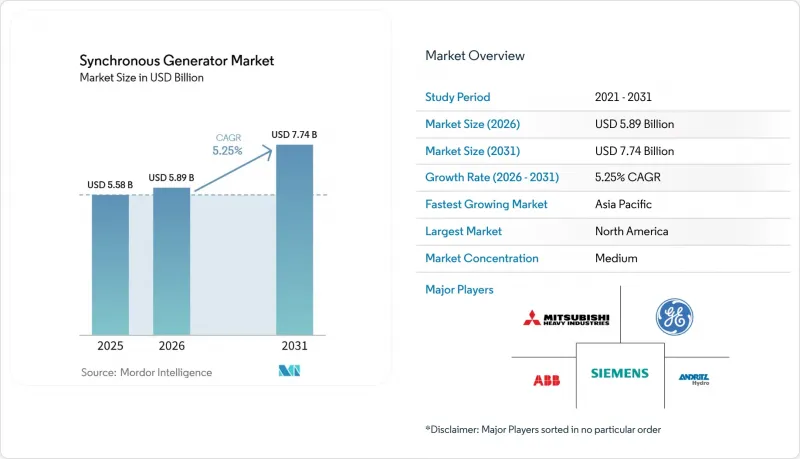
This report is Segmented by Type (Cylindrical Rotor, Salient Pole, and More), Cooling Type (Air, Hydrogen, Water, Oil), Phase (Single, Three), Power Rating (Below 100 KVA, and More), Application (Power Plants, and More), End-User (Utilities, and More), and Geography (North America, Europe, Asia-Pacific, South America, Middle East and Africa). Market Forecasts are Provided in Value (USD).
Global Synchronous Generator Market Trends and Insights
Rising Demand for Grid-Stabilizing Generators in Renewable-Heavy Power Mixes
Transmission operators are turning to synchronous condensers because wind and solar penetration above 40% of the instantaneous load can trigger frequency deviations that violate NERC PRC-024-4 ride-through limits within milliseconds. Siemens Energy commissioned a 250 MVAr unit at Ireland's Moneypoint site in 2024, providing 3,500 MW of inertia and reactive support for a dispatch that now tops 70% renewables. GE Vernova delivered a similar installation in Townsville, Australia, where cyclone-islanded operation raises stability risk. ENTSO-E's 2024 roadmap obliges every European TSO to meet minimum inertia floors by 2027, effectively guaranteeing a multiyear order pipeline for synchronous machines. The physical-inertia attribute cannot be replicated economically by grid-forming inverters today, anchoring long-term value.
Rapid Expansion of Hyperscale Data Centers Worldwide
Hyperscalers are procuring on-site gas turbine generation to bypass interconnection bottlenecks and secure local baseload power for AI workloads that draw 50-100 MW per hall. Meta's Hyperion campus in Louisiana will deploy 7.5 GW of combined-cycle capacity with synchronous generators between 2026 and 2030. Microsoft signed a USD 16 billion power purchase agreement in 2024 to restart the 835 MW Three Mile Island Unit 1 reactor exclusively for its Pennsylvania cloud region. Amazon and Google have executed similar nuclear and SMR arrangements, reflecting a broader shift toward behind-the-meter generation that favors 1-5 MVA modules. Bloomberg estimates hyperscaler capital expenditure at USD 640 billion through 2027, of which USD 240 billion targets physical infrastructure such as generators and transformers.
Cost Competitiveness of Inverter-Based Induction Generators
Grid-forming inverters deliver 20-30% lower upfront cost and simpler maintenance for applications where inertia is noncritical. NREL's 2024 study confirmed they can emulate voltage-source behavior, but inadequate kinetic energy limits their ability to arrest large-signal frequency excursions. South Australia's 100% renewable demonstration achieved two-hour stability using synthetic inertia, yet required over-specification of batteries, offsetting some capex benefit. Cost-sensitive markets in Southeast Asia and Africa favor induction-generator packages paired with static VAR compensators, which deliver roughly 85% of synchronous-machine performance at 60-70% of the cost.
Other drivers and restraints analyzed in the detailed report include:
- Industrial Output Growth in Emerging Economies
- Modernization of Aging Thermal & Hydro Plants in OECD
- High CAPEX and Maintenance Intensity
For complete list of drivers and restraints, kindly check the Table Of Contents.
Segment Analysis
Permanent-magnet synchronous generators are expanding at a 9.5% CAGR, nearly twice the synchronous generator market average. Their compact footprint attracts offshore wind and naval customers, while brushless excitation eliminates slip-ring maintenance. Cylindrical-rotor machines retained 42.1% of the synchronous generator market share in 2025, as 3,000-3,600 RPM steam- and gas-turbine drives continue to dominate baseload build-outs and their iron-core rotors are not affected by rare-earth supply shortages. Salient-pole units remain essential in hydro plants, where low-speed, high-pole designs provide large diameters without excessive centrifugal stress.
Rare-earth supply risk is limiting PMSG penetration. China's export controls pushed NdFeB magnet prices 18-22% higher in 2025, raising offshore wind capital expenditure forecasts. Research into high-entropy borides and manganese-based magnets could enable rare-earth-free rotors after 2028, easing supply constraints but not affecting the synchronous generator market size in the near term. Meanwhile, brushless wound-rotor machines are finding a practical application in marine and industrial settings by extending operation and maintenance intervals from 5,000 to 10,000 hours through static excitation.
Hydrogen-cooled designs held 39.6% of the synchronous generator market in 2025 and are expected to grow at a CAGR of 5.8% through 2031. Superior thermal conductivity enables high power density; the payback period for retrofitting a 300 MVA air-cooled unit to hydrogen averages 3 years at an 80% capacity factor. Plants above 200 MVA predominantly select hydrogen cooling, while air-cooled machines continue to dominate below-100 kVA standby sets where simplicity takes priority over efficiency.
Hybrid water-hydrogen systems in ultra-high-power nuclear units reduce stator hot-spots by 12-15 °C, prolonging insulation life by up to 40%. Maintenance complexity remains a barrier: operators must maintain 98% hydrogen purity and monitor seals quarterly to avoid explosive mixtures. Air-cooled machines carry a 0.8-1.2% efficiency penalty and require 20-30% larger frames; however, their lower auxiliary-system cost keeps them attractive in distributed-generation and mobile applications.
Complete Report Scope:
- By Type
- Cylindrical Rotor Synchronous Generators
- Salient Pole Synchronous Generators
- Brushless Synchronous Generators
- Permanent-Magnet Synchronous Generators (PMSG)
- By Cooling Type
- Air-Cooled
- Hydrogen-Cooled
- Water-Cooled
- Oil-Cooled
- By Phase
- Single-Phase
- Three-Phase
- By Power Rating
- Below 100 kVA
- 100 to 500 kVA
- 500 to 1000 kVA
- 1 to 5 MVA
- Above 5 MVA
- By Application
- Power Plants
- Industrial
- Oil and Gas
- Marine
- Mining
- Data Centres
- Others (Aerospace, Military, Commercial Buildings)
- By End-user
- Utilities
- Commercial and Industrial
- Residential
- By Geography
- North America
- United States
- Canada
- Mexico
- Europe
- Germany
- United Kingdom
- France
- Italy
- NORDIC Countries
- Russia
- Rest of Europe
- Asia-Pacific
- China
- India
- Japan
- South Korea
- ASEAN Countries
- Rest of Asia-Pacific
- South America
- Brazil
- Argentina
- Rest of South America
- Middle East and Africa
- Saudi Arabia
- United Arab Emirates
- South Africa
- Egypt
- Rest of Middle East and Africa
- North America
Geography Analysis
North America accounted for 31.9% of 2025 revenue. FERC Order 842 and NERC PRC-024-4 upgrades, along with synchronous condenser retrofits at retired coal plants, support replacement demand. Hyperscalers in Virginia, Texas, and the Pacific Northwest are securing multi-gigawatt on-site capacity, while nuclear uprates in Canada and combined-cycle tenders in Mexico contribute additional volume.
Asia-Pacific is the fastest-growing region, with a CAGR of 6.1%. India, Vietnam, and Indonesia are ordering multi-gigawatt coal, gas, and hydro projects that require synchronous machines for inertia and voltage regulation. Japan's reactor restarts, China's ultra-supercritical builds, and gas conversions across ASEAN further broaden the market base.
Europe is balancing coal plant exits with inertia mandates. ENTSO-E's 2027 floor requirement is driving condenser installations even as Germany retires 42 GW of synchronous capacity. Nuclear uprates in Finland and hydro modernizations across Scandinavia sustain retrofit activity, while Russia's Volzhskaya overhaul adds 2.7 GW of refurbished units.
- ABB Ltd.
- ANDRITZ AG
- Bharat Heavy Electricals Limited (BHEL)
- Brush Group Limited
- Caterpillar Inc.
- Cummins Inc.
- Doosan Enerbility Co., Ltd.
- Franklin Electric Co., Inc.
- Fuji Electric Co., Ltd.
- General Electric Company
- Harbin Electric Machinery Company Limited
- Hyundai Electric & Energy Systems Co., Ltd.
- Meidensha Corporation
- Mitsubishi Heavy Industries, Ltd.
- Nidec Leroy-Somer Holding
- SDMO Industries SAS
- Siemens AG
- TMEIC Corporation (Toshiba Mitsubishi-Electric Industrial Systems Corporation)
- Toshiba Energy Systems & Solutions Corporation
- Turbo-Dienst GmbH (TDG)
- WEG S.A.
Additional Benefits:
- The market estimate (ME) sheet in Excel format
- 3 months of analyst support
TABLE OF CONTENTS
1 Introduction
- 1.1 Study Assumptions & Market Definition
- 1.2 Scope of the Study
2 Research Methodology
3 Executive Summary
4 Market Landscape
- 4.1 Market Overview
- 4.2 Market Drivers
- 4.2.1 Rising demand for grid-stabilising generators in renewable-heavy power mixes
- 4.2.2 Rapid expansion of hyperscale data centres worldwide
- 4.2.3 Industrial output growth in emerging economies
- 4.2.4 Modernisation of ageing thermal & hydro plants in OECD
- 4.2.5 Grid operators adopting synchronous condensers for inertia (under-reported)
- 4.2.6 Naval platforms shifting to integrated electric propulsion (under-reported)
- 4.3 Market Restraints
- 4.3.1 Cost competitiveness of inverter-based induction generators
- 4.3.2 High CAPEX and maintenance intensity
- 4.3.3 Supply-chain tightness for rare-earth magnets (under-reported)
- 4.3.4 Tighter NOx/CO norms accelerating shift to non-rotating solutions (under-reported)
- 4.4 Supply-Chain Analysis
- 4.5 Regulatory Landscape
- 4.6 Technological Outlook
- 4.7 Porter's Five Forces
- 4.7.1 Threat of New Entrants
- 4.7.2 Bargaining Power of Buyers
- 4.7.3 Bargaining Power of Suppliers
- 4.7.4 Threat of Substitutes
- 4.7.5 Competitive Rivalry
5 Market Size & Growth Forecasts
- 5.1 By Type
- 5.1.1 Cylindrical Rotor Synchronous Generators
- 5.1.2 Salient Pole Synchronous Generators
- 5.1.3 Brushless Synchronous Generators
- 5.1.4 Permanent-Magnet Synchronous Generators (PMSG)
- 5.2 By Cooling Type
- 5.2.1 Air-Cooled
- 5.2.2 Hydrogen-Cooled
- 5.2.3 Water-Cooled
- 5.2.4 Oil-Cooled
- 5.3 By Phase
- 5.3.1 Single-Phase
- 5.3.2 Three-Phase
- 5.4 By Power Rating
- 5.4.1 Below 100 kVA
- 5.4.2 100 to 500 kVA
- 5.4.3 500 to 1000 kVA
- 5.4.4 1 to 5 MVA
- 5.4.5 Above 5 MVA
- 5.5 By Application
- 5.5.1 Power Plants
- 5.5.2 Industrial
- 5.5.3 Oil and Gas
- 5.5.4 Marine
- 5.5.5 Mining
- 5.5.6 Data Centres
- 5.5.7 Others (Aerospace, Military, Commercial Buildings)
- 5.6 By End-user
- 5.6.1 Utilities
- 5.6.2 Commercial and Industrial
- 5.6.3 Residential
- 5.7 By Geography
- 5.7.1 North America
- 5.7.1.1 United States
- 5.7.1.2 Canada
- 5.7.1.3 Mexico
- 5.7.2 Europe
- 5.7.2.1 Germany
- 5.7.2.2 United Kingdom
- 5.7.2.3 France
- 5.7.2.4 Italy
- 5.7.2.5 NORDIC Countries
- 5.7.2.6 Russia
- 5.7.2.7 Rest of Europe
- 5.7.3 Asia-Pacific
- 5.7.3.1 China
- 5.7.3.2 India
- 5.7.3.3 Japan
- 5.7.3.4 South Korea
- 5.7.3.5 ASEAN Countries
- 5.7.3.6 Rest of Asia-Pacific
- 5.7.4 South America
- 5.7.4.1 Brazil
- 5.7.4.2 Argentina
- 5.7.4.3 Rest of South America
- 5.7.5 Middle East and Africa
- 5.7.5.1 Saudi Arabia
- 5.7.5.2 United Arab Emirates
- 5.7.5.3 South Africa
- 5.7.5.4 Egypt
- 5.7.5.5 Rest of Middle East and Africa
- 5.7.1 North America
6 Competitive Landscape
- 6.1 Market Concentration
- 6.2 Strategic Moves (M&A, Partnerships, PPAs)
- 6.3 Market Share Analysis (Market Rank/Share for key companies)
- 6.4 Company Profiles (includes Global level Overview, Market level overview, Core Segments, Financials as available, Strategic Information, Products & Services, and Recent Developments)
- 6.4.1 ABB Ltd.
- 6.4.2 ANDRITZ AG
- 6.4.3 Bharat Heavy Electricals Limited (BHEL)
- 6.4.4 Brush Group Limited
- 6.4.5 Caterpillar Inc.
- 6.4.6 Cummins Inc.
- 6.4.7 Doosan Enerbility Co., Ltd.
- 6.4.8 Franklin Electric Co., Inc.
- 6.4.9 Fuji Electric Co., Ltd.
- 6.4.10 General Electric Company
- 6.4.11 Harbin Electric Machinery Company Limited
- 6.4.12 Hyundai Electric & Energy Systems Co., Ltd.
- 6.4.13 Meidensha Corporation
- 6.4.14 Mitsubishi Heavy Industries, Ltd.
- 6.4.15 Nidec Leroy-Somer Holding
- 6.4.16 SDMO Industries SAS
- 6.4.17 Siemens AG
- 6.4.18 TMEIC Corporation (Toshiba Mitsubishi-Electric Industrial Systems Corporation)
- 6.4.19 Toshiba Energy Systems & Solutions Corporation
- 6.4.20 Turbo-Dienst GmbH (TDG)
- 6.4.21 WEG S.A.
7 Market Opportunities & Future Outlook
- 7.1 White-space & Unmet-Need Assessment

