PUBLISHER: Mordor Intelligence | PRODUCT CODE: 2097325

PUBLISHER: Mordor Intelligence | PRODUCT CODE: 2097325
Fault Current Limiter - Market Share Analysis, Industry Trends & Statistics, Growth Forecasts (2026 - 2031)
According to Mordor Intelligence, the fault current limiter market size was valued at USD 5.77 billion in 2025 and is estimated to grow from USD 6.21 billion in 2026 to reach USD 8.82 billion by 2031, at a CAGR of 7.26% during the forecast period (2026-2031).
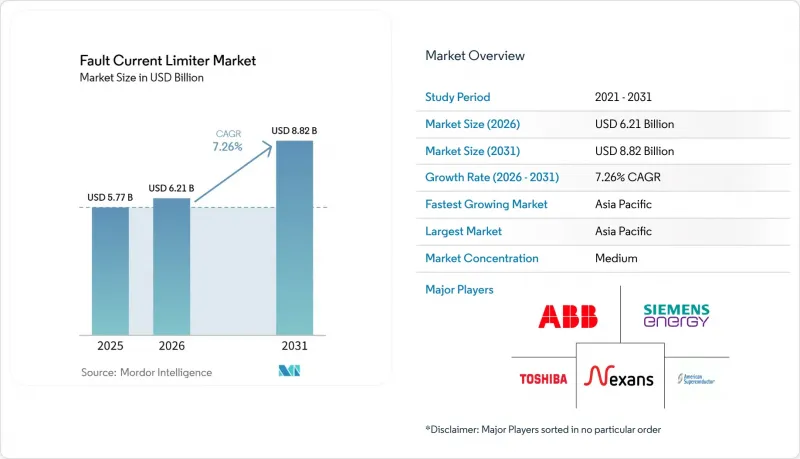
This report is Segmented by Type (Superconducting, Non-Superconducting), Voltage Level (Medium Voltage 1-36 KV, and More), Application (Power Transmission and Distribution, and More), End-User (Utilities, Industrial, Commercial, Transportation), and Geography (North America, Europe, Asia-Pacific, South America, Middle East and Africa). Market Forecasts are Provided in Terms of Value (USD).
Global Fault Current Limiter Market Trends and Insights
Rapid Grid-Capacity Expansion Mandates Drive Near-Term Procurement
Regulators in China, India, and the Gulf Cooperation Council have mandated a 15%-25% expansion in transmission capacity by 2028. However, many substations in these regions are already operating beyond their original interrupting ratings. The State Grid Corporation of China has included fault current limiters in its 2025 purchasing code for all new 220 kV renewable-zone substations. This measure ensures a steady order flow while reducing breaker upgrade capital expenditures by up to 60%. In July 2025, a network event in the Czech Republic caused currents to surge to 63 kA on equipment rated for 50 kA, prompting Central European utilities to accelerate their purchase schedules. By installing fault current limiters, breaker replacements can be deferred by 8-12 years, smoothing capital expenditures and reducing regulatory pressures.
Renewable Energy Fault-Current Incidents Shift Protection Philosophy
Aggregated inverters deliver sustained, semiconductor-limited fault currents that complicate relay coordination. The Nan'ao three-terminal VSC-HVDC project showed a 53% current reduction within 7 ms using a 160 kV superconducting limiter. Germany's VDE FNN guideline, issued in October 2025, mandates the inclusion of impedance-limiting devices in large photovoltaic and battery plants. Grid operators, particularly those with renewable penetration exceeding 50%, prioritize fault-limiting over fault-clearing as the primary measure to prevent significant voltage sags.
High Cryogenic OPEX for Utility-Scale SFCLs Limits Adoption in Emerging Markets
Maintaining a temperature of 77 K incurs an annual cost of USD 20,000-30,000 per device. In regions without established liquid-nitrogen logistics, supply costs can be 2-3 times higher, extending the payback period to over 15 years. Korea Electric Power's 22.9 kV pilot recorded an average cryocooler power consumption of 8 kW, resulting in an annual cost of approximately USD 7,000 based on local electricity tariffs, emphasizing the sensitivity of operational expenses. Closed-cycle cryocoolers and materials operating above 90 K are currently in the pilot phase and are not expected to be commercialized before 2028.
Other drivers and restraints analyzed in the detailed report include:
- Ageing T&D Infrastructure in OECD Economies Creates Retrofit Demand
- Commercialisation of REBCO HTS Wire Unlocks Utility-Scale Projects
- Utilities' CAPEX Deferral Culture Amid Rate-Base Pressure Delays Technology Adoption
For complete list of drivers and restraints, kindly check the Table Of Contents.
Segment Analysis
Superconducting units accounted for 66.6% of the fault current limiter market share in 2025, driven by their capability to reduce currents by 50%-70% within 2-5 milliseconds while occupying 40% less space compared to reactors. In contrast, solid-state designs are projected to grow at a CAGR of 7.6% through 2031, supported by silicon-carbide switches that interrupt currents in less than 200 microseconds and eliminate the need for cryogenic maintenance. The fault current limiter market size for superconducting devices is projected to climb alongside REBCO wire cost declines, yet their share will slip as data-center, rail, and MVDC buyers favor maintenance-free electronics.
Solid-state limiters leverage traction-inverter supply chains, enabling companies like ABB, Eaton, and Schneider Electric to provide integrated protection solutions. Inductive-resistive hybrids continue to serve a retrofit niche, particularly in cases where utilities prioritize simplicity over response speed. A trend of technology convergence is evident, with vendors developing hybrid superconducting-solid-state stacks to handle duties exceeding 100 kA, where no single topology is adequate. As utilities increasingly demand modular and digitally monitored assets, platform flexibility is emerging as a more critical factor than physical performance alone.
High-voltage systems (above 36 kV) accounted for 72.8% of revenue in 2025. However, medium-voltage demand is growing at a compound annual growth rate (CAGR) of 9.1%, driven by factors such as rooftop solar installations, battery storage systems, and 400 kW-plus electric vehicle (EV) chargers, which increase distribution fault levels beyond breaker limits. The medium-voltage segment of the fault current limiter market is projected to nearly double in size by 2031, narrowing the value gap with high-voltage systems. For example, LS Electric's 22.9 kV modular superconducting fault current limiter (SFCL) reduces the footprint by 70% compared to traditional air-core reactors and can be integrated into existing pad-mount enclosures.
The adoption of high-voltage systems remains dependent on standardized testing. Until the International Electrotechnical Commission (IEC) extends testing protocols beyond 63 kA, growth in this segment is expected to remain moderate. Additionally, medium-voltage direct current (MVDC) offshore wind export cables operating at +-30-80 kV are challenging traditional classifications, requiring high-voltage energy absorption capabilities within a medium-voltage framework. Vendors capable of scaling a single design across voltage ranges from 12 kV to 220 kV with standardized controls are well-positioned to capture a significant market share.
Complete Report Scope:
- By Type
- Superconducting
- Non-Superconducting
- By Voltage Level
- Medium Voltage (1 to 36 kV)
- High Voltage (Above 36 kV)
- By Application
- Power Transmission and Distribution
- Industrial Systems
- Renewable Energy Integration
- By End-User
- Utilities
- Industrial
- Commercial
- Transportation (Rail, E-Mobility Hubs)
- By Geography
- North America
- United States
- Canada
- Mexico
- Europe
- Germany
- United Kingdom
- France
- Italy
- NORDIC Countries
- Russia
- Rest of Europe
- Asia-Pacific
- China
- India
- Japan
- South Korea
- ASEAN Countries
- Rest of Asia-Pacific
- South America
- Brazil
- Argentina
- Rest of South America
- Middle East and Africa
- Saudi Arabia
- United Arab Emirates
- South Africa
- Egypt
- Rest of Middle East and Africa
- North America
Geography Analysis
The Asia-Pacific region is projected to account for a 44.3% market share in 2025 and is expected to register the highest regional CAGR of 7.5% through 2031. China's requirement for limiters in all 220 kV renewable-zone substations and Japan's superconducting rail projects provide sustained demand visibility over multiple years. Korea Electric Power's 22.9 kV trial underscores regional willingness to deploy cryogenic solutions where grid density justifies premium equipment.
In Europe, demand is primarily driven by offshore wind projects and HVDC (High Voltage Direct Current) rollouts. For example, NKT's 525 kV Scottish links, contracted for January 2026, demonstrate how converter-station specifications now routinely include current limiters. Regulatory clarity under the RIIO-ED2 framework in the United Kingdom and incentive mechanisms within Germany's Energiewende are contributing to a steady increase in adoption.
In North America, demand remains lower as investor-owned utilities have historically deferred capital expenditures. However, states like California and New York have permitted out-of-rate-case recovery for limiter installations, which is expected to strengthen the 2026-2028 project pipeline. In the Middle East, Oman's planned deployment in June 2025 marks an early adoption effort aimed at avoiding expensive breaker replacements. Meanwhile, South America is still in the early stages, but updates to grid codes in Brazil and Chile, requiring fault-ride-through capabilities after 2027, indicate potential growth beyond the forecast period.
- ABB Ltd
- American Superconductor Corporation
- Beijing Jingqi Electric Co., Ltd.
- Bharat Heavy Electricals Limited
- Eaton Corporation plc
- GE Vernova Inc.
- GridON Systems Ltd.
- Hyundai Electric & Energy Systems Co., Ltd.
- LS ELECTRIC Co., Ltd.
- MetOx International, Inc.
- Mitsubishi Electric Corporation
- Nexans S.A.
- NKT A/S
- Rongxin Power Electronic Co., Ltd.
- Schneider Electric SE
- SC Power Systems
- Siemens Energy AG
- SuperPower Inc.
- Toshiba Energy Systems & Solutions Corporation
- Zenergy Power plc
Additional Benefits:
- The market estimate (ME) sheet in Excel format
- 3 months of analyst support
TABLE OF CONTENTS
1 Introduction
- 1.1 Study Assumptions & Market Definition
- 1.2 Scope of the Study
2 Research Methodology
3 Executive Summary
4 Market Landscape
- 4.1 Market Overview
- 4.2 Market Drivers
- 4.2.1 Rapid grid-capacity expansion mandates (post-2025)
- 4.2.2 Surge in renewable energy fault-current incidents
- 4.2.3 Ageing T&D infrastructure in OECD economies
- 4.2.4 Mandatory arc-flash safety regulations in data-centres
- 4.2.5 Commercialisation of REBCO HTS wire below $50 kA-m cost
- 4.2.6 MVDC adoption for offshore wind export cables
- 4.3 Market Restraints
- 4.3.1 High cryogenic OPEX for utility-scale SFCLs
- 4.3.2 Absence of IEC/IEEE type-testing protocols above 63 kA
- 4.3.3 Procurement risk from HTS tape supply concentration
- 4.3.4 Utilities CAPEX deferral culture amid rate-base pressure
- 4.4 Supply-Chain Analysis
- 4.5 Regulatory Landscape
- 4.6 Technological Outlook
- 4.7 Porters Five Forces Analysis
- 4.7.1 Threat of New Entrants
- 4.7.2 Bargaining Power of Buyers
- 4.7.3 Bargaining Power of Suppliers
- 4.7.4 Threat of Substitutes
- 4.7.5 Competitive Rivalry
- 4.8 Investment & Pilot-Project Analysis
5 Market Size & Growth Forecasts
- 5.1 By Type
- 5.1.1 Superconducting
- 5.1.2 Non-Superconducting
- 5.2 By Voltage Level
- 5.2.1 Medium Voltage (1 to 36 kV)
- 5.2.2 High Voltage (Above 36 kV)
- 5.3 By Application
- 5.3.1 Power Transmission and Distribution
- 5.3.2 Industrial Systems
- 5.3.3 Renewable Energy Integration
- 5.4 By End-User
- 5.4.1 Utilities
- 5.4.2 Industrial
- 5.4.3 Commercial
- 5.4.4 Transportation (Rail, E-Mobility Hubs)
- 5.5 By Geography
- 5.5.1 North America
- 5.5.1.1 United States
- 5.5.1.2 Canada
- 5.5.1.3 Mexico
- 5.5.2 Europe
- 5.5.2.1 Germany
- 5.5.2.2 United Kingdom
- 5.5.2.3 France
- 5.5.2.4 Italy
- 5.5.2.5 NORDIC Countries
- 5.5.2.6 Russia
- 5.5.2.7 Rest of Europe
- 5.5.3 Asia-Pacific
- 5.5.3.1 China
- 5.5.3.2 India
- 5.5.3.3 Japan
- 5.5.3.4 South Korea
- 5.5.3.5 ASEAN Countries
- 5.5.3.6 Rest of Asia-Pacific
- 5.5.4 South America
- 5.5.4.1 Brazil
- 5.5.4.2 Argentina
- 5.5.4.3 Rest of South America
- 5.5.5 Middle East and Africa
- 5.5.5.1 Saudi Arabia
- 5.5.5.2 United Arab Emirates
- 5.5.5.3 South Africa
- 5.5.5.4 Egypt
- 5.5.5.5 Rest of Middle East and Africa
- 5.5.1 North America
6 Competitive Landscape
- 6.1 Market Concentration
- 6.2 Strategic Moves (M&A, Partnerships, PPAs)
- 6.3 Market Share Analysis (Market Rank/Share for key companies)
- 6.4 Company Profiles (includes Global level Overview, Market level overview, Core Segments, Financials as available, Strategic Information, Products & Services, and Recent Developments)
- 6.4.1 ABB Ltd
- 6.4.2 American Superconductor Corporation
- 6.4.3 Beijing Jingqi Electric Co., Ltd.
- 6.4.4 Bharat Heavy Electricals Limited
- 6.4.5 Eaton Corporation plc
- 6.4.6 GE Vernova Inc.
- 6.4.7 GridON Systems Ltd.
- 6.4.8 Hyundai Electric & Energy Systems Co., Ltd.
- 6.4.9 LS ELECTRIC Co., Ltd.
- 6.4.10 MetOx International, Inc.
- 6.4.11 Mitsubishi Electric Corporation
- 6.4.12 Nexans S.A.
- 6.4.13 NKT A/S
- 6.4.14 Rongxin Power Electronic Co., Ltd.
- 6.4.15 Schneider Electric SE
- 6.4.16 SC Power Systems
- 6.4.17 Siemens Energy AG
- 6.4.18 SuperPower Inc.
- 6.4.19 Toshiba Energy Systems & Solutions Corporation
- 6.4.20 Zenergy Power plc
7 Market Opportunities & Future Outlook
- 7.1 White-Space & Unmet-Need Assessment

