PUBLISHER: Mordor Intelligence | PRODUCT CODE: 2097335

PUBLISHER: Mordor Intelligence | PRODUCT CODE: 2097335
Microbial Fuel Cell - Market Share Analysis, Industry Trends & Statistics, Growth Forecasts (2025 - 2030)
According to Mordor Intelligence, the microbial fuel cell market size is estimated at USD 230.92 million in 2025, and is expected to reach USD 295.84 million by 2030, at a CAGR of 5.08% during the forecast period (2025-2030).
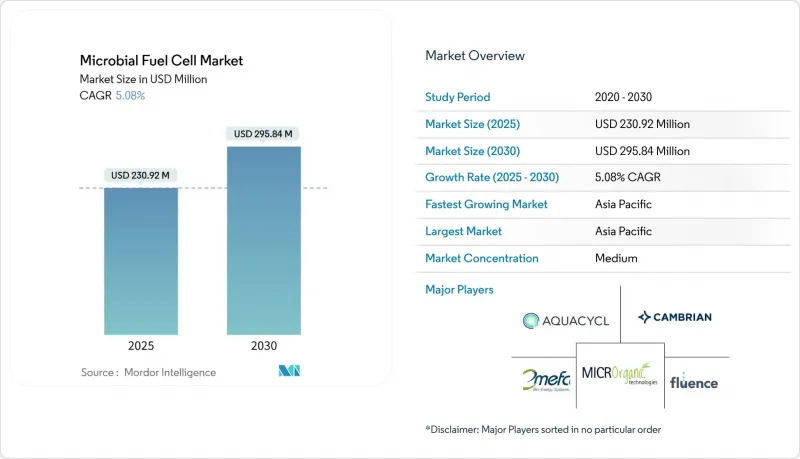
This report is Segmented by Type (Mediator-Based MFC and Mediator-Free MFC), Design (Single-Chamber, and More), Electrode Material (Carbon Cloth/Felt, and More), Substrate Source (Municipal Wastewater/Industrial Effluents, and More), Application (Wastewater Treatment and Energy Recovery, and More), End-User (Industrial, Research Institutions, and More), and Geography (North America, Asia-Pacific, and More)
Global Microbial Fuel Cell Market Trends and Insights
R&D Funding Surge Post-2025
Robust federal and multilateral grant programs channel resources into the microbial fuel cell market, including the U.S. Department of Energy's USD 46 million hydrogen and fuel-cell call. These funds accelerate electrode material discovery, microbial community engineering, and stack integration trials that address lingering power density gaps. Universities coordinate translational projects with utilities to validate pilot rigs on real wastewater, compressing proof-of-concept timelines. Parallel EU initiatives under Horizon Europe earmark funds for circular-economy water projects, anchoring collaborative test beds in Germany, Spain, and the Netherlands. Therefore, the convergence of academic expertise and utility-scale pilots underwrites a rapid feedback loop that speeds commercial readiness.
Tightening Global Wastewater-Discharge Norms
The European Union's Directive 2024/3019 obliges municipal plants to recover energy from wastewater, explicitly referencing bioelectrochemical solutions. Similar provisions in revised Canadian effluent rules grant transitional approvals to facilities installing advanced treatment units. These mandates establish a predictable compliance pathway for operators that select microbial fuel cell reactors, since simultaneous COD removal and electricity output help offset penalty fees. Regulatory certainty also influences lender risk models, allowing project-finance structures to carry longer tenors that reduce annual debt service and broaden adoption potential across mid-tier municipalities.
Low Power Density Versus Alternatives
Average industrial-scale prototypes rarely exceed 200 mW/m2, which limits addressable loads to sensing and supplemental energy recovery. As reactor footprints grow, internal resistance and bio-fouling depress performance, creating a mismatch between land constraints and output expectations. Researchers target hierarchical porous structures and synthetic consortia to raise electron transfer rates, but commercial tipping points will likely require at least a 3-fold jump. Until then, power economics restricts adoption to niche zones where heat, solar, or grid power are infeasible.
Other drivers and restraints analyzed in the detailed report include:
- Demand for Off-Grid Micro-Power Sensors
- Falling Graphene-Anode Prices from China
- High Capex vs. Conventional Treatment
For complete list of drivers and restraints, kindly check the Table Of Contents.
Segment Analysis
Mediator-free architectures delivered 60.9% of 2024 revenue, equal to USD 133.5 million of the microbial fuel cell market size, thanks to direct electron transfer that eliminates costly redox chemicals. These reactors appeal to operators prioritizing simple maintenance schedules and low consumables inventory. Growth will follow improvements in biofilm management and surface functionalization that further elevate coulombic efficiencies. Simultaneously, the mediator-based cohort, valued at USD 86.7 million, offers upside because next-generation polymeric mediators withstand higher current densities without toxicity drift, supporting a 5.6% CAGR.
The microbial fuel cell market benefits from this two-track evolution because risk-averse users select proven mediator-free rigs, whereas performance-oriented labs trial mediator-enhanced stacks to breach higher power ceilings. Technology vendors, therefore, hedge portfolios across both styles, ensuring continuing knowledge transfer between segments and preserving revenue resilience against unforeseen performance setbacks.
Single-chamber reactors captured 59.8% of revenue in 2024 by offering plug-and-play installation and minimal gasket management, translating to lower downtime in harsh industrial settings. Yet the modular stack format, presently only USD 29.4 million, is accelerating at an 8.5% CAGR as utilities demand scalable blocks that match fluctuating influent loads without civil-works overhauls. This design also mitigates channel clogging risk by isolating failure to one cassette, protecting plant uptime.
Manufacturers now pre-assemble stackable skid units in ISO-container footprints, enabling rapid brownfield retrofits and providing a migration path for plants to expand capacity in 50 kW increments. With several municipal bids specifying modularity as a tender criterion, the microbial fuel cell market base broadens from niche pilots to mainstream procurement checklists.
Complete Report Scope:
- By Type
- Mediator-Based MFC
- Mediator-Free MFC
- By Design
- Single-Chamber
- Dual-Chamber
- Stackable Modular
- By Electrode Material
- Carbon Cloth/Felt
- Graphene and Composites
- Metal-Based (SS, Ti)
- Novel Bio-derived
- By Substrate Source
- Municipal Wastewater/Industrial Effluents
- Agricultural Run-off
- Marine Sediments
- By Application
- Wastewater Treatment and Energy Recovery
- Power Generation (Remote/Portable)
- Biosensors and Environmental Monitoring
- Others
- By End-User
- Industrial
- Municipal Utilities
- Commercial and Residential
- Research Institutions
- By Geography
- North America
- United States
- Canada
- Mexico
- Europe
- Germany
- United Kingdom
- France
- Italy
- NORDIC Countries
- Russia
- Rest of Europe
- Asia-Pacific
- China
- India
- Japan
- South Korea
- ASEAN Countries
- Rest of Asia-Pacific
- South America
- Brazil
- Argentina
- Rest of South America
- Middle East and Africa
- Saudi Arabia
- United Arab Emirates
- South Africa
- Egypt
- Rest of Middle East and Africa
- North America
Geography Analysis
Asia-Pacific commanded 45.1% of 2024 revenue and is advancing at a 6.9% CAGR, powered by China's graphene supply chain, India's low-cost earthen-pot prototypes, and Japan's agricultural sensor pilots. Regional industrial wastewater volume and policy mandates for carbon neutrality create sustained project pipelines despite currency fluctuations. Therefore, the microbial fuel cell market enjoys both demand-side pull and cost-side push in the zone that houses much of the world's electronics assembly and food-processing capacity.
North America follows, buoyed by Department of Energy funding streams, defense pilot programs, and a robust venture-capital ecosystem that nurtures bioelectrochemical start-ups. Environmental NGOs increasingly pressure utilities to upgrade aging plants, and microbial fuel cell stacks offer a pathway to meet renewable-energy procurement targets while complying with discharge caps. Canadian effluent-rule amendments provide transitional permit relief, further greasing deployment rails for early movers.
Thanks to Directive 2024/3019, Europe remains technology-forward, which embeds energy-positive treatment as a legal obligation. Utilities in Germany, France, and the Nordics run pre-commercial pilots integrating MFC modules with anaerobic digesters, thereby widening the microbial fuel cell market's reference base. Although regional capex is higher, green debt instruments and ESG-linked bonds lower financing costs, offsetting initial expenditure gaps relative to Asian builds.
- Cambrian Innovation
- Fluence Corporation
- Aquacycl
- MICROrganic Technologies
- Pilus Energy LLC
- Cascade Clean Energy, Inc.
- Electro-Active Technologies Inc.
- Frontis Energy
- FuturoLEAF
- Kurita Water Industries Ltd
- Sainergy Tech, Inc.
- Novozymes A/S
Additional Benefits:
- The market estimate (ME) sheet in Excel format
- 3 months of analyst support
TABLE OF CONTENTS
1 Introduction
- 1.1 Study Assumptions & Market Definition
- 1.2 Scope of the Study
2 Research Methodology
3 Executive Summary
4 Market Landscape
- 4.1 Market Overview
- 4.2 Market Drivers
- 4.2.1 R&D funding surge post-2025
- 4.2.2 Tightening global wastewater-discharge norms
- 4.2.3 Demand for off-grid micro-power sensors
- 4.2.4 ESCO contracts for effluent-to-power in F&B plants
- 4.2.5 Falling graphene-anode prices from China
- 4.2.6 Defence grants for self-powered remote biosensors
- 4.3 Market Restraints
- 4.3.1 Low power density versus alternatives
- 4.3.2 High capex vs. conventional treatment
- 4.3.3 Cathode bio-fouling in saline waste streams
- 4.3.4 Limited life of PGM-free catalysts
- 4.4 Supply-Chain Analysis
- 4.5 Regulatory Landscape
- 4.6 Technological Outlook
- 4.7 Porter's Five Forces
- 4.7.1 Threat of New Entrants
- 4.7.2 Bargaining Power of Buyers
- 4.7.3 Bargaining Power of Suppliers
- 4.7.4 Threat of Substitutes
- 4.7.5 Competitive Rivalry
5 Market Size & Growth Forecasts
- 5.1 By Type
- 5.1.1 Mediator-Based MFC
- 5.1.2 Mediator-Free MFC
- 5.2 By Design
- 5.2.1 Single-Chamber
- 5.2.2 Dual-Chamber
- 5.2.3 Stackable Modular
- 5.3 By Electrode Material
- 5.3.1 Carbon Cloth/Felt
- 5.3.2 Graphene and Composites
- 5.3.3 Metal-Based (SS, Ti)
- 5.3.4 Novel Bio-derived
- 5.4 By Substrate Source
- 5.4.1 Municipal Wastewater/Industrial Effluents
- 5.4.2 Agricultural Run-off
- 5.4.3 Marine Sediments
- 5.5 By Application
- 5.5.1 Wastewater Treatment and Energy Recovery
- 5.5.2 Power Generation (Remote/Portable)
- 5.5.3 Biosensors and Environmental Monitoring
- 5.5.4 Others
- 5.6 By End-User
- 5.6.1 Industrial
- 5.6.2 Municipal Utilities
- 5.6.3 Commercial and Residential
- 5.6.4 Research Institutions
- 5.7 By Geography
- 5.7.1 North America
- 5.7.1.1 United States
- 5.7.1.2 Canada
- 5.7.1.3 Mexico
- 5.7.2 Europe
- 5.7.2.1 Germany
- 5.7.2.2 United Kingdom
- 5.7.2.3 France
- 5.7.2.4 Italy
- 5.7.2.5 NORDIC Countries
- 5.7.2.6 Russia
- 5.7.2.7 Rest of Europe
- 5.7.3 Asia-Pacific
- 5.7.3.1 China
- 5.7.3.2 India
- 5.7.3.3 Japan
- 5.7.3.4 South Korea
- 5.7.3.5 ASEAN Countries
- 5.7.3.6 Rest of Asia-Pacific
- 5.7.4 South America
- 5.7.4.1 Brazil
- 5.7.4.2 Argentina
- 5.7.4.3 Rest of South America
- 5.7.5 Middle East and Africa
- 5.7.5.1 Saudi Arabia
- 5.7.5.2 United Arab Emirates
- 5.7.5.3 South Africa
- 5.7.5.4 Egypt
- 5.7.5.5 Rest of Middle East and Africa
- 5.7.1 North America
6 Competitive Landscape
- 6.1 Market Concentration
- 6.2 Strategic Moves (M&A, Partnerships, PPAs)
- 6.3 Market Share Analysis (Market Rank/Share for key companies)
- 6.4 Company Profiles (includes Global level Overview, Market level overview, Core Segments, Financials as available, Strategic Information, Products & Services, and Recent Developments)
- 6.4.1 Cambrian Innovation
- 6.4.2 Fluence Corporation
- 6.4.3 Aquacycl
- 6.4.4 MICROrganic Technologies
- 6.4.5 Pilus Energy LLC
- 6.4.6 Cascade Clean Energy, Inc.
- 6.4.7 Electro-Active Technologies Inc.
- 6.4.8 Frontis Energy
- 6.4.9 FuturoLEAF
- 6.4.10 Kurita Water Industries Ltd
- 6.4.11 Sainergy Tech, Inc.
- 6.4.12 Novozymes A/S
7 Market Opportunities & Future Outlook
- 7.1 White-space & Unmet-Need Assessment

