
PUBLISHER: Mordor Intelligence | PRODUCT CODE: 2097340

PUBLISHER: Mordor Intelligence | PRODUCT CODE: 2097340
Solar Charger - Market Share Analysis, Industry Trends & Statistics, Growth Forecasts (2026 - 2031)
According to Mordor Intelligence, the solar charger market size is expected to increase from USD 7.02 billion in 2025 to USD 9.03 billion in 2026 and reach USD 30.22 billion by 2031, growing at a CAGR of 27.33% over 2026-2031.
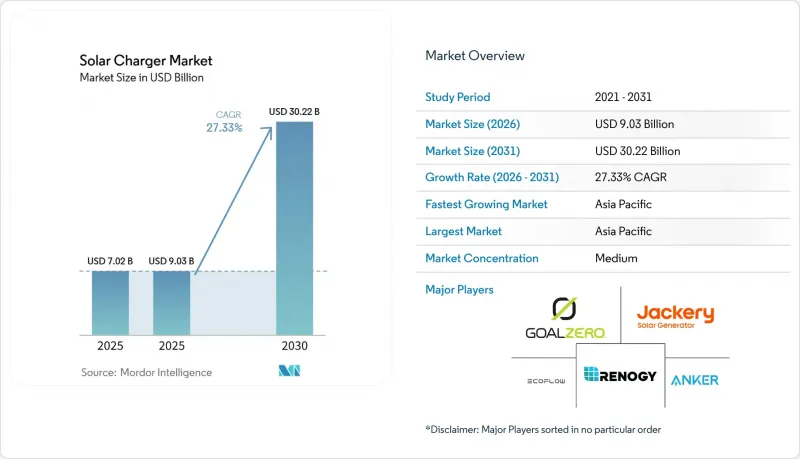
This report is Segmented by Type (Panel, Car-Battery, Foldable/Flexible, Backpack, Integrated), Power Output (Below 5W, 5-20W, 21-50W, Above 50W), Application (Consumer Electronics, Automotive, Military, Industrial, Off-Grid), End-User (Individual, Corporate, Government, Ngos), and Geography (North America, Europe, Asia-Pacific, South America, Middle East and Africa). Market Forecasts in Value (USD).
Global Solar Charger Market Trends and Insights
Rising Outdoor Recreation & Off-Grid Power Demand
Outdoor recreation spending continues to climb and now directly shapes purchasing patterns for 20-50 watt foldable panels that keep phones, drones, and laptops running for multi-day trips . Distributed photovoltaics supplied 42% of new global solar capacity in 2025, underscoring the structural shift toward small-scale systems. Defense validation reinforces the civilian narrative: 300-watt roof arrays on tactical vehicles trimmed diesel use by 10%, a proof point that resonates with overlanders and expedition outfitters . Disaster preparedness is another demand driver, as NGOs deploy containerized microgrids in cyclone- and wildfire-prone regions, positioning solar chargers as low-cost resilience assets. Together, these factors expand the solar charger market from a camping accessory niche into a broader off-grid power category.
Declining Solar-PV Cost and Efficiency Gains
Sub-USD 0.10 per-watt pricing reached the portable segment in 2025, cutting bill-of-materials costs by 30-40% compared with 2020. Flexible perovskite-silicon tandem cells achieved 33.89% efficiency in laboratory-validated prototypes, shrinking footprint and weight. Automakers are already capitalizing on cost efficiencies, with AGC Automotive's back-contact solar roof set to enter mass production at greater than 25% efficiency. This development will provide range extension without plug-in charging and eliminate the need for roller-blind mechanisms. As unit economics improve, aggressive retail pricing is making solar power banks cheaper on a per-watt-hour basis than conventional fast-charge packs, a trend expected to materialize within three years. These factors are driving a 27.3% CAGR in the solar charger market.
Variable Irradiance and Intermittency of Solar Resource
Longitudinal monitoring across 1 million km of road trials revealed that vehicle-roof panels in Central Europe harvest only 2.8 kWh per m2 annually, versus 4.6 kWh in equatorial regions. This variability means a wintertime smartphone charge in Oslo can take three times longer than in Bangkok. Portable power brands address intermittency with MPPT controllers and oversized batteries, but the added cost and weight slow adoption in cloudier geographies, making the solar charger market inherently regional.
Other drivers and restraints analyzed in the detailed report include:
- Growth in Portable Consumer-Electronics Ownership
- Clean-Energy Incentives and E-Waste Reduction Policies
- Competition from Fast-Charge Power Banks/Adapters
For complete list of drivers and restraints, kindly check the Table Of Contents.
Segment Analysis
Foldable and flexible models grew at a 31.8% CAGR through 2031, well above the overall solar charger market, driven by perovskite-silicon tandem cells with 33.89% efficiency that bend without cracking. Rigid panel chargers retained a 37.9% market share in 2025, as RV, marine, and cabin owners continue to prioritize durability over portability.
Automotive vehicle-integrated photovoltaics (VIPV) is raising performance benchmarks: Hyundai spin-off Solarstic's injection-molded polymer modules output 500 watts and integrate directly into body panels. As costs decline, aftermarket car-battery trickle chargers may lose relevance, while flexible consumer panels benefit from vehicle-driven scale effects. This technological convergence is reshaping value distribution across the solar charger market.
The 5-20 watt segment accounted for 39.6% of revenue in 2025, reflecting its dominance in smartphone charging applications. The 21-50 watt segment is growing at the fastest rate, with a CAGR of 30.2%, driven by expanding use in laptops, drones, and micromobility devices.
High-wattage (100 watt+) foldable panels increasingly overlap with semi-permanent array applications. A notable example is Nissan's 500-watt Ao-Solar Extender prototype, which can add 3,000 km of annual EV range. Growing consumer expectations for 100-watt panels to match rooftop efficiency levels are pushing suppliers to use premium cell bins and hardened laminates to maintain product reliability in the solar charger market.
Complete Report Scope:
- By Type
- Solar Panel Chargers
- Solar Power Banks
- Solar Car-Battery Chargers
- Foldable/Flexible Solar Chargers
- Solar Backpack Chargers
- Integrated Solar-Device Chargers
- By Power Output (Watts)
- Below 5 W
- 5 to 20 W
- 21 to 50 W
- Above 50 W
- By Application
- Consumer Electronics
- Smartphones and Tablets
- Laptops and Wearables
- Cameras and Drones
- Automotive and Mobility
- Passenger Vehicles
- Micromobility (e-bikes, scooters)
- Military and Defense
- Industrial and Commercial
- Remote and Off-grid Locations
- Consumer Electronics
- By End-user
- Individual Consumers
- Corporate and Commercial Enterprises
- Government and Public Sector
- NGOs and Emergency Services
- By Geography
- North America
- United States
- Canada
- Mexico
- Europe
- Germany
- United Kingdom
- France
- Italy
- NORDIC Countries
- Russia
- Rest of Europe
- Asia-Pacific
- China
- India
- Japan
- South Korea
- ASEAN Countries
- Rest of Asia-Pacific
- South America
- Brazil
- Argentina
- Rest of South America
- Middle East and Africa
- Saudi Arabia
- United Arab Emirates
- South Africa
- Egypt
- Rest of Middle East and Africa
- North America
Geography Analysis
Asia-Pacific accounted for 35.5% of global revenue in 2025 and is projected to grow at a CAGR of 29.1% through 2031. This growth is supported by certification frameworks such as TISI, ICC, and CR, which restrict sub-standard imports and strengthen consumer confidence. China's vertically integrated supply chain enables landed costs 20-30% below those of Western competitors, while import duties in India are redirecting assembly investment toward domestic production. Rising smartphone adoption in Indonesia and the Philippines sustains baseline unit demand, and typhoon-prone island nations are adopting solar chargers to improve energy resilience.
North America presents a mixed outlook. Demand from outdoor recreation and RV users supports sales in the 50-200 watt segment, while the expiry of the federal Investment Tax Credit (ITC) has extended residential payback periods to 10 years, reducing momentum in the rooftop segment. The U.S. Army's multiyear procurement pipeline and Massachusetts' solar e-bike hub in Somerville demonstrate how defense and municipal programs offset volatility in the civilian market. Canada's cabin market and Mexico's off-grid rural regions maintain steady mid-power demand, supporting North America's overall market share.
Europe benefits from consistent policy support. Germany's balcony solar installations and the UK's authorization of plug-in panels in March 2026 reduce the need for professional installation, making adoption more accessible for renters. France's feed-in tariff (FiT) schemes support residential uptake, while the Nordic countries utilize extended summer daylight for marine and cabin applications. In other regions, Brazil's Amazonia, the UAE's desert environments, and South Africa's ongoing load-shedding challenges represent high-growth but high-risk markets that depend on financing mechanisms such as green bonds and multilateral aid. These emerging regions broaden the global solar charger market and reduce reliance on demand from mature Western markets.
- ALLPOWERS Industrial International Co., Ltd.
- Anker Innovations Technology Co., Ltd.
- BigBlue Technology Co., Ltd.
- BioLite, Inc.
- EcoFlow Inc.
- ECEEN Technology Co., Ltd.
- Elecaenta Technology Co., Ltd.
- Goal Zero, LLC
- HQST (HQST Solar)
- Instapark
- Jackery Inc.
- Nekteck, Inc.
- Poweradd (Poweradd Technology Co., Ltd.)
- Powertraveller International Ltd.
- RAVPower
- Renogy
- Solio Ltd.
- SunJack
- SunKing (Greenlight Planet Inc.)
- Voltaic Systems, Inc.
- Xtorm B.V.
- X-Dragon Technology Co., Ltd.
Additional Benefits:
- The market estimate (ME) sheet in Excel format
- 3 months of analyst support
TABLE OF CONTENTS
1 Introduction
- 1.1 Study Assumptions & Market Definition
- 1.2 Scope of the Study
2 Research Methodology
3 Executive Summary
4 Market Landscape
- 4.1 Market Overview
- 4.2 Market Drivers
- 4.2.1 Rising outdoor recreation & off-grid power demand
- 4.2.2 Declining solar-PV cost and efficiency gains
- 4.2.3 Growth in portable consumer-electronics ownership
- 4.2.4 Clean-energy incentives & e-waste reduction policies
- 4.2.5 Adoption of solar-integrated fabrics in defense wearables
- 4.2.6 ESG-funded micromobility solar charging roll-outs
- 4.3 Market Restraints
- 4.3.1 Variable irradiance & intermittency of solar resource
- 4.3.2 Competition from fast-charge power banks/adapters
- 4.3.3 Import tariffs on PV components in key markets
- 4.3.4 Lithium-ion supply-chain tightness for integrated banks
- 4.4 Supply-Chain Analysis
- 4.5 Regulatory Landscape
- 4.6 Technological Outlook
- 4.7 Porter's Five Forces
- 4.7.1 Threat of New Entrants
- 4.7.2 Bargaining Power of Buyers
- 4.7.3 Bargaining Power of Suppliers
- 4.7.4 Threat of Substitutes
- 4.7.5 Competitive Rivalry
5 Market Size & Growth Forecasts
- 5.1 By Type
- 5.1.1 Solar Panel Chargers
- 5.1.2 Solar Power Banks
- 5.1.3 Solar Car-Battery Chargers
- 5.1.4 Foldable/Flexible Solar Chargers
- 5.1.5 Solar Backpack Chargers
- 5.1.6 Integrated Solar-Device Chargers
- 5.2 By Power Output (Watts)
- 5.2.1 Below 5 W
- 5.2.2 5 to 20 W
- 5.2.3 21 to 50 W
- 5.2.4 Above 50 W
- 5.3 By Application
- 5.3.1 Consumer Electronics
- 5.3.1.1 Smartphones and Tablets
- 5.3.1.2 Laptops and Wearables
- 5.3.1.3 Cameras and Drones
- 5.3.2 Automotive and Mobility
- 5.3.2.1 Passenger Vehicles
- 5.3.2.2 Micromobility (e-bikes, scooters)
- 5.3.3 Military and Defense
- 5.3.4 Industrial and Commercial
- 5.3.5 Remote and Off-grid Locations
- 5.3.1 Consumer Electronics
- 5.4 By End-user
- 5.4.1 Individual Consumers
- 5.4.2 Corporate and Commercial Enterprises
- 5.4.3 Government and Public Sector
- 5.4.4 NGOs and Emergency Services
- 5.5 By Geography
- 5.5.1 North America
- 5.5.1.1 United States
- 5.5.1.2 Canada
- 5.5.1.3 Mexico
- 5.5.2 Europe
- 5.5.2.1 Germany
- 5.5.2.2 United Kingdom
- 5.5.2.3 France
- 5.5.2.4 Italy
- 5.5.2.5 NORDIC Countries
- 5.5.2.6 Russia
- 5.5.2.7 Rest of Europe
- 5.5.3 Asia-Pacific
- 5.5.3.1 China
- 5.5.3.2 India
- 5.5.3.3 Japan
- 5.5.3.4 South Korea
- 5.5.3.5 ASEAN Countries
- 5.5.3.6 Rest of Asia-Pacific
- 5.5.4 South America
- 5.5.4.1 Brazil
- 5.5.4.2 Argentina
- 5.5.4.3 Rest of South America
- 5.5.5 Middle East and Africa
- 5.5.5.1 Saudi Arabia
- 5.5.5.2 United Arab Emirates
- 5.5.5.3 South Africa
- 5.5.5.4 Egypt
- 5.5.5.5 Rest of Middle East and Africa
- 5.5.1 North America
6 Competitive Landscape
- 6.1 Market Concentration
- 6.2 Strategic Moves (M&A, Partnerships, PPAs)
- 6.3 Market Share Analysis (Market Rank/Share for key companies)
- 6.4 Company Profiles (includes Global level Overview, Market level overview, Core Segments, Financials as available, Strategic Information, Products & Services, and Recent Developments)
- 6.4.1 ALLPOWERS Industrial International Co., Ltd.
- 6.4.2 Anker Innovations Technology Co., Ltd.
- 6.4.3 BigBlue Technology Co., Ltd.
- 6.4.4 BioLite, Inc.
- 6.4.5 EcoFlow Inc.
- 6.4.6 ECEEN Technology Co., Ltd.
- 6.4.7 Elecaenta Technology Co., Ltd.
- 6.4.8 Goal Zero, LLC
- 6.4.9 HQST (HQST Solar)
- 6.4.10 Instapark
- 6.4.11 Jackery Inc.
- 6.4.12 Nekteck, Inc.
- 6.4.13 Poweradd (Poweradd Technology Co., Ltd.)
- 6.4.14 Powertraveller International Ltd.
- 6.4.15 RAVPower
- 6.4.16 Renogy
- 6.4.17 Solio Ltd.
- 6.4.18 SunJack
- 6.4.19 SunKing (Greenlight Planet Inc.)
- 6.4.20 Voltaic Systems, Inc.
- 6.4.21 Xtorm B.V.
- 6.4.22 X-Dragon Technology Co., Ltd.
7 Market Opportunities & Future Outlook
- 7.1 White-space & Unmet-need Assessment
- 7.2 Emerging Portable & Wearable Charging
- 7.3 Solar Chargers in Disaster-Relief & Emergency Response
- 7.4 Integration with EVs, Drones & Micromobility
- 7.5 Advances in Flexible & Lightweight Materials
- 7.6 Energy-as-a-Service Models for Off-grid Charging

