PUBLISHER: Mordor Intelligence | PRODUCT CODE: 2097380

PUBLISHER: Mordor Intelligence | PRODUCT CODE: 2097380
India Construction Ornamental Stone - Market Share Analysis, Industry Trends & Statistics, Growth Forecasts (2026 - 2031)
According to Mordor Intelligence, the India construction ornamental stone market size is expected to grow from USD 5.20 billion in 2025 to USD 5.54 billion in 2026 and is forecast to reach USD 7.62 billion by 2031 at 6.58% CAGR over 2026-2031.
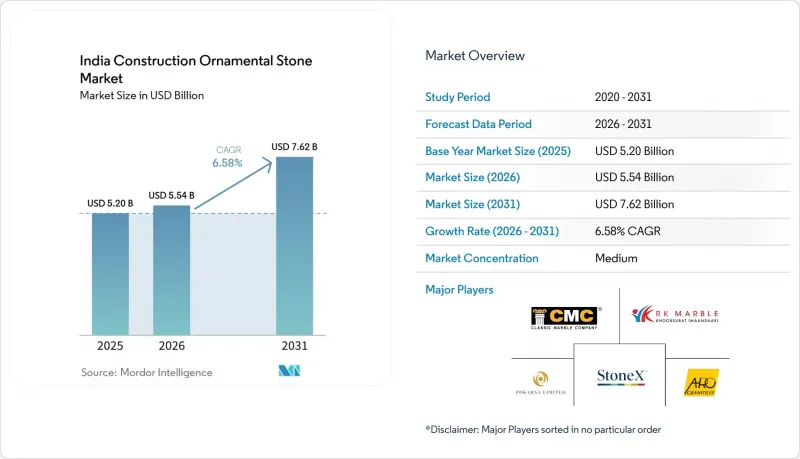
This report is Segmented by Stone Type (Granite, Marble, and More), Manufacturing Type (Raw/Unpolished, and More), Application (Flooring, Walls, and More), End User (Residential, Commercial), Distribution Channel (Directly From the Manufacturers, Dealers and Fabricators), and Region (North India, South India, and More). The Market Forecasts are Provided in Value (USD).
India Construction Ornamental Stone Market Trends and Insights
Premium Housing Demand in Tier-I and Tier-II Cities
In India, the luxury real estate market is experiencing a surge in demand for high-end apartments and premium bungalows. This trend is accompanied by an increased use of premium products in residential construction. Natural stones, once used sparingly, are now widely incorporated into construction projects. The cost of construction and investment in luxury projects has doubled, aligning with increased consumer spending capacity. Italian marble and large-sized premium tiles, including imported brands, are in higher demand. Brazilian products are popular due to their recognized premium quality, though high prices remain a challenge. Premium residential construction is changing stone demand in the India ornamental stone market at the project level, not only at the national level. Homes priced above INR 1 crore made up 50% of total housing sales in 2025, compared with 44% in 2024, which shows how quickly sales have shifted toward higher-value formats.
Smart Cities and Urban Landscaping Spend
Public works remain a second strong support for the India ornamental stone market because they create demand outside private housing cycles. As of mid-2025, the Smart Cities Mission had completed 94% of its 8,067 projects, with total investment reaching INR 1.64 lakh crore across 100 cities. Budget 2026 also raised capital expenditure to INR 12.2 lakh crore and introduced City Economic Regions, which keeps the pipeline active for paving, plaza work, heritage-zone flooring, and other public-space uses where stone remains a preferred material AMRUT 2.0 widens this demand to more cities and expands the geographic reach of the India ornamental stone market beyond the main metro clusters. Government procurement also tends to favor domestic sandstone, kota stone, and granite, which protects demand for local quarrying and processing clusters that do not rely on luxury housing alone..
Ceramic and Sintered Surface Substitution
Large-format porcelain and sintered surfaces are becoming the clearest substitute threat to parts of the India ornamental stone market. Sintered products offer low porosity, full UV resistance, and high hardness, while larger slab sizes reduce visible joints and make the final surface look closer to natural stone. This challenge is strongest in kitchen countertops and bathroom wall panels, where mid-market home buyers compare installed cost, upkeep, and visual finish more directly than in flooring or civic applications. The pressure is most visible in the INR 50 lakh to INR 1 crore housing bracket, where design aspirations remain high but price sensitivity is tighter. As Morbi-based ceramic producers expand sintered capabilities, the substitute risk is moving lower across price bands and affecting application areas that once carried better margins for natural stone.
Other drivers and restraints analyzed in the detailed report include:
- Commercial Real Estate Renovation Cycle
- CNC, Wire Saw, and Digital Fabrication Adoption
- Mining Permission and Environmental Clearance Delays
For complete list of drivers and restraints, kindly check the Table Of Contents.
Segment Analysis
Granite held 40.9% of the Indian ornamental stone market share in 2025, maintaining its leading revenue position among stone types. Its strength comes from dependable domestic block supply in Telangana, Karnataka, and Andhra Pradesh, as well as broad use in institutional flooring, luxury residences, and commercial interiors. In the India ornamental stone industry, granite remains the most practical material for projects that need both visual consistency and easier procurement across large floor areas. This combination of supply depth and familiarity with specifications gives granite a broader base than other stones.
Marble remained the second-largest category and stayed concentrated in high-end residential lobbies, hospitality interiors, and temple construction. Rajasthan's Makrana and Kishangarh belts continued to anchor premium marble supply for projects in Delhi NCR and Mumbai, where white and decorative grades remain closely tied to luxury specifications. Quartzite and slate occupied a smaller share, but they benefited from designer preference for textured and honed surfaces in premium facade and hospitality work. Limestone, sandstone, and Kota stone served public-space, temple, and restoration uses, giving the Indian ornamental stone market a set of demand pockets that face weaker substitute pressure than kitchen and bathroom applications.
Raw and unpolished stone accounted for 80.6% share of the India ornamental stone market size in 2025, which shows how large the basic supply layer still is. Even so, polished slabs are forecast to expand at 7.8% CAGR through 2031, which makes them the fastest-growing manufacturing format in the India ornamental stone market. The direction of value is therefore moving toward higher-finish processing even though raw material trade still holds the biggest revenue base. This shift is being driven by premium housing, commercial upgrades, and export demand for better-finished surfaces.
India has long supplied raw blocks to processors in China, the Middle East, and Europe, so the large share of unpolished material reflects that established trade pattern. However, that structure is changing as domestic processors in Tamil Nadu and Gujarat compete more actively in polished slab categories such as leathered granite, honed marble, and brushed quartzite. These finishes allow Indian suppliers to defend margins through workmanship and finish quality rather than only through raw stone availability. In the India ornamental stone industry, this is widening the gap between operators that process for value and those that still depend mainly on block trading.
Complete Report Scope:
- By Stone Type
- Granite
- Marble
- Quartzites
- Slates
- Other Natural Stones, Limestone, Sandstone, Etc.
- By Manufacturing Type
- Raw/Unpolished
- Polished Slabs
- Cut-to-Size
- By Application
- Flooring
- Walls or Wall Panels
- Countertops, Both Kitchen and Bathroom
- Other Applications, Temples, Monuments, Furniture
- By End-User
- Residential
- Commercial
- By Distribution Channel
- Directly from the Manufacturers
- Dealers and Fabricators
- By Region
- North India
- South India
- West India
- East & North-East India
List of Companies Covered in this Report:
- Pokarna Limited
- Aro Granite Industries Ltd
- R K Marble
- Classic Marble Company (KalingaStone)
- Stonex India Pvt Ltd
- Asian Granito India Ltd
- Madhav Marbles & Granites Ltd
- Tab India Pvt Ltd
- Johnson Marble & Quartz
- Global Stone (India) Pvt Ltd
- Paradigm Granite
- Divyashakti Granites Ltd
- Tripura Stones Pvt Ltd
- Titia Granites Pvt Ltd
- Radhamadhav Marbles
- Aravali India Marbles & Granites
- Regatta Universal Exports Ltd
- Kajaria Stone Pvt Ltd
- Levantina India
- Bhandari Marble Group
Additional Benefits:
- The market estimate (ME) sheet in Excel format
- 3 months of analyst support
TABLE OF CONTENTS
1 Introduction
- 1.1 Study Assumptions & Market Definition
- 1.2 Scope of the Study
2 Research Methodology
3 Executive Summary
4 Market Landscape
- 4.1 Market Overview
- 4.2 Market Drivers
- 4.2.1 Premium Housing Demand in Tier-I and Tier-II Cities
- 4.2.2 Smart Cities and Urban Landscaping Spend
- 4.2.3 Commercial Real Estate Renovation Cycle
- 4.2.4 Dry-Cladding Facade Adoption in Premium Projects
- 4.2.5 Engineered Quartz Capacity Expansion and Import Mix Shift
- 4.2.6 CNC, Wire Saw, and Digital Fabrication Adoption
- 4.3 Market Restraints
- 4.3.1 GST and Compliance Cost Burden
- 4.3.2 Quarry Supply Diversion Toward Export Grades
- 4.3.3 Ceramic and Sintered Surface Substitution
- 4.3.4 Mining Permission and Environmental Clearance Delays
- 4.4 Industry Value Chain Analysis
- 4.5 Porter's Five Forces Analysis
- 4.5.1 Threat of New Entrants
- 4.5.2 Bargaining Power of Suppliers
- 4.5.3 Bargaining Power of Buyers
- 4.5.4 Threat of Substitutes
- 4.5.5 Competitive Rivalry
- 4.6 Insights into the Latest Trends and Innovations in the Industry
- 4.7 Insights into the Recent Developments (New Product Launches, Strategic Initiatives, Investments, Partnerships, JVs, Expansion, M&As, etc.) in the Industry
5 Market Size & Growth Forecasts (Value, INR Billion)
- 5.1 By Stone Type
- 5.1.1 Granite
- 5.1.2 Marble
- 5.1.3 Quartzites
- 5.1.4 Slates
- 5.1.5 Other Natural Stones, Limestone, Sandstone, Etc.
- 5.2 By Manufacturing Type
- 5.2.1 Raw/Unpolished
- 5.2.2 Polished Slabs
- 5.2.3 Cut-to-Size
- 5.3 By Application
- 5.3.1 Flooring
- 5.3.2 Walls or Wall Panels
- 5.3.3 Countertops, Both Kitchen and Bathroom
- 5.3.4 Other Applications, Temples, Monuments, Furniture
- 5.4 By End-User
- 5.4.1 Residential
- 5.4.2 Commercial
- 5.5 By Distribution Channel
- 5.5.1 Directly from the Manufacturers
- 5.5.2 Dealers and Fabricators
- 5.6 By Region
- 5.6.1 North India
- 5.6.2 South India
- 5.6.3 West India
- 5.6.4 East & North-East India
6 Competitive Landscape
- 6.1 Market Concentration
- 6.2 Strategic Moves
- 6.3 Market Share Analysis
- 6.4 Company Profiles (includes Global level Overview, Market level overview, Core Segments, Financials as available, Strategic Information, Market Rank/Share for key companies, Products & Services, and Recent Developments)
- 6.4.1 Pokarna Limited
- 6.4.2 Aro Granite Industries Ltd
- 6.4.3 R K Marble
- 6.4.4 Classic Marble Company (KalingaStone)
- 6.4.5 Stonex India Pvt Ltd
- 6.4.6 Asian Granito India Ltd
- 6.4.7 Madhav Marbles & Granites Ltd
- 6.4.8 Tab India Pvt Ltd
- 6.4.9 Johnson Marble & Quartz
- 6.4.10 Global Stone (India) Pvt Ltd
- 6.4.11 Paradigm Granite
- 6.4.12 Divyashakti Granites Ltd
- 6.4.13 Tripura Stones Pvt Ltd
- 6.4.14 Titia Granites Pvt Ltd
- 6.4.15 Radhamadhav Marbles
- 6.4.16 Aravali India Marbles & Granites
- 6.4.17 Regatta Universal Exports Ltd
- 6.4.18 Kajaria Stone Pvt Ltd
- 6.4.19 Levantina India
- 6.4.20 Bhandari Marble Group
7 Market Opportunities & Future Outlook
- 7.1 Green-Certified Stone Demand in Premium Projects
- 7.2 Prefab Stone-Panel Systems for Metro and Transit Infra

