PUBLISHER: Mordor Intelligence | PRODUCT CODE: 2100764

PUBLISHER: Mordor Intelligence | PRODUCT CODE: 2100764
Construction Ornamental Stone - Market Share Analysis, Industry Trends & Statistics, Growth Forecasts (2026 - 2031)
According to Mordor Intelligence, the construction ornamental stone market size is expected to grow from USD 54.20 billion in 2025 to USD 56.60 billion in 2026 and is forecast to reach USD 70.60 billion by 2031 at 4.52% CAGR over 2026-2031.
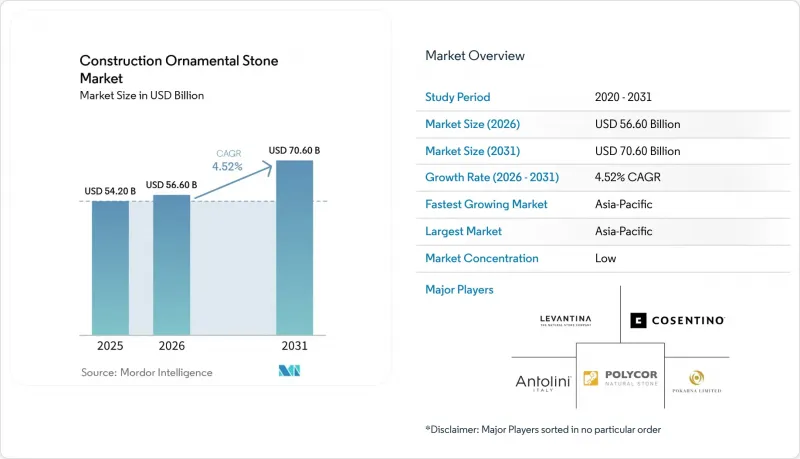
This report is Segmented by Stone Type (Marble, Granite, Quartzite, Slate, and Others), Manufacturing Type (Raw, Polished Slabs, and Cut-To-Size), Application (Flooring, Walls, Countertops, and Others), End-User (Residential and Commercial), Distribution Channel (Direct and Dealers/Fabricators), and Geography (North America, South America, Europe, Asia-Pacific, MEA). Forecasts are in Value (USD).
Global Construction Ornamental Stone Market Trends and Insights
Rising Premium Residential And Commercial Construction
Premium residential and commercial construction remains the strongest demand base for the construction ornamental stone market because these projects use more stone per square meter than mass-market buildings. India's 8 major cities recorded 66.4 million sq ft of office absorption in 2024, and 142 stalled towers in Mumbai, Pune, and Delhi NCR restarted with large granite flooring and facade requirements in each project. In Saudi Arabia, Vision 2030 projects, including NEOM, the Red Sea Project, and Qiddiya, are creating long procurement pipelines for granite and marble across decorative and structural uses. North America and Europe are also supporting this demand through a stay-and-renovate pattern, in which homeowners direct their housing equity toward interior upgrades rather than moving. That behavior is keeping countertop and flooring demand firm, even when new residential starts are not moving at the same pace.
Growing Demand For Aesthetic And Durable Natural Surfaces
The construction ornamental stone market is also gaining support from architects and buyers who want durable materials with stronger environmental credentials. Natural stone is being specified more often in green-certified projects because it offers long service life and a clearer sourcing story when certification is available. The Natural Stone Council had certified 24 quarries and 10 fabricators or producers under the NSC 373 Sustainable Production Standard by 2024, providing procurement teams with a recognized framework aligned with LEED and BREEAM requirements. Italy's stone sector also issued its first industry-wide Environmental Product Declaration in 2025 under ISO 14025 and EN 15804, which improved its position in specification reviews against porcelain and sintered alternatives. Producers that invest early in certification and product documentation are therefore better placed in institutional and government projects where provenance is becoming a formal requirement.
Substitution From Ceramic, Porcelain, And Sintered Surfaces
Substitution remains the largest competitive restraint on the construction ornamental stone market, especially in mid-tier applications where cost and speed matter more than provenance. Sintered stone product lines are growing at 7.0% to 10.5% CAGRs through the early 2030s, which is clearly faster than the 4.5% pace expected for natural ornamental stone. Glazed porcelain tiles are also improving through inkjet decoration, low water absorption below 0.5%, and abrasion ratings above PEI IV, which helps them compete in airport lounges, hotel lobbies, and healthcare spaces. A 2025 Scientific Reports study found stronger rivalry, substitution pressure, and supply chain flexibility in ceramics than in natural stone, where extraction remains more location-bound and supplier power is higher. Natural stone still holds strong positions in luxury residential, heritage restoration, and high-end hospitality, but it is losing share in price-sensitive projects that can accept a lookalike material.
Other drivers and restraints analyzed in the detailed report include:
- Digital Fabrication And Precision Cutting Adoption
- Expansion Of Renovation And Retrofit Activity
- Environmental And Quarrying Restrictions
For complete list of drivers and restraints, kindly check the Table Of Contents.
Segment Analysis
Granite held 40% of the construction ornamental stone market in 2025, giving it the largest share in the stone type segmentation. That share came from its strong hardness-to-cost profile across public infrastructure, residential flooring, and kitchen countertops. State-backed projects in coastal China continued to specify domestic granite for railway stations and government buildings, which kept institutional demand stable. Granite is also projected to grow at a 5.0% CAGR through 2031, reflecting continued use in public projects and its cost-performance advantage across high-volume flooring programs.
Marble remained the second-largest stone category because premium hotels and resorts continue to specify it for lobbies, spas, and other statement interiors. The ornamental stone market also continues to see quartzite gain attention in premium applications, as buyers value its hardness and distinctive veining. Cosentino expanded this premium pocket in May 2025 when Sensa by Cosentino added 6 new protected quartzite offerings for the natural stone portfolio. Slate, limestone, sandstone, and other natural stones remain important in heritage restoration, landscaping, temple construction, and projects where material authenticity matters. The result is a segment led by granite in volume, while premium growth is spreading across higher-value stones with stronger design appeal. Quartzite is rising from a smaller base, but its commercial appeal is clear in bespoke countertops and accent wall designs. Buyers willing to pay for visual differentiation are helping this category win more space in luxury homes and hospitality projects. Marble continues to defend its position where prestige and visual effect matter more than maintenance intensity. The broader mix shows that volume still sits with proven mainstream stones, while premium specification is moving toward visually distinctive materials with stronger price realization.
Raw and unpolished stone accounted for 78% of revenue in 2025, which made it the largest manufacturing format in the construction ornamental stone market. This dominance reflects the market's role as an upstream raw material base for processors and fabricators that add finishing value in local or regional markets. Quarry output still moves first through basic block and slab supply because many buyers depend on downstream finishing for project-specific needs. Even with that volume lead, polished slabs are forecast to grow at a 6.0% CAGR through 2031, making them the fastest-growing manufacturing format.
The growth of polished slabs is tied to premium kitchens, bathrooms, hospitality interiors, and feature walls where full-slab presentation matters. AI-based slab layout tools are improving the economics of polished output by reducing material loss by 15% to 30% while preserving natural veining patterns. Cut-to-size formats are also gaining traction in renovation work because precise dimensions reduce installation waste and save labor at the job site. Polycor's North American upgrade added dry-lay inspection, which helps match veining and tone before shipment, lowering rejection risk on high-specification projects . These shifts show that value creation is moving toward processing and finishing, even as raw stone still accounts for most of the current volume.
Complete Report Scope:
- By Stone Type
- Marble
- Granite
- Quartzites
- Slates
- Other Natural Stones, Limestone, Sandstone, Etc.
- By Manufacturing Type
- Raw/Unpolished
- Polished Slabs
- Cut-to-Size
- By Application
- Flooring
- Walls or Wall Panels
- Countertops, Both Kitchen and Bathroom
- Other Applications, Temples, Monuments, Furniture
- By End-User
- Residential
- Commercial
- By Distribution Channel
- Directly from the Manufacturers
- Dealers and Fabricators
- By Geography
- North America
- Canada
- United States
- Mexico
- South America
- Brazil
- Peru
- Chile
- Argentina
- Rest of South America
- Europe
- United Kingdom
- Germany
- France
- Spain
- Italy
- BENELUX (Belgium, Netherlands, Luxembourg)
- NORDICS (Denmark, Finland, Iceland, Norway, Sweden)
- Rest of Europe
- Asia-Pacific
- India
- China
- Japan
- Australia
- South Korea
- South-East Asia
- Rest of Asia-Pacific
- Middle East & Africa
- United Arab Emirates
- Saudi Arabia
- South Africa
- Nigeria
- Rest of Middle East & Africa
- North America
Geography Analysis
Asia-Pacific held 48% of the construction ornamental stone market share in 2025, and it is forecast to expand at a 6.0% CAGR through 2031. This gives the region both the largest current position and the fastest growth path within the global market. China and India remain the core demand engines because they combine heavy construction activity with a large appetite for premium surfaces in both public and private projects. China's urbanization rate reached 68% in recent years, supporting continued demand for granite flooring, marble lobbies, and stone facades across residential towers, government buildings, and transit infrastructure. India adds further support through Smart Cities projects, affordable housing programs, and export diversification toward the UAE, South Korea, and Vietnam.
Japan and South Korea are contributing through commercial renovation cycles rather than broad-based new construction. Aging hospitality and retail assets in these countries are being upgraded with premium stone finishes to improve asset positioning in dense urban markets. Australia and Southeast Asia are adding steady volume through premium residential builds and resort development. This combination keeps the ornamental stone market in Asia-Pacific tied to both large-scale urban construction and higher-value, design-driven projects. The region's breadth also helps absorb slower cycles in any one country, which supports its lead over other geographies.
North America and Europe present medium-growth profiles, but the internal drivers differ by region. In North America, renovation is the main support because limited housing mobility and strong homeowner equity redirected spending toward kitchens, bathrooms, and interior upgrades. The United States also faces supply-side stress from tariff pressure on Indian and Chinese imports and constrained domestic quarrying capacity, which has increased interest in local alternatives. Polycor's USD 15 million North American manufacturing upgrade was aimed directly at that gap, reducing custom-cut lead times from 12 to 16 weeks to 4 to 6 weeks.
- Levantina y Asociados de Minerales, S.A.
- Cosentino, S.A.
- Polycor Inc.
- Antolini Luigi and C. S.p.A.
- Pokarna Limited
- Aro Granite Industries Ltd
- R K Marble
- Classic Marble Company (KalingaStone)
- Stonex India Pvt Ltd
- Asian Granito India Ltd
- Marmo Granito India Limited
- M S International, Inc.
- Elliott Stone Company
- Temmer Marble
- Xiamen Wanli Stone Stock Co., Ltd.
- Kangli Stone Group
- Bain Granite
- Coldspring
- R.E.D. Graniti S.p.A.
- Topalidis S.A.
Additional Benefits:
- The market estimate (ME) sheet in Excel format
- 3 months of analyst support
TABLE OF CONTENTS
1 INTRODUCTION
- 1.1 Study Assumptions and Market Definition
- 1.2 Scope of the Study
2 RESEARCH METHODOLOGY
3 EXECUTIVE SUMMARY
4 MARKET LANDSCAPE
- 4.1 Market Overview
- 4.2 Market Drivers
- 4.2.1 Rising Premium Residential and Commercial Construction
- 4.2.2 Growing Demand for Aesthetic and Durable Natural Surfaces
- 4.2.3 Expansion of Renovation and Retrofit Activity
- 4.2.4 Preference for Low-Maintenance Engineered Stone
- 4.2.5 Increased Use in Facades, Flooring, and Interior Applications
- 4.2.6 Digital Fabrication and Precision Cutting Adoption
- 4.3 Market Restraints
- 4.3.1 Volatile Raw Material and Transportation Costs
- 4.3.2 Environmental and Quarrying Restrictions
- 4.3.3 Substitution from Ceramic, Porcelain, and Sintered Surfaces
- 4.3.4 High Installation and Maintenance Requirements for Certain Stone Types
- 4.4 Industry Value Chain Analysis
- 4.5 Porter's Five Forces Analysis
- 4.5.1 Threat of New Entrants
- 4.5.2 Bargaining Power of Suppliers
- 4.5.3 Bargaining Power of Buyers
- 4.5.4 Threat of Substitutes
- 4.5.5 Competitive Rivalry
- 4.6 Insights into the Latest Trends and Innovations in the Industry
- 4.7 Insights into the Recent Developments (New Product Launches, Strategic Initiatives, Investments, Partnerships, JVs, Expansion, M&As, etc.) in the Industry
5 Market Size & Growth Forecasts (Value in USD Billion)
- 5.1 By Stone Type
- 5.1.1 Marble
- 5.1.2 Granite
- 5.1.3 Quartzites
- 5.1.4 Slates
- 5.1.5 Other Natural Stones, Limestone, Sandstone, Etc.
- 5.2 By Manufacturing Type
- 5.2.1 Raw/Unpolished
- 5.2.2 Polished Slabs
- 5.2.3 Cut-to-Size
- 5.3 By Application
- 5.3.1 Flooring
- 5.3.2 Walls or Wall Panels
- 5.3.3 Countertops, Both Kitchen and Bathroom
- 5.3.4 Other Applications, Temples, Monuments, Furniture
- 5.4 By End-User
- 5.4.1 Residential
- 5.4.2 Commercial
- 5.5 By Distribution Channel
- 5.5.1 Directly from the Manufacturers
- 5.5.2 Dealers and Fabricators
- 5.6 By Geography
- 5.6.1 North America
- 5.6.1.1 Canada
- 5.6.1.2 United States
- 5.6.1.3 Mexico
- 5.6.2 South America
- 5.6.2.1 Brazil
- 5.6.2.2 Peru
- 5.6.2.3 Chile
- 5.6.2.4 Argentina
- 5.6.2.5 Rest of South America
- 5.6.3 Europe
- 5.6.3.1 United Kingdom
- 5.6.3.2 Germany
- 5.6.3.3 France
- 5.6.3.4 Spain
- 5.6.3.5 Italy
- 5.6.3.6 BENELUX (Belgium, Netherlands, Luxembourg)
- 5.6.3.7 NORDICS (Denmark, Finland, Iceland, Norway, Sweden)
- 5.6.3.8 Rest of Europe
- 5.6.4 Asia-Pacific
- 5.6.4.1 India
- 5.6.4.2 China
- 5.6.4.3 Japan
- 5.6.4.4 Australia
- 5.6.4.5 South Korea
- 5.6.4.6 South-East Asia
- 5.6.4.7 Rest of Asia-Pacific
- 5.6.5 Middle East & Africa
- 5.6.5.1 United Arab Emirates
- 5.6.5.2 Saudi Arabia
- 5.6.5.3 South Africa
- 5.6.5.4 Nigeria
- 5.6.5.5 Rest of Middle East & Africa
- 5.6.1 North America
6 COMPETITIVE LANDSCAPE
- 6.1 Market Concentration Overview
- 6.2 Strategic Moves
- 6.3 Market Share Analysis
- 6.4 Company Profiles (includes Global level Overview, Market level overview, Core Segments, Financials as available, Strategic Information, Market Rank/Share for key companies, Products & Services, and Recent Developments)
- 6.4.1 Levantina y Asociados de Minerales, S.A.
- 6.4.2 Cosentino, S.A.
- 6.4.3 Polycor Inc.
- 6.4.4 Antolini Luigi and C. S.p.A.
- 6.4.5 Pokarna Limited
- 6.4.6 Aro Granite Industries Ltd
- 6.4.7 R K Marble
- 6.4.8 Classic Marble Company (KalingaStone)
- 6.4.9 Stonex India Pvt Ltd
- 6.4.10 Asian Granito India Ltd
- 6.4.11 Marmo Granito India Limited
- 6.4.12 M S International, Inc.
- 6.4.13 Elliott Stone Company
- 6.4.14 Temmer Marble
- 6.4.15 Xiamen Wanli Stone Stock Co., Ltd.
- 6.4.16 Kangli Stone Group
- 6.4.17 Bain Granite
- 6.4.18 Coldspring
- 6.4.19 R.E.D. Graniti S.p.A.
- 6.4.20 Topalidis S.A.
7 MARKET OPPORTUNITIES AND FUTURE OUTLOOK
- 7.1 Premium Commercial Fit-Out Demand
- 7.2 Sustainable and Certified Stone Solutions

