PUBLISHER: Mordor Intelligence | PRODUCT CODE: 2097381

PUBLISHER: Mordor Intelligence | PRODUCT CODE: 2097381
South America Electric Utility Protective Relay - Market Share Analysis, Industry Trends & Statistics, Growth Forecasts (2026 - 2031)
According to Mordor Intelligence, the South America electric utility protective relay market is valued at USD 117.89 million in 2026 and is projected to reach USD 146.63 million by 2031, reflecting a 4.46% CAGR.
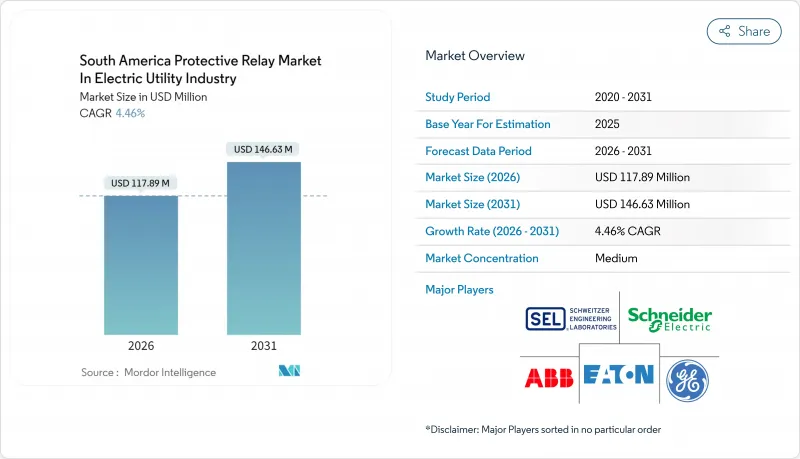
This report is Segmented by Relay Technology (Electromechanical, Static/Solid-State, and More), Voltage Range (Low-Voltage, Medium-Voltage, and High-Voltage), Application (Generator Protection, Motor Protection, and More), End-User (Generation Utilities, Transmission Utilities, and More), and Country. The Market Forecasts are Provided in Terms of Value (USD).
South America Electric Utility Protective Relay Market Trends and Insights
Surge in Grid-Connected Renewable Capacity Additions
Utilities added 12.4 GW of wind and solar in 2024, and cumulative installations are expected to reach 95 GW by 2030. Variable generation causes more frequent voltage excursions, forcing operators to adopt adaptive protection schemes that static relays cannot perform. Brazil logged 1,847 renewable curtailments in 2024 due to insufficient dynamic support, highlighting the need for relays with embedded voltage-regulation logic. Chile now requires synthetic inertia for solar farms above 20 MW, driving demand for fast-frequency response algorithms in new relay procurements. Modular intelligent electronic devices allow utilities to reconfigure firmware as the resource mix evolves, cutting future hardware swaps. Vendors able to support rapid firmware upgrades are therefore favored in upcoming tenders in the South America Electric Utility Protective Relay Market.
Accelerating Adoption of IEC 61850 and Digital Substations
Brazil's ISA CTEEP retrofitted 14 substations with IEC 61850 in 2024 and reported a 38% reduction in fault-clearance times after migrating to process-bus architectures. Colombia has mandated compliance for all 220 kV substations by December 2026, prompting an estimated 1,200 relay panel replacements. Removal of copper wiring can lower construction cost by up to 20% but poses new cybersecurity challenges that must be addressed through IEC 62351 encryption. Digital substations also enable traveling-wave fault locators, which cut outage duration and improve the reliability metrics regulators use for tariff incentives. Utilities now rank digital-substation capability as a top technical specification in tender documents.
High Upfront Cost of Microprocessor Relays Versus Electromechanical
Digital relays cost USD 2,500 to USD 8,000 each, while electromechanical units range from USD 600 to USD 1,200, challenging utilities that operate under rate-of-return caps. Inflation above 200% in Argentina during 2024 forced several provincial distributors to postpone upgrades, choosing to refurbish legacy panels. Smaller Central American utilities saw landed costs rise 15% to 25% after currency depreciation. Although total ownership favors digital relays over 15 years, short planning cycles and uncertain tariff recovery hinder procurement.
Other drivers and restraints analyzed in the detailed report include:
- Government-Funded T&D Reliability Programs
- Large-Scale HVDC Interconnection Projects Across Mercosur
- Shortage of Skilled Relay-Testing Technicians
For complete list of drivers and restraints, kindly check the Table Of Contents.
Segment Analysis
In 2025, digital and numerical platforms commanded a dominant 55.83% share of South America Electric Utility Protective Relay Market. As the digital segment is projected to grow at a 5.67% CAGR through 2031, static and electromechanical devices are set to trail behind. Static and electromechanical devices persist in rural networks, where capital budgets remain tight, as production lines close. ABB has confirmed its exit from static relay manufacturing by 2027.
The adoption curve favors digital relays that integrate synchrophasor units and cybersecurity modules. Products like the SEL-400 provide fault stamps within sub-millisecond windows, aiding post-event analysis. Their modular architecture supports 20-year life cycles, twice the span of many static units. Training complexity and vendor dependence remain pain points, yet the clear operational gains keep utilities on the migration path.
High-voltage applications above 35 kV captured 45.83% of 2025 revenue as transmission expansions intensified. Medium-voltage feeders, however, are expected to record the fastest 5.34% CAGR due to the integration pressures of rooftop solar and community wind. Brazil's ANEEL now requires adaptive protection on new medium-voltage circuits, a specification that only microprocessor relays can meet.
ISA in Colombia added 1,200 km of 34.5 kV lines in 2024 and installed automated relays to cut truck rolls. Chile's utilities have identified 68% of customer outages as being caused by medium-voltage faults, prompting retrofits with sectionalizing capabilities. Declining microcontroller costs allowed Eaton to trim relay prices by 9% in 2024, improving ROI for distributors.
Complete Report Scope:
- By Relay Technology
- Electromechanical
- Static / Solid-State
- Digital and Numerical
- By Voltage Range
- Low-Voltage (Below 1 kV)
- Medium-Voltage (1-35 kV)
- High-Voltage (Above 35 kV)
- By Application
- Generator Protection
- Substation Protection
- Transmission Line Protection
- Distribution Feeder Protection
- Motor Protection
- By End-User
- Generation Utilities
- Transmission Utilities
- Distribution Utilities
- Independent Power Producers
- By Country
- Brazil
- Argentina
- Chile
- Colombia
- Peru
- Rest of South America
List of Companies Covered in this Report:
- ABB Ltd.
- Siemens AG
- Schneider Electric SE
- General Electric Company
- Schweitzer Engineering Laboratories, Inc.
- Eaton Corporation plc
- Hitachi Energy Ltd.
- NR Electric Co. Ltd.
- Mitsubishi Electric Corporation
- Toshiba Corporation
- Rockwell Automation, Inc.
- Basler Electric Company
- Littelfuse, Inc.
- Larsen and Toubro Limited
- OMICRON electronics GmbH
- Beckwith Electric Co., Inc.
- ERLPhase Power Technologies Ltd.
- Carlo Gavazzi Automation SpA
- Bender GmbH and Co KG
- Fanox Electronics SL
- TE Connectivity Ltd.
- Alstom SA
- CG Power and Industrial Solutions Ltd.
- Woodward Inc.
- Panasonic Industry Co.
Additional Benefits:
- The market estimate (ME) sheet in Excel format
- 3 months of analyst support
TABLE OF CONTENTS
1 INTRODUCTION
- 1.1 Study Assumptions and Market Definition
- 1.2 Scope of the Study
2 RESEARCH METHODOLOGY
3 EXECUTIVE SUMMARY
4 MARKET LANDSCAPE
- 4.1 Market Overview
- 4.2 Market Drivers
- 4.2.1 Surge in grid-connected renewable capacity additions
- 4.2.2 Accelerating adoption of IEC-61850 and digital substations
- 4.2.3 Government-funded T&D reliability programmes (e.g., Brazil's Procel)
- 4.2.4 Large-scale HVDC interconnection projects across Mercosur
- 4.2.5 AI-enabled predictive-maintenance relays lowering OPEX
- 4.2.6 Growing demand for cyber-secure relay retrofits after 2026 attacks
- 4.3 Market Restraints
- 4.3.1 High upfront cost of microprocessor relays vs. electromechanical
- 4.3.2 Shortage of skilled relay-testing technicians
- 4.3.3 Single-source dependence on European ASIC fabs for IEDs
- 4.3.4 Fragmented utility procurement delaying IEC-61850 roll-outs
- 4.4 Industry Value Chain Analysis
- 4.5 Regulatory Landscape
- 4.6 Technological Outlook
- 4.7 Porter's Five Forces Analysis
- 4.7.1 Threat of New Entrants
- 4.7.2 Bargaining Power of Suppliers
- 4.7.3 Bargaining Power of Buyers
- 4.7.4 Threat of Substitutes
- 4.7.5 Intensity of Competitive Rivalry
5 MARKET SIZE AND GROWTH FORECASTS (VALUE)
- 5.1 By Relay Technology
- 5.1.1 Electromechanical
- 5.1.2 Static / Solid-State
- 5.1.3 Digital and Numerical
- 5.2 By Voltage Range
- 5.2.1 Low-Voltage (Below 1 kV)
- 5.2.2 Medium-Voltage (1-35 kV)
- 5.2.3 High-Voltage (Above 35 kV)
- 5.3 By Application
- 5.3.1 Generator Protection
- 5.3.2 Substation Protection
- 5.3.3 Transmission Line Protection
- 5.3.4 Distribution Feeder Protection
- 5.3.5 Motor Protection
- 5.4 By End-User
- 5.4.1 Generation Utilities
- 5.4.2 Transmission Utilities
- 5.4.3 Distribution Utilities
- 5.4.4 Independent Power Producers
- 5.5 By Country
- 5.5.1 Brazil
- 5.5.2 Argentina
- 5.5.3 Chile
- 5.5.4 Colombia
- 5.5.5 Peru
- 5.5.6 Rest of South America
6 COMPETITIVE LANDSCAPE
- 6.1 Market Concentration
- 6.2 Strategic Moves
- 6.3 Market Share Analysis
- 6.4 Company Profiles (includes Global level Overview, Market level overview, Core Segments, Financials as available, Strategic Information, Market Rank/Share for key companies, Products and Services, and Recent Developments)
- 6.4.1 ABB Ltd.
- 6.4.2 Siemens AG
- 6.4.3 Schneider Electric SE
- 6.4.4 General Electric Company
- 6.4.5 Schweitzer Engineering Laboratories, Inc.
- 6.4.6 Eaton Corporation plc
- 6.4.7 Hitachi Energy Ltd.
- 6.4.8 NR Electric Co. Ltd.
- 6.4.9 Mitsubishi Electric Corporation
- 6.4.10 Toshiba Corporation
- 6.4.11 Rockwell Automation, Inc.
- 6.4.12 Basler Electric Company
- 6.4.13 Littelfuse, Inc.
- 6.4.14 Larsen and Toubro Limited
- 6.4.15 OMICRON electronics GmbH
- 6.4.16 Beckwith Electric Co., Inc.
- 6.4.17 ERLPhase Power Technologies Ltd.
- 6.4.18 Carlo Gavazzi Automation SpA
- 6.4.19 Bender GmbH and Co KG
- 6.4.20 Fanox Electronics SL
- 6.4.21 TE Connectivity Ltd.
- 6.4.22 Alstom SA
- 6.4.23 CG Power and Industrial Solutions Ltd.
- 6.4.24 Woodward Inc.
- 6.4.25 Panasonic Industry Co.
7 MARKET OPPORTUNITIES AND FUTURE OUTLOOK
- 7.1 White-Space and Unmet-Need Assessment

