PUBLISHER: Mordor Intelligence | PRODUCT CODE: 2097385

PUBLISHER: Mordor Intelligence | PRODUCT CODE: 2097385
Video Laryngoscope - Market Share Analysis, Industry Trends & Statistics, Growth Forecasts (2026 - 2031)
According to Mordor Intelligence, the video laryngoscope market size was valued at USD 256.95 million in 2025 and is estimated to grow from USD 302.72 million in 2026 to reach USD 612.06 million by 2031, at a CAGR of 15.12% during the forecast period (2026-2031).
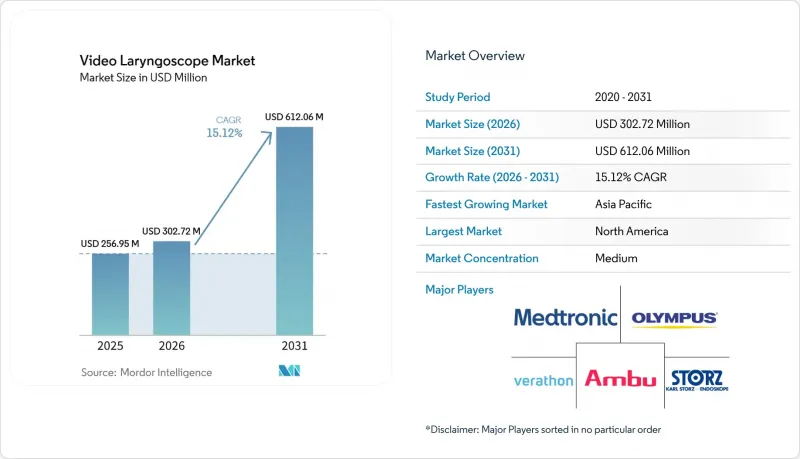
This report is Segmented by Product Type (Rigid Video Laryngoscopes and Flexible Video Laryngoscopes), Usability (Reusable Devices and Disposable Devices), Blade Geometry (Standard Curved, Hyper-Angulated, and Straight / Pediatric), Channel Type (Channeled and Non-Channeled), End User (Hospitals, Pre-Hospital / EMS, and More), and Geography. The Market Forecasts are Provided in Terms of Value (USD).
Global Video Laryngoscope Market Trends and Insights
Rising Incidence of Difficult Airway Cases and Surgical Volumes
Obesity and cervical-spine injury trends are elevating difficult-airway frequency, making indirect visualization indispensable for anesthesia providers. Meta-analyses published in 2024 showed that video laryngoscopes cut failed intubations by 42% compared with direct blades, a margin pivotal for emergency departments seeking to avoid surgical airways. Post-pandemic rebounds in elective surgery have further expanded the candidate pool for video-guided intubation. Institutional adoption of "universal video laryngoscopy" protocols accelerates unit utilization, especially in teaching hospitals where resident training emphasizes first-pass success. ISO 7376-2:2025 now codifies optical baselines, anchoring clinician confidence that any compliant device will perform adequately under difficult-airway conditions.
Post-COVID Infection-Control Push Toward Disposable Devices
The pandemic spotlighted the hidden costs of reusable blade reprocessing, which can exceed 15 minutes of staff time and consumables per cycle. Single-use blades eliminate those expenses and remove residual biofilm risk, trading USD 30-50 per procedure for guaranteed sterility. Revised 2024 FDA guidance also tightened reprocessing validation requirements, implicitly discouraging off-label reuse. European hospitals face sustainability mandates, so vendors are fielding bio-based polymers that meet both infection-control and environmental goals. These converging forces underpin the 16.85% CAGR projected for disposables.
High Capital Cost and Limited Reimbursement Pathways
Hospitals weigh USD 15,000-25,000 outlays for reusable systems against tight operating margins, while CPT code 31500 does not differentiate direct from video intubation, leaving facilities to absorb consumable expenses. Lease programs and value-based contracts tied to complication reduction are emerging but require robust actuarial data seldom available outside academic centers. Cost sensitivity is most acute in Latin America and parts of Asia, where equipment imports face tariffs that inflate list prices.
Other drivers and restraints analyzed in the detailed report include:
- Technological Advances: HD Imaging, Portability, and Wireless Connectivity
- AI-Assisted Intubation Analytics Boosting First-Pass Success
- Shortage of Trained Airway Specialists in LMICs
For complete list of drivers and restraints, kindly check the Table Of Contents.
Segment Analysis
Flexible systems accounted for a modest share of the video laryngoscope market at USD 55 million in 2026, but are forecast to grow at a 16.25% CAGR due to their superior maneuverability in cervical-spine-immobilized or limited-mouth-opening cases. Rigid platforms still held 64.55% 2025 revenue share, favored for routine surgical cases and lower acquisition cost.
Clinical trials in 2025 showed that flexible devices shaved 23 seconds off intubation time in trauma patients, reducing the risk of hypoxemia. Intensive-care units now deploy them for bedside awake intubations, while anesthesiology fellowships incorporate flexible-scope modules into curricula. Higher price tags and maintenance complexity mean rigid models will continue to dominate the video laryngoscope market through the forecast horizon.
Reusable systems generated 70.53% of 2025 revenue. Yet disposables are set to overtake in specific settings, as total-cost-of-ownership analyses favor single-use blades, particularly when reprocessing labor costs exceed USD 10 per cycle. Hospitals balancing infection-control compliance with sustainability budgets adopt hybrid fleets, using disposables for high-risk infectious cases and reusables elsewhere.
The disposable surge is anchored in ambulatory surgical centers, emergency rooms, and low-resource clinics lacking disinfection infrastructure. If blade prices drop to USD 20, disposables could match reusable per-procedure cost after 50-75 uses, accelerating penetration and lifting the wider video laryngoscope market.
Complete Report Scope:
- By Product Type
- Rigid Video Laryngoscopes
- Flexible Video Laryngoscopes
- By Usability
- Reusable Devices
- Disposable Devices
- By Blade Geometry
- Standard Curved
- Hyper-angulated
- Straight / Pediatric
- By Channel Type
- Channeled
- Non-channeled
- By End User
- Hospitals
- Pre-hospital / EMS
- Ambulatory Surgical Centers
- Others
- By Geography
- North America
- United States
- Canada
- Mexico
- Europe
- Germany
- United Kingdom
- France
- Italy
- Spain
- Rest of Europe
- Asia-Pacific
- China
- India
- Japan
- Australia
- South Korea
- Rest of Asia-Pacific
- Middle East and Africa
- GCC
- South Africa
- Rest of Middle East and Africa
- South America
- Brazil
- Argentina
- Rest of South America
- North America
Geography Analysis
North America generated 38.13% of 2025 revenue, buoyed by FDA 510(k) clearances that compress launch timelines and hospital budgets averaging USD 12-18 million annually for anesthesia technology. U.S. facilities are now replacing first-generation scopes with secure wireless models that integrate seamlessly with electronic records. At the same time, Canada and Mexico face slower uptake due to reimbursement caps and tariffs. Replacement sales constitute 40-50% of 2025-2026 demand, stabilizing the mature regional video laryngoscope market.
Asia-Pacific is forecast to grow at 16.51% CAGR, supported by India's Ayushman Bharat scheme, which lifted surgical volumes 18% in 2024-2025. China reports 97.18% penetration in tertiary centers yet <30% in county facilities, offering a substantial first-install market. Japan and South Korea are near saturation, focusing on AI-enhanced replacements rather than new installations. Tele-intubation pilots in Australia's Outback demonstrate how connectivity investments unlock new use cases for the video laryngoscope market.
Europe, the Middle East & Africa, and South America supply the remaining share. The EU's single-use plastics directive drives bio-based blade launches despite 15-20% higher costs. Gulf states equip new megahospitals with premium systems under Vision 2030 programs, whereas South American public hospitals wrestle with currency volatility and import duties. Regional distribution hubs and vendor financing could help relieve procurement bottlenecks and lift the global video laryngoscope market size further.
- Ambu
- Hebei Vimed Medical
- Infinium Medical
- Intersurgical Ltd.
- Karl Storz
- Medcaptain Medical
- Medtronic
- Nihon Kohden Corp.
- Olympus Corp.
- Pentax Medical
- Prodol Meditec S.A.
- Smiths Group
- Teleflex
- Timesco Healthcare
- Tuoren Group
- Venner Medical International
- Verathon
- Vyaire Medical
Additional Benefits:
- The market estimate (ME) sheet in Excel format
- 3 months of analyst support
TABLE OF CONTENTS
1 Introduction
- 1.1 Study Assumptions & Market Definition
- 1.2 Scope of the Study
2 Research Methodology
3 Executive Summary
4 Market Landscape
- 4.1 Market Overview
- 4.2 Market Drivers
- 4.2.1 Rising Incidence of Difficult Airway Cases & Surgical Volumes
- 4.2.2 Post-COVID Infection-Control Push toward Disposable Devices
- 4.2.3 Technological Advances: HD Imaging, Portability & Wireless
- 4.2.4 AI-assisted Intubation Analytics Boosting First-pass Success
- 4.2.5 Tele-intubation Initiatives in Rural EMS Systems
- 4.3 Market Restraints
- 4.3.1 High Capital Cost & Limited Reimbursement Pathways
- 4.3.2 Shortage of Trained Airway Specialists in LMICs
- 4.3.3 Environmental Concerns Over Single-use Plastic Blades
- 4.3.4 Cyber-Security / Data-Privacy Risks in Connected Devices
- 4.4 Supply-Chain Analysis
- 4.5 Technological Outlook
- 4.6 Regulatory Landscape
- 4.7 Porter's Five Forces
- 4.7.1 Threat of New Entrants
- 4.7.2 Bargaining Power of Suppliers
- 4.7.3 Bargaining Power of Buyers
- 4.7.4 Threat of Substitutes
- 4.7.5 Competitive Rivalry
5 Market Size & Growth Forecasts (Value, USD)
- 5.1 By Product Type
- 5.1.1 Rigid Video Laryngoscopes
- 5.1.2 Flexible Video Laryngoscopes
- 5.2 By Usability
- 5.2.1 Reusable Devices
- 5.2.2 Disposable Devices
- 5.3 By Blade Geometry
- 5.3.1 Standard Curved
- 5.3.2 Hyper-angulated
- 5.3.3 Straight / Pediatric
- 5.4 By Channel Type
- 5.4.1 Channeled
- 5.4.2 Non-channeled
- 5.5 By End User
- 5.5.1 Hospitals
- 5.5.2 Pre-hospital / EMS
- 5.5.3 Ambulatory Surgical Centers
- 5.5.4 Others
- 5.6 By Geography
- 5.6.1 North America
- 5.6.1.1 United States
- 5.6.1.2 Canada
- 5.6.1.3 Mexico
- 5.6.2 Europe
- 5.6.2.1 Germany
- 5.6.2.2 United Kingdom
- 5.6.2.3 France
- 5.6.2.4 Italy
- 5.6.2.5 Spain
- 5.6.2.6 Rest of Europe
- 5.6.3 Asia-Pacific
- 5.6.3.1 China
- 5.6.3.2 India
- 5.6.3.3 Japan
- 5.6.3.4 Australia
- 5.6.3.5 South Korea
- 5.6.3.6 Rest of Asia-Pacific
- 5.6.4 Middle East and Africa
- 5.6.4.1 GCC
- 5.6.4.2 South Africa
- 5.6.4.3 Rest of Middle East and Africa
- 5.6.5 South America
- 5.6.5.1 Brazil
- 5.6.5.2 Argentina
- 5.6.5.3 Rest of South America
- 5.6.1 North America
6 Competitive Landscape
- 6.1 Market Concentration
- 6.2 Market Share Analysis
- 6.3 Company Profiles (includes Global level Overview, Market level overview, Core Segments, Financials as available, Strategic Information, Market Rank/Share for key companies, Products & Services, and Recent Developments)
- 6.3.1 Ambu A/S
- 6.3.2 Hebei Vimed Medical
- 6.3.3 Infinium Medical
- 6.3.4 Intersurgical Ltd.
- 6.3.5 Karl Storz SE & Co. KG
- 6.3.6 Medcaptain Medical
- 6.3.7 Medtronic plc
- 6.3.8 Nihon Kohden Corp.
- 6.3.9 Olympus Corp.
- 6.3.10 Pentax Medical
- 6.3.11 Prodol Meditec S.A.
- 6.3.12 Smiths Medical (ICU Medical)
- 6.3.13 Teleflex Inc.
- 6.3.14 Timesco Healthcare
- 6.3.15 Tuoren Group
- 6.3.16 Venner Medical International
- 6.3.17 Verathon Inc.
- 6.3.18 Vyaire Medical
7 Market Opportunities & Future Outlook
- 7.1 White-space & Unmet-need Assessment

