PUBLISHER: Mordor Intelligence | PRODUCT CODE: 2116901

PUBLISHER: Mordor Intelligence | PRODUCT CODE: 2116901
Laryngoscope - Market Share Analysis, Industry Trends & Statistics, Growth Forecasts (2026 - 2031)
According to Mordor Intelligence, global laryngoscope market size in 2026 is estimated at USD 639.66 million, growing from 2025 value of USD 595.52 million with 2031 projections showing USD 914.48 million, growing at 7.41% CAGR over 2026-2031.
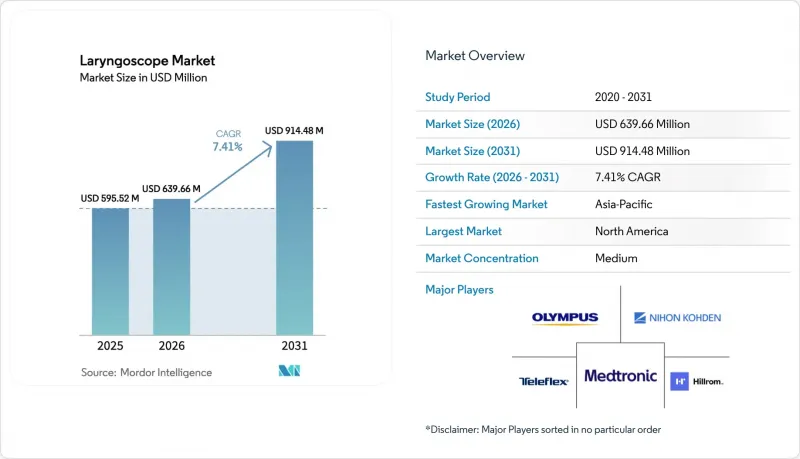
This report is Segmented by Product Type (Direct Laryngoscopes, Video-CMOS Laryngoscopes, and More), by Component (Blades, Handles, and More), by Usability (Disposable, Reusable), by Age Group (Neonatal & Pediatric, Adult, Geriatric), by End User (Hospitals, Clinics, and More), and by Geography (North America, Europe, Asia-Pacific, and More). The Market Forecasts are Provided in Terms of Value (USD).
Global Laryngoscope Market Trends and Insights
Rising Prevalence of Laryngeal Disorders & Airway-Management Procedures
Hoarseness after general anesthesia affected 11.77% of 104,720 patients reviewed in 2024, underscoring how common laryngoscopy-based follow-up has become. Direct procedural costs average USD 842 per diagnostic laryngoscopy, and ancillary expenses for consultations and therapy multiply the overall burden. Geriatric populations face higher dysphagia and malignancy risks, pushing clinicians toward early visualization strategies. High-speed videoendoscopy combined with AI now detects organic lesions with 93% accuracy, reshaping diagnostic protocols. These clinical realities sustain long-run demand for both reusable and single-use platforms across inpatient and outpatient settings.
Technological Advances in Video & Fiber-Optic Systems
Video laryngoscopy delivers 74% first-pass success in neonatal cases versus 45% for direct techniques, demonstrating clear performance advantages. Upgraded CMOS sensors bring brighter imaging and lower noise, while quick-connect battery handles cut setup times. Flexible fiber-optic scopes with slim profiles navigate irregular anatomies in ENT and trauma scenarios. Dual-view designs let operators keep traditional sight lines while capturing high-resolution video for documentation and teaching. Real-time AI overlays can mark epiglottis, vocal cords, and tracheal rings, supporting less-experienced practitioners and reducing complications.
Device-Related Airway Injuries & Postoperative Complications
Dental trauma, esophageal perforation, and laryngeal swelling continue to generate malpractice exposure. The FDA's Class I recall of McGrath MAC video laryngoscopes because of battery explosion risk underscores how safety events can disrupt procurement patterns. Pediatric intubations carry additional hazards due to narrow airways and limited blade size availability, prompting stricter credentialing and simulation training. Video platforms do mitigate many risks by enhancing glottic visualization, yet equipment failures or misuse still drive litigation and insurance premiums. Hospital risk-management departments therefore weigh safety data heavily when approving capital requests.
Other drivers and restraints analyzed in the detailed report include:
- Shift Toward Single-Use Devices for Infection Control Post-COVID-19
- AI-Enabled Real-Time Intubation Guidance Systems
- High Capital & Maintenance Cost of Advanced Systems
For complete list of drivers and restraints, kindly check the Table Of Contents.
Segment Analysis
Video-CMOS systems held 47.25% of the laryngoscope market share in 2025 thanks to unparalleled visualization and digital integration. First-pass success gains of nearly 30 percentage points over direct techniques win adoption in trauma bays and neonatal ICUs. Direct Macintosh and Miller designs persist in resource-constrained settings for their familiarity and low cost. Fiber-optic scopes address ENT and anticipated difficult airways where flexibility is indispensable.
Video platforms are forecast to grow 8.02% annually to 2031 as health systems codify video intubation into guidelines. As adoption deepens, real-time AI overlays and cloud-based video archiving become standard. Clinicians value the ability to record procedures for quality improvement and medico-legal documentation. Meanwhile, research prototypes that blend rigid optics with embedded augmented-reality cues hint at the next performance leap.
Blades accounted for 43.85% of the laryngoscope market size in 2025, reflecting their central role and frequent turnover. Metal and polymer edge designs now feature higher-intensity LED lighting and anti-fog coatings. Mac blades dominate adult surgery, while Miller variants are preferred for neonatal airways.
Consumables and accessories show an 8.44% CAGR, propelled by single-use adoption and modular clip-on sensors. Manufacturers pursue recurring revenue through proprietary blade cartridges and disposable light pipes. Hospitals readily approve these expenditures because unit cost is low relative to OR revenue and infection-control benefits are quantifiable.
Complete Report Scope:
- By Product Type
- Direct (Macintosh / Miller) Laryngoscopes
- Fibre-optic Laryngoscopes
- Video-CMOS Laryngoscopes
- Rigid Indirect & Others
- By Component
- Blades
- Mac Blades
- Miller Blades
- Handles
- Consumables & Accessories
- Blades
- By Usability
- Disposable
- Reusable
- By Age Group
- Neonatal & Pediatric
- Adult
- Geriatric
- By End User
- Hospitals
- Clinics
- Ambulatory Surgical Centres (ASCs)
- Others
- By Geography
- North America
- United States
- Canada
- Mexico
- Europe
- Germany
- United Kingdom
- France
- Italy
- Spain
- Rest of Europe
- Asia-Pacific
- China
- Japan
- India
- Australia
- South Korea
- Rest of Asia-Pacific
- Middle East and Africa
- GCC
- South Africa
- Rest of Middle East and Africa
- South America
- Brazil
- Argentina
- Rest of South America
- North America
Geography Analysis
North America held 39.10% of global revenue in 2025. EMS agencies mandate video-laryngoscopy kits on advanced life-support rigs, and hospitals integrate footage into electronic health records. FDA advisories on supply-chain and sterilization resilience shape purchasing decisions.Canada follows similar patterns, while Mexico's public-hospital modernization drives mid-tier adoption.
Asia-Pacific posts the highest growth at 9.25% CAGR. China funds broad device upgrades, pushing its medical-device market toward USD 210 billion by 2025. Japan's super-aging society spurs higher per-capita intubation rates. India and Southeast Asia invest in secondary-care networks and medical tourism, prioritizing cost-efficient yet advanced video blades. Reusable-handle plus disposable-blade bundles resonate in these markets.
Europe grows steadily under stringent waste-reduction and infection-prevention directives. Circular-economy regulations accelerate bio-based product rollouts. Germany and France equip ambulance fleets with compact video scopes, while the United Kingdom channels National Health Service funds toward AI-ready platforms. Emerging Central and Eastern European members tap EU cohesion funds to update ENT suites and anesthesia carts.
- Medtronic
- Ambu
- Karl Storz
- Verathon
- Teleflex
- Olympus
- Baxter (Hill-Rom Co., Inc.)
- Nihon Kohden
- Penlon Ltd (BPL Medical Technologies)
- Flexicare Medical
- Smiths Group
- Venner Medical International
- UE Medical Devices, Inc.
- Timesco Healthcare Ltd.
- Vivid Medical, Inc.
- Intersurgical Ltd.
- Clarus Medical
Additional Benefits:
- The market estimate (ME) sheet in Excel format
- 3 months of analyst support
TABLE OF CONTENTS
1 Introduction
- 1.1 Study Assumptions & Market Definition
- 1.2 Scope of the Study
2 Research Methodology
3 Executive Summary
4 Market Landscape
- 4.1 Market Overview
- 4.2 Market Drivers
- 4.2.1 Rising Prevalence of Laryngeal Disorders & Airway-management Procedures
- 4.2.2 Technological Advances in Video & Fibre-optic Systems
- 4.2.3 Shift Toward Single-use Devices for Infection Control Post-COVID-19
- 4.2.4 AI-enabled Real-time Intubation Guidance Systems\
- 4.2.5 Mandatory Video-laryngoscopy Protocols in Pre-hospital & Military care
- 4.2.6 Expansion of Ambulatory Surgical Centers and Outpatient Procedures
- 4.3 Market Restraints
- 4.3.1 Device-related Airway Injuries & Postoperative Complications
- 4.3.2 High Capital & Maintenance Cost of Advanced Systems
- 4.3.3 Environmental Scrutiny on Disposable Device Waste (ESG Pressure)
- 4.3.4 Supply-chain Disruptions for CMOS Image Sensors
- 4.4 Value / Supply-Chain Analysis
- 4.5 Regulatory Landscape
- 4.6 Technological Outlook
- 4.7 Porter's Five Forces Analysis
- 4.7.1 Threat of New Entrants
- 4.7.2 Bargaining Power of Buyers/Consumers
- 4.7.3 Bargaining Power of Suppliers
- 4.7.4 Threat of Substitute Products
- 4.7.5 Intensity of Competitive Rivalry
5 Market Size & Growth Forecasts (Value)
- 5.1 By Product Type
- 5.1.1 Direct (Macintosh / Miller) Laryngoscopes
- 5.1.2 Fibre-optic Laryngoscopes
- 5.1.3 Video-CMOS Laryngoscopes
- 5.1.4 Rigid Indirect & Others
- 5.2 By Component
- 5.2.1 Blades
- 5.2.1.1 Mac Blades
- 5.2.1.2 Miller Blades
- 5.2.2 Handles
- 5.2.3 Consumables & Accessories
- 5.2.1 Blades
- 5.3 By Usability
- 5.3.1 Disposable
- 5.3.2 Reusable
- 5.4 By Age Group
- 5.4.1 Neonatal & Pediatric
- 5.4.2 Adult
- 5.4.3 Geriatric
- 5.5 By End User
- 5.5.1 Hospitals
- 5.5.2 Clinics
- 5.5.3 Ambulatory Surgical Centres (ASCs)
- 5.5.4 Others
- 5.6 By Geography
- 5.6.1 North America
- 5.6.1.1 United States
- 5.6.1.2 Canada
- 5.6.1.3 Mexico
- 5.6.2 Europe
- 5.6.2.1 Germany
- 5.6.2.2 United Kingdom
- 5.6.2.3 France
- 5.6.2.4 Italy
- 5.6.2.5 Spain
- 5.6.2.6 Rest of Europe
- 5.6.3 Asia-Pacific
- 5.6.3.1 China
- 5.6.3.2 Japan
- 5.6.3.3 India
- 5.6.3.4 Australia
- 5.6.3.5 South Korea
- 5.6.3.6 Rest of Asia-Pacific
- 5.6.4 Middle East and Africa
- 5.6.4.1 GCC
- 5.6.4.2 South Africa
- 5.6.4.3 Rest of Middle East and Africa
- 5.6.5 South America
- 5.6.5.1 Brazil
- 5.6.5.2 Argentina
- 5.6.5.3 Rest of South America
- 5.6.1 North America
6 Competitive Landscape
- 6.1 Market Concentration
- 6.2 Market Share Analysis
- 6.3 Company Profiles (includes Global level Overview, Market level overview, Core Segments, Financials as available, Strategic Information, Market Rank/Share for key companies, Products & Services, and Recent Developments)
- 6.3.1 Medtronic plc
- 6.3.2 Ambu A/S
- 6.3.3 KARL STORZ GmbH & Co. KG
- 6.3.4 Verathon Inc.
- 6.3.5 Teleflex Incorporated
- 6.3.6 Olympus Corporation
- 6.3.7 Baxter (Hill-Rom Co., Inc.)
- 6.3.8 Nihon Kohden Corporation
- 6.3.9 Penlon Ltd (BPL Medical Technologies)
- 6.3.10 Flexicare Medical Limited
- 6.3.11 Smiths Medical
- 6.3.12 Venner Medical International
- 6.3.13 UE Medical Devices, Inc.
- 6.3.14 Timesco Healthcare Ltd.
- 6.3.15 Vivid Medical, Inc.
- 6.3.16 Intersurgical Ltd.
- 6.3.17 Clarus Medical LLC
7 Market Opportunities & Future Outlook
- 7.1 White-space & Unmet-Need Assessment

