PUBLISHER: Mordor Intelligence | PRODUCT CODE: 2097395

PUBLISHER: Mordor Intelligence | PRODUCT CODE: 2097395
FR-4 PCB - Market Share Analysis, Industry Trends & Statistics, Growth Forecasts (2026 - 2031)
According to Mordor Intelligence, the FR-4 printed circuit board market size reached USD 45.02 billion in 2026 and is projected to advance to USD 56.14 billion by 2031, reflecting a 4.51% CAGR.
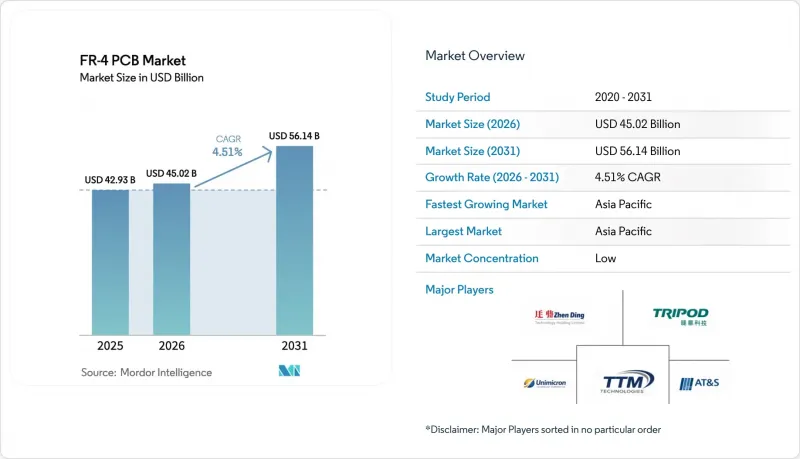
This report is Segmented by PCB Type (Standard Multilayer (non-HDI) Rigid, and More), Material Grade (Standard FR-4 (Tg 130°C-140°C), and More), End-Use Industry (Consumer Electronics, Computing and Data Centers, Telecommunications, Automotive and EV, Industrial and Power, Healthcare/Medical, Aerospace and Defense, and More), and Geography. The Market Forecasts are Provided in Terms of Value (USD).
Global FR-4 PCB Market Trends and Insights
Growing Miniaturization Trend in Consumer Electronics
Demand for thinner smartphones and wearables has driven a 34% jump in component density since 2022. Flagship devices now carry any-layer HDI boards with microvias only 0.075 millimeters wide, held within a 1.2-millimeter stack height. Rigid-flex constructions enable glucose monitors to wrap around 3-millimeter radii while maintaining IPC Class 3 reliability. Layer counts in high-end handsets rose from 8 in 2020 to 12 in 2025, lifting average laminate consumption per phone by 22% even as shipment volumes plateaued. As the FR-4 printed circuit board market integrates these HDI designs, mid-Tg formulations with tighter coefficient-of-thermal-expansion control protect solder joints over five-year duty cycles. The result is steady upside for producers that can image sub-50-micron lines without yield loss.
Accelerating Adoption of EV On-Board Chargers and Powertrains
Electric-vehicle power electronics regularly expose boards to 800-volt transients and localized hot spots nearing 175°C. BYD specified high-Tg laminates with decomposition temperatures above 340°C to withstand 3,000 fast-charge cycles in its Blade Battery system. Infineon's HybridPACK Drive G2 matches 1.2-kilovolt SiC MOSFETs to 10-layer FR-4 substrates clad with 105-micron copper foil, doubling conventional thickness to dissipate 15 kilowatts. Euro 7 diagnostics effective in July 2025 require voltage sensing within 10 millivolts, tightening trace-spacing rules to 0.05 millimeters. These conditions elevate high-Tg and heavy-copper constructions, securing a growth premium over the broader FR-4 Printed Circuit Board market.
Supply Insecurity of High-Tg Glass Yarns
Only three qualified producers supply alkali-resistant E-glass yarns able to maintain 0.02%-dimensional stability over 10,000 cycles. A fire at Jushi's Tongxiang plant removed 12% of global capacity for nine weeks in early 2025, doubling modified-epoxy lead times to 16 weeks. OEMs air-freighted yarn from Owens Corning's South Carolina site at quadruple normal cost. Automotive Tier-1 suppliers now hold 12-week buffer stock and pay a 6% premium for dual-sourced high-Tg laminates, tempering near-term volume elasticity in the FR-4 PCB market.
Other drivers and restraints analyzed in the detailed report include:
- Shrinking Server Motherboard Trace Widths in Hyperscale Data Centers
- Novel AI Accelerator Boards Driving Multilayer Count Per Device
- US-China Tech Decoupling Complicating Global Sourcing
For complete list of drivers and restraints, kindly check the Table Of Contents.
Segment Analysis
The FR-4 PCB market size for standard multilayer non-HDI product stood at USD 12.11 billion in 2025, translating to 26.87% of global revenue. Price-sensitive consumer devices and industrial controls continue to tolerate 0.15-millimeter lines and 0.3-millimeter through-hole vias. Yet flexible circuits are expanding at a 5.99% CAGR, a 148-basis-point uplift over the broader FR-4 printed circuit board market, as foldable phones and medical wearables demand 3-millimeter bend radii without delamination. HDI boards exceed 200 conductors per square inch, finding particular traction in AI accelerator modules and millimeter-wave radios. Rigid-flex designs, though lower in volume, remain indispensable for aerospace and defense contracts that specify IPC-6013 Class 3 endurance against 2,000 G shocks. One- and two-sided boards continue to exist in commodity lighting and power-supply niches as even low-cost appliances migrate to 4-layer layouts to satisfy stricter FCC radiated-emission rules. Heavy-copper FR-4 supports solar inverters and motor drives where trace current density reaches 10 amperes per square millimeter, commanding a threefold price premium over baseline laminates.
Demand elasticity differs sharply across types. HDI and rigid-flex orders carry cycle times of five to seven days in Taiwan and South Korea, reinforcing the competitive advantage of fabricators that invested early in laser-direct-imaging and automated optical inspection. Samsung Electro-Mechanics recorded a 34% year-over-year jump in rigid-flex shipments in 2025 as automotive head-up displays integrated flexible tails within tight instrument clusters. Meanwhile, Chinese quick-turn shops quote two-day prototype cycles for commodity eight-layer boards, driving 8-12% annual price erosion. As complexity rises, the FR-4 printed circuit board market share of high-layer-count product will continue to edge up at the expense of legacy double-sided formats.
Complete Report Scope:
- By PCB Type
- Standard Multilayer (non-HDI) Rigid
- 1-2 Sided
- High-Density Interconnect (HDI)
- Rigid-Flex
- Other PCB Type
- By Material Grade
- Standard FR-4 (Tg 130°C-140°C)
- Mid-Tg FR-4 (Tg 150°C-160°C)
- High-Tg FR-4 (Tg 170°C+)
- Halogen-Free FR-4
- By End-Use Industry
- Consumer Electronics
- Computing and Data Centres
- Telecommunications
- Automotive and EV
- Industrial and Power
- Healthcare / Medical
- Aerospace and Defense
- Other End-User Industries
- By Geography
- North America
- United States
- Rest of North America
- Europe
- United Kingdom
- Germany
- Netherlands
- Rest of Europe
- Asia-Pacific
- China
- Japan
- India
- South Korea
- Taiwan
- Southeast Asia
- Rest of Asia-Pacific
- Rest of World
- North America
Geography Analysis
Asia-Pacific anchored 82.54% of 2025 revenue and is on a 6.25% CAGR path through 2031. China supplied 58% of global capacity, yet India's Production Linked Incentive outlays of INR 550 billion (USD 6.6 billion) and Vietnam's USD 3.2 billion of 2025 investment signal a southward migration of cost-competitive volume. Taiwan preserves technology leadership with 22% of HDI capacity, serving Apple, NVIDIA, and AMD on 48-hour prototype cycles. Japan focuses on automotive and industrial jobs where zero-defect rates justify 30% price premiums.
North America and Europe combined for 17.46% of revenue in 2025 but benefit from reshoring. TTM Technologies doubled its Syracuse, New York, ITAR-compliant footprint in November 2025 to serve defense primes. AT&S added 24-layer HDI lines in Leoben, Austria, to chase 800-volt electric-vehicle contracts. Mexico's Guadalajara corridor grew PCB output 18% in 2025 as automotive OEMs nearshored procurement from Asia. South America remains a net importer despite Brazil's Lei de Informatica incentives.
Geopolitical risk reshapes sourcing. The US-China tech split forces dual-sourcing outside the People's Republic, lifting Malaysian, Thai, and Mexican share by 2026. European buyers favour in-region fabrication to comply with carbon-border-adjustment rules effective 2026. Meanwhile, lead times for prototypes in India dropped from 21 days in 2023 to 12 days by late 2025, narrowing the service gap with Taiwanese peers. Over the forecast horizon, the Asia-Pacific share of the FR-4 Printed Circuit Board market will ease modestly as regional diversification continues.
- AT&S AG
- TTM Technologies Inc.
- Tripod Technology Corp.
- Unimicron Technology Corp.
- Kingboard Holdings Ltd.
- Wus Printed Circuit Co. Ltd.
- Young Poong Electronics Co. Ltd.
- Nan Ya Printed Circuit Board Corp.
- Ibiden Co. Ltd.
- HannStar Board Corp.
- Zhen Ding Technology Holding Ltd.
- Compeq Manufacturing Co. Ltd.
- Sanmina Corp.
- NCAB Group AB
- Advanced Circuits Inc.
- Jabil Inc. (Chung Nam)
- Ellington Electronics Technology Group
- Shenzhen Kinwong Electronic Co. Ltd.
- Sumitomo Electric Printed Circuits Inc.
- Isola Group (Laminate Partner)
Additional Benefits:
- The market estimate (ME) sheet in Excel format
- 3 months of analyst support
TABLE OF CONTENTS
1 INTRODUCTION
- 1.1 Study Assumptions and Market Definition
- 1.2 Scope of the Study
2 RESEARCH METHODOLOGY
3 EXECUTIVE SUMMARY
4 MARKET LANDSCAPE
- 4.1 Market Overview
- 4.2 Market Drivers
- 4.2.1 Growing miniaturisation trend in consumer electronics
- 4.2.2 Accelerating adoption of EV on-board chargers and powertrains
- 4.2.3 Rapid rollout of 5G base-stations requiring low-loss FR-4 variants
- 4.2.4 Shrinking server motherboard trace widths in hyperscale data centres
- 4.2.5 Government incentives for domestic PCB fabrication in India and Vietnam
- 4.2.6 Novel AI accelerator boards driving multilayer count per device
- 4.3 Market Restraints
- 4.3.1 Supply insecurity of high-Tg glass yarns
- 4.3.2 Rising sustainability pressure versus halogen-rich epoxy chemistries
- 4.3.3 Intensifying price competition from polyimide and metal-core PCBs
- 4.3.4 US-China tech decoupling complicating global sourcing
- 4.4 Impact of Macroeconomic Factors on the Market
- 4.5 Industry Value-Chain Analysis
- 4.6 Regulatory Landscape
- 4.7 Technological Outlook
- 4.8 Porter's Five Forces Analysis
- 4.8.1 Threat of New Entrants
- 4.8.2 Bargaining Power of Suppliers
- 4.8.3 Bargaining Power of Buyers
- 4.8.4 Threat of Substitutes
- 4.8.5 Competitive Rivalry
5 MARKET SIZE AND GROWTH FORECASTS (VALUE)
- 5.1 By PCB Type
- 5.1.1 Standard Multilayer (non-HDI) Rigid
- 5.1.2 1-2 Sided
- 5.1.3 High-Density Interconnect (HDI)
- 5.1.4 Rigid-Flex
- 5.1.5 Other PCB Type
- 5.2 By Material Grade
- 5.2.1 Standard FR-4 (Tg 130°C-140°C)
- 5.2.2 Mid-Tg FR-4 (Tg 150°C-160°C)
- 5.2.3 High-Tg FR-4 (Tg 170°C+)
- 5.2.4 Halogen-Free FR-4
- 5.3 By End-Use Industry
- 5.3.1 Consumer Electronics
- 5.3.2 Computing and Data Centres
- 5.3.3 Telecommunications
- 5.3.4 Automotive and EV
- 5.3.5 Industrial and Power
- 5.3.6 Healthcare / Medical
- 5.3.7 Aerospace and Defense
- 5.3.8 Other End-User Industries
- 5.4 By Geography
- 5.4.1 North America
- 5.4.1.1 United States
- 5.4.1.2 Rest of North America
- 5.4.2 Europe
- 5.4.2.1 United Kingdom
- 5.4.2.2 Germany
- 5.4.2.3 Netherlands
- 5.4.2.4 Rest of Europe
- 5.4.3 Asia-Pacific
- 5.4.3.1 China
- 5.4.3.2 Japan
- 5.4.3.3 India
- 5.4.3.4 South Korea
- 5.4.3.5 Taiwan
- 5.4.3.6 Southeast Asia
- 5.4.3.7 Rest of Asia-Pacific
- 5.4.4 Rest of World
- 5.4.1 North America
6 COMPETITIVE LANDSCAPE
- 6.1 Market Concentration
- 6.2 Strategic Moves
- 6.3 Market Share Analysis
- 6.4 Company Profiles (includes Global Level Overview, Market Level Overview, Core Segments, Financials as available, Strategic Information, Market Rank/Share, Products and Services, Recent Developments)
- 6.4.1 AT&S AG
- 6.4.2 TTM Technologies Inc.
- 6.4.3 Tripod Technology Corp.
- 6.4.4 Unimicron Technology Corp.
- 6.4.5 Kingboard Holdings Ltd.
- 6.4.6 Wus Printed Circuit Co. Ltd.
- 6.4.7 Young Poong Electronics Co. Ltd.
- 6.4.8 Nan Ya Printed Circuit Board Corp.
- 6.4.9 Ibiden Co. Ltd.
- 6.4.10 HannStar Board Corp.
- 6.4.11 Zhen Ding Technology Holding Ltd.
- 6.4.12 Compeq Manufacturing Co. Ltd.
- 6.4.13 Sanmina Corp.
- 6.4.14 NCAB Group AB
- 6.4.15 Advanced Circuits Inc.
- 6.4.16 Jabil Inc. (Chung Nam)
- 6.4.17 Ellington Electronics Technology Group
- 6.4.18 Shenzhen Kinwong Electronic Co. Ltd.
- 6.4.19 Sumitomo Electric Printed Circuits Inc.
- 6.4.20 Isola Group (Laminate Partner)
7 MARKET OPPORTUNITIES AND FUTURE OUTLOOK
- 7.1 White-Space and Unmet-Need Assessment

