PUBLISHER: Mordor Intelligence | PRODUCT CODE: 2097403

PUBLISHER: Mordor Intelligence | PRODUCT CODE: 2097403
AI In Clinical Knowledge Platforms - Market Share Analysis, Industry Trends & Statistics, Growth Forecasts (2026 - 2031)
According to Mordor Intelligence, the AI in clinical knowledge platforms market size is expected to increase from USD 2.60 billion in 2025 to USD 3.20 billion in 2026 and reach USD 8.90 billion by 2031, growing at a CAGR of 22.79% over 2026-2031.
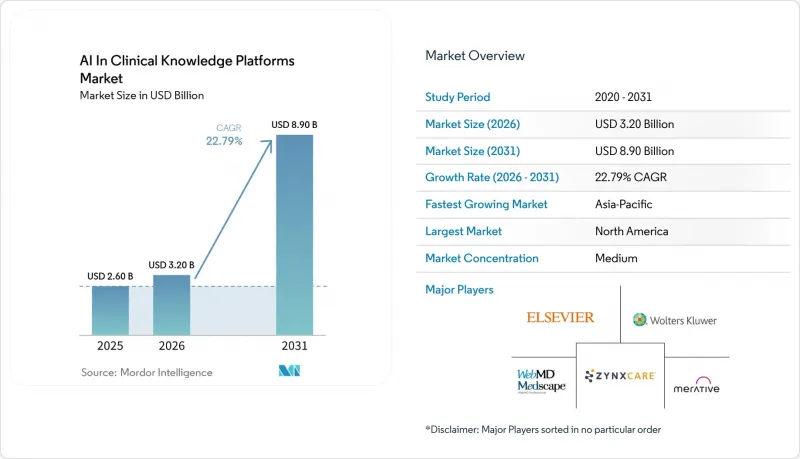
This report is Segmented by Product (Standalone CDSS, Integrated CPOE With CDSS, Integrated EHR With CDSS), Model (Knowledge-Based, Non-Knowledge-Based AI/ML), Delivery Mode (On-Premises, Cloud/Web), Setting (Inpatient, Ambulatory/Outpatient), Application (Drug Allergy Alerts and More), and Geography (North America and More). Market Forecasts are Provided in Value (USD).
Global AI In Clinical Knowledge Platforms Market Trends and Insights
EHR-Integrated, Evidence-Based Answers at Point of Care
Clinicians currently spend approximately two hours per shift navigating reference websites, guideline portals, and drug databases. Embedded decision support is addressing this inefficiency by providing context-specific answers directly within electronic health records (EHR). Epic's AI Charting, implemented in multiple U.S. systems since 2025, streamlines workflows by summarizing visits and identifying guideline deviations, reducing documentation time by up to 15 minutes per patient encounter. In 2026, Wolters Kluwer partnered with Microsoft to integrate UpToDate's extensive database into Microsoft DAX Copilot, enabling users to access evidence without leaving the EHR.Hospitals are increasingly prioritizing single-sign-on capabilities and FHIR APIs that maintain audit trails, pressuring standalone vendors to adopt open connectors or risk losing market presence. This shift reflects a broader industry trend toward embedding intelligence directly into workflows, securing longer-term contracts for vendors that meet interoperability standards.
Clinician Productivity Pressure Driving AI Copilots
Physician burnout exceeded 50% in 2025, with charting and inbox management identified as primary contributors. This has driven demand for AI copilots that automate note creation and streamline administrative tasks. By mid-2025, Microsoft's DAX Copilot had been adopted by over 200 health systems, saving an average of 5-7 minutes per office visit. EBSCO's Dyna AI Mode, introduced in 2026, integrates conversational answers within DynaMed, recording each interaction with timestamps and enabling clinicians to incorporate evidence directly into their notes. These productivity gains are particularly significant in primary-care settings, where patient panel sizes have increased by 30% without corresponding changes in visit durations. Importantly, these tools are designed with human oversight to ensure compliance with emerging FDA guidelines, which emphasize clinician accountability for algorithmic outputs.
GenAI Accuracy and Safety Concerns in Clinical Use
Benchmark studies have shown that general LLMs, when addressing clinical queries, can exhibit hallucination rates of up to 15%. These inaccuracies have occasionally resulted in the citation of non-existent sources or unsafe dosing recommendations. In response, the FDA introduced clinical decision support guidelines in January 2026, requiring provenance documentation, model update protocols, and rigorous post-market surveillance for higher-risk tools. These measures have narrowed previously broad exemptions. Similarly, Brazil's CFM Resolution in August 2026 mandated validation audits and prohibited the exclusive reliance on AI for critical communications. Specialties such as obstetrics and oncology, which face higher malpractice risks, remain cautious and are awaiting improvements in AI explainability.
Other drivers and restraints analyzed in the detailed report include:
- Medication Safety and Pharmacy CDS Modernization
- Licensed, Publisher-Owned GenAI Copilots Build Trust
- Workflow/EHR Integration and IT Backlog Constraints
For complete list of drivers and restraints, kindly check the Table Of Contents.
Segment Analysis
In 2025, integrated EHR deployments dominated the AI in Clinical Knowledge Platforms market, capturing 58.18% of the revenue. Hospitals are increasingly opting for single-vendor solutions to ensure accountability, provide a seamless user experience, and maintain unified audit trails. Companies like Epic and Oracle Health embed features such as guideline checking, note summarization, and ambient documentation directly into core workflows. This integration reduces the need for clinicians to switch between applications and minimizes training requirements. While standalone CDSS is projected to grow at a robust 24.16% CAGR, it must either deepen its specialty focus or ensure cross-EHR interoperability to remain competitive. The market share for standalone tools in the AI in Clinical Knowledge Platforms space is expanding in ambulatory networks, particularly where diverse EHR systems dominate and modular tools outperform traditional monolithic stacks.
Knowledge-based platforms accounted for 65.13% of the 2025 revenue, driven by their transparent, human-edited rules that align with regulatory preferences for explainability. Platforms like UpToDate, DynaMed, and BMJ Best Practice rely on physician editors to curate recommendations and disclose conflicts of interest, fostering clinician trust. However, non-knowledge-based AI/ML algorithms are scaling at a 25.16% CAGR, leveraging retrieval-augmented generation to contextualize recommendations with the latest research. This development is expanding the AI in Clinical Knowledge Platforms market by introducing adaptive models that learn from institutional data patterns without requiring manual rule set updates.
Complete Report Scope:
- By Product
- Standalone CDSS
- Integrated CPOE with CDSS
- Integrated EHR with CDSS
- By Model
- Knowledge-based
- Non-knowledge-based (AI/ML)
- By Delivery Mode
- On-premises
- Cloud/Web
- By Setting
- Inpatient settings
- Ambulatory/Outpatient settings
- By Application
- Drug allergy alerts
- Drug dosing & IV compatibility
- Clinical guidelines & pathways
- Point-of-care clinical answers
- Diagnostic decision support
- Others
- By Geography
- North America
- United States
- Canada
- Mexico
- Europe
- Germany
- United Kingdom
- France
- Italy
- Spain
- Rest of Europe
- Asia-Pacific
- China
- India
- Japan
- South Korea
- Australia
- Rest of Asia-Pacific
- Middle East & Africa
- GCC
- South Africa
- Rest of Middle East and Africa
- South America
- Brazil
- Argentina
- Rest of South America
- North America
Geography Analysis
In 2025, North America led the AI in Clinical Knowledge Platforms market, contributing 42.18% of the revenue. This leadership is primarily due to Epic and Oracle Health, which collectively dominate over 70% of the electronic health record (EHR) market in U.S. hospitals. Additionally, clear FDA guidelines have exempted certain low-risk clinical decision support (CDS) tools from stringent regulations. The region faces significant burnout rates among healthcare professionals but continues to attract substantial venture capital funding, as demonstrated by Hippocratic AI's USD 126 million Series C funding round in April 2026. Combined with pressures from value-based payment models, these factors have created a market environment where stakeholders are willing to invest at a premium. Canada, while slightly behind the U.S., benefits from nationwide interoperability initiatives that effectively reduce integration costs.
Europe has maintained steady growth in the mid-teens range. The region's single-payer systems, such as NHS England, have utilized blanket licenses, as evidenced by their 2025 diagnostic AI registry, to ensure consistent access to AI tools for 1.5 million clinicians. However, the EU AI Act presents challenges by classifying most decision support tools as "high-risk," necessitating strict conformance audits and transparency requirements. This has resulted in longer procurement cycles. Despite these hurdles, the region demonstrates adaptability, with Germany's leading radiology firms and France's AP-HP projects serving as early compliance models.
Asia-Pacific is projected to achieve a strong 26.55% CAGR through 2031, driven by government mandates and minimal legacy IT constraints. In China, major technology companies like Alibaba Cloud and Tencent are driving the development of extensive telehealth platforms that extend to tier-2 cities. In India, the Ayushman Bharat Digital Mission is advancing FHIR-based personal health records, opening opportunities for third-party CDS applications. Japan is also making strides with its national electronic medication record system, which enhances pharmacy safety and encourages local vendors to integrate AI for polypharmacy management.
- BMJ Group
- ClinicalKey Student & Institutional
- EBSCO Information Services
- Elsevier Clinical Drug Information
- Elsevier Health
- EvidenceCare
- Isabel Healthcare
- McGraw Hill
- Medscape Education/Reference for point-of-care
- Merative
- PEPID
- QxMD
- Stanson Health
- Thieme
- Unbound Medicine
- VisualDx
- WebMD/Medscape
- Wolters Kluwer Health
- Zynx Health
Additional Benefits:
- The market estimate (ME) sheet in Excel format
- 3 months of analyst support
TABLE OF CONTENTS
1 Introduction
- 1.1 Study Assumptions & Market Definition
- 1.2 Scope of the Study
2 Research Methodology
3 Executive Summary
4 Market Landscape
- 4.1 Market Overview
- 4.2 Market Drivers
- 4.2.1 EHR-Integrated, Evidence-Based Answers at Point of Care
- 4.2.2 Clinician Productivity Pressure Driving AI Copilots
- 4.2.3 Medication Safety and Pharmacy CDS Modernization
- 4.2.4 Licensed, Publisher-Owned Genai Copilots Build Trust
- 4.2.5 National-Scale Licensing Expands Reach (E.G., NHS)
- 4.3 Market Restraints
- 4.3.1 GenAI Accuracy and Safety Concerns in Clinical Use
- 4.3.2 Workflow/EHR Integration and IT Backlog Constraints
- 4.3.3 Tighter CDS/AI Regulatory Obligations Raise Cost
- 4.3.4 Provenance/IP Constraints on Training and RAG Content
- 4.4 Value / Supply-Chain Analysis
- 4.5 Regulatory Landscape
- 4.6 Technological Outlook
- 4.7 Porter's Five Forces Analysis
- 4.7.1 Threat of New Entrants
- 4.7.2 Bargaining Power of Suppliers
- 4.7.3 Bargaining Power of Buyers
- 4.7.4 Threat of Substitutes
- 4.7.5 Competitive Rivalry
5 Market Size & Growth Forecasts (Value, USD)
- 5.1 By Product
- 5.1.1 Standalone CDSS
- 5.1.2 Integrated CPOE with CDSS
- 5.1.3 Integrated EHR with CDSS
- 5.2 By Model
- 5.2.1 Knowledge-based
- 5.2.2 Non-knowledge-based (AI/ML)
- 5.3 By Delivery Mode
- 5.3.1 On-premises
- 5.3.2 Cloud/Web
- 5.4 By Setting
- 5.4.1 Inpatient settings
- 5.4.2 Ambulatory/Outpatient settings
- 5.5 By Application
- 5.5.1 Drug allergy alerts
- 5.5.2 Drug dosing & IV compatibility
- 5.5.3 Clinical guidelines & pathways
- 5.5.4 Point-of-care clinical answers
- 5.5.5 Diagnostic decision support
- 5.5.6 Others
- 5.6 By Geography
- 5.6.1 North America
- 5.6.1.1 United States
- 5.6.1.2 Canada
- 5.6.1.3 Mexico
- 5.6.2 Europe
- 5.6.2.1 Germany
- 5.6.2.2 United Kingdom
- 5.6.2.3 France
- 5.6.2.4 Italy
- 5.6.2.5 Spain
- 5.6.2.6 Rest of Europe
- 5.6.3 Asia-Pacific
- 5.6.3.1 China
- 5.6.3.2 India
- 5.6.3.3 Japan
- 5.6.3.4 South Korea
- 5.6.3.5 Australia
- 5.6.3.6 Rest of Asia-Pacific
- 5.6.4 Middle East & Africa
- 5.6.4.1 GCC
- 5.6.4.2 South Africa
- 5.6.4.3 Rest of Middle East and Africa
- 5.6.5 South America
- 5.6.5.1 Brazil
- 5.6.5.2 Argentina
- 5.6.5.3 Rest of South America
- 5.6.1 North America
6 Competitive Landscape
- 6.1 Market Concentration
- 6.2 Market Share Analysis
- 6.3 Company Profiles (includes Global level Overview, Market-level Overview, Core Segments, Financials, Strategic Information, Market Rank/Share, Products & Services, Recent Developments)
- 6.3.1 BMJ Group
- 6.3.2 ClinicalKey Student & Institutional
- 6.3.3 EBSCO Information Services
- 6.3.4 Elsevier Clinical Drug Information
- 6.3.5 Elsevier Health
- 6.3.6 EvidenceCare
- 6.3.7 Isabel Healthcare
- 6.3.8 McGraw Hill
- 6.3.9 Medscape Education/Reference for point-of-care
- 6.3.10 Merative
- 6.3.11 PEPID
- 6.3.12 QxMD
- 6.3.13 Stanson Health
- 6.3.14 Thieme
- 6.3.15 Unbound Medicine
- 6.3.16 VisualDx
- 6.3.17 WebMD/Medscape
- 6.3.18 Wolters Kluwer Health
- 6.3.19 Zynx Health
7 Market Opportunities & Future Outlook
- 7.1 White-space & unmet-need assessment

