PUBLISHER: Mordor Intelligence | PRODUCT CODE: 2097431

PUBLISHER: Mordor Intelligence | PRODUCT CODE: 2097431
Germany AI-powered Energy Management Software - Market Share Analysis, Industry Trends & Statistics, Growth Forecasts (2026 - 2031)
According to Mordor Intelligence, the Germany AI-powered energy management software market size is expected to increase from USD 275.37 million in 2025 to USD 317.50 million in 2026 and reach USD 686.38 million by 2031, growing at a CAGR of 16.67% over 2026-2031.
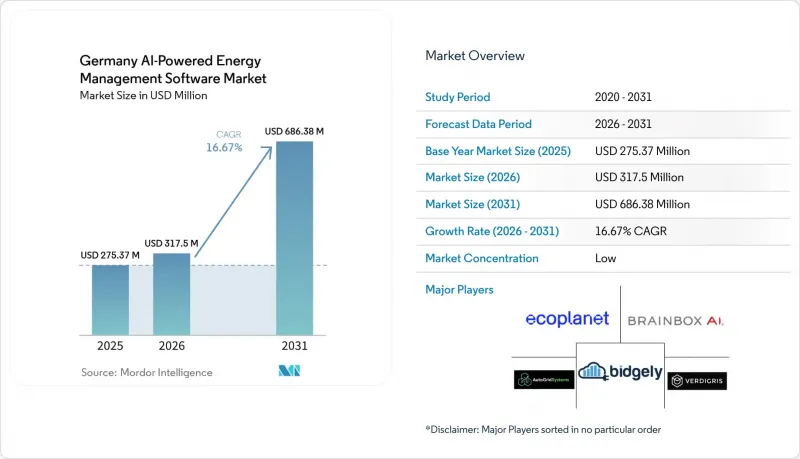
This report is Segmented by Component (Software, Services), Deployment Mode (Cloud-Based, On-Premises, Hybrid), Application (Energy Consumption, Asset Performance, Smart Grid, Renewable Forecasting, Energy Trading), and End User (Utilities, Commercial Buildings, Industrial Facilities, Residential Buildings). The Market Forecasts are in Terms of Value (USD).
Germany AI-powered Energy Management Software Market Trends and Insights
Accelerating Grid Flexibility Requirements
Germany's target to move to 80% renewable electricity by 2030 and fossil-free power generation by 2035 is pushing grid operators to rely on faster digital balancing tools. The Dena SET Pilot 4 showed that AI-based control of flexibility in nonresidential buildings can operate with dynamic tariffs and time-variable grid charges in a real operating environment. That matters because manual control methods cannot keep pace when renewable output, building demand, and flexible loads shift across short time intervals. The Germany AI-powered Energy Management Software Market is therefore seeing stronger demand for platforms that can forecast, dispatch, and optimize with limited delay. This driver is strongest where industrial load density is high, and grid stability needs are more immediate.
Rising Demand For AI-Driven Load Management
Germany's commercial and industrial power use is under added pressure from electrification, which is increasing the value of flexible and data-driven load control. The Dena pilot confirmed that a hybrid cloud-edge AI energy management system can respond to dynamic tariffs and variable grid charges in ways that align with real operating needs. C3 AI has also demonstrated in enterprise energy deployments that high-frequency forecasting can combine load and price signals within a single decision environment. Buyers now see these tools less as optional analytics and more as a way to reduce peak exposure and improve operational control. The Germany AI-powered Energy Management Software Market is benefiting from this shift, as demand management is becoming a daily operating requirement rather than a pilot use case.
Fragmented Building Data And Legacy Infrastructure
Germany amended the Messstellenbetriebsgesetz in February 2025 to accelerate smart meter rollout, which showed that deployment was still behind what the energy transition requires. Dena also identified faster smart meter rollout as one of the unresolved structural conditions for scaling AI-based flexibility control. Where buildings and utility systems still operate with incomplete device, meter, and control records, AI models start from weaker inputs. That slows the Germany AI-powered Energy Management Software Market because buyers want proof of performance before they expand deployments across older portfolios. Legacy infrastructure, therefore, remains a practical barrier even when long-term demand conditions are favorable.
Other drivers and restraints analyzed in the detailed report include:
- Expanding Smart Building Retrofit Programs
- Growing Need For Automated Energy Compliance
- Cybersecurity And Data Sovereignty Concerns
For complete list of drivers and restraints, kindly check the Table Of Contents.
Segment Analysis
Software captured 68.12% of the German AI-Powered Energy Management System market in 2025, which shows that buyers are prioritizing adaptable digital layers over hardware-led replacement cycles. Software leadership is tied to its ability to work with existing building automation, smart meter gateways, and utility control environments without forcing a full rebuild of installed systems. The Germany AI-powered Energy Management Software Market also favors software, as subscription models can update forecasting and optimization logic as the generation mix and tariff environment change. Services are projected to expand at a 18.23% CAGR through 2031, as implementation, model retraining, support, and operational tuning continue after the initial rollout.
This segment is also shaped by the move away from single-purpose tools toward platforms that combine forecasting, monitoring, predictive maintenance, and demand response in a single operating layer. Buyers across utilities, buildings, and industrial sites are trying to reduce system fragmentation, which supports broader software adoption in the Germany AI-powered Energy Management Software Market. In January 2026, Itron deepened its Microsoft collaboration and integrated generative AI technology into the Intelligent Edge Operating System, demonstrating how major vendors are expanding software capabilities across their installed infrastructure base. Software, therefore, remains the anchor segment, while services grow faster as deployments become more operationally complex.
Cloud-based deployment held 52.04% of the Germany AI-powered Energy Management Software Market size in 2025, supported by easier scaling, lower upfront burden, and faster access to updated AI tools. On-premises setups still matter where operators want tighter local control over operational data and site-level decision paths. Hybrid deployment is projected to grow at a 18.97% CAGR through 2031, as it combines local response speed with broader optimization across connected assets. That balance is important in the Germany AI-powered Energy Management Software Market, where site responsiveness and centralized analytics both carry weight.
The Dena pilot provided a practical reference point by using a hybrid cloud-edge architecture for AI-based flexibility control in a non-residential building. The model works because facilities can react quickly on-site while still using broader datasets for optimization and learning. The Germany AI-powered Energy Management Software Market is therefore moving beyond a simple cloud-versus-on-premises choice toward deployment models built around control speed, auditability, and integration depth. Vendors that can demonstrate clean data flows across the edge and the cloud are likely to win more utility and industrial tenders.
Complete Report Scope:
- By Component
- Software
- Services
- By Deployment Mode
- Cloud-Based
- On-Premises
- Hybrid
- By Application
- Energy Consumption and Demand Optimization
- Asset Performance and Predictive Maintenance
- Smart Grid and Distributed Energy Resource (DER) Management
- Renewable Energy Forecasting and Integration
- Energy Trading, Pricing and Market Intelligence
- By End User
- Utilities
- Commercial Buildings
- Industrial Facilities
- Residential Buildings
List of Companies Covered in this Report:
- AutoGrid Systems, Inc.
- Bidgely, Inc.
- BrainBox AI Inc.
- BuildingIQ, Inc.
- C3.AI, Inc.
- Carbon Lighthouse, Inc.
- CopperTree Analytics Inc.
- DEXMA Sensors, S.L.
- ecoplanet GmbH
- EnergyCAP, LLC
- Enertiv, Inc.
- Flexidao Ltd.
- GridPoint, Inc.
- Green Fusion GmbH
- Itron, Inc.
- KODE Labs, Inc.
- Landis+Gyr Group AG
- Lumenaza GmbH
- Open Energy Solutions GmbH
- Optiwatt, Inc.
- Pecan Street Inc.
- Smappee NV
- Spacewell International N.V.
- Tibber AS
- Verdigris Technologies, Inc.
- Wattics Limited
- 7Signal, LLC
- WiredScore, Inc.
- ZE PowerGroup Inc.
- ZENNER International GmbH & Co. KG
Additional Benefits:
- The market estimate (ME) sheet in Excel format
- 3 months of analyst support
TABLE OF CONTENTS
1 INTRODUCTION
- 1.1 Study Assumptions and Market Definition
- 1.2 Scope of the Study
2 RESEARCH METHODOLOGY
3 EXECUTIVE SUMMARY
4 MARKET LANDSCAPE
- 4.1 Market Overview
- 4.2 Market Drivers
- 4.2.1 Accelerating Grid Flexibility Requirements From Renewables and Electrification
- 4.2.2 Rising Demand for AI-Driven Load Forecasting and Peak Shaving
- 4.2.3 Expanding Smart Building Retrofits Across Commercial Portfolios
- 4.2.4 Growing Need for Automated Energy Cost and Carbon Optimization
- 4.2.5 Utility Incentives for Demand Response and Distributed Energy Resource Orchestration
- 4.2.6 Increased Adoption of Edge-Aware Analytics for Real-Time Energy Control
- 4.3 Market Restraints
- 4.3.1 Fragmented Building Data and Legacy System Interoperability Gaps
- 4.3.2 Cybersecurity and Data Sovereignty Concerns for Operational Technology Data
- 4.3.3 High Integration and Change Management Costs for Midmarket Buyers
- 4.3.4 Limited Trust in Autonomous Control Decisions in Safety-Critical Assets
- 4.4 Industry Value Chain Analysis
- 4.5 Impact of Macroeconomic Factors on the Market
- 4.6 Regulatory Landscape
- 4.7 Technological Outlook
- 4.8 Porter's Five Forces Analysis
- 4.8.1 Bargaining Power of Suppliers
- 4.8.2 Bargaining Power of Buyers
- 4.8.3 Threat of New Entrants
- 4.8.4 Threat of Substitutes
- 4.8.5 Competitive Rivalry
5 MARKET SIZE AND GROWTH FORECASTS (VALUE)
- 5.1 By Component
- 5.1.1 Software
- 5.1.2 Services
- 5.2 By Deployment Mode
- 5.2.1 Cloud-Based
- 5.2.2 On-Premises
- 5.2.3 Hybrid
- 5.3 By Application
- 5.3.1 Energy Consumption and Demand Optimization
- 5.3.2 Asset Performance and Predictive Maintenance
- 5.3.3 Smart Grid and Distributed Energy Resource (DER) Management
- 5.3.4 Renewable Energy Forecasting and Integration
- 5.3.5 Energy Trading, Pricing and Market Intelligence
- 5.4 By End User
- 5.4.1 Utilities
- 5.4.2 Commercial Buildings
- 5.4.3 Industrial Facilities
- 5.4.4 Residential Buildings
6 COMPETITIVE LANDSCAPE
- 6.1 Market Concentration
- 6.2 Strategic Moves
- 6.3 Market Share Analysis
- 6.4 Company Profiles (includes Global Level Overview, Market Level Overview, Core Segments, Financials as available, Strategic Information, Market Rank/Share, Products and Services, Recent Developments)
- 6.4.1 AutoGrid Systems, Inc.
- 6.4.2 Bidgely, Inc.
- 6.4.3 BrainBox AI Inc.
- 6.4.4 BuildingIQ, Inc.
- 6.4.5 C3.ai, Inc.
- 6.4.6 Carbon Lighthouse, Inc.
- 6.4.7 CopperTree Analytics Inc.
- 6.4.8 DEXMA Sensors, S.L.
- 6.4.9 ecoplanet GmbH
- 6.4.10 EnergyCAP, LLC
- 6.4.11 Enertiv, Inc.
- 6.4.12 Flexidao Ltd.
- 6.4.13 GridPoint, Inc.
- 6.4.14 Green Fusion GmbH
- 6.4.15 Itron, Inc.
- 6.4.16 KODE Labs, Inc.
- 6.4.17 Landis+Gyr Group AG
- 6.4.18 Lumenaza GmbH
- 6.4.19 Open Energy Solutions GmbH
- 6.4.20 Optiwatt, Inc.
- 6.4.21 Pecan Street Inc.
- 6.4.22 Smappee NV
- 6.4.23 Spacewell International N.V.
- 6.4.24 Tibber AS
- 6.4.25 Verdigris Technologies, Inc.
- 6.4.26 Wattics Limited
- 6.4.27 7Signal, LLC
- 6.4.28 WiredScore, Inc.
- 6.4.29 ZE PowerGroup Inc.
- 6.4.30 ZENNER International GmbH & Co. KG
7 MARKET OPPORTUNITIES AND FUTURE OUTLOOK
- 7.1 White-Space and Unmet-Need Assessment

