PUBLISHER: Mordor Intelligence | PRODUCT CODE: 2097495

PUBLISHER: Mordor Intelligence | PRODUCT CODE: 2097495
United States Digestive Health Products - Market Share Analysis, Industry Trends & Statistics, Growth Forecasts (2026 - 2031)
According to Mordor Intelligence, the United States digestive health products market was valued at USD 14.91 billion in 2025 and is projected to grow from USD 16.08 billion in 2026 to reach USD 23.69 billion by 2031, registering a CAGR of 8.06% during the forecast period from 2026 to 2031.
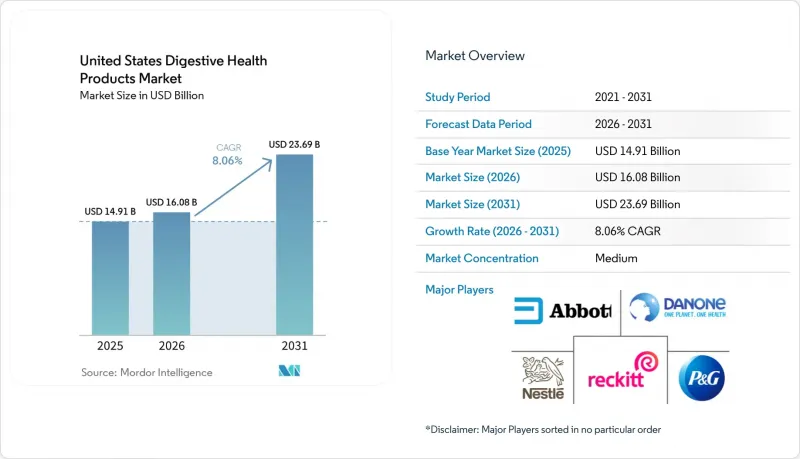
This report is Segmented by Product Type (Dairy Products, Non-Alcoholic Beverages, and More), Ingredient Type (Prebiotics, Probiotics, and More), Form (Tablets/Capsules, Powder, and More), End User (Adults and Kids), Distribution Channel (Supermarkets/Hypermarkets, Online Retail Stores, and More). The Market Forecasts are Provided in Terms of Value (USD).
United States Digestive Health Products Market Trends and Insights
Prevalence of digestive disorders and gastrointestinal health concerns
The digestive health products market in the United States is growing steadily, driven by the increasing number of people facing gastrointestinal (GI) issues. A survey conducted by Educated Patient in March 2026 revealed that half of Americans (50%) either have a diagnosed GI condition or suspect they may have one, underscoring significant demand for digestive health solutions. Additionally, 52% of Americans view common digestive problems like bloating, constipation, and irregular bowel movements as a normal part of life, which points to a gap in awareness and preventive care. This growing awareness of digestive health has led to increased use of products such as probiotics, prebiotics, fiber supplements, digestive enzymes, and functional foods. Consumers are increasingly incorporating these products into their daily routines to address digestive issues and improve overall gut health.
Growth in functional foods and beverages with digestive health benefits
The digestive health products market in the United States is witnessing significant growth as consumers increasingly prioritize gut health as part of their overall wellness. People are now looking for convenient options like probiotic yogurts, fiber-enriched snacks, digestive wellness beverages, and gut-health supplements that can be easily incorporated into their daily routines rather than being used only when digestive issues occur. This shift is particularly evident among younger and health-conscious individuals who prefer preventive measures to maintain their well-being. Manufacturers are responding to this demand by introducing innovative products, such as Nature Made's SuperGreens and Digestive Enzymes, Pendulum Therapeutics' Gut Fuel powder, and Reckitt's Dulcolax Daily Digestive Wellness range, which go beyond traditional supplements to offer more diverse and accessible solutions for digestive health.
High product costs compared to conventional dietary supplements and food products
The high prices of many digestive health products are a significant challenge for the United States' digestive health products market. Products like premium probiotics, digestive enzymes, synbiotics, and advanced gut health formulations are often much more expensive than regular dietary supplements. This is mainly due to the use of clinically tested ingredients, proprietary strains, and complex formulations. While some health-conscious consumers are willing to pay extra for these benefits, many price-sensitive households find it difficult to afford these products regularly. Additionally, since these products are usually purchased out of pocket and not covered by insurance, cost is a major factor in buying decisions. As a result, high prices limit the market's reach, making it harder for these products to gain widespread adoption among a broader range of consumers.
Other drivers and restraints analyzed in the detailed report include:
- Expanding adoption of probiotics, prebiotics, and microbiome-supporting products
- Increasing launches of plant-based probiotic and digestive health products
- Stringent regulatory requirements governing health claims and product labeling
For complete list of drivers and restraints, kindly check the Table Of Contents.
Segment Analysis
In 2025, dairy products made up 76.06% of the United States digestive health products market, making them the largest segment. This is because products such as yogurt, kefir, cultured milk drinks, and fermented dairy products are widely consumed for their probiotic benefits. These products are seen as an easy way to improve gut health and digestion as part of daily diets. Their strong presence in retail stores, high consumer trust, and ongoing innovations by major dairy companies have helped maintain their leading position in the market.
Non-alcoholic beverages are expected to grow the fastest among all product segments, with a projected CAGR of 9.27% from 2026 to 2031. This growth is driven by the rising demand for functional drinks that support digestive health in convenient, ready-to-drink formats. Companies are introducing products like probiotic beverages, kombucha, wellness shots, and fiber-enriched drinks to meet the needs of health-conscious consumers. Increasing awareness of gut health and a growing preference for preventive health solutions are key factors expected to drive this segment's expansion during the forecast period.
Probiotics were the leading ingredient type in the United States digestive health products market, accounting for 88.15% of total revenue in 2025. This dominance is due to increasing consumer awareness about the benefits of probiotics in maintaining a healthy gut microbiome, improving digestion, and supporting overall health. Probiotics are commonly used in dietary supplements, dairy products, functional foods, and beverages, making them a key component in digestive health products. Ongoing research and the availability of specialized probiotic strains have further boosted their popularity among consumers.
Food enzymes are projected to be the fastest-growing ingredient segment, with a CAGR of 9.16% during 2026-2031. The rising demand for products that aid the digestion of proteins, carbohydrates, fats, and lactose is driving this growth. Food enzymes are increasingly included in supplements and functional foods to address digestive issues and enhance nutrient absorption. Moreover, the growing interest in personalized nutrition and digestive health solutions is expected to further increase the adoption of enzyme-based products during the forecast period.
Complete Report Scope:
- By Product Type
- Dairy Products
- Bakery Products and Cereals
- Non-Alcoholic Beverages
- Others
- By Ingredient Type
- Probiotics
- Prebiotics
- Food Enzymes
- Others
- By Form
- Tablets/Capsules
- Powder
- Gummies/Chewables
- Others
- By End User
- Adults
- Kids
- By Distribution Channel
- Supermarkets/Hypermarkets
- Drugstores and Pharmacies
- Online Retail Stores
- Other Distribution Channels
List of Companies Covered in this Report:
- Nestle S.A.
- Danone S.A.
- Abbott Laboratories
- Bayer AG
- Haleon plc
- The Procter & Gamble Company
- Reckitt Benckiser Group plc
- The Clorox Company
- Otsuka Holdings Co., Ltd.
- Amway Corporation
- Herbalife Ltd.
- NOW Health Group, Inc.
- BioGaia AB
- Yakult Honsha Co., Ltd.
- Seed Health, Inc.
- Lifeway Foods, Inc.
- General Mills, Inc.
- Kellanova
- Chobani, LLC
- Kenvue Inc.
Additional Benefits:
- The market estimate (ME) sheet in Excel format
- 3 months of analyst support
TABLE OF CONTENTS
1 INTRODUCTION
- 1.1 Study Assumptions and Market Definition
- 1.2 Scope of the Study
2 RESEARCH METHODOLOGY
3 EXECUTIVE SUMMARY
4 MARKET LANDSCAPE
- 4.1 Market Overview
- 4.2 Market Drivers
- 4.2.1 Prevalence of digestive disorders and gastrointestinal health concerns
- 4.2.2 Growth in functional foods and beverages with digestive health benefits
- 4.2.3 Expanding adoption of probiotics, prebiotics, and microbiome-supporting products
- 4.2.4 Increasing consumer interest in holistic approaches to health and wellness
- 4.2.5 Expansion of clean-label and natural ingredient trends in digestive health formulations
- 4.2.6 Increasing launches of plant-based probiotic and digestive health products
- 4.3 Market Restraints
- 4.3.1 High product costs compared to conventional dietary supplements and food products
- 4.3.2 Stringent regulatory requirements governing health claims and product labeling
- 4.3.3 Increasing competition from traditional and natural digestive remedies
- 4.3.4 Consumer skepticism regarding the effectiveness of digestive health supplements
- 4.4 Consumer Behavior Analysis
- 4.5 Regulatory Outlook
- 4.6 Porter's Five Forces
- 4.6.1 Threat of New Entrants
- 4.6.2 Bargaining Power of Buyers
- 4.6.3 Bargaining Power of Suppliers
- 4.6.4 Threat of Substitute Products
- 4.6.5 Intensity of Competitive Rivalry
5 MARKET SIZE AND GROWTH FORECASTS (VALUE)
- 5.1 By Product Type
- 5.1.1 Dairy Products
- 5.1.2 Bakery Products and Cereals
- 5.1.3 Non-Alcoholic Beverages
- 5.1.4 Others
- 5.2 By Ingredient Type
- 5.2.1 Probiotics
- 5.2.2 Prebiotics
- 5.2.3 Food Enzymes
- 5.2.4 Others
- 5.3 By Form
- 5.3.1 Tablets/Capsules
- 5.3.2 Powder
- 5.3.3 Gummies/Chewables
- 5.3.4 Others
- 5.4 By End User
- 5.4.1 Adults
- 5.4.2 Kids
- 5.5 By Distribution Channel
- 5.5.1 Supermarkets/Hypermarkets
- 5.5.2 Drugstores and Pharmacies
- 5.5.3 Online Retail Stores
- 5.5.4 Other Distribution Channels
6 COMPETITIVE LANDSCAPE
- 6.1 Market Concentration
- 6.2 Strategic Moves
- 6.3 Market Share Analysis
- 6.4 Company Profiles (includes Global-level Overview, Market-level Overview, Core Segments, Financials (if available), Strategic Information, Market Rank/Share, Products and Services, Recent Developments)
- 6.4.1 Nestle S.A.
- 6.4.2 Danone S.A.
- 6.4.3 Abbott Laboratories
- 6.4.4 Bayer AG
- 6.4.5 Haleon plc
- 6.4.6 The Procter & Gamble Company
- 6.4.7 Reckitt Benckiser Group plc
- 6.4.8 The Clorox Company
- 6.4.9 Otsuka Holdings Co., Ltd.
- 6.4.10 Amway Corporation
- 6.4.11 Herbalife Ltd.
- 6.4.12 NOW Health Group, Inc.
- 6.4.13 BioGaia AB
- 6.4.14 Yakult Honsha Co., Ltd.
- 6.4.15 Seed Health, Inc.
- 6.4.16 Lifeway Foods, Inc.
- 6.4.17 General Mills, Inc.
- 6.4.18 Kellanova
- 6.4.19 Chobani, LLC
- 6.4.20 Kenvue Inc.
7 MARKET OPPORTUNITIES AND FUTURE OUTLOOK

