PUBLISHER: Mordor Intelligence | PRODUCT CODE: 2098517

PUBLISHER: Mordor Intelligence | PRODUCT CODE: 2098517
Commercial Vinyl Flooring - Market Share Analysis, Industry Trends & Statistics, Growth Forecasts (2026 - 2031)
According to Mordor Intelligence, the commercial vinyl flooring market size was valued at USD 14.80 billion in 2025 and is estimated to grow from USD 15.64 billion in 2026 to reach USD 20.75 billion by 2031, at a CAGR of 5.82% during the forecast period (2026-2031).
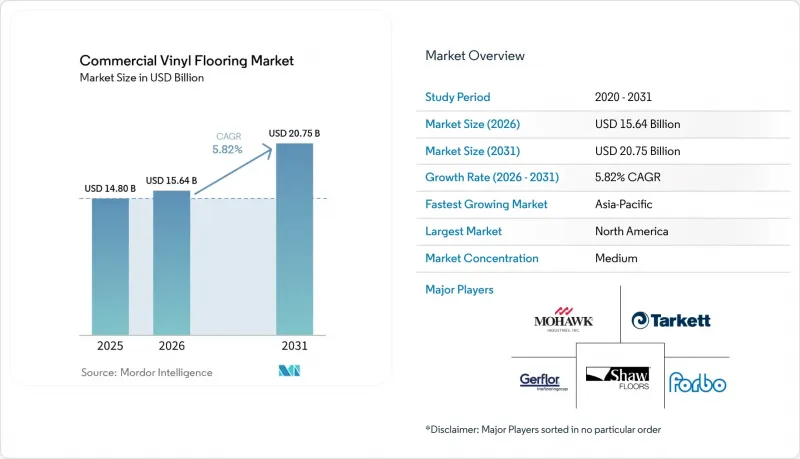
This report is Segmented by Product Type (Luxury Vinyl Tile (LVT) and Others), Installation Type (Self-Adhesive Vinyl Tiles and Others), Construction Type (New Construction and Remodeling/Retrofit), End-User (Office Buildings/Corporate Spaces and Others), Distribution Channel (Direct Sales and Distributors / Dealers), and Geography. Market Forecasts are Provided in Terms of Value (USD).
Global Commercial Vinyl Flooring Market Trends and Insights
LVT Displacing Ceramic and Wood in Commercial Fit-Outs Due to Lifecycle Cost, Durability, Waterproof Performance, and Design Realism
Owners and operators in offices, healthcare, education, retail, and hospitality continue to favor LVT over ceramic and engineered wood because it reduces the total cost of ownership while maintaining high aesthetic standards. LVT's waterproof performance mitigates risk in spill-prone corridors and front-of-house areas and simplifies cleaning protocols in environments that run strict hygiene routines. Modern direct digital printing and high-definition texturing deliver wood and stone visual parity alongside large choice sets, allowing designers to meet brand and project objectives without premium material sourcing. Third-party IAQ certifications, such as FloorScore and GREENGUARD Gold, are available across many commercial LVT lines, support LEED and WELL goals, and streamline submittals for public tenders. The operational savings from skipping strip-and-wax cycles, combined with selective plank replacement, continue to outweigh the initial premium over VCT in heavy traffic zones. The balance of product performance and lifecycle cost strengthens LVT's position as the default surface in mainstream commercial reconfigurations across North America and Europe in 2026.
Rapid Adoption of Rigid Core LVT (SPC/WPC) for Dimensional Stability and Faster Installs Over Imperfect Subfloors
Rigid core technologies bridge subfloor irregularities and reduce telegraphing, which improves outcomes in retrofit projects and high-mobility areas. Click-lock systems allow faster installation than wet-set glue-down and permit immediate space turnover, a priority in operating healthcare corridors and open retail units. Adhesive-free or low-adhesive approaches reduce site constraints tied to cure times and VOC submissions, improving project scheduling and simplifying compliance documentation. Acoustically focused WPC options help facility teams maintain comfort in open-plan workspace layouts and collaborative zones without the need for separate underlayments, as required in many specifications. Manufacturers have expanded their rigid core lines with diverse formats and wear layers to cover back-of-house, front-of-house, and patient care settings under single-brand programs, reducing complexity for specifiers. The cumulative advantages in speed, stability, and acoustic control continue to pull share from legacy glue-down LVT and institutional VCT in 2026.
PVC Resin and Plasticizer Price Volatility and Trade Actions Pressuring Costs and Margins
Resin and plasticizer prices have shown sharp swings tied to energy markets and regional supply outages, complicating pricing strategies and squeezing margins for import-reliant producers . Non-phthalate plasticizers command higher input costs than legacy alternatives, forcing reformulation or tighter cost controls without eroding commercial-grade durability. Where suppliers lack long-term resin agreements, exposure to spot markets can challenge price stability in large retail programs and private-label channels. Shifts in country-of-origin trade policies can add transit time and increase logistics complexity, undermining just-in-time inventory models in fast-turn programs. Domestic production footprints can buffer volatility and reduce tariff risks, which has encouraged incremental capacity additions in North America. The resulting environment rewards scale, supply diversification, and proactive contracting to protect contribution margins in 2026.
Other drivers and restraints analyzed in the detailed report include:
- Non-Residential Renovation Cycles in Offices, Healthcare, Education, and Retail Accelerating Resilient Specifications
- Asia-Pacific Construction Growth and Deep Vinyl Manufacturing Base Expanding Commercial Availability and Adoption
- Environmental/health scrutiny (phthalates, VOC/IAQ standards) is raising the compliance burden.
For complete list of drivers and restraints, kindly check the Table Of Contents.
Segment Analysis
Luxury vinyl tile held 60.40% of product-type revenue in 2025 and is projected to grow at a 6.77% CAGR through 2031. That combination is notable because the leading format in most building-material categories usually slows as smaller formats gain momentum. In the commercial vinyl flooring market, LVT continues to strengthen its position, now covering a broad range of commercial needs. It works across office lobbies, healthcare corridors, hospitality interiors, and industrial spaces with a performance range that fits both light-traffic and heavy-duty use. Product innovation is also keeping the category competitive at the premium end. AHF Products' Armstrong Natural Creations LVT, launched in April 2026 with Diamond 10 Technology and a 30-year commercial warranty, demonstrates how suppliers are raising durability standards while preserving LVT's mainstream appeal .
Vinyl composition tile, once a common institutional choice, is steadily losing relevance as facility managers place greater weight on maintenance costs and ongoing labor needs. Sheet vinyl still holds a strong position in the most demanding healthcare settings where seamless installation and chemical resistance remain essential. Rigid core vinyl, including SPC and WPC, is also gaining preference in projects that require better dimensional stability over imperfect subfloors and faster installation. These formats are especially useful in commercial settings where downtime, floor durability, and ease of replacement all matter. At the higher end of the category, competition is also shifting toward recyclability, environmental disclosures, and take-back programs rather than focusing only on initial cost or wear performance. Tarkett's iQ Motion launch in April 2026 clearly reflects that shift.
Interlocking vinyl tiles are projected to grow at a 6.24% CAGR through 2031, making them the fastest-growing installation type, even though glue-down remained the largest format in 2025 with a 41.30% share. This reflects a change in how buyers assess flooring over their full service life. Glue-down systems are still valued for permanence and familiarity, especially in heavy-traffic commercial spaces. At the same time, that permanence can make later replacement more difficult and more expensive. Interlocking systems offer a practical advantage because they allow damaged planks to be replaced without disturbing surrounding areas. That flexibility is especially useful in retail, hospitality, and office environments where layouts and visual requirements change more frequently.
Self-adhesive vinyl tiles still serve as a middle option for buyers looking for quicker installation than wet-set glue-down. However, they do not offer the same long-term flexibility as interlocking systems in demanding environments. Adhesive-free and loose-lay systems are also becoming more relevant where fast occupancy and lower-emission installation matter. Forbo's Modul'up is a good example of how installation innovation is aligned with circularity goals and tighter project schedules. Certification requirements also influence installation choices more than before. Low-VOC adhesive rules on environmentally sensitive projects can add complexity to installation, strengthening the case for systems that reduce or eliminate adhesive dependence.
Complete Report Scope:
- By Product Type
- Luxury Vinyl Tile (LVT)
- Stone Plastic Composite (SPC)
- Wood Plastic Composite (WPC)
- Luxury Vinyl Plank (LVP)
- Sheet Vinyl
- Others
- Luxury Vinyl Tile (LVT)
- By Installation Type
- Self-Adhesive Vinyl Tiles
- Glue-Down
- Interlocking Vinyl Tiles
- Others
- By Construction Type
- New Construction
- Remodeling / Retrofit
- By End-user
- Office Buildings / Corporate Spaces
- Retail Stores / Shopping Malls
- Healthcare Facilities
- Hospitality & Leisure
- Education
- Industrial / Warehouses
- Others
- By Distribution Channel
- Direct Sales
- Distributors / Dealers
- By Geography
- North America
- Canada
- United States
- Mexico
- South America
- Brazil
- Peru
- Chile
- Argentina
- Rest of South America
- Europe
- United Kingdom
- Germany
- France
- Spain
- Italy
- BENELUX (Belgium, Netherlands, Luxembourg)
- NORDICS (Denmark, Finland, Iceland, Norway, Sweden)
- Rest of Europe
- Asia-Pacific
- India
- China
- Japan
- Australia
- South Korea
- South-East Asia
- Rest of Asia-Pacific
- Middle East & Africa
- United Arab Emirates
- Saudi Arabia
- South Africa
- Nigeria
- Rest of Middle East & Africa
- North America
Geography Analysis
North America led global commercial vinyl flooring revenue in 2025 with a 35.60% share. The region's lead reflects its mature commercial real estate base, long use of resilient flooring systems, and strong focus on lifecycle value in specification decisions. Commercial property owners across offices, hospitals, schools, and retail centers continue to favor flooring solutions that offer durability, easier upkeep, and better support for hygiene requirements. Growth in the region remains supported by renovation activity in healthcare and education, even as office vacancy in some secondary markets slows momentum. Domestic manufacturing also strengthens the region's position by improving supply stability and reducing exposure to trade-related disruptions. Canada benefits from steady trade links with the United States, while Mexico continues to add demand through industrial and commercial construction in key urban corridors.
Asia-Pacific is the fastest-growing geography with 7.60% through 2031, supported by public refurbishment activity, hospitality development, and expanding corporate real estate in major urban centers. China remains central to this growth because urban renewal programs continue to support healthcare and education upgrades, where quick-install vinyl flooring is well-suited. The region also benefits from a deep manufacturing base that supports competitive pricing, broad product availability, and faster delivery across commercial projects. That manufacturing strength has also improved access to supply for nearby regions that depend on specification-grade vinyl products. Vietnam and Thailand are becoming more important as part of the regional supply network as producers diversify manufacturing locations and improve logistics resilience. Asia-Pacific's growth is being shaped not only by new construction, but also by policy-backed modernization programs that keep demand steady across commercial end uses.
Europe continues to stand out as the region most influenced by sustainability regulation and material transparency requirements. Environmental compliance, phthalate restrictions, and circularity expectations are shaping competition more directly there than in many other markets. This has strengthened the position of integrated manufacturers, enabling them to more clearly document recycled content, emissions, and end-of-life pathways. The Middle East shows a different growth pattern, with hospitality and mixed-use development driving demand for high-performance flooring in demanding climate conditions. Sub-Saharan Africa is seeing more institution-led demand, especially in schools and hospitals, while South America continues to show replacement potential despite economic and political volatility. Across these regions, the pace and nature of demand differ, but resilient flooring continues to gain importance in commercial applications.
- Mohawk Industries
- Shaw Industries Group
- Tarkett
- Forbo Flooring Systems
- Gerflor Group
- Mannington Mills (Mannington Commercial)
- Interface
- AHF Products (Armstrong Flooring brand)
- Karndean Designflooring
- LX Hausys (LG Hausys)
- Beaulieu International Group (B.I.G.)
- Polyflor (James Halstead)
- Novalis Innovative Flooring (AVA)
- Altro
- HMTX Industries (Teknoflor, Aspecta)
- Fatra (Agrofert)
- Responsive Industries
- NOX Corporation
- Metroflor (HMTX)
- Amtico (Mannington group company)
Additional Benefits:
- The market estimate (ME) sheet in Excel format
- 3 months of analyst support
TABLE OF CONTENTS
1 Introduction
- 1.1 Study Assumptions & Market Definition
- 1.2 Scope of the Study
2 Research Methodology
3 Executive Summary
4 Market Landscape
- 4.1 Market Overview
- 4.2 Market Drivers
- 4.2.1 LVT displacing ceramic/wood in commercial fit-outs due to lifecycle cost, durability, waterproof performance, design realism
- 4.2.2 Rapid adoption of rigid core LVT (SPC/WPC) for dimensional stability and faster installs over imperfect subfloors
- 4.2.3 Non-residential renovation cycles in offices, healthcare, education, retail accelerating resilient specifications
- 4.2.4 Asia-Pacific construction growth and deep vinyl manufacturing base expanding commercial availability and adoption
- 4.2.5 Spec-driven switch to low-VOC and PVC-free resilient in healthcare/education and EU public tenders
- 4.2.6 Digital print-driven brand refreshes in retail/hospitality enabling micro-collection rollouts at scale
- 4.3 Market Restraints
- 4.3.1 PVC resin/plasticizer price volatility and trade actions pressuring costs and margins
- 4.3.2 Environmental/health scrutiny (phthalates, VOC/IAQ standards) raising compliance burden
- 4.3.3 Supply risk from relocation of rigid LVT capacity across Asia impacting lead times
- 4.3.4 Adhesive/VOC and moisture-mitigation requirements adding install complexity and time in sensitive facilities
- 4.4 Industry Value Chain Analysis
- 4.5 Porter's Five Forces
- 4.5.1 Threat of New Entrants
- 4.5.2 Bargaining Power of Suppliers
- 4.5.3 Bargaining Power of Buyers
- 4.5.4 Threat of Substitutes
- 4.5.5 Competitive Rivalry
- 4.6 Insights into the Latest Trends and Innovations in the Industry
- 4.7 Insights on Recent Developments (New Product Launches, Strategic Initiatives, Investments, Partnerships, JVs, Expansion, M&As, etc.) in the Industry
- 4.8 Insights on Pricing Benchmarks & Buyer Preferences
- 4.8.1 VCT vs Sheet Vinyl vs LVT ( typical installed-cost patterns, lifecycle/TCO contrasts)
- 4.8.2 End-user Preferences (healthcare, education, retail,etc.)
5 Market Size & Growth Forecasts (value in USD Billion)
- 5.1 By Product Type
- 5.1.1 Luxury Vinyl Tile (LVT)
- 5.1.1.1 Stone Plastic Composite (SPC)
- 5.1.1.2 Wood Plastic Composite (WPC)
- 5.1.2 Luxury Vinyl Plank (LVP)
- 5.1.3 Sheet Vinyl
- 5.1.4 Others
- 5.1.1 Luxury Vinyl Tile (LVT)
- 5.2 By Installation Type
- 5.2.1 Self-Adhesive Vinyl Tiles
- 5.2.2 Glue-Down
- 5.2.3 Interlocking Vinyl Tiles
- 5.2.4 Others
- 5.3 By Construction Type
- 5.3.1 New Construction
- 5.3.2 Remodeling / Retrofit
- 5.4 By End-user
- 5.4.1 Office Buildings / Corporate Spaces
- 5.4.2 Retail Stores / Shopping Malls
- 5.4.3 Healthcare Facilities
- 5.4.4 Hospitality & Leisure
- 5.4.5 Education
- 5.4.6 Industrial / Warehouses
- 5.4.7 Others
- 5.5 By Distribution Channel
- 5.5.1 Direct Sales
- 5.5.2 Distributors / Dealers
- 5.6 By Geography
- 5.6.1 North America
- 5.6.1.1 Canada
- 5.6.1.2 United States
- 5.6.1.3 Mexico
- 5.6.2 South America
- 5.6.2.1 Brazil
- 5.6.2.2 Peru
- 5.6.2.3 Chile
- 5.6.2.4 Argentina
- 5.6.2.5 Rest of South America
- 5.6.3 Europe
- 5.6.3.1 United Kingdom
- 5.6.3.2 Germany
- 5.6.3.3 France
- 5.6.3.4 Spain
- 5.6.3.5 Italy
- 5.6.3.6 BENELUX (Belgium, Netherlands, Luxembourg)
- 5.6.3.7 NORDICS (Denmark, Finland, Iceland, Norway, Sweden)
- 5.6.3.8 Rest of Europe
- 5.6.4 Asia-Pacific
- 5.6.4.1 India
- 5.6.4.2 China
- 5.6.4.3 Japan
- 5.6.4.4 Australia
- 5.6.4.5 South Korea
- 5.6.4.6 South-East Asia
- 5.6.4.7 Rest of Asia-Pacific
- 5.6.5 Middle East & Africa
- 5.6.5.1 United Arab Emirates
- 5.6.5.2 Saudi Arabia
- 5.6.5.3 South Africa
- 5.6.5.4 Nigeria
- 5.6.5.5 Rest of Middle East & Africa
- 5.6.1 North America
6 Competitive Landscape
- 6.1 Market Concentration
- 6.2 Strategic Moves
- 6.3 Market Share Analysis
- 6.4 Company Profiles {(includes Global level Overview, Market level overview, Core Segments, Financials as available, Strategic Information, Market Rank/Share for key companies, Products & Services, and Recent Developments)}
- 6.4.1 Mohawk Industries
- 6.4.2 Shaw Industries Group
- 6.4.3 Tarkett
- 6.4.4 Forbo Flooring Systems
- 6.4.5 Gerflor Group
- 6.4.6 Mannington Mills (Mannington Commercial)
- 6.4.7 Interface
- 6.4.8 AHF Products (Armstrong Flooring brand)
- 6.4.9 Karndean Designflooring
- 6.4.10 LX Hausys (LG Hausys)
- 6.4.11 Beaulieu International Group (B.I.G.)
- 6.4.12 Polyflor (James Halstead)
- 6.4.13 Novalis Innovative Flooring (AVA)
- 6.4.14 Altro
- 6.4.15 HMTX Industries (Teknoflor, Aspecta)
- 6.4.16 Fatra (Agrofert)
- 6.4.17 Responsive Industries
- 6.4.18 NOX Corporation
- 6.4.19 Metroflor (HMTX)
- 6.4.20 Amtico (Mannington group company)
7 Market Opportunities & Future Outlook
- 7.1 PVC-free and circular resilient systems (recyclable cores, adhesive-free tiles) for healthcare/education tenders
- 7.2 AI-assisted micro-batch digital printing for retail/hospitality chain rollouts with rapid design refresh cycles

