PUBLISHER: Mordor Intelligence | PRODUCT CODE: 2098523

PUBLISHER: Mordor Intelligence | PRODUCT CODE: 2098523
Encapsulated Lactic Acid - Market Share Analysis, Industry Trends & Statistics, Growth Forecasts (2026 - 2031)
According to Mordor Intelligence, the encapsulated lactic acid market size is projected to be USD 1.38 billion in 2025, USD 1.45 billion in 2026, and reach USD 2.01 billion by 2031, growing at a CAGR of 6.72% from 2026 to 2031.
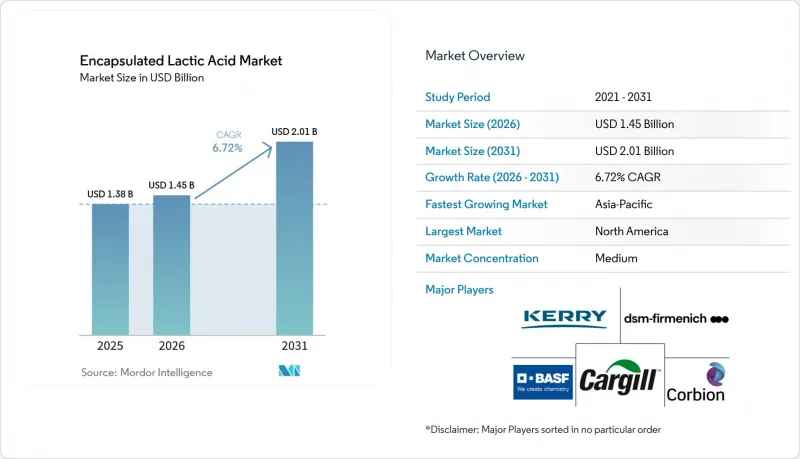
This report is Segmented by Form (Powder, Liquid, and Granules), Source (Plant-Based and Animal-Based), Application (Food and Beverages, Pharmaceuticals, Cosmetics and Personal Care, Animal Feed, and Others), and Geography (North America, Europe, Asia-Pacific, South America, and the Middle East and Africa). The Market Forecasts are Provided in Terms of Value (USD).
Global Encapsulated Lactic Acid Market Trends and Insights
Nutraceutical And Dietary Supplement Demand Redefines Encapsulation Economics
The encapsulated lactic acid market is benefiting from stronger nutraceutical demand because supplement brands need delivery systems that protect sensitive actives and improve ingredient performance. Lactic acid already has GRAS recognition in the United States, which gives product developers a clearer regulatory path in food and supplement applications. Probiotic supplement expansion is increasing demand for coatings that can protect ingredients during gastric transit and release them later in the digestive cycle. Corbion stated in 2025 that its pharmaceutical-grade sodium lactate and biomedical polymer capabilities are being extended into nutraceutical delivery systems, which shows tighter overlap between supplement and pharmaceutical supply requirements. This is raising the value of suppliers that can meet pharmaceutical-grade L(+) purity expectations while still serving the broader encapsulated lactic acid market. The result is a margin profile in premium supplements that commodity food-grade suppliers are less able to access.
Encapsulation Technology Advances Lower The Barrier To Specialty Formats
The encapsulated lactic acid market continues to rely on spray drying because it remains the most scalable and cost-effective way to produce stable encapsulated powders. The technology focus is now moving toward dual-coating systems and complex coacervation based on plant proteins and polysaccharides. Research published in 2025 showed that plant protein and polysaccharide coacervates can reach encapsulation performance close to synthetic polymer systems while also supporting vegan-label compatibility. For the encapsulated lactic acid market, that shift matters because it creates a cleaner-label route that also reduces dependence on older coating systems. Balchem's BakeShure(R), ConfecShure(R), and MeatShure(R) lines show how changes in coating chemistry can directly widen addressable applications and support margin defense. Better coating efficiency and lower wall-material cost are also making specialty grades more accessible in applications that once relied on standard powder formats.
High Encapsulation Cost And Process Complexity Limit Mid-Market Penetration
The encapsulated lactic acid market still faces cost pressure because encapsulation adds a premium that many bulk food categories cannot absorb easily. Commodity-oriented manufacturers in standard bakery, dairy, and seasoning applications often compare encapsulated formats directly with free acid alternatives. Controlled-release manufacturing also requires wall-material selection, coating thickness control, moisture testing, and release-rate validation. Those steps raise both capital needs and technical complexity for regional suppliers in South America and the Middle East and Africa. Balchem's USD 36 million investment in a new microencapsulation facility in Orange County, New York, highlights the scale required to reduce unit cost while maintaining coating quality. The encapsulated lactic acid market therefore remains harder to enter for smaller producers that lack both specialized personnel and the financial capacity to build repeatable controlled-release systems.
Other drivers and restraints analyzed in the detailed report include:
- Functional Foods And Probiotic Expansion Create A Compounding Demand Effect
- Bio-Based Sourcing Mandates Elevate Feedstock Origin As A Competitive Differentiator
- Feedstock Supply Concentration Creates A Structural Input Vulnerability
For complete list of drivers and restraints, kindly check the Table Of Contents.
Segment Analysis
Powder formats retained 41.27% of the encapsulated lactic acid market in 2025, which kept them in the lead across form segments. Their position reflects long-established dry-blend infrastructure in bakery, meat processing, and instant food production. Powder also remains easy to dose, stable under ambient conditions, and compatible with standard blending equipment used in large-volume processing lines. These traits keep the encapsulated lactic acid market anchored in formats that support scale and consistency across routine manufacturing runs. Spray drying remains the main production route for powder and granule formats because it can support high-volume output with controlled particle morphology.
Granules serve a narrower but important role in the encapsulated lactic acid market because they are better suited to slower dissolution and staged acid release. That makes them useful in confectionery applications, especially sour candy, and in probiotic systems that require delayed release behavior. The segment is also seeing interest in combining nanoencapsulation techniques with conventional spray drying to improve coating uniformity without losing industrial throughput. MDPI.COM Liquid is projected to grow at 8.02% CAGR through 2031, which makes it the fastest-growing form in the encapsulated lactic acid market size outlook. That growth is tied to ready-to-drink probiotic beverages, sports nutrition liquids, and liquid nutraceuticals where rapid dispersibility is essential.
Complete Report Scope:
- By Form
- Powder
- Liquid
- Granuels
- By Source
- Plant-Based
- Animal-Based
- By Application
- Food and Beverages
- Pharmaceuticals
- Cosmetics and Personal Care
- Animal Feed
- Others
- By Geography
- North America
- United States
- Canada
- Mexico
- Rest of North America
- Europe
- Germany
- United Kingdom
- France
- Italy
- Spain
- Netherlands
- Rest of Europe
- Asia-Pacific
- China
- India
- Japan
- Australia
- Rest of Asia-Pacific
- South America
- Brazil
- Argentina
- Rest of South America
- Middle East and Africa
- United Arab Emirates
- South Africa
- Rest of Middle East and Africa
- North America
Geography Analysis
North America remained the largest regional segment in the encapsulated lactic acid market at 40.21% in 2025. The United States supports that position because lactic acid has GRAS status for food applications, which lowers regulatory friction across food and supplement formulation. The region also benefits from strong processed meat activity and a mature nutraceutical channel, both of which support repeat demand for controlled-release acidulants. Balchem's USD 36 million investment in Orange County, New York, which is intended to more than double its microencapsulation capacity, reinforces confidence in sustained domestic demand. Europe held the second-largest position in the encapsulated lactic acid market, supported by demand for fermentation-derived acid systems in processed food and clean-label reformulation. Corbion's BRIGHT 2030 strategy also places clean-label preservation and biomedical polymers at the center of its growth agenda across European and North American channels.
Asia-Pacific is the fastest-growing region in the encapsulated lactic acid market size profile, with a projected CAGR of 7.62% through 2031. Food processing expansion across China, India, Japan, and Southeast Asia is broadening the regional demand base. China remains the largest country market in the region, while India is gaining importance through its expanding nutraceutical and pharmaceutical contract manufacturing base. Japan adds a more specialized demand pattern centered on enzyme-stabilized and pH-sensitive functional food systems. NatureWorks' fully integrated 75,000-ton facility in Nakhon Sawan, Thailand, opened in April 2026 and signaled deeper regional integration across lactic acid, lactide, and PLA supply.
South America and the Middle East and Africa remain smaller in the encapsulated lactic acid market, but each region has distinct demand patterns. Brazil anchors South America through processed meat preservation needs, while Argentina remains more visible in dairy-related use. Price sensitivity across the region favors cost-competitive powder formats over higher-priced specialty encapsulation systems. In the Middle East and Africa, demand is still at an early stage and remains concentrated in the UAE and South Africa across food service and pharmaceutical cold-chain applications.
- BASF SE
- Cargill, Incorporated
- Corbion N.V.
- DSM-Firmenich
- Kerry Group plc
- Ingredion Incorporated
- Tate and Lyle PLC
- Balchem Corporation
- Sensient Technologies Corporation
- NatureWorks LLC
- Futerro S.A.
- Galactique?
- Galactic S.A.
- Henan Jindan Lactic Acid Technology Co., Ltd.
- Jungbunzlauer Suisse AG
- Archer Daniels Midland Company
- Roquette Freres
- DuPont de Nemours, Inc.
- Mitsubishi Chemical Group Corporation
- Dow Inc.
- Advanced Enzyme Technologies Ltd.
Additional Benefits:
- The market estimate (ME) sheet in Excel format
- 3 months of analyst support
TABLE OF CONTENTS
1 INTRODUCTION
- 1.1 Study Assumptions and Market Definition
- 1.2 Scope of the Study
2 RESEARCH METHODOLOGY
3 EXECUTIVE SUMMARY
4 MARKET LANDSCAPE
- 4.1 Market Overview
- 4.2 Market Drivers
- 4.2.1 Increasing Application in Nutraceutical and Dietary Supplement Products
- 4.2.2 Expansion of Dry Mixes and Instant Food Products
- 4.2.3 Technological Advancements in Encapsulation Methods
- 4.2.4 Rising Demand for Acid-Sensitive Ingredient Formulations
- 4.2.5 Expansion of Functional Foods and Probiotic Formats
- 4.2.6 Shift to Sustainable and Bio-Based Formulations
- 4.3 Market Restraints
- 4.3.1 High Encapsulation Cost and Process Complexity
- 4.3.2 Limited Scale-Ready Supply of Specialized Feedstocks
- 4.3.3 Substitution by Free Lactic Acid in Low-Sensitivity Uses
- 4.3.4 Regulatory and Stability Validation Burden
- 4.4 Supply Chain Analysis
- 4.5 Regulatory Landscape
- 4.6 Technological Outlook
- 4.7 Porter's Five Forces
- 4.7.1 Bargaining Power of Suppliers
- 4.7.2 Bargaining Power of Buyers
- 4.7.3 Threat of New Entrants
- 4.7.4 Threat of Substitutes
- 4.7.5 Competitive Rivalry
5 MARKET SIZE AND GROWTH FORECASTS (VALUE)
- 5.1 By Form
- 5.1.1 Powder
- 5.1.2 Liquid
- 5.1.3 Granuels
- 5.2 By Source
- 5.2.1 Plant-Based
- 5.2.2 Animal-Based
- 5.3 By Application
- 5.3.1 Food and Beverages
- 5.3.2 Pharmaceuticals
- 5.3.3 Cosmetics and Personal Care
- 5.3.4 Animal Feed
- 5.3.5 Others
- 5.4 By Geography
- 5.4.1 North America
- 5.4.1.1 United States
- 5.4.1.2 Canada
- 5.4.1.3 Mexico
- 5.4.1.4 Rest of North America
- 5.4.2 Europe
- 5.4.2.1 Germany
- 5.4.2.2 United Kingdom
- 5.4.2.3 France
- 5.4.2.4 Italy
- 5.4.2.5 Spain
- 5.4.2.6 Netherlands
- 5.4.2.7 Rest of Europe
- 5.4.3 Asia-Pacific
- 5.4.3.1 China
- 5.4.3.2 India
- 5.4.3.3 Japan
- 5.4.3.4 Australia
- 5.4.3.5 Rest of Asia-Pacific
- 5.4.4 South America
- 5.4.4.1 Brazil
- 5.4.4.2 Argentina
- 5.4.4.3 Rest of South America
- 5.4.5 Middle East and Africa
- 5.4.5.1 United Arab Emirates
- 5.4.5.2 South Africa
- 5.4.5.3 Rest of Middle East and Africa
- 5.4.1 North America
6 COMPETITIVE LANDSCAPE
- 6.1 Market Concentration
- 6.2 Strategic Moves
- 6.3 Market Ranking Analysis
- 6.4 Company Profiles (Includes Global-level Overview, Market-level Overview, Core Segments, Financials, Strategic Info, Market Rank/Share, Products & Services, Recent Developments)
- 6.4.1 BASF SE
- 6.4.2 Cargill, Incorporated
- 6.4.3 Corbion N.V.
- 6.4.4 DSM-Firmenich
- 6.4.5 Kerry Group plc
- 6.4.6 Ingredion Incorporated
- 6.4.7 Tate and Lyle PLC
- 6.4.8 Balchem Corporation
- 6.4.9 Sensient Technologies Corporation
- 6.4.10 NatureWorks LLC
- 6.4.11 Futerro S.A.
- 6.4.12 Galactique?
- 6.4.13 Galactic S.A.
- 6.4.14 Henan Jindan Lactic Acid Technology Co., Ltd.
- 6.4.15 Jungbunzlauer Suisse AG
- 6.4.16 Archer Daniels Midland Company
- 6.4.17 Roquette Freres
- 6.4.18 DuPont de Nemours, Inc.
- 6.4.19 Mitsubishi Chemical Group Corporation
- 6.4.20 Dow Inc.
- 6.4.21 Advanced Enzyme Technologies Ltd.
7 MARKET OPPORTUNITIES AND FUTURE OUTLOOK

