PUBLISHER: Mordor Intelligence | PRODUCT CODE: 2098524

PUBLISHER: Mordor Intelligence | PRODUCT CODE: 2098524
Botanical Extracts - Market Share Analysis, Industry Trends & Statistics, Growth Forecasts (2026 - 2031)
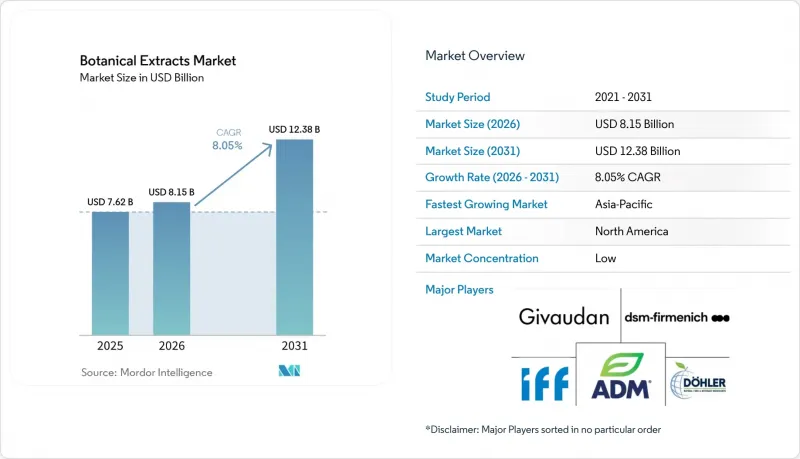
According to Mordor Intelligence, the botanical extracts market size is expected to grow from USD 7.62 billion in 2025 to USD 8.15 billion in 2026 and is forecast to reach USD 12.38 billion by 2031 at 8.05% CAGR over 2026-2031.
This report is Segmented by Source (Leaves, Roots and Rhizomes, Flowers, Spices and Herbs, and Others), Form (Powder, Liquid, and Oils/Oleoresin), Application (Food and Beverages, Dietary Supplements, Cosmetics and Personal Care, Pharmaceuticals, and Others), and Geography (North America, Europe, Asia-Pacific, South America, Middle East and Africa). The Market Forecasts are Provided in Terms of Value (USD).
Global Botanical Extracts Market Trends and Insights
Rising Demand for Natural and Plant-Based Ingredients
Demand for natural and plant-based inputs remains the strongest force shaping the botanical extracts market across packaged food, dietary supplements, and personal care. This demand is becoming more specific, because buyers are not only asking for natural origin claims, they are also asking for standardized extracts with defined active content and stronger product documentation. That change is compressing the commercial space available to undifferentiated botanical powders and basic commodity extracts. It is also pushing suppliers to align more closely with formulation needs tied to metabolic health, skin support, and adaptogenic positioning. The botanical extracts market is therefore moving toward higher-value plant actives with clearer quality markers and more stable supply credentials. This direction fits broader policy and consumer acceptance of traditional and complementary health approaches in many countries.
Growing Nutraceutical and Dietary Supplement Industry
The nutraceutical channel is changing how extract suppliers compete in the botanical extracts market. Buyers in this channel are placing greater emphasis on traceability, clinical support, and compatibility with capsules, powders, gummies, and liquid delivery systems. That shift means supplier relationships are becoming harder to win with scale alone, because quality documentation and formulation support are now part of the purchasing decision. Public health systems in several countries are also recognizing the role of traditional and complementary medicine, which supports longer-term demand for botanical-based interventions beyond short consumer cycles. As a result, the botanical extracts market is seeing stronger demand for suppliers that can connect plant sourcing with evidence-backed product positioning. This is reinforcing premiumization in supplement formats that target cognition, stress, gut health, and metabolic support.
Variability in Raw Material Quality and Availability
Raw material variability remains one of the clearest constraints on the botanical extracts market, and the issue goes well beyond simple price swings. Research published in 2025 showed that changing temperature and precipitation conditions are affecting plant distribution, growth patterns, and secondary metabolite profiles in medicinal species. The user-supplied case around ashwagandha also points to a deeper problem, because cultivation expansion into lower-quality areas can weaken active compound consistency and create regulatory concerns over plant-part usage. Wetter conditions in parts of South and Southeast Asia are further complicating drying and contamination control for sensitive crops, which raises quality assurance costs. UEBT's 2025 work on biodiversity and resilient sourcing suggests that more stable supply chains will depend on stronger sourcing models, but that approach also implies higher procurement discipline and tighter supplier screening. The botanical extracts market is therefore becoming more demanding for companies that depend on narrow sourcing regions or weak agronomic oversight.
Other drivers and restraints analyzed in the detailed report include:
- Advancements in Extraction Technologies
- Growing Applications in Natural Cosmetics and Personal Care Products
- Risk of Adulteration and Quality Concerns
For complete list of drivers and restraints, kindly check the Table Of Contents.
Segment Analysis
Spices and herbs held 38.56% of the botanical extracts market in 2025, which reflected the broad use of turmeric, black pepper, capsicum, and ginger across food, nutrition, and personal care applications. This segment benefits from established logistics, strong familiarity among formulators, and clearer analytical standards for widely traded materials. Leaves, roots, and rhizomes also remain important for volume, especially where green tea, echinacea, valerian, and ashwagandha continue to support stable demand across several end uses. The other category serves smaller but important niches in pharmaceuticals, cosmetics, and specialty ingredient programs. Flowers is projected to grow at 9.85% through 2031, and that pace shows how value is shifting toward botanicals such as hibiscus, chamomile, rose, and elderflower in premium applications. In this part of the botanical extracts industry, sensory profile, origin story, and fit with high-value formulations are becoming more important than bulk volume alone.
The source mix also highlights a supply concentration issue inside the botanical extracts market, because a large share of global extract activity still depends on a few producing regions. China's plant extract exports reached USD 3.0 billion in 2025 with total volumes of 138,000 tons, which underlines the scale of its role in global supply chains. The same source showed wide differences in value per kilogram across export destinations, and that points to clear premium opportunities for higher-purity and more traceable materials. Suppliers that can pair source origin with extraction purity and third-party verification are better positioned to capture those premiums. That is why the botanical extracts market is moving away from simple source availability and toward source-level differentiation built on geographic origin, cultivation method, and downstream certification.
Complete Report Scope:
- By Source
- Leaves
- Roots and Rhizomes
- Flowers
- Spices and Herbs
- Others
- By Form
- Powder
- Liquid
- Oils/Oleoresin
- By Application
- Food and Beverages
- Bakery and Confectionery
- Functional Food and Beverages
- Sauces and Condiments
- Others
- Dietary Supplements
- Cosmetics and Personal Care
- Pharmaceuticals
- Others
- Food and Beverages
- By Geography
- North America
- United States
- Canada
- Mexico
- Rest of North America
- Europe
- Germany
- United Kingdom
- France
- Italy
- Spain
- Netherlands
- Sweden
- Poland
- Belgium
- Rest of Europe
- Asia-Pacific
- China
- India
- Japan
- Australia
- South Korea
- Vietnam
- Indonesia
- Thailand
- Singapore
- Rest of Asia-Pacific
- South America
- Brazil
- Argentina
- Chile
- Peru
- Colombia
- Rest of South America
- Middle East and Africa
- United Arab Emirates
- Saudi Arabia
- South Africa
- Nigeria
- Egypt
- Morocco
- Turkey
- Rest of Middle East and Africa
- North America
Geography Analysis
North America held 33.78% of the botanical extracts market in 2025, and the region remained the largest geographic base because of strong supplement demand, high spending on functional nutrition, and mature formulation capabilities. The United States continues to offer relatively accessible supplement pathways under DSHEA, which supports broad product activity compared with stricter novel food routes in other regions. At the same time, FDA preventive control requirements under FSMA are raising expectations for traceability, handling, and supply chain quality across imported and domestic botanical ingredients. This gives an edge to suppliers with audited sourcing networks and better compliance systems. Canada and Mexico are also building botanical demand, but the United States remains the dominant revenue center within the regional structure.
Europe remains a premium destination in the botanical extracts market, especially for standardized and certified-organic materials used in functional foods, cosmeceuticals, and herbal pharmaceutical products. Germany, the United Kingdom, France, and Italy continue to serve as the region's main formulation and consumption hubs. EFSA's novel food framework and related European requirements create a clear regulatory filter that can slow new ingredient scaling but also strengthen entry barriers for prepared suppliers. Northern Europe is also supporting demand through stronger functional food and natural retail channels. In South America, Brazil is becoming more important not only as a source base but also as a value creation platform, and IFF's 2025 bioprospecting partnership in Legado das Aguas shows how biodiversity access is gaining strategic value for future cosmetic and fragrance ingredient development.
Asia-Pacific is forecast to grow at 9.66% through 2031, which makes it the fastest-growing regional segment in the botanical extracts market. The region combines two strengths, because it is both a major raw material production hub and an expanding end-use market with rising local demand. China's 2025 plant extract exports of USD 3.0 billion and 138,000 tons show the scale of regional processing capacity and export relevance. Japan stands out as a premium destination, where willingness to pay for traceable and high-purity materials supports better value realization. WHO documentation on traditional medicine also supports the importance of established medical and cultural use frameworks in parts of Asia, including Japan's integration of Kampo into healthcare practice. The Middle East and Africa is smaller but still expanding, with the United Arab Emirates and South Africa acting as distribution anchors and Morocco and Nigeria showing early local formulation momentum. This keeps the botanical extracts market geographically broad, even though value capture remains uneven across sourcing and demand centers.
- International Flavors and Fragrances Inc.
- Archer Daniels Midland Company
- Givaudan SA
- DSM-Firmenich AG
- Dohler GmbH
- Symrise AG
- Martin Bauer Group
- Synthite Industries Ltd.
- Nexira SAS
- Kalsec Inc.
- Bio-Botanica, Inc.
- Sabinsa Corporation
- Prinova Group LLC
- Indena S.p.A.
- Haldin Natural
- PT Indesso Aroma
- Blue Sky Botanics Ltd.
- Naturex SA
- Layn Natural Ingredients Corporation
- Arjuna Natural Pvt. Ltd.
Additional Benefits:
- The market estimate (ME) sheet in Excel format
- 3 months of analyst support
TABLE OF CONTENTS
1 INTRODUCTION
- 1.1 Study Assumptions and Market Definition
- 1.2 Scope of the Study
2 RESEARCH METHODOLOGY
3 EXECUTIVE SUMMARY
4 MARKET LANDSCAPE
- 4.1 Market Overview
- 4.2 Market Drivers
- 4.2.1 Rising Demand for Natural and Plant-Based Ingredients
- 4.2.2 Growing Nutraceutical and Dietary Supplement Industry
- 4.2.3 Increasing Consumer Interest in Herbal and Traditional Medicine
- 4.2.4 Advancements in Extraction Technologies
- 4.2.5 Growth of Organic and Sustainable Product Markets
- 4.2.6 Growing Applications in Natural Cosmetics and Personal Care Products
- 4.3 Market Restraints
- 4.3.1 Variability in Raw Material Quality and Availability
- 4.3.2 High Production and Processing Costs
- 4.3.3 Risk of Adulteration and Quality Concerns
- 4.3.4 Competition from Synthetic Alternatives
- 4.4 Supply Chain Analysis
- 4.5 Regulatory Landscape
- 4.6 Technological Outlook
- 4.7 Porter's Five Forces
- 4.7.1 Bargaining Power of Suppliers
- 4.7.2 Bargaining Power of Buyers
- 4.7.3 Threat of New Entrants
- 4.7.4 Threat of Substitutes
- 4.7.5 Competitive Rivalry
5 MARKET SIZE AND GROWTH FORECASTS (VALUE)
- 5.1 By Source
- 5.1.1 Leaves
- 5.1.2 Roots and Rhizomes
- 5.1.3 Flowers
- 5.1.4 Spices and Herbs
- 5.1.5 Others
- 5.2 By Form
- 5.2.1 Powder
- 5.2.2 Liquid
- 5.2.3 Oils/Oleoresin
- 5.3 By Application
- 5.3.1 Food and Beverages
- 5.3.1.1 Bakery and Confectionery
- 5.3.1.2 Functional Food and Beverages
- 5.3.1.3 Sauces and Condiments
- 5.3.1.4 Others
- 5.3.2 Dietary Supplements
- 5.3.3 Cosmetics and Personal Care
- 5.3.4 Pharmaceuticals
- 5.3.5 Others
- 5.3.1 Food and Beverages
- 5.4 By Geography
- 5.4.1 North America
- 5.4.1.1 United States
- 5.4.1.2 Canada
- 5.4.1.3 Mexico
- 5.4.1.4 Rest of North America
- 5.4.2 Europe
- 5.4.2.1 Germany
- 5.4.2.2 United Kingdom
- 5.4.2.3 France
- 5.4.2.4 Italy
- 5.4.2.5 Spain
- 5.4.2.6 Netherlands
- 5.4.2.7 Sweden
- 5.4.2.8 Poland
- 5.4.2.9 Belgium
- 5.4.2.10 Rest of Europe
- 5.4.3 Asia-Pacific
- 5.4.3.1 China
- 5.4.3.2 India
- 5.4.3.3 Japan
- 5.4.3.4 Australia
- 5.4.3.5 South Korea
- 5.4.3.6 Vietnam
- 5.4.3.7 Indonesia
- 5.4.3.8 Thailand
- 5.4.3.9 Singapore
- 5.4.3.10 Rest of Asia-Pacific
- 5.4.4 South America
- 5.4.4.1 Brazil
- 5.4.4.2 Argentina
- 5.4.4.3 Chile
- 5.4.4.4 Peru
- 5.4.4.5 Colombia
- 5.4.4.6 Rest of South America
- 5.4.5 Middle East and Africa
- 5.4.5.1 United Arab Emirates
- 5.4.5.2 Saudi Arabia
- 5.4.5.3 South Africa
- 5.4.5.4 Nigeria
- 5.4.5.5 Egypt
- 5.4.5.6 Morocco
- 5.4.5.7 Turkey
- 5.4.5.8 Rest of Middle East and Africa
- 5.4.1 North America
6 COMPETITIVE LANDSCAPE
- 6.1 Market Concentration
- 6.2 Strategic Moves
- 6.3 Market Ranking Analysis
- 6.4 Company Profiles (Includes Global-level Overview, Market-level Overview, Core Segments, Financials, Strategic Info, Market Rank/Share, Products & Services, Recent Developments)
- 6.4.1 International Flavors and Fragrances Inc.
- 6.4.2 Archer Daniels Midland Company
- 6.4.3 Givaudan SA
- 6.4.4 DSM-Firmenich AG
- 6.4.5 Dohler GmbH
- 6.4.6 Symrise AG
- 6.4.7 Martin Bauer Group
- 6.4.8 Synthite Industries Ltd.
- 6.4.9 Nexira SAS
- 6.4.10 Kalsec Inc.
- 6.4.11 Bio-Botanica, Inc.
- 6.4.12 Sabinsa Corporation
- 6.4.13 Prinova Group LLC
- 6.4.14 Indena S.p.A.
- 6.4.15 Haldin Natural
- 6.4.16 PT Indesso Aroma
- 6.4.17 Blue Sky Botanics Ltd.
- 6.4.18 Naturex SA
- 6.4.19 Layn Natural Ingredients Corporation
- 6.4.20 Arjuna Natural Pvt. Ltd.
7 MARKET OPPORTUNITIES AND FUTURE OUTLOOK

