PUBLISHER: Mordor Intelligence | PRODUCT CODE: 2098566

PUBLISHER: Mordor Intelligence | PRODUCT CODE: 2098566
Sustainable Personal Care Products - Market Share Analysis, Industry Trends & Statistics, Growth Forecasts (2026 - 2031)
According to Mordor Intelligence, the sustainable personal care products market size is expected to grow from USD 52.99 billion in 2025 to USD 56.41 billion in 2026 and is forecast to reach USD 79.56 billion by 2031 at 7.12% CAGR over 2026-2031.
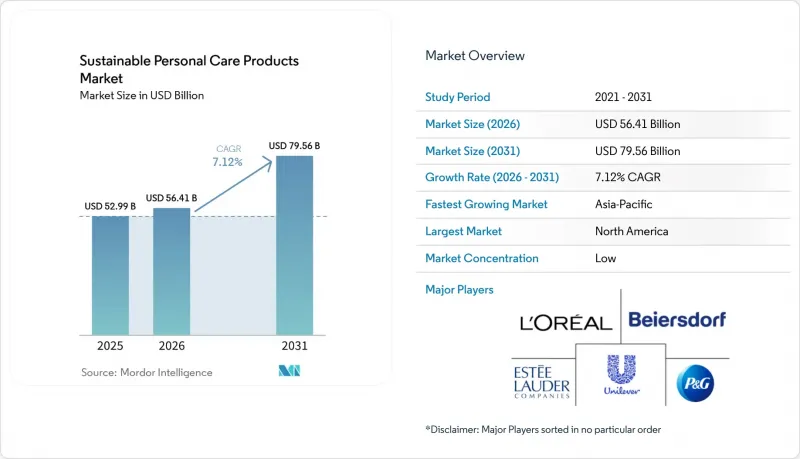
This report is Segmented by Product Type (Skin Care, Hair Care, Bath and Shower, Oral Care, and More), End User (Men, Women, Children), Distribution Channel (Supermarkets/Hypermarkets, Specialty Stores, Online Retail Stores and More), and Geography (North America, Europe, Asia-Pacific, South America, Middle East and Africa). The Market Forecasts are Provided in Terms of Value (USD).
Global Sustainable Personal Care Products Market Trends and Insights
Rising consumer preference for natural and eco-friendly personal care products
Growing awareness of environmental sustainability and health-conscious lifestyles is encouraging consumers to choose personal care products made with natural, plant-based, and biodegradable ingredients. Increasing concerns about the environmental impact of synthetic chemicals, plastic packaging, and resource-intensive manufacturing are accelerating the shift toward eco-friendly alternatives. Consumers are also placing greater value on cruelty-free, vegan, and ethically sourced formulations that align with their personal values. This trend has prompted manufacturers to expand their portfolios with clean-label products that emphasize ingredient transparency and sustainable packaging. As sustainability becomes a key purchasing criterion across global markets, demand for natural and eco-friendly personal care products continues to strengthen, supporting long-term market expansion.
Growing awareness of environmental sustainability and plastic waste reduction
Increasing public concern over environmental degradation and plastic pollution is encouraging the adoption of sustainable personal care products with minimal ecological impact. Consumers are actively seeking brands that use recyclable, biodegradable, refillable, or plastic-free packaging to reduce household waste. Governments, environmental organizations, and advocacy campaigns are also raising awareness about the harmful effects of single-use plastics, influencing purchasing behavior. In response, manufacturers are investing in innovative packaging solutions, such as paper-based containers, reusable systems, and compostable materials. Sustainability certifications and transparent environmental claims further strengthen consumer trust and brand loyalty.
Higher production costs of sustainable raw materials and packaging
The use of sustainably sourced ingredients and environmentally friendly packaging significantly increases production costs for sustainable personal care manufacturers. Organic botanical extracts, certified natural raw materials, biodegradable packaging, recycled plastics, and refillable containers are generally more expensive than conventional alternatives due to limited supply, certification requirements, and complex sourcing processes. In addition, investments in sustainable manufacturing practices, ethical supply chains, and regulatory compliance further raise operational expenses. These higher costs are often passed on to consumers through premium pricing, which can reduce affordability and limit adoption in price-sensitive markets. As a result, elevated production costs continue to constrain the widespread adoption and profitability of sustainable personal care products.
Other drivers and restraints analyzed in the detailed report include:
- Increasing demand for clean-label and non-toxic ingredient formulations
- Rising disposable incomes supporting premium sustainable product purchases
- Premium pricing limiting adoption among price-sensitive consumers
For complete list of drivers and restraints, kindly check the Table Of Contents.
Segment Analysis
By product type, skin care accounted for the largest revenue share of 40.45% in 2025, maintaining its leadership position within the sustainable personal care products market. The segment's dominance is driven by strong consumer demand for natural, organic, vegan, and clean-label skincare formulations that are perceived as safer and environmentally responsible. Rising awareness regarding skin health, ingredient transparency, and the harmful effects of synthetic chemicals has encouraged consumers to shift toward sustainable skincare products. Manufacturers continue to expand their portfolios with refillable packaging, biodegradable materials, plant-based ingredients, and cruelty-free certifications to align with evolving consumer preferences.
Hair care is projected to register the fastest growth during the forecast period, expanding at a CAGR of 7.46% through 2031. Growth is being fueled by increasing consumer preference for sulfate-free, silicone-free, and naturally derived shampoos, conditioners, hair oils, and styling products that minimize environmental impact. Rising concerns regarding hair damage, scalp health, pollution, and chemical exposure are encouraging consumers to adopt sustainable hair care solutions. Companies are investing heavily in innovative formulations featuring botanical extracts, biodegradable ingredients, water-efficient production processes, and recyclable packaging to differentiate their offerings.
Complete Report Scope:
- By Product Type
- Skin Care
- Hair Care
- Bath and Shower Products
- Oral Care
- Feminine Care
- Sun Care
- Other Product Types
- By End User
- Men
- Women
- Children
- By Distribution Channel
- Supermarkets/Hypermarkets
- Convenience Stores
- Specialty Stores
- Online Retail Stores
- Other Distribution Channels
- By Geography
- North America
- United States
- Canada
- Mexico
- Rest of North America
- Europe
- United Kingdom
- Germany
- Spain
- France
- Italy
- Sweden
- Belgium
- Poland
- Rest of Europe
- Asia-Pacific
- China
- Japan
- India
- South Korea
- New Zealand
- Australia
- Rest of Asia-Pacific
- South America
- Brazil
- Argentina
- Rest of South America
- Middle East and Africa
- United Arab Emirates
- Saudi Arabia
- South Africa
- Rest of Middle East and Africa
- North America
Geography Analysis
North America held the largest share of the sustainable personal care products market, accounting for 34.81% of global revenue in 2025. The region's leadership is driven by high consumer awareness regarding clean-label products, ethical sourcing, and environmental sustainability. Strong demand for organic skincare, natural hair care, vegan cosmetics, and cruelty-free personal care products has encouraged manufacturers to continuously expand their sustainable product portfolios. Well-established retail infrastructure, widespread e-commerce adoption, and the presence of leading global personal care companies further support market growth across the United States and Canada.
Asia-Pacific is projected to register the fastest CAGR of 7.52% through 2031, making it the most rapidly expanding regional market for sustainable personal care products. Rising disposable incomes, rapid urbanization, and a growing middle-class population are significantly increasing demand for eco-friendly beauty and personal care products across countries such as China, India, Japan, South Korea, and Southeast Asia. Around 54% of the global urban population, more than 2.2 billion people, live in Asia. By 2050, the urban population in Asia is expected to grow by 50% - an additional 1.2 billion people. Consumers are becoming more conscious of natural ingredients, chemical-free formulations, and environmentally responsible packaging, driving higher adoption of sustainable products.
Europe is a mature, highly regulated market, driven by strong demand for organic, vegan, and environmentally certified personal care products, along with clean beauty trends and advanced recycling initiatives. In South America, rising consumer awareness, expanding retail networks, and demand for naturally derived products, particularly in Brazil and Argentina, support market growth. The Middle East and Africa region is growing steadily, driven by rising disposable incomes, urbanization, and wider availability of premium sustainable brands through modern retail and online channels.
- L'Oreal S.A.
- The Estee Lauder Companies Inc.
- Unilever PLC
- Procter & Gamble Company
- Beiersdorf AG
- Kao Corporation
- Shiseido Company, Limited
- Natura &Co Holding S.A.
- Henkel AG & Co. KGaA
- Amway Corp.
- Colgate-Palmolive Company
- Johnson & Johnson
- The Clorox Company
- Weleda AG
- L'Occitane International SA
- Coty Inc.
- Edgewell Personal Care Company
- Oriflame Holding AG
- The Honest Company, Inc.
- EO Products, Inc.
Additional Benefits:
- The market estimate (ME) sheet in Excel format
- 3 months of analyst support
TABLE OF CONTENTS
1 INTRODUCTION
- 1.1 Study Assumptions and Market Definition
- 1.2 Scope of the Study
2 RESEARCH METHODOLOGY
3 EXECUTIVE SUMMARY
4 MARKET LANDSCAPE
- 4.1 Market Overview
- 4.2 Market Drivers
- 4.2.1 Rising consumer preference for natural and eco-friendly personal care products
- 4.2.2 Growing awareness of environmental sustainability and plastic waste reduction
- 4.2.3 Increasing demand for clean-label and non-toxic ingredient formulations
- 4.2.4 Expansion of vegan and cruelty-free beauty product adoption
- 4.2.5 Government regulations promoting sustainable packaging and ingredient transparency
- 4.2.6 Rising disposable incomes supporting premium sustainable product purchases
- 4.3 Market Restraints
- 4.3.1 Higher production costs of sustainable raw materials and packaging
- 4.3.2 Premium pricing limiting adoption among price-sensitive consumers
- 4.3.3 Complex and costly regulatory compliance for sustainability certifications
- 4.3.4 Supply chain challenges in sourcing ethical and traceable ingredients
- 4.4 Consumer Behavior Analysis
- 4.5 Regulatory Landscape
- 4.6 Technological Outlook
- 4.7 Porter's Five Forces Analysis
- 4.7.1 Bargaining Power of Suppliers
- 4.7.2 Bargaining Power of Buyers
- 4.7.3 Threat of New Entrants
- 4.7.4 Threat of Substitutes
- 4.7.5 Intensity of Competitive Rivalry
5 MARKET SIZE AND GROWTH FORECASTS (VALUE)
- 5.1 By Product Type
- 5.1.1 Skin Care
- 5.1.2 Hair Care
- 5.1.3 Bath and Shower Products
- 5.1.4 Oral Care
- 5.1.5 Feminine Care
- 5.1.6 Sun Care
- 5.1.7 Other Product Types
- 5.2 By End User
- 5.2.1 Men
- 5.2.2 Women
- 5.2.3 Children
- 5.3 By Distribution Channel
- 5.3.1 Supermarkets/Hypermarkets
- 5.3.2 Convenience Stores
- 5.3.3 Specialty Stores
- 5.3.4 Online Retail Stores
- 5.3.5 Other Distribution Channels
- 5.4 By Geography
- 5.4.1 North America
- 5.4.1.1 United States
- 5.4.1.2 Canada
- 5.4.1.3 Mexico
- 5.4.1.4 Rest of North America
- 5.4.2 Europe
- 5.4.2.1 United Kingdom
- 5.4.2.2 Germany
- 5.4.2.3 Spain
- 5.4.2.4 France
- 5.4.2.5 Italy
- 5.4.2.6 Sweden
- 5.4.2.7 Belgium
- 5.4.2.8 Poland
- 5.4.2.9 Rest of Europe
- 5.4.3 Asia-Pacific
- 5.4.3.1 China
- 5.4.3.2 Japan
- 5.4.3.3 India
- 5.4.3.4 South Korea
- 5.4.3.5 New Zealand
- 5.4.3.6 Australia
- 5.4.3.7 Rest of Asia-Pacific
- 5.4.4 South America
- 5.4.4.1 Brazil
- 5.4.4.2 Argentina
- 5.4.4.3 Rest of South America
- 5.4.5 Middle East and Africa
- 5.4.5.1 United Arab Emirates
- 5.4.5.2 Saudi Arabia
- 5.4.5.3 South Africa
- 5.4.5.4 Rest of Middle East and Africa
- 5.4.1 North America
6 COMPETITIVE LANDSCAPE
- 6.1 Market Concentration
- 6.2 Strategic Moves
- 6.3 Market Share Analysis
- 6.4 Company Profiles (Includes Company Highlights, Strategic Information, Core Segments, Financials, Products & Services, Recent Developments)
- 6.4.1 L'Oreal S.A.
- 6.4.2 The Estee Lauder Companies Inc.
- 6.4.3 Unilever PLC
- 6.4.4 Procter & Gamble Company
- 6.4.5 Beiersdorf AG
- 6.4.6 Kao Corporation
- 6.4.7 Shiseido Company, Limited
- 6.4.8 Natura &Co Holding S.A.
- 6.4.9 Henkel AG & Co. KGaA
- 6.4.10 Amway Corp.
- 6.4.11 Colgate-Palmolive Company
- 6.4.12 Johnson & Johnson
- 6.4.13 The Clorox Company
- 6.4.14 Weleda AG
- 6.4.15 L'Occitane International SA
- 6.4.16 Coty Inc.
- 6.4.17 Edgewell Personal Care Company
- 6.4.18 Oriflame Holding AG
- 6.4.19 The Honest Company, Inc.
- 6.4.20 EO Products, Inc.
7 MARKET OPPORTUNITIES AND FUTURE OUTLOOK

