PUBLISHER: Mordor Intelligence | PRODUCT CODE: 2098585

PUBLISHER: Mordor Intelligence | PRODUCT CODE: 2098585
Facial Cleanser - Market Share Analysis, Industry Trends & Statistics, Growth Forecasts (2026 - 2031)
According to Mordor Intelligence, the face cleanser market size is expected to increase from USD 23.11 billion in 2025 to USD 24.68 billion in 2026 and reach USD 34.80 billion by 2031, growing at a CAGR of 7.11% over 2026-2031.
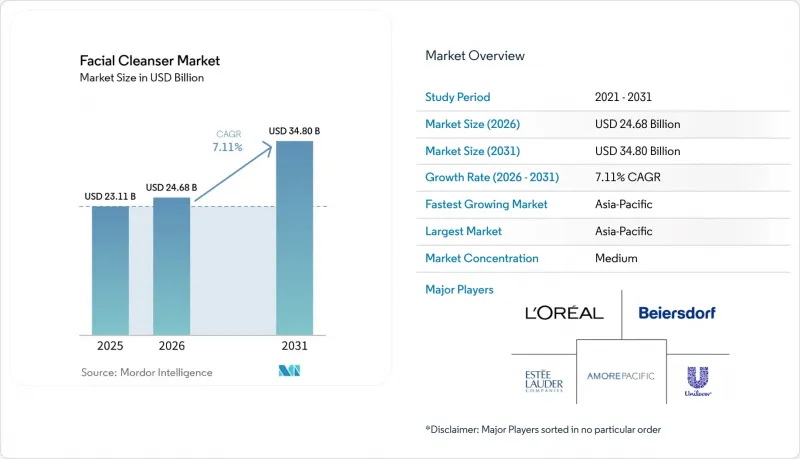
This report is Segmented by Product Type (Gel-Based, Foam-Based, Cream-Based, and More), Category (Conventional and Natural/Organic), Price Range (Mass and Premium), Distribution Channel (Supermarkets/Hypermarkets, Health and Beauty Stores, and More) and Geography (North America, Europe, Asia-Pacific, South America, and Middle East and Africa). The Market Forecasts are Provided in Terms of Value (USD).
Global Facial Cleanser Market Trends and Insights
Rising consumer focus on skincare and facial hygiene
Consumer expectations from face washes and facial cleansers have evolved significantly, with the category moving beyond basic cleansing to become an essential part of daily skincare routines. Cleansers are increasingly viewed as the foundation of skincare regimens, with consumers seeking products that address concerns such as hydration, acne management, and skin barrier protection. This has elevated the importance of face washes as an entry point into broader skincare routines and strengthened their role in influencing brand loyalty and long-term consumer engagement with skincare brands. For example, consumers who adopt a hydrating or barrier-repair cleanser from brands such as CeraVe or Neutrogena often extend their routines to include moisturizers, serums, and treatment products from the same portfolio. Supporting this trend, consumer spending on personal care products in the United Kingdom increased from GBP 36,132 million in 2023 to GBP 38,290 million in 2025, according to the Office for National Statistics, reflecting the growing prioritization of skincare and wellness among consumers . Consequently, efficacy and skin compatibility have become key purchase drivers, encouraging manufacturers to invest further in advanced formulations, dermatological testing, and ingredient innovation.
Increasing demand for personalized and skin-specific formulations
The increasing demand for personalized and skin-specific formulations is reshaping the facial cleanser market, as consumers increasingly expect products that address their unique skin biology rather than broad skin-type categories. This trend extends beyond conventional "for oily skin" or "for dry skin" positioning toward formulations tailored to individual factors such as age, lifestyle, climate, pollution exposure, hormonal changes, and skin sensitivity. For example, PROVEN Skincare offers AI-driven personalized cleansers that analyze more than 40 individual parameters, including skin concerns, environmental conditions, and lifestyle factors, to create unique formulations for each consumer rather than assigning them to a standard product segment. Similarly, Prose Skincare develops made-to-order facial cleansers based on over 80 variables, including geographic location, humidity levels, and skincare goals, with formulations that evolve over time as consumer needs change. These developments illustrate the industry's shift from demographic segmentation toward precision skincare, creating opportunities for brands with strong data analytics, dermatological expertise, and formulation capabilities.
Stringent regulations on cosmetic ingredients and labeling
Ingredient regulations are increasing pressure on the facial cleanser market by shortening reformulation timelines and raising compliance requirements. Stricter restrictions on fragrances, preservatives, and other cosmetic ingredients are prompting companies to reassess product portfolios, particularly those reliant on traditional foaming systems. Regulatory momentum continues to intensify, with the European Union introducing restrictions on an additional 15 chemicals classified as carcinogenic, mutagenic, or toxic to reproduction (CMR) in April 2026, underscoring the increasing pace of compliance changes facing personal care manufacturers . This challenge is especially significant for foam-based products, as consumers continue to associate rich lather with effective cleansing. Reformulation efforts are both time-intensive and costly, involving extensive testing, packaging revisions, inventory management, and sourcing changes. As a result, manufacturers must carefully balance maintaining the sensory experience consumers expect while transitioning to cleaner and gentler ingredient profiles. This trade-off is expected to remain a key challenge shaping the facial cleanser market in the coming years.
Other drivers and restraints analyzed in the detailed report include:
- Increasing prevalence of acne, sensitivity, and other skin conditions
- Increasing preference for natural, organic, and clean-label products
- Rising concerns over harsh chemicals and skin irritation
For complete list of drivers and restraints, kindly check the Table Of Contents.
Segment Analysis
Foam-based cleansers accounted for the largest share of the market in 2025, representing 39.84% of total value, supported by their broad appeal across consumer groups, suitability for multiple skin types, and strong presence across retail channels. Their leadership is reinforced by long-standing consumer perceptions linking foam textures with superior cleansing performance, resulting in high repeat purchase rates. Gel-based cleansers continue to cater primarily to oily and acne-prone skin, while cream and lotion formats remain preferred for dry and sensitive skin due to their moisturizing properties.
Micellar and water-based cleansers are projected to register the fastest growth, expanding at a CAGR of 8.54% during 2026-2031, driven by rising demand for convenient, no-rinse products that cleanse while preserving the skin barrier. Growing adoption of multifunctional skincare routines and increasing awareness of sensitive skin needs are accelerating this shift. Oil-based cleansers continue to benefit from the popularity of the K-beauty-inspired double-cleansing routine, particularly in East Asian markets, while texture innovation across formats is emerging as a key premiumization strategy for brands.
The conventional segment held the largest share of the facial cleanser market in 2025, accounting for 82.73% of total market value, supported by its affordability, widespread retail penetration, and strong consumer trust in established surfactant-based cleansing technologies. While conventional formulations are expected to remain dominant in the near term, their share is gradually moderating in premium consumer segments as demand shifts toward higher-value and ingredient-conscious alternatives. The expansion of clean-label and certified formulations is also contributing to an increase in category average selling prices.
The natural/organic segment is projected to record the fastest CAGR of 7.95% during 2026-2031, driven by rising consumer preference for ingredient transparency, sustainability, and certification-backed claims. Growth in this segment is increasingly supported by demand for products that combine natural ingredients with clinically proven efficacy rather than relying solely on "natural" positioning. This trend is encouraging both emerging and established brands to reformulate products and adopt certification-led strategies, strengthening the premiumization of the facial cleanser market.
Complete Report Scope:
- By Product Type
- Gel-Based
- Foam-Based
- Cream-Based
- Micellar/Water-Based
- Oil-Based
- Other Product Types
- By Category
- Conventional
- Natural/Organic
- By Price Range
- Mass
- Premium
- By Distribution Channel
- Supermarkets/Hypermarkets
- Health and Beauty Stores
- Online Retail Stores
- Other Distribution Channels
- By Geography
- North America
- United States
- Canada
- Mexico
- Rest of North America
- Europe
- Germany
- United Kingdom
- Italy
- France
- Spain
- Netherlands
- Poland
- Belgium
- Sweden
- Rest of Europe
- Asia-Pacific
- China
- India
- Japan
- Australia
- Indonesia
- South Korea
- Thailand
- Singapore
- Rest of Asia-Pacific
- South America
- Brazil
- Argentina
- Colombia
- Chile
- Peru
- Rest of South America
- Middle East and Africa
- South Africa
- Saudi Arabia
- United Arab Emirates
- Nigeria
- Egypt
- Morocco
- Turkey
- Rest of Middle East and Africa
- North America
Geography Analysis
Asia-Pacific accounted for 41.37% of the facial cleanser market in 2025 and is expected to register the fastest regional growth through 2031 at a CAGR of 8.32%. Despite its large market size, the region continues to expand as consumers increasingly prioritize ingredient transparency and skin compatibility in cleansing products. China remains the largest value contributor, while South Korea continues to influence global cleansing routines through its skincare-led culture. Premium skincare habits in Japan and rising demand for herbal and Ayurvedic products in India further strengthen regional growth prospects.
The facial cleanser market in North America and Europe represents the largest concentration of value outside Asia-Pacific, although growth drivers differ across the two regions. In the United States, demand is supported by strong consumer interest in acne-focused and dermatologist-recommended products. Canada shows similar preferences for quality and safety, while affordability plays a more prominent role in purchasing decisions in Mexico. Across Europe, consumers increasingly favor clean-label and dermocosmetic cleansers, encouraging manufacturers to adopt gentler ingredient systems and reformulate existing products.
South America, the Middle East, and Africa are emerging as important long-term growth regions due to urbanization, youthful populations, and expanding retail access. Demand in Latin America is supported by a growing need for targeted skincare solutions, particularly for acne management. The Middle East reflects a mix of premium demand in affluent urban markets and value-oriented purchasing in more price-sensitive economies. In Africa, companies are increasingly introducing localized offerings, highlighted by launches such as Garnier's tailored cleanser products in markets such as Kenya.
- L'Oreal S.A.
- Beiersdorf AG
- Kenvue Inc.
- Amorepacific Corporation
- The Estee Lauder Companies Inc.
- Unilever PLC
- Natura & Co.
- The Procter & Gamble Company
- Kao Corporation
- Shiseido Company Limited
- Galderma
- Coty Inc.
- The Body Shop International Limited
- Laboratoires Pierre Fabre
- LG Household & Health Care
- Mary Kay Inc.
- LVMH Moet Hennessy Louis Vuitton SE
- Groupe Clarins
- Kose Corporation
- Puig
Additional Benefits:
- The market estimate (ME) sheet in Excel format
- 3 months of analyst support
TABLE OF CONTENTS
1 INTRODUCTION
- 1.1 Study Assumptions and Market Definition
- 1.2 Scope of the Study
2 RESEARCH METHODOLOGY
3 EXECUTIVE SUMMARY
4 MARKET LANDSCAPE
- 4.1 Market Overview
- 4.2 Market Drivers
- 4.2.1 Rising consumer focus on skincare and facial hygiene
- 4.2.2 Increasing demand for personalized and skin-specific formulations
- 4.2.3 Rising male grooming and gender-inclusive skincare adoption
- 4.2.4 Increasing prevalence of acne, sensitivity, and other skin conditions
- 4.2.5 Influence of social media, beauty influencers, and celebrity endorsements
- 4.2.6 Increasing preference for natural, organic, and clean-label products
- 4.3 Market Restraints
- 4.3.1 Price sensitivity among consumers in developing markets
- 4.3.2 Stringent regulations on cosmetic ingredients and labeling
- 4.3.3 Supply chain disruptions affecting ingredient availability
- 4.3.4 Rising concerns over harsh chemicals and skin irritation
- 4.4 Consumer Behavior Analysis
- 4.5 Regulatory Landscape
- 4.6 Technological Outlook
- 4.7 Porters Five Forces
- 4.7.1 Threat of New Entrants
- 4.7.2 Bargaining Power of Buyers/Consumers
- 4.7.3 Bargaining Power of Suppliers
- 4.7.4 Threat of Substitute Products
- 4.7.5 Intensity of Competitive Rivalry
5 MARKET SIZE AND GROWTH FORECASTS (VALUE)
- 5.1 By Product Type
- 5.1.1 Gel-Based
- 5.1.2 Foam-Based
- 5.1.3 Cream-Based
- 5.1.4 Micellar/Water-Based
- 5.1.5 Oil-Based
- 5.1.6 Other Product Types
- 5.2 By Category
- 5.2.1 Conventional
- 5.2.2 Natural/Organic
- 5.3 By Price Range
- 5.3.1 Mass
- 5.3.2 Premium
- 5.4 By Distribution Channel
- 5.4.1 Supermarkets/Hypermarkets
- 5.4.2 Health and Beauty Stores
- 5.4.3 Online Retail Stores
- 5.4.4 Other Distribution Channels
- 5.5 By Geography
- 5.5.1 North America
- 5.5.1.1 United States
- 5.5.1.2 Canada
- 5.5.1.3 Mexico
- 5.5.1.4 Rest of North America
- 5.5.2 Europe
- 5.5.2.1 Germany
- 5.5.2.2 United Kingdom
- 5.5.2.3 Italy
- 5.5.2.4 France
- 5.5.2.5 Spain
- 5.5.2.6 Netherlands
- 5.5.2.7 Poland
- 5.5.2.8 Belgium
- 5.5.2.9 Sweden
- 5.5.2.10 Rest of Europe
- 5.5.3 Asia-Pacific
- 5.5.3.1 China
- 5.5.3.2 India
- 5.5.3.3 Japan
- 5.5.3.4 Australia
- 5.5.3.5 Indonesia
- 5.5.3.6 South Korea
- 5.5.3.7 Thailand
- 5.5.3.8 Singapore
- 5.5.3.9 Rest of Asia-Pacific
- 5.5.4 South America
- 5.5.4.1 Brazil
- 5.5.4.2 Argentina
- 5.5.4.3 Colombia
- 5.5.4.4 Chile
- 5.5.4.5 Peru
- 5.5.4.6 Rest of South America
- 5.5.5 Middle East and Africa
- 5.5.5.1 South Africa
- 5.5.5.2 Saudi Arabia
- 5.5.5.3 United Arab Emirates
- 5.5.5.4 Nigeria
- 5.5.5.5 Egypt
- 5.5.5.6 Morocco
- 5.5.5.7 Turkey
- 5.5.5.8 Rest of Middle East and Africa
- 5.5.1 North America
6 COMPETITIVE LANDSCAPE
- 6.1 Market Concentration
- 6.2 Strategic Moves
- 6.3 Market Share Analysis
- 6.4 Company Profiles (includes Global level Overview, Market level overview, Core Segments, Financials as available, Strategic Information, Market Rank/Share for key companies, Products & Services, and Recent Developments)
- 6.4.1 L'Oreal S.A.
- 6.4.2 Beiersdorf AG
- 6.4.3 Kenvue Inc.
- 6.4.4 Amorepacific Corporation
- 6.4.5 The Estee Lauder Companies Inc.
- 6.4.6 Unilever PLC
- 6.4.7 Natura & Co.
- 6.4.8 The Procter & Gamble Company
- 6.4.9 Kao Corporation
- 6.4.10 Shiseido Company Limited
- 6.4.11 Galderma
- 6.4.12 Coty Inc.
- 6.4.13 The Body Shop International Limited
- 6.4.14 Laboratoires Pierre Fabre
- 6.4.15 LG Household & Health Care
- 6.4.16 Mary Kay Inc.
- 6.4.17 LVMH Moet Hennessy Louis Vuitton SE
- 6.4.18 Groupe Clarins
- 6.4.19 Kose Corporation
- 6.4.20 Puig
7 MARKET OPPORTUNITIES AND FUTURE OUTLOOK

