PUBLISHER: Mordor Intelligence | PRODUCT CODE: 2098590

PUBLISHER: Mordor Intelligence | PRODUCT CODE: 2098590
Germany Healthcare Cold Chain Logistics - Market Share Analysis, Industry Trends & Statistics, Growth Forecasts (2026 - 2031)
According to Mordor Intelligence, the Germany healthcare cold chain logistics market size is expected to increase from USD 3.16 billion in 2025 to USD 3.41 billion in 2026 and reach USD 4.88 billion by 2031, growing at a CAGR of 7.47% over 2026-2031.
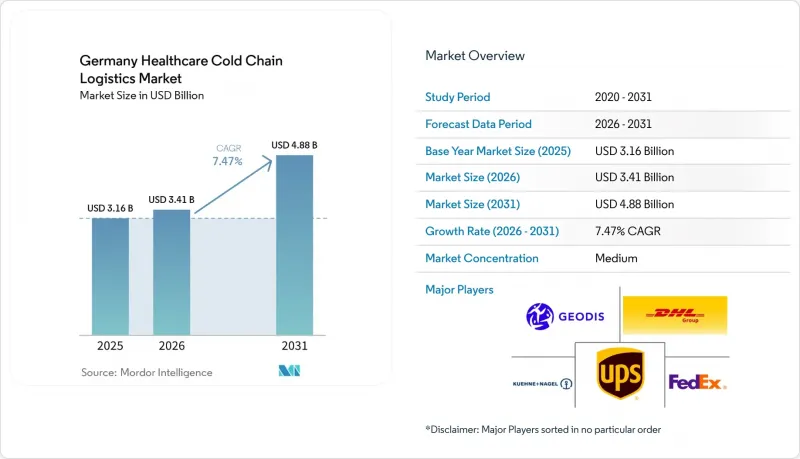
Growth in the Germany healthcare cold chain logistics market is tied to the wider use of biopharmaceuticals, tighter compliance requirements under EU Good Distribution Practice rules, and the rising need for cryogenic handling for advanced therapies. This report is Segmented by Logistics Function (Transportation, and More), by Temperature Type (Chilled, Frozen, Ambient, Deep-Frozen), by Product Type (Pharmaceuticals, and More), by Destination (Domestic, International), by End User (Pharma Manufacturers, and More), and by Geography (NRW, Bavaria, Baden-Wurttemberg, Rest of States). The Market Forecasts are Provided in Value (USD).
Germany Healthcare Cold Chain Logistics Market Trends and Insights
Biologics and Biosimilars Volume Growth
Germany's manufacturing base for biologics and biosimilars is creating demand that standard logistics systems were not built to handle. Biosimilar development costs can reach EUR 300 million (USD 324 million), and that technical complexity carries through to transport, storage, and dispensing. These products need uninterrupted 2 °C to 8 °C control from origin to point of use, and any temperature excursion can invalidate a batch and create liability exposure. Germany's GKV-led substitution practices are also increasing the number of GDP-qualified routes needed to connect manufacturers with 19,000 pharmacies across the country. That pattern is concentrating volume with operators that already have validated infrastructure, documented temperature controls, and established GDP workflows.
ALBVVG Safety-Stock Mandates Lifting Cold Inventory Nodes
The Germany healthcare cold chain logistics market is also being lifted by the ALBVVG stockpiling framework, which is active through 2025 and 2026 and requires 6-month reserves for rebated off-patent drugs. A 2026 Scientific Reports analysis estimated the annual cost of this reserve at EUR 163 million (USD 176 million), and cold-chain products represent a meaningful part of the affected stock-keeping units because 17% to 31% of pharmaceutical shipments require temperature control. Hospital pharmacies and wholesalers have already had to expand GDP-compliant cold rooms and cross-docking capacity near major pharmaceutical clusters. The Techniker Krankenkasse Lieferklima-Report 2025 also showed that warehousing capacity remains a limiting factor even where supply reliability has improved. This requirement gives the Germany healthcare cold chain logistics market a regulatory demand floor that is less exposed to normal cyclical swings.
Refrigeration Energy and Compliance Cost Pressure
Energy use is becoming one of the clearest structural cost pressures in the Germany healthcare cold chain logistics market. LOXXESS has stated that temperature control can account for up to 65% of total electricity consumption in GDP-compliant cold chain facilities. Germany's high industrial electricity prices make this burden harder for smaller regional operators to absorb than for global integrators with more purchasing scale. The F-Gas phase-down is also forcing fleet and facility upgrades toward low-GWP systems, which adds another capital layer before 2030. These factors are pushing the market toward consolidation because operators without retrofit capacity may struggle to keep certified cold assets competitive.
Other drivers and restraints analyzed in the detailed report include:
- CGT and Precision-Oncology Cluster Build-Out
- GDP-Led Digital Visibility Upgrades
- Qualified GDP Driver and Technician Shortages
For complete list of drivers and restraints, kindly check the Table Of Contents.
Segment Analysis
Transportation accounted for 41.78% of the Germany healthcare cold chain logistics market size in 2025, which reflected Germany's role as a pharmaceutical manufacturing and export gateway in Europe. Road transport remained the dominant mode because the country's motorway network connects the main pharmaceutical clusters in NRW, Bavaria, and Baden-Wurttemberg with high route frequency. Air freight remained smaller by volume, yet it carried an outsized revenue contribution because time-critical biologics and cell and gene therapy shipments command premium pricing through Frankfurt. Rail and sea freight remained limited inside domestic healthcare distribution and were used more for import and export flows than for routine in-country delivery.
Value-added services are projected to grow at an 8.22% CAGR through 2031, which makes them the fastest-rising logistics function in the Germany healthcare cold chain logistics market. This expansion comes from higher regulatory complexity rather than from volume alone. Pharmaceutical customers increasingly want bundled services that include serialization support, re-labeling, documentation handling, clinical trial kitting, and chain-of-identity controls. Warehousing and distribution still hold an important position, but GDP-approved space limits near key hubs are slowing the pace at which storage capacity can scale.
The chilled segment captured 48.12% of the Germany healthcare cold chain logistics market size in 2025 because biologics, biosimilars, vaccines, blood products, and many specialty injectables still move mainly within the 2 °C to 8 °C range. Germany's biologic prescribing growth and wider biosimilar use are sustaining that temperature band at scale. The segment also carries heavy compliance obligations because chilled-chain integrity requires close documentation and deviation management under GDP rules. That combination of volume and compliance keeps chilled handling central to the Germany healthcare cold chain logistics industry.
Frozen is the fastest-growing thermal segment, with a projected CAGR of 11.39% through 2031. Growth is being led by mRNA-derived biologics, frozen plasma products, and biosimilar formulations that need sub-zero handling throughout their shelf life. Ambient flows remain more stable, but they face margin pressure as some legacy formulations move toward broader temperature tolerance. Deep-frozen and ultra-low logistics are still niche, yet they are attracting targeted investment, including Movianto's 2026 deep-freeze capability of minus 20 °C to minus 80 °C at its Wiesloch-Walldorf site in Baden-Wurttemberg.
Complete Report Scope:
- By Logistics Function
- Transportation
- Road
- Air
- Sea and Inland Waterways
- Rail
- Warehousing and Distribution
- Value-added Services and Others
- Transportation
- By Temperature Type
- Chilled (0-5 °C)
- Frozen (-18-0 °C)
- Ambient
- Deep-Frozen / Ultra-Low (less than -20 °C)
- By Product Type
- Pharmaceuticals
- Prescription and Specialty Drugs
- OTC Drugs
- Biopharmaceuticals (Biologics and Biosimilars)
- Vaccines
- Clinical Trial Materials
- Cell and Gene Therapies
- Medical Devices
- Veterinary Medicine
- Blood, Plasma and Blood Components
- Diagnostic and Laboratory Products
- Organs and Human Tissues
- Others
- Pharmaceuticals
- By Destination
- Domestics
- International
- By End User
- Pharmaceutical Manufacturers
- Biopharmaceutical Manufacturers
- Hospitals and Clinics
- Hospitals and Retail Pharmacies
- Healthcare Distributors and Wholesalers
- Others
- By Region
- North Rhine-Westphalia
- Bavaria (Bayern)
- Baden-Wurttemberg
- Rest of States
List of Companies Covered in this Report:
- DHL Group
- Kuehne+Nagel
- United Parcel Service of America, Inc. (UPS)
- FedEx
- CMA CGM Group (Including CEVA Logistics)
- GEODIS
- A.P. Moller - Maersk
- GXO Logistics
- Arvato SE
- LOXXESS
- Movianto Germany GmbH
- Eurotranspharma Deutschland GmbH
- SK Pharma Logistics GmbH
- Biocair Germany GmbH
- Pharmaserv Logistics
- LIFE LOGISTICS FREIGHT GmbH
- World Courier
- QuickSTAT
- Cencora
- Trans-o-Flex ThermoMed
- Frigo-Trans
Additional Benefits:
- The market estimate (ME) sheet in Excel format
- 3 months of analyst support
TABLE OF CONTENTS
1 Introduction
- 1.1 Study Assumptions and Market Definition
- 1.2 Scope of the Study
2 Research Methodology
3 Executive Summary
4 Market Landscape
- 4.1 Market Overview and Role of Cold Chain Logistics in Healthcare
- 4.2 Healthcare Spending Trends
- 4.3 Market Drivers
- 4.3.1 Biologics and Biosimilars Volume Growth
- 4.3.2 Vaccine, Blood, and Specialty Therapy Cold Flows
- 4.3.3 E-Prescription and Home-Delivery Expansion
- 4.3.4 GDP-Led Digital Visibility Upgrades
- 4.3.5 ALBVVG Safety-Stock Mandates Lifting Cold Inventory Nodes
- 4.3.6 CGT and Precision-Oncology Cluster Build-Out
- 4.4 Market Restraints
- 4.4.1 Refrigeration Energy and Compliance Cost Pressure
- 4.4.2 Qualified GDP Driver and Technician Shortages
- 4.4.3 GDP-Approved Space Scarcity Near Pharma Hubs
- 4.4.4 Mandated Stock Buffers Raising Expiry and Returns Risk
- 4.5 Regulatory Framework
- 4.6 Value Chain and Distribution Channel Architecture Analysis
- 4.7 Technology Innovations Outlook
- 4.8 Porter's Five Forces Analysis
- 4.8.1 Threat of New Entrants
- 4.8.2 Bargaining Power of Suppliers
- 4.8.3 Bargaining Power of Buyers
- 4.8.4 Threat of Substitutes
- 4.8.5 Rivalry Among Competitors
- 4.9 Evolution of Healthcare Cold Chain Logistics Requirements
- 4.10 Impact of Geo-Political Events on Supply Chain Shifts
5 Market Size and Growth Forecasts
- 5.1 By Logistics Function
- 5.1.1 Transportation
- 5.1.1.1 Road
- 5.1.1.2 Air
- 5.1.1.3 Sea and Inland Waterways
- 5.1.1.4 Rail
- 5.1.2 Warehousing and Distribution
- 5.1.3 Value-added Services and Others
- 5.1.1 Transportation
- 5.2 By Temperature Type
- 5.2.1 Chilled (0-5 °C)
- 5.2.2 Frozen (-18-0 °C)
- 5.2.3 Ambient
- 5.2.4 Deep-Frozen / Ultra-Low (less than -20 °C)
- 5.3 By Product Type
- 5.3.1 Pharmaceuticals
- 5.3.1.1 Prescription and Specialty Drugs
- 5.3.1.2 OTC Drugs
- 5.3.2 Biopharmaceuticals (Biologics and Biosimilars)
- 5.3.3 Vaccines
- 5.3.4 Clinical Trial Materials
- 5.3.5 Cell and Gene Therapies
- 5.3.6 Medical Devices
- 5.3.7 Veterinary Medicine
- 5.3.8 Blood, Plasma and Blood Components
- 5.3.9 Diagnostic and Laboratory Products
- 5.3.10 Organs and Human Tissues
- 5.3.11 Others
- 5.3.1 Pharmaceuticals
- 5.4 By Destination
- 5.4.1 Domestics
- 5.4.2 International
- 5.5 By End User
- 5.5.1 Pharmaceutical Manufacturers
- 5.5.2 Biopharmaceutical Manufacturers
- 5.5.3 Hospitals and Clinics
- 5.5.4 Hospitals and Retail Pharmacies
- 5.5.5 Healthcare Distributors and Wholesalers
- 5.5.6 Others
- 5.6 By Region
- 5.6.1 North Rhine-Westphalia
- 5.6.2 Bavaria (Bayern)
- 5.6.3 Baden-Wurttemberg
- 5.6.4 Rest of States
6 Competitive Landscape
- 6.1 Market Concentration
- 6.2 Key Strategic Moves
- 6.3 Market Share Analysis
- 6.4 Company Profiles (Includes Global Level Overview, Market Level Overview, Core Segments, Financials as Available, Strategic Information, Market Rank/Share for Key Companies, Products and Services, and Recent Developments)
- 6.4.1 DHL Group
- 6.4.2 Kuehne+Nagel
- 6.4.3 United Parcel Service of America, Inc. (UPS)
- 6.4.4 FedEx
- 6.4.5 CMA CGM Group (Including CEVA Logistics)
- 6.4.6 GEODIS
- 6.4.7 A.P. Moller - Maersk
- 6.4.8 GXO Logistics
- 6.4.9 Arvato SE
- 6.4.10 LOXXESS
- 6.4.11 Movianto Germany GmbH
- 6.4.12 Eurotranspharma Deutschland GmbH
- 6.4.13 SK Pharma Logistics GmbH
- 6.4.14 Biocair Germany GmbH
- 6.4.15 Pharmaserv Logistics
- 6.4.16 LIFE LOGISTICS FREIGHT GmbH
- 6.4.17 World Courier
- 6.4.18 QuickSTAT
- 6.4.19 Cencora
- 6.4.20 Trans-o-Flex ThermoMed
- 6.4.21 Frigo-Trans
7 Market Opportunities and Future Outlook
- 7.1 White-space and Unmet-Need Assessment

