PUBLISHER: Mordor Intelligence | PRODUCT CODE: 2099151

PUBLISHER: Mordor Intelligence | PRODUCT CODE: 2099151
GCC ITSM - Market Share Analysis, Industry Trends & Statistics, Growth Forecasts (2026 - 2031)
According to Mordor Intelligence, the GCC ITSM market size was valued at USD 0.38 billion in 2025 and is estimated to grow from USD 0.45 billion in 2026 to reach USD 1.09 billion by 2031, at a CAGR of 19.08% during the forecast period (2026-2031).
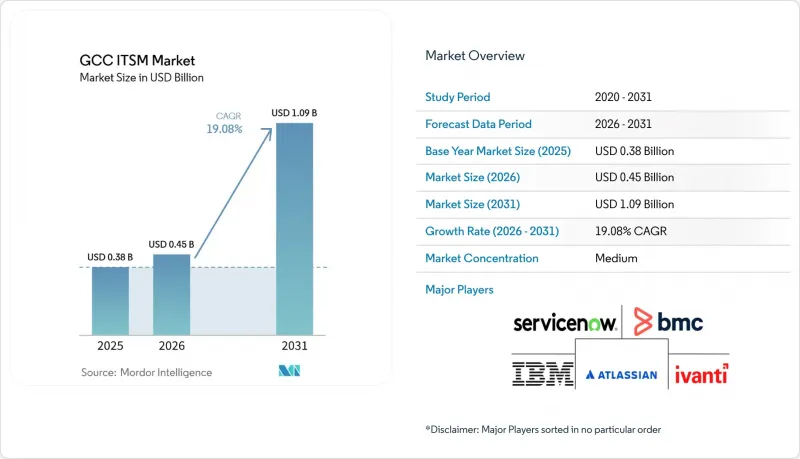
This report is Segmented by Component (Solutions and Services), Deployment (Cloud, On-Premise, and Hybrid), Application (Service Desk and Incident Management, Asset and Configuration Management, and More), End-User Industry (BFSI, Manufacturing, and Others), Enterprise Size (Large Enterprises and Small and Mid-Size Enterprises (SME)), and Country. The Market Forecasts are Provided in Terms of Value (USD).
GCC ITSM Market Trends and Insights
Cloud-First Government And Enterprise Modernization
Cloud-led modernization is a major growth engine for the GCC ITSM market because public institutions and large enterprises are standardizing service delivery across more digital systems. Saudi Arabia's digital government policy framework is pushing agencies toward more structured governance, stronger operating controls, and clearer service accountability across public entities. The UAE also moved to tighten oversight of digital services in June 2026 when it established a federal AI and Data Authority to govern data quality, AI standards, and broader digital transformation compliance. These shifts matter because once services, data, and approvals are consolidated, incident, request, and change processes also need to be handled through consistent service management frameworks. That makes ITSM adoption less optional in many public-facing environments and more closely tied to policy execution and operating discipline.
AI-Enabled Service Automation And Ticket Deflection
AI is changing the GCC ITSM market from a system of record into a system of action, especially in environments with high service volume and repeated support requests. The UAE government launched its first set of AI agents in May 2026 across tax audits, procurement, customer service, and IT technical support, which shows that service automation is already moving into live government workflows. Freshworks also introduced AI Agent Studio in Freshservice in 2026, giving IT and operations teams a no-code way to build service agents and automate resolution paths. As AI tools become part of daily support operations, buyers are placing more weight on autonomous workflow capability, knowledge reuse, and built-in governance than they did in earlier replacement cycles. This favors vendors that can combine automation speed with policy control in government, banking, healthcare, and other regulated settings.
Legacy Migration Friction And Customization Lock-In
Legacy migration remains a real brake on the GCC ITSM market because older service environments often contain years of local custom work that cannot be moved cleanly into newer platforms. The issue is not only software replacement, but also the need to preserve service history, approval logic, audit trails, and configuration records during transition. Saudi Arabia's digital government policy direction places clear weight on governance, service continuity, and stronger public-sector operating standards, which raises the cost of getting migration wrong. The same pressure is visible in the UAE, where the new federal AI and Data Authority adds another layer of digital service oversight that organizations must accommodate as they modernize systems. This means even willing buyers can face longer project cycles when they move from older ticketing tools and heavily tailored workflows into more standardized cloud platforms.
Other drivers and restraints analyzed in the detailed report include:
- Multi-Cloud And Hybrid IT Complexity
- Low-Code Self-Service Workflow Expansion
- Shortage Of ITSM Architects And ITOM Skills
For complete list of drivers and restraints, kindly check the Table Of Contents.
Segment Analysis
Solutions held 67.30% share of the GCC ITSM market in 2025, which shows that software platform spending is still ahead of services spending in the current cycle. This reflects a market where many organizations first secured core platforms and only later moved into broader optimization, integration, and enterprise-wide workflow design. The GCC ITSM market has therefore been shaped by license-led adoption in its earlier phase, especially where public and large enterprise buyers moved quickly on platform selection. Services are projected to grow at a 17.23% CAGR from 2026 to 2031 as those early deployments mature, and buyers look for more value from automation, analytics, and cross-functional workflow expansion.
This second phase supports a wider role for implementation, integration, change management, and ongoing support partners. BMC said in February 2025 that it planned to expand its Saudi commitment and scale its certified regional partner headcount from 300 to more than 600 by 2030, which points to the growing need for delivery capacity around enterprise accounts. At the same time, embedded AI is starting to reduce some of the manual work that once lifted services demand, especially for routine setup and service design tasks. Freshworks' 2026 AI Agent Studio launch reinforces that shift by giving teams a faster way to automate workflows without heavy custom development.
Cloud accounted for 72.10% of the GCC ITSM market size in 2025 and is also the fastest-growing deployment model with an 18.37% CAGR through 2031. This mix of leading share and leading growth shows that the market is still in an active transition phase rather than a settled one. The GCC ITSM market is gaining from buyer preference for faster deployment, lower infrastructure burden, and easier access to AI and workflow updates in cloud environments. Even so, on-premise and hybrid models remain relevant in sectors where data handling rules, internal control practices, or service continuity needs are stricter.
That is why hybrid is shaping up as a lasting operating model rather than just a step between legacy systems and full cloud. ServiceNow's decision to launch Saudi data centers in 2026 addresses one side of this issue by improving local hosting, data residency comfort, and regional service delivery. OpenText's agreement with Core42 in the UAE shows the same direction, as sovereign cloud and AI infrastructure are becoming central to public-sector digital programs. As a result, enterprises are likely to keep a mixed architecture where sensitive records remain tightly controlled while service automation and broader workflow orchestration continue to move into the cloud.
Complete Report Scope:
- By Component
- Solutions
- Services
- By Deployment
- Cloud
- On-premise
- Hybrid
- By Application
- Service Desk and Incident Management
- Asset and Configuration Management
- Change and Release Management
- Service Request Management
- Knowledge Management
- Other Applications
- By End-user Industry
- BFSI
- Manufacturing
- Government and Public Sector
- IT and Telecommunications
- Retail and E-commerce
- Healthcare
- Travel and Hospitality
- Other End-user Industries
- By Enterprise Size
- Large Enterprises
- Small and Mid-size Enterprises (SME)
- By Country
- Saudi Arabia
- United Arab Emirates
- Qatar
- Kuwait
- Oman
- Bahrain
List of Companies Covered in this Report:
- ServiceNow, Inc.
- BMC Software, Inc.
- IBM Corporation
- Atlassian
- Ivanti, Inc.
- ManageEngine
- Freshworks Inc.
- Broadcom Inc.
- OpenText Corporation
- Zendesk, Inc.
- SolarWinds Corporation
- EasyVista
- SysAid Technologies Ltd.
- TOPdesk B.V.
- Hornbill Service Management
- Aisera, Inc.
- 4me, Inc.
- GoTo
- HaloITSM
- TeamDynamix
- Efecte Oyj
Additional Benefits:
- The market estimate (ME) sheet in Excel format
- 3 months of analyst support
TABLE OF CONTENTS
1 INTRODUCTION
- 1.1 Study Assumptions and Market Definition
- 1.2 Scope of the Study
2 RESEARCH METHODOLOGY
3 EXECUTIVE SUMMARY
4 MARKET LANDSCAPE
- 4.1 Market Overview
- 4.2 Market Drivers
- 4.2.1 Cloud-First Government and Enterprise Modernization
- 4.2.2 AI-Enabled Service Automation and Ticket Deflection
- 4.2.3 Multi-Cloud and Hybrid IT Complexity
- 4.2.4 Low-Code Self-Service Workflow Expansion
- 4.2.5 FinOps and GreenOps Visibility Inside ITSM Workflows
- 4.2.6 Edge, 5G, and Smart-Operations Support Demand
- 4.3 Market Restraints
- 4.3.1 Legacy Migration Friction and Customization Lock-In
- 4.3.2 Shortage of ITSM Architects and ITOM Skills
- 4.3.3 Data Residency, AI Governance, and Compliance Constraints
- 4.3.4 Tool Sprawl and Integration Overhead Across Point Solutions
- 4.4 Industry Value Chain Analysis
- 4.5 Regulatory Landscape
- 4.6 Technological Outlook
- 4.7 Porter's Five Forces Analysis
- 4.7.1 Bargaining Power of Suppliers
- 4.7.2 Bargaining Power of Buyers
- 4.7.3 Threat of New Entrants
- 4.7.4 Threat of Substitutes
- 4.7.5 Intensity of Competitive Rivalry
- 4.8 Impact of Macroeconomic Factors on the Market
5 MARKET SIZE AND GROWTH FORECASTS (VALUE)
- 5.1 By Component
- 5.1.1 Solutions
- 5.1.2 Services
- 5.2 By Deployment
- 5.2.1 Cloud
- 5.2.2 On-premise
- 5.2.3 Hybrid
- 5.3 By Application
- 5.3.1 Service Desk and Incident Management
- 5.3.2 Asset and Configuration Management
- 5.3.3 Change and Release Management
- 5.3.4 Service Request Management
- 5.3.5 Knowledge Management
- 5.3.6 Other Applications
- 5.4 By End-user Industry
- 5.4.1 BFSI
- 5.4.2 Manufacturing
- 5.4.3 Government and Public Sector
- 5.4.4 IT and Telecommunications
- 5.4.5 Retail and E-commerce
- 5.4.6 Healthcare
- 5.4.7 Travel and Hospitality
- 5.4.8 Other End-user Industries
- 5.5 By Enterprise Size
- 5.5.1 Large Enterprises
- 5.5.2 Small and Mid-size Enterprises (SME)
- 5.6 By Country
- 5.6.1 Saudi Arabia
- 5.6.2 United Arab Emirates
- 5.6.3 Qatar
- 5.6.4 Kuwait
- 5.6.5 Oman
- 5.6.6 Bahrain
6 COMPETITIVE LANDSCAPE
- 6.1 Market Concentration
- 6.2 Strategic Moves
- 6.3 Market Share Analysis
- 6.4 Company Profiles (includes Global Level Overview, Market Level Overview, Core Segments, Financials as available, Strategic Information, Market Rank/Share, Products and Services, Recent Developments)
- 6.4.1 ServiceNow, Inc.
- 6.4.2 BMC Software, Inc.
- 6.4.3 IBM Corporation
- 6.4.4 Atlassian
- 6.4.5 Ivanti, Inc.
- 6.4.6 ManageEngine
- 6.4.7 Freshworks Inc.
- 6.4.8 Broadcom Inc.
- 6.4.9 OpenText Corporation
- 6.4.10 Zendesk, Inc.
- 6.4.11 SolarWinds Corporation
- 6.4.12 EasyVista
- 6.4.13 SysAid Technologies Ltd.
- 6.4.14 TOPdesk B.V.
- 6.4.15 Hornbill Service Management
- 6.4.16 Aisera, Inc.
- 6.4.17 4me, Inc.
- 6.4.18 GoTo
- 6.4.19 HaloITSM
- 6.4.20 TeamDynamix
- 6.4.21 Efecte Oyj
7 MARKET OPPORTUNITIES AND FUTURE OUTLOOK
- 7.1 White-Space and Unmet-Need Assessment

