PUBLISHER: Mordor Intelligence | PRODUCT CODE: 2117634

PUBLISHER: Mordor Intelligence | PRODUCT CODE: 2117634
United Kingdom ITSM - Market Share Analysis, Industry Trends & Statistics, Growth Forecasts (2026 - 2035)
According to Mordor Intelligence, the United Kingdom ITSM market size was valued at USD 0.87 billion in 2025 and is estimated to grow from USD 0.99 billion in 2026 to reach USD 1.99 billion by 2035, at a CAGR of 14.94% during the forecast period (2026-2035).
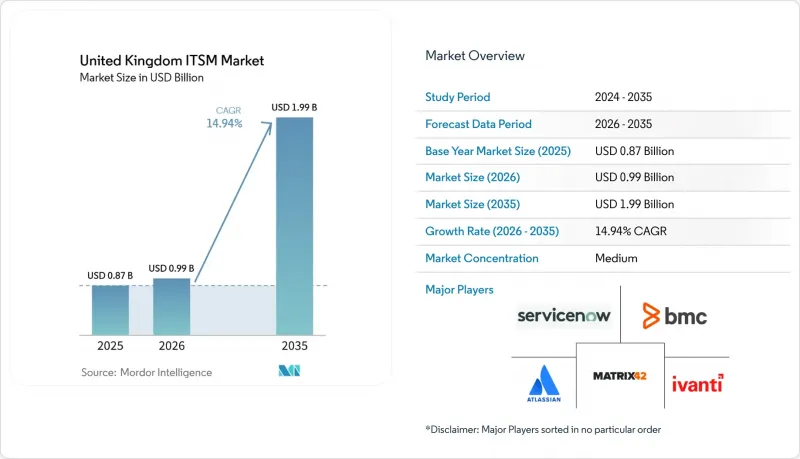
This report is Segmented by Component (Solutions, Services), Deployment (Cloud, On-Premise, Hybrid), Application (Service Desk and Incident, Asset and Config, Change and Release, Service Request, Knowledge Mgmt, Others), End-User Industry (BFSI, Manufacturing, Government, IT and Telecom, and More) and Enterprise Size (Large Enterprises, Smes). The Market Forecasts are Provided in Terms of Value (USD).
United Kingdom ITSM Market Trends and Insights
Rising Demand For IT Efficiency And Automation
UK organizations are treating service automation as an operating need rather than an optional productivity project. In May 2026, NHS Shared Business Services deployed SBS One with Salesforce, and the AI-powered help center was targeted to handle up to 50% of service demand across NHS corporate services. Freshworks also launched Freddy AI Agent Studio for Freshservice in May 2026, which gave service teams a no-code way to automate requests and connect outside tools through an MCP Gateway. These product and deployment moves show that automation is now being built directly into the service layer instead of being added as a side tool after rollout. That shift is strengthening the UK ITSM market because buyers are now looking for platforms that reduce manual service effort at the same time they improve speed, consistency, and scale.
Expansion Of Cloud-Based ITSM Adoption Among UK Enterprises
Cloud delivery continues to gain ground because buyers want faster upgrades, lower infrastructure burden, and better access to AI features. The UK Competition and Markets Authority found that cloud customers still face switching friction tied to egress costs and interoperability barriers, which is increasing the value of service platforms that can govern multi-cloud estates from one environment. ServiceNow strengthened this direction in October 2025 by activating NVIDIA AI infrastructure in its UK data centers in London and Newport, which supports local large language model processing for customers with data sovereignty requirements. ServiceNow and Google Cloud had also expanded their partnership in January 2025 to make the Now Platform available on Google Distributed Cloud, which widened sovereign and partner-operated deployment options for regulated users. As more UK buyers weigh resilience, jurisdiction control, and AI access together, the UK ITSM market is moving further toward cloud-native delivery as the default architecture.
High Cost And Complexity Of Legacy Platform Replacement
The Germany ITSM market still faces a major constraint from legacy complexity, because many enterprises have service workflows that sit across old ERP systems, plant systems, endpoint tools, and internally customized support processes. Replacing or upgrading service management in those settings is rarely a single-platform job, and the work often depends on stable links between asset data, request handling, user directories, and operational records. SAP's Syntegon example shows how large modernizations can span 47 locations and nearly 400 interfaces, which helps explain why service management redesign often becomes slower and more demanding than planned. Ivanti's emphasis on stronger cloud-to-on-premises synchronization also underlines the reality that the Germany ITSM market still has to serve buyers who cannot cut away from mixed environments in one step. This restraint does not stop adoption, but it does lengthen project timelines, increase service dependency, and reward vendors with tested connectors, migration tools, and local implementation depth. It also keeps services demand high, because many customers need ongoing support after the initial platform rollout is complete.
Other drivers and restraints analyzed in the detailed report include:
- Increased Need For Hybrid Work Service Support
- Greater Use Of AI-Driven Service Desk Workflows
- Data Migration And CMDB Normalization Challenges
For complete list of drivers and restraints, kindly check the Table Of Contents.
Segment Analysis
Solutions held a 68.42% share of the UK ITSM market in 2025, which kept software licenses and SaaS subscriptions as the main revenue base. Services is projected to expand at an 18.65% CAGR through 2031, which makes it the faster-growing component in the UK ITSM market. That pattern shows that buyers are no longer stopping at platform purchase and first deployment. They are spending more on configuration, workflow design, integration support, and managed service delivery as service environments become broader and more complex. This shift is also consistent with a market where AI features, cross-functional service catalogs, and cloud migrations require ongoing hands-on support after the initial implementation phase.
Services growth is also being reinforced by channel and partner strategies across the UK ITSM industry. Freshworks and Unisys announced a strategic partnership in February 2025 to resell Freshworks ITSM solutions, including Freshservice and Device42, to mid-market and enterprise customers. That kind of model gives buyers access to both the platform and the surrounding implementation capability through one commercial route. In practice, it shortens the gap between purchase and operational use, especially for organizations that do not have deep internal ITSM administration teams. As a result, the UK ITSM market is seeing services move from a supporting role into a stronger value driver that shapes how platforms are adopted, expanded, and renewed.
Cloud deployment led with 73.43% of UK ITSM market share in 2025, which confirmed cloud as the main architecture for new and expanding deployments. The remaining on-premise and hybrid demand stayed concentrated in sectors where data sovereignty, legacy integration, or internal control still limit full cloud migration. This mix shows that the UK ITSM market has already moved well beyond cloud experimentation. Buyers now treat cloud as the normal operating model, while local or hybrid environments are used where institutional constraints remain harder to remove. The leadership of cloud also reflects the practical value of subscription pricing, faster product upgrades, and direct access to AI-enabled service capabilities.
ServiceNow strengthened the cloud case in October 2025 when it activated NVIDIA AI infrastructure in its UK data centers in London and Newport for local model processing. ServiceNow and Google Cloud had already expanded sovereign deployment options in January 2025 by making the Now Platform available on Google Distributed Cloud. The CMA's cloud market findings also showed why centralized governance across providers has become more valuable for UK customers facing interoperability and switching limits. Together, these factors are keeping cloud at the center of the UK ITSM market, even where buyers still need UK-resident processing and tightly controlled deployment conditions. The UK ITSM market size tied to cloud deployment is therefore supported by both functionality gains and regulatory practicality.
Complete Report Scope:
- By Component
- Solutions
- Services
- By Deployment
- Cloud
- On-Premise
- Hybrid
- By Application
- Service Desk
- Asset and Configuration Management
- Change and Release Management
- Service Request Management
- Knowledge Management
- Other Applications
- By End-User Industry
- BFSI
- Manufacturing
- Government and Public Sector
- IT and Telecom
- Retail and E-Commerce
- Healthcare
- Travel and Hospitality
- Other End-User Industries
- By Enterprise Size
- Large Enterprises
- Small and Medium Enterprises
List of Companies Covered in this Report:
- ServiceNow, Inc.
- BMC Software, Inc.
- Ivanti, Inc.
- Atlassian Corporation Plc
- Open Text Corporation
- SolarWinds Corporation
- Freshworks Inc.
- Zoho Corporation Private Limited
- Broadcom Inc.
- EasyVista
- TOPdesk Nederland B.V.
- Hornbill Limited
- SysAid Technologies Ltd.
- HaloITSM Limited
- Axios Systems Limited
- Assyst Europe GmbH
- Matrix42 AG
- IFS AB
Additional Benefits:
- The market estimate (ME) sheet in Excel format
- 3 months of analyst support
TABLE OF CONTENTS
1 INTRODUCTION
- 1.1 Study Assumptions and Market Definition
- 1.2 Scope of the Study
2 RESEARCH METHODOLOGY
3 EXECUTIVE SUMMARY
4 MARKET LANDSCAPE
- 4.1 Market Overview
- 4.2 Market Drivers
- 4.2.1 Rising Demand for IT Efficiency and Automation
- 4.2.2 Expansion of Cloud-Based ITSM Adoption Among UK Enterprises
- 4.2.3 Increased Need for Hybrid Work Service Support
- 4.2.4 Greater Use of AI-Driven Service Desk Workflows
- 4.2.5 Regulatory Pressure for Auditability and Service Governance
- 4.2.6 Rising Integration Demand With IT Asset, Observability, and Workflow Tools
- 4.3 Market Restraints
- 4.3.1 High Cost and Complexity of Legacy Platform Replacement
- 4.3.2 Data Migration and CMDB Normalization Challenges
- 4.3.3 Budget Sensitivity in Mid-Market and Public Sector Buyers
- 4.3.4 Skills Gaps in ITSM Administration and Workflow Design
- 4.4 Industry Value Chain Analysis
- 4.5 Impact of Macroeconomic Factors on the Market
- 4.6 Regulatory Landscape
- 4.7 Technological Outlook
- 4.8 Porter's Five Forces Analysis
- 4.8.1 Bargaining Power of Suppliers
- 4.8.2 Bargaining Power of Buyers
- 4.8.3 Threat of New Entrants
- 4.8.4 Threat of Substitutes
- 4.8.5 Industry Rivalry
5 MARKET SIZE AND GROWTH FORECASTS (VALUE)
- 5.1 By Component
- 5.1.1 Solutions
- 5.1.2 Services
- 5.2 By Deployment
- 5.2.1 Cloud
- 5.2.2 On-Premise
- 5.2.3 Hybrid
- 5.3 By Application
- 5.3.1 Service Desk
- 5.3.2 Asset and Configuration Management
- 5.3.3 Change and Release Management
- 5.3.4 Service Request Management
- 5.3.5 Knowledge Management
- 5.3.6 Other Applications
- 5.4 By End-User Industry
- 5.4.1 BFSI
- 5.4.2 Manufacturing
- 5.4.3 Government and Public Sector
- 5.4.4 IT and Telecom
- 5.4.5 Retail and E-Commerce
- 5.4.6 Healthcare
- 5.4.7 Travel and Hospitality
- 5.4.8 Other End-User Industries
- 5.5 By Enterprise Size
- 5.5.1 Large Enterprises
- 5.5.2 Small and Medium Enterprises
6 COMPETITIVE LANDSCAPE
- 6.1 Market Concentration
- 6.2 Strategic Moves
- 6.3 Market Share Analysis
- 6.4 Company Profiles (includes Global Level Overview, Market Level Overview, Core Segments, Financials as available, Strategic Information, Market Rank/Share, Products and Services, Recent Developments)
- 6.4.1 ServiceNow, Inc.
- 6.4.2 BMC Software, Inc.
- 6.4.3 Ivanti, Inc.
- 6.4.4 Atlassian Corporation Plc
- 6.4.5 Open Text Corporation
- 6.4.6 SolarWinds Corporation
- 6.4.7 Freshworks Inc.
- 6.4.8 Zoho Corporation Private Limited
- 6.4.9 Broadcom Inc.
- 6.4.10 EasyVista
- 6.4.11 TOPdesk Nederland B.V.
- 6.4.12 Hornbill Limited
- 6.4.13 SysAid Technologies Ltd.
- 6.4.14 HaloITSM Limited
- 6.4.15 Axios Systems Limited
- 6.4.16 Assyst Europe GmbH
- 6.4.17 Matrix42 AG
- 6.4.18 IFS AB
7 MARKET OPPORTUNITIES AND FUTURE OUTLOOK
- 7.1 White-Space and Unmet-Need Assessment

