PUBLISHER: Mordor Intelligence | PRODUCT CODE: 2099208

PUBLISHER: Mordor Intelligence | PRODUCT CODE: 2099208
Publishing and Print Media - Market Share Analysis, Industry Trends & Statistics, Growth Forecasts (2026 - 2031)
According to Mordor Intelligence, the publishing and Print Media market size is projected to expand from USD 349.60 billion in 2025 and USD 357.58 billion in 2026 to USD 398.03 billion by 2031, registering a CAGR of 2.17% between 2026 to 2031.
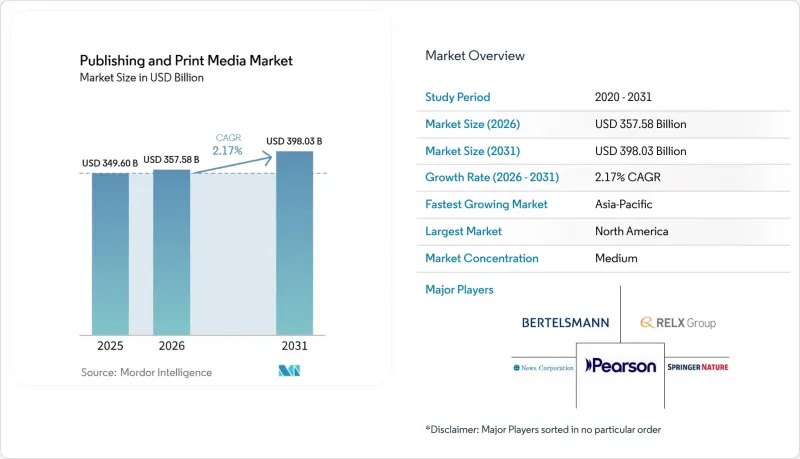
This report is Segmented by Product Type (Books, Newspapers, Magazines and Periodicals, Catalogs, Journals and Scholarly, Brochure and Flyers, and More), Format (Traditional, and Digital), End User (Individual Consumers, Public and Institutional Sector, and Enterprises and Professional Users), and Geography (North America, Europe, and More). The Market Forecasts are Provided in Terms of Value (USD).
Global Publishing and Print Media Market Trends and Insights
Accelerating Shift to Subscription-Led Digital Revenue Models
The publishing and print media market is moving further toward subscription-led revenue because recurring digital payments are proving more stable than advertising-led models. FIPP states in 2026 that publishers using bundle strategies and strong direct audience relationships are still recording better retention across regions, even as growth patterns become less uniform. That matters because the publishing and print media market increasingly rewards operators that can keep readers inside a paid ecosystem across news, books, audio, and specialist content. Subscription businesses also gain better visibility on churn, pricing, and product usage, which helps them plan content investment with more discipline than publishers that depend on volatile traffic and advertising. The result is a publishing and print media market where loyalty, renewal rates, and bundle design are becoming more important than scale in raw audience reach. Companies that establish durable subscription habits now are likely to enter the later years of the forecast period with stronger pricing control and better revenue quality.
Rising Demand for Educational and Academic Publishing
Educational and academic demand remains one of the most stable growth supports in the publishing and print media market. Pearson reports 4% underlying revenue growth for 2025, while its Virtual Learning segment records 8% sales growth on higher enrollments, which shows that institutional learning demand continues to support publisher revenue even in a slower-growth environment. Pearson also signals in 2026 that partnerships with Microsoft, AWS, Google Cloud, and Salesforce.com are supporting the wider shift toward AI-enabled learning content and digital courseware within mainstream procurement. The publishing and print media market benefits from this because academic, professional, and workforce learning content is purchased through multiyear institutional channels that are less exposed to the traffic swings seen in consumer media. Journals and scholarly publishing are also supported by higher research activity and open-access requirements, which widen the submission and usage base for specialized content. This keeps the publishing and print media market anchored by demand that is tied to education, training, and research rather than only consumer discretionary spending.
Secular Decline in Print Circulation and Revenue
The publishing and print media market still depends on print revenue in several categories, but the economics of that base continue to weaken. Print remains important in educational books, institutional procurement, and parts of trade publishing, yet it no longer offers the same protection for newspapers and advertising-supported media. The pressure is strongest where younger audiences shift to digital formats faster than legacy revenue can be replaced, which leaves publishers managing a slower decline rather than a stable base. This creates a difficult balance because publishers must keep serving loyal print audiences while also funding digital products that will support future growth. The publishing and print media market therefore carries a structural drag from print-heavy businesses that have not fully diversified toward subscription, licensing, or software-linked services. That drag does not remove demand for print altogether, but it lowers the pace at which total revenue can expand.
Other drivers and restraints analyzed in the detailed report include:
- Growth of Multi-Format Monetization Platforms
- Expansion of Direct-to-Consumer Reader Engagement
- Rising Customer Acquisition Costs for Digital Platforms
For complete list of drivers and restraints, kindly check the Table Of Contents.
Segment Analysis
Books (Educational and Trade) held 30.63% of revenue in 2025, making them the largest product category in the publishing and print media market. That scale reflects steady procurement from schools, universities, libraries, and corporate learning buyers, along with persistent consumer demand for trade titles in print and digital forms. The publishing and print media market still depends on books for broad revenue coverage because this category serves both institutional contracts and retail channels. Even where growth is modest, books provide a stable base that many other product lines do not match. Newspapers remain under more pressure because they are more exposed to print circulation weakness and advertising erosion. Magazines and periodicals, along with catalogs, brochures, and flyers, continue to rely on clearer digital monetization paths to defend revenue.
The Others segment is forecast to expand at 3.16% CAGR through 2031, which makes it the fastest-growing product group within the publishing and print media market. John Wiley and Sons acquires Emerald Publishing Limited in June 2026 for GBP 337 million, USD 452 million, adding a business with 92% recurring subscription revenue and more than USD 85 million in projected 2026 revenue. That move shows why journals, scholarly content, academic publishing, audiobooks, podcasts, and born-digital formats are becoming more valuable inside the publishing and print media industry. Open-access mandates and higher research output also support journals and scholarly titles, which strengthens demand for trusted editorial processes and subscription-backed specialist content. Established publishers have an advantage here because they already operate the governance, peer review, and information security systems that institutional buyers expect. This leaves the publishing and print media market with a product mix where books anchor scale, while specialized and recurring content is doing more to improve growth quality.
Complete Report Scope:
- By Product Type
- Books (Educational and Trade)
- Newspapers
- Magazines and Periodicals
- Journals and Scholarly
- Catalogs, Brochures and Flyers
- Other Product Types
- By Format
- Traditional
- Digital
- By End User
- Individual Consumers
- Public and Instituitional Sector
- Enterprises and Professional Users
- By Geography
- North America
- United States
- Canada
- Mexico
- South America
- Brazil
- Argentina
- Chile
- Rest of South America
- Europe
- Germany
- United Kingdom
- France
- Italy
- Spain
- Rest of Europe
- Asia-Pacific
- China
- Japan
- India
- South Korea
- Australia
- Rest of Asia-Pacific
- Middle East
- Saudi Arabia
- United Arab Emirates
- Qatar
- Rest of Middle East
- Africa
- South Africa
- Egypt
- Nigeria
- Rest of Africa
- North America
Geography Analysis
North America held 33.64% of revenue in 2025, which gave it the largest regional position in the publishing and print media market size. The region benefits from mature subscription habits, strong educational procurement, and a large base of professional information services revenue. The United States remains the main center of this activity because higher education, legal, tax, healthcare, and business information products generate steady demand across digital and print-linked formats. Canada adds support through educational and professional publishing, while Mexico remains an important Spanish-language consumer market where book revenue grew 7.0% in 2025.
Asia-Pacific is projected to grow at 3.22% CAGR through 2031, making it the fastest-growing region in the publishing and print media market. India stands out because its book market revenue grew 20.7% in 2025, showing strong demand for educational and consumer titles. China is important for a different reason, because digital reading, online fiction, and wider IP monetization are linking publishing to merchandise and screen adaptation. China Literature reports 820,000 original works online and strong growth in merchandise-linked monetization, which points to a broad digital reading infrastructure that extends beyond book sales alone. South Korea adds momentum through digital comics and webtoon ecosystems, while Australia contributes steady institutional and educational demand. Together, these factors make Asia-Pacific the region where the publishing and print media market is changing fastest in format mix, reader behavior, and monetization structure.
Europe presents a mixed picture in the publishing and print media market, with strong export performance in some countries and softer consumer demand in others. The United Kingdom reaches its highest-ever publishing revenue in 2025, with exports rising 4%, which shows the region's continued strength in rights, education, and English-language trade publishing. France declines 1.0% in value to EUR 4.4 billion, USD 4.75 billion, in 2025, while Brazil grows 11.2%, showing that South America is expanding from a lower base through stronger local demand and wider digital access. The Middle East is building publishing infrastructure through literacy programs and digital platform investment, while Africa remains centered on educational and academic demand led by markets such as South Africa, Egypt, and Nigeria. This leaves the publishing and print media market with a regional pattern where North America leads in current revenue, Asia-Pacific leads in growth, and Europe, South America, the Middle East, and Africa each reflect different mixes of institutional demand, consumer recovery, and digital adoption.
- Bertelsmann SE & Co. KGaA
- RELX PLC
- News Corporation
- Pearson PLC
- Springer Nature AG & Co. KGaA
- John Wiley & Sons, Inc.
- Hachette Livre
- Simon & Schuster LLC
- Hearst Communications, Inc.
- McGraw Hill, Inc.
- Advance Publications, Inc.
- Gannett Co., Inc.
- Axel Springer SE
- Thomson Reuters Corporation
- Wolters Kluwer N.V.
- Informa PLC
- Scholastic Corporation
- Cengage Learning Holdings II, Inc.
- Postmedia Network Canada Corp.
- Guardian Media Group plc
- Daily Mail and General Trust plc
Additional Benefits:
- The market estimate (ME) sheet in Excel format
- 3 months of analyst support
TABLE OF CONTENTS
1 INTRODUCTION
- 1.1 Study Assumptions and Market Definition
- 1.2 Scope of the Study
2 RESEARCH METHODOLOGY
3 EXECUTIVE SUMMARY
4 MARKET LANDSCAPE
- 4.1 Market Overview
- 4.2 Market Drivers
- 4.2.1 Accelerating Shift to Subscription-Led Digital Publishing
- 4.2.2 Rising Demand for Educational and Academic Content
- 4.2.3 Growth of Multi-Format Monetization, Print, Digital, Audio, and Bundled Access
- 4.2.4 Expansion of Direct-to-Consumer Reader Relationships
- 4.2.5 Higher Value From Niche, Localized, and Specialist Content
- 4.2.6 AI-Assisted Editorial and Production Workflow Efficiency
- 4.3 Market Restraints
- 4.3.1 Secular Decline in Print Circulation and Print Advertising
- 4.3.2 Rising Customer Acquisition Costs for Digital Subscription Growth
- 4.3.3 Higher Exposure to Content Piracy and Unauthorized Distribution
- 4.3.4 Margin Pressure From Paper, Logistics, and Distribution Volatility
- 4.4 Industry Value Chain Analysis
- 4.5 Impact of Macroeconomic Factors on the Market
- 4.6 Regulatory Landscape
- 4.7 Technological Outlook
- 4.8 Porter's Five Forces Analysis
- 4.8.1 Threat of New Entrants
- 4.8.2 Bargaining Power of Suppliers
- 4.8.3 Bargaining Power of Buyers
- 4.8.4 Threat of Substitutes
- 4.8.5 Competitive Rivalry
5 MARKET SIZE AND GROWTH FORECASTS (VALUE)
- 5.1 By Product Type
- 5.1.1 Books (Educational and Trade)
- 5.1.2 Newspapers
- 5.1.3 Magazines and Periodicals
- 5.1.4 Journals and Scholarly
- 5.1.5 Catalogs, Brochures and Flyers
- 5.1.6 Other Product Types
- 5.2 By Format
- 5.2.1 Traditional
- 5.2.2 Digital
- 5.3 By End User
- 5.3.1 Individual Consumers
- 5.3.2 Public and Instituitional Sector
- 5.3.3 Enterprises and Professional Users
- 5.4 By Geography
- 5.4.1 North America
- 5.4.1.1 United States
- 5.4.1.2 Canada
- 5.4.1.3 Mexico
- 5.4.2 South America
- 5.4.2.1 Brazil
- 5.4.2.2 Argentina
- 5.4.2.3 Chile
- 5.4.2.4 Rest of South America
- 5.4.3 Europe
- 5.4.3.1 Germany
- 5.4.3.2 United Kingdom
- 5.4.3.3 France
- 5.4.3.4 Italy
- 5.4.3.5 Spain
- 5.4.3.6 Rest of Europe
- 5.4.4 Asia-Pacific
- 5.4.4.1 China
- 5.4.4.2 Japan
- 5.4.4.3 India
- 5.4.4.4 South Korea
- 5.4.4.5 Australia
- 5.4.4.6 Rest of Asia-Pacific
- 5.4.5 Middle East
- 5.4.5.1 Saudi Arabia
- 5.4.5.2 United Arab Emirates
- 5.4.5.3 Qatar
- 5.4.5.4 Rest of Middle East
- 5.4.6 Africa
- 5.4.6.1 South Africa
- 5.4.6.2 Egypt
- 5.4.6.3 Nigeria
- 5.4.6.4 Rest of Africa
- 5.4.1 North America
6 COMPETITIVE LANDSCAPE
- 6.1 Market Concentration
- 6.2 Strategic Moves
- 6.3 Market Share Analysis
- 6.4 Company Profiles (includes Global Level Overview, Market Level Overview, Core Segments, Financials as available, Strategic Information, Market Rank/Share, Products and Services, Recent Developments)
- 6.4.1 Bertelsmann SE & Co. KGaA
- 6.4.2 RELX PLC
- 6.4.3 News Corporation
- 6.4.4 Pearson PLC
- 6.4.5 Springer Nature AG & Co. KGaA
- 6.4.6 John Wiley & Sons, Inc.
- 6.4.7 Hachette Livre
- 6.4.8 Simon & Schuster LLC
- 6.4.9 Hearst Communications, Inc.
- 6.4.10 McGraw Hill, Inc.
- 6.4.11 Advance Publications, Inc.
- 6.4.12 Gannett Co., Inc.
- 6.4.13 Axel Springer SE
- 6.4.14 Thomson Reuters Corporation
- 6.4.15 Wolters Kluwer N.V.
- 6.4.16 Informa PLC
- 6.4.17 Scholastic Corporation
- 6.4.18 Cengage Learning Holdings II, Inc.
- 6.4.19 Postmedia Network Canada Corp.
- 6.4.20 Guardian Media Group plc
- 6.4.21 Daily Mail and General Trust plc
7 MARKET OPPORTUNITIES AND FUTURE OUTLOOK
- 7.1 White-Space and Unmet-Need Assessment

