PUBLISHER: Mordor Intelligence | PRODUCT CODE: 2099239

PUBLISHER: Mordor Intelligence | PRODUCT CODE: 2099239
Europe HBM - Market Share Analysis, Industry Trends & Statistics, Growth Forecasts (2026 - 2031)
According to Mordor Intelligence, the Europe HBM market size is projected to be USD 0.43 billion in 2025, USD 0.55 billion in 2026, and reach USD 1.68 billion by 2031, growing at a CAGR of 25.02% from 2026 to 2031.
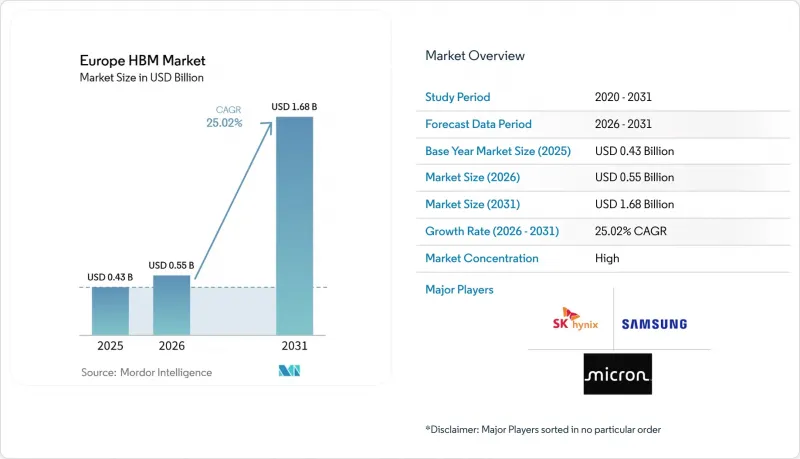
This report is Segmented by HBM Type (HBM2E, HBM3, HBM3E, HBM4, and HBM4E), Technology Node (1X, 1Y, 1Z, and Sub-1Z), End Use Industry (Cloud, AI Developers, Enterprise, Government, Telecom, and More), Application (AI Model Training, AI Model Inference, Network and Telecom Processing, and More), Packaging (2. 5D Interposer, 3D Stacking, and Fan-Out), and Geography. The Market Forecasts are Provided in Terms of Value (USD).
Europe HBM Market Trends and Insights
AI-Driven Accelerator Density in European Data Centers
The rapid buildout of GPU-heavy infrastructure remains the strongest near-term support for the Europe HBM market because each new AI cluster adds high-bandwidth memory requirements at system scale. NVIDIA said in June 2026 that 35 new AI supercomputers were in development across 23 European countries, with more than 800 AI exaflops deployed or announced in Europe since 2025. That buildout matters for the Europe HBM market because more than 90% of those AI factory deployments were tied to Blackwell and Hopper systems that use HBM as their memory base. The shift from model training to live inference is also widening demand, as production workloads require consistent memory throughput across multiple simultaneous sessions rather than periodic bursts. As that pattern spreads into more national and enterprise deployments, the Europe HBM market is moving from a narrow hyperscaler buying cycle toward a broader and more repeatable procurement base.
EuroHPC Sovereign Compute Buildout
The EuroHPC network is creating a policy-backed demand floor for the Europe HBM market that sits outside the usual commercial cloud spending cycle. EuroHPC moved from isolated flagship systems toward a wider network of AI factories, and that shift is spreading high-bandwidth compute demand across multiple member states. The IT4LIA AI Factory contract signed in April 2026 showed the scale of this demand because the system was built on NVIDIA GB200 NVL4 architecture with more than 8,000 GPUs and over 160 exaflops of peak inference performance. SiPearl's Rhea1 completed power-on in May 2026, and its design with 4 integrated HBM stacks added a direct European pathway for HBM-enabled sovereign compute. Because these programs are tied to multiyear institutional roadmaps, they give the Europe HBM market a steadier source of demand even when commercial spending becomes less predictable
Limited Indigenous HBM Supply Base in Europe
The biggest structural limit on the Europe HBM market is that the region still lacks local HBM fabrication at a commercial scale. That gap means European demand growth does not automatically translate into local value capture, because supply still depends on producers outside the region. The Europe HBM market, therefore, remains exposed to external allocation priorities, supplier qualification cycles, and packaging bottlenecks that European buyers do not directly control. The EU Chips Act has strengthened the broader semiconductor agenda, but the projects highlighted in the current pipeline are focused more on logic and power semiconductors than on HBM capacity itself. Until that gap narrows, the Europe HBM market will remain sensitive to upstream decisions in other regions, even as local AI infrastructure demand remains strong.
Other drivers and restraints analyzed in the detailed report include:
- Specialized Inference Platforms Using On-Package Memory
- Automotive ADAS and In-Vehicle AI Memory Intensity
- Advanced Packaging Capacity Concentration Outside Europe
For complete list of drivers and restraints, kindly check the Table Of Contents.
Segment Analysis
HBM3E held 51.95% of the Europe HBM market by revenue in 2025, reflecting its role as the standard memory configuration on the AI accelerator platforms most widely deployed across the region. The installed base built around Hopper and early Blackwell systems keeps HBM3E central to current procurement because these platforms continue to anchor many cloud, research, and sovereign deployments. The Europe HBM market also shows that platform continuity matters, because existing HBM3E-based systems will remain active even as the next generation starts to scale. Samsung said in May 2026 that it shipped HBM4E samples to NVIDIA ahead of schedule, with specifications of up to 16 Gbps per pin, 48 GB capacity, and up to 3.6 TB/s per stack. NVIDIA's confirmation of the Vera Rubin platform's production start in June 2026 reinforces that the market is already preparing for the HBM4 transition.
HBM4E and later variants are projected to record the fastest CAGR of 25.94% through 2031, indicating how quickly the demand mix is shifting toward the next performance tier. This part of the Europe HBM market is not only about a speed upgrade; the move also changes integration requirements due to new base-die and packaging expectations. Samsung's early HBM4E sampling and the NVIDIA roadmap both suggest that qualification timing will play a major role in supplier positioning. Older generations such as HBM2E and HBM3, as well as legacy deployments, still have a place in academic, institutional, and earlier AI clusters, but they are no longer setting the direction of the Europe HBM market. The segment, therefore, reflects a layered adoption curve where current volume remains concentrated in HBM3E, while future growth is already defined by HBM4E readiness.
Advanced nodes below 1Z held 59.13% of the Europe HBM market in 2025, and this tier also represented the leading edge of new HBM deployment. That concentration shows that European procurement is closely aligned with the most advanced memory processes required to meet bandwidth density and power efficiency targets in modern AI systems. The Europe HBM market is therefore not spreading evenly across process generations, because the demand profile strongly favors memory built for the newest accelerator platforms. Supplier roadmaps from Samsung and SK Hynix indicate that the transition from HBM3E toward HBM4 is tied to continued migration into more advanced process classes. As a result, the share of advanced nodes within the Europe HBM market is likely to keep rising as new AI system generations move into production.
The 1Z tier remains relevant for HBM3 deployments that continue to serve institutions and operators that are not yet refreshing to HBM3E or HBM4-based configurations. Earlier nodes, such as 1Y and 1X, are increasingly tied to legacy HBM programs and older HPC installations rather than new mainstream deployment cycles. This creates a process-layer winner-takes-most pattern in the Europe HBM market, because each successful node migration increases the commercial gap with prior generations. Standards work around HBM interoperability helps reduce the risk of complete lock-in for system integrators, yet it does not change the fact that commercial demand is clustering around the most advanced manufacturing nodes. The segment therefore shows that process leadership is becoming one of the clearest structural filters for participation in the Europe HBM market.
Complete Report Scope:
- By HBM Type
- HBM2E and Earlier Generations
- HBM3
- HBM3E
- HBM4
- HBM4E
- By Technology Node
- 1X And Above Legacy Nodes
- 1Y Node
- 1Z Node
- Advanced Nodes Below 1Z
- By Packaging Type
- 2.5D Interposer-Based Packaging
- 3D Stacking
- Fan-Out Advanced Packaging
- By End Use Industry
- Cloud Service Providers and Hyperscalers
- Internet Platforms and AI Model Developers
- Government, Defense, Research, and Academic Institutions
- Enterprise Data Centers
- Telecommunications Operators and Network Equipment Providers
- Other Enterprise Verticals
- By Application
- AI Model Training
- AI Model Inference
- HPC and Scientific Computing
- Professional Graphics, Rendering, and Visualization
- Network and Telecom Processing
- Other High-Bandwidth Compute Workloads
- By Geography
- Germany
- United Kingdom
- France
- Italy
- Spain
- Nordics
- Rest of Europe
List of Companies Covered in this Report:
- Samsung Electronics Co., Ltd.
- SK hynix Inc.
- Micron Technology, Inc.
Additional Benefits:
- The market estimate (ME) sheet in Excel format
- 3 months of analyst support
TABLE OF CONTENTS
1 INTRODUCTION
- 1.1 Study Assumptions and Market Definition
- 1.2 Scope of the Study
2 RESEARCH METHODOLOGY
3 EXECUTIVE SUMMARY
4 MARKET LANDSCAPE
- 4.1 Market Overview
- 4.2 Market Drivers
- 4.2.1 AI-Driven Accelerator Density in European Data Centers
- 4.2.2 EuroHPC Sovereign Compute Buildout
- 4.2.3 Automotive ADAS and In-Vehicle AI Memory Intensity
- 4.2.4 HBM Adoption in Memory-Bound Scientific Workloads
- 4.2.5 Advanced Packaging Pull-Through from European System Integrators
- 4.2.6 Specialized Inference Platforms Using On-Package Memory
- 4.3 Market Restraints
- 4.3.1 Limited Indigenous HBM Supply Base in Europe
- 4.3.2 Advanced Packaging Capacity Concentration Outside Europe
- 4.3.3 High Thermal and Power-Delivery Complexity at Scale
- 4.3.4 Long Qualification Cycles for Automotive and Industrial Platforms
- 4.4 Industry Supply Chain Analysis
- 4.5 Regulatory Landscape
- 4.6 Technological Outlook
- 4.7 Porter's Five Forces Analysis
- 4.7.1 Bargaining Power of Suppliers
- 4.7.2 Bargaining Power of Buyers
- 4.7.3 Threat of New Entrants
- 4.7.4 Threat of Substitutes
- 4.7.5 Intensity of Competitive Rivalry
5 MARKET SIZE AND GROWTH FORECASTS (VALUE)
- 5.1 By HBM Type
- 5.1.1 HBM2E and Earlier Generations
- 5.1.2 HBM3
- 5.1.3 HBM3E
- 5.1.4 HBM4
- 5.1.5 HBM4E
- 5.2 By Technology Node
- 5.2.1 1X And Above Legacy Nodes
- 5.2.2 1Y Node
- 5.2.3 1Z Node
- 5.2.4 Advanced Nodes Below 1Z
- 5.3 By Packaging Type
- 5.3.1 2.5D Interposer-Based Packaging
- 5.3.2 3D Stacking
- 5.3.3 Fan-Out Advanced Packaging
- 5.4 By End Use Industry
- 5.4.1 Cloud Service Providers and Hyperscalers
- 5.4.2 Internet Platforms and AI Model Developers
- 5.4.3 Government, Defense, Research, and Academic Institutions
- 5.4.4 Enterprise Data Centers
- 5.4.5 Telecommunications Operators and Network Equipment Providers
- 5.4.6 Other Enterprise Verticals
- 5.5 By Application
- 5.5.1 AI Model Training
- 5.5.2 AI Model Inference
- 5.5.3 HPC and Scientific Computing
- 5.5.4 Professional Graphics, Rendering, and Visualization
- 5.5.5 Network and Telecom Processing
- 5.5.6 Other High-Bandwidth Compute Workloads
- 5.6 By Geography
- 5.6.1 Germany
- 5.6.2 United Kingdom
- 5.6.3 France
- 5.6.4 Italy
- 5.6.5 Spain
- 5.6.6 Nordics
- 5.6.7 Rest of Europe
6 COMPETITIVE LANDSCAPE
- 6.1 Market Concentration
- 6.2 Strategic Moves
- 6.3 Market Share Analysis
- 6.4 Company Profiles (includes Global Level Overview, Market Level Overview, Core Segments, Financials as available, Strategic Information, Products and Services, Recent Developments)
- 6.4.1 Samsung Electronics Co., Ltd.
- 6.4.2 SK hynix Inc.
- 6.4.3 Micron Technology, Inc.
- 6.5 Other Ecosystem Players
- 6.5.1 NVIDIA Corporation
- 6.5.2 Advanced Micro Devices, Inc.
- 6.5.3 Intel Corporation
- 6.5.4 Broadcom Inc.
- 6.5.5 Hewlett Packard Enterprise Company
- 6.5.6 Lenovo Group Limited
- 6.5.7 ASML Holding N.V.
- 6.5.8 STMicroelectronics N.V.
- 6.5.9 Infineon Technologies AG
- 6.5.10 Robert Bosch GmbH
- 6.5.11 SiPearl SAS
- 6.5.12 Eviden
- 6.5.13 Atos SE
- 6.5.14 imec vzw
- 6.5.15 Fraunhofer-Gesellschaft zur Forderung der angewandten Forschung e.V.
- 6.5.16 Cadence Design Systems, Inc.
- 6.5.17 Synopsys, Inc.
- 6.5.18 Marvell Technology, Inc.
- 6.5.19 Applied Materials, Inc.
- 6.5.20 Renault Group
- 6.5.21 BMW AG
- 6.5.22 Mercedes-Benz Group AG
- 6.5.23 Volkswagen AG
7 MARKET OPPORTUNITIES AND FUTURE OUTLOOK
- 7.1 White-Space and Unmet-Need Assessment

