PUBLISHER: Mordor Intelligence | PRODUCT CODE: 2099281

PUBLISHER: Mordor Intelligence | PRODUCT CODE: 2099281
Stem Cell Umbilical Cord Blood - Market Share Analysis, Industry Trends & Statistics, Growth Forecasts (2026 - 2031)
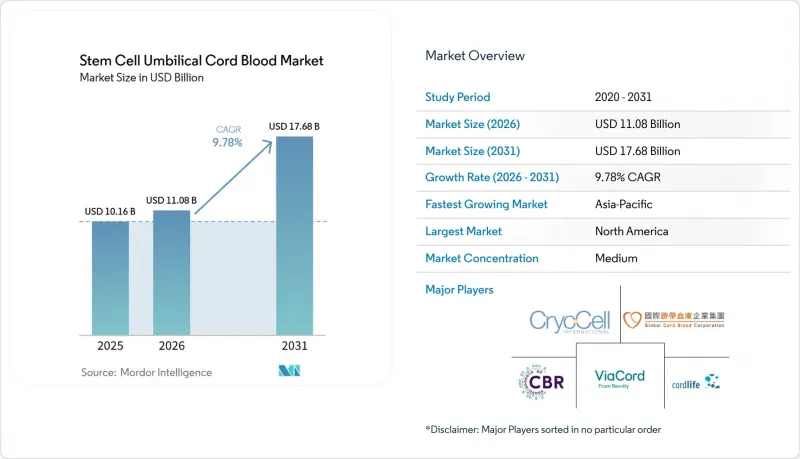
According to Mordor Intelligence, the stem cell umbilical cord blood market increased from USD 10.16 billion in 2025 and is estimated to grow from USD 11.08 billion in 2026 to reach USD 17.68 billion by 2031, at a CAGR of 9.78% during the forecast period (2026-2031).
This report is Segmented by Storage Type (Private Cord Blood Banks, Public Cord Blood Banks, and Others), Component (Cord Blood, Cord Tissue), Service Type (Collection and Transportation, and Others), Application (Cancer, Blood Disorders, and Others), End-User (Hospitals, and Others), and Geography (North America, Europe, and Others). The Market Forecasts are Provided in Terms of Value (USD).
Global Stem Cell Umbilical Cord Blood Market Trends and Insights
Rising Use of Umbilical Cord Blood in Regenerative Medicine
The stem cell umbilical cord blood market is benefiting from stronger medical support for cord blood transplantation in settings where matched donors remain limited. Clinical outcomes are helping this shift because cord blood continues to show a favorable graft-versus-host disease profile in comparison with other transplant sources. A phase 2 study published in April 2026 reported that 27 of 28 patients with leukemia or myelodysplastic syndrome who received umbilical cord blood transplant plus dilanubicel survived at least 1 year, and no severe acute or chronic graft-versus-host disease was reported. A separate 2025 prospective phase II study found that haploidentical hematopoietic stem cell transplantation combined with umbilical cord blood infusion delivered a 95.4% 2-year overall survival rate and 2.4% non-relapse mortality in patients who lacked young donors.These results matter for the stem cell umbilical cord blood market because they support wider transplant use across multiethnic populations where registry depth is often weak. They also strengthen the case for higher procurement commitments from transplant centers and for continued investment in public inventory programs.
Expansion of Private Family Banking as a Long-Term Biological Insurance Model
The stem cell umbilical cord blood market continues to draw support from private family banking, but the basis of demand is changing. Enrollment is now tied less to broad marketing claims and more to a practical view of long-term biological access when future therapeutic use becomes clearer. That change improves retention quality because families are more likely to value stored material when clinical use cases are visible and collection pathways are simple. A 2025 study indexed in PubMed Central showed that hybrid cord blood banking models can be implemented within private-public partnerships inside obstetric settings, which reduces friction between donation and family storage at the same point of care.The stem cell umbilical cord blood market is therefore seeing more room for hybrid models that expand collection volumes without forcing a strict split between public and private channels. Over time, this model can improve both inventory depth and consumer acceptance by aligning family choice with broader clinical use.
High Lifetime Cost of Collection, Processing, and Storage
Cost remains one of the clearest limits on the stem cell umbilical cord blood market, especially where storage is fully out of pocket. Private banking often involves an initial collection fee and recurring annual storage fees, which together create a long contract burden for households. This narrows participation to families with stronger disposable income and weakens penetration in price-sensitive markets. FamiCord AG stated in its 2026 outlook that low European birth rates and weaker consumer willingness tied to higher energy costs were holding back enrollment growth, which shows how household economics directly affect demand. The stem cell umbilical cord blood market would likely respond more to reimbursement progress than to awareness campaigns alone because reimbursement changes the economics of long-term storage. Until that happens at wider scale, cost will remain a structural cap on conversion.
Other drivers and restraints analyzed in the detailed report include:
- Growing Demand for Perinatal Tissue Preservation Beyond Cord Blood
- Automation and Closed-System Cryopreservation Improving Unit Viability
- Uncertain Utilization Rate of Stored Units
For complete list of drivers and restraints, kindly check the Table Of Contents.
Segment Analysis
Private cord blood banks held 49.32% of the stem cell umbilical cord blood market share in 2025, which reflects long-standing family storage programs in North America, Europe, and parts of Asia-Pacific. Public banks are the fastest-growing storage segment and are projected to rise at a 9.91% CAGR through 2031. This split shows that the stem cell umbilical cord blood market still depends on mature consumer-facing operators, but the balance is gradually changing as unrelated donor access becomes more important. Public inventory programs continue to benefit from institutional support and a clearer role in transplant pathways.
The shift in the stem cell umbilical cord blood market is not a simple move away from private banking. Private operators still retain value because they own customer relationships, large stored inventories, and collection systems that have been in place for years. At the same time, public banks are gaining ground because clinical programs need broader unrelated donor access and stronger inventory depth. Hybrid collection models are starting to narrow the divide between the 2 approaches by allowing donation and family storage choices within the same maternity setting. Across the stem cell umbilical cord blood industry, the competitive question is moving away from which model is ideologically stronger and toward which model can show consistent clinical retrieval and practical patient use.
Cord blood represented 53.46% of component revenue in 2025, which confirms its continuing role as the base service in the stem cell umbilical cord blood market. Cord tissue is the fastest-growing component and is projected to expand at a 10.12% CAGR through 2031. This pattern shows that the stem cell umbilical cord blood market is broadening from traditional hematopoietic storage into a wider perinatal cell preservation model. Cord blood remains central because transplant use has a longer medical record and clearer clinical familiarity.
The component mix matters because it changes the revenue logic of the stem cell umbilical cord blood market. Cord blood banking is closely linked to transplant relevance, while cord tissue preservation is linked to therapeutic optionality across a broader treatment pipeline. That difference creates a more durable commercial case for combined collection at a single birth event. It also helps banks raise customer value without requiring a second collection episode or a separate patient journey. As more clinical work supports umbilical cord-derived mesenchymal stromal cells, the stem cell umbilical cord blood market is likely to see stronger demand for banks that can preserve both blood and tissue within one traceable platform. This is one of the clearest signs that the stem cell umbilical cord blood industry is no longer defined only by storage of hematopoietic units.
Complete Report Scope:
- By Storage Type
- Private Cord Blood Banks
- Public Cord Blood Banks
- Hybrid Cord Blood Banks
- By Component
- Cord Blood
- Cord Tissue
- By Service Type
- Collection and Transportation
- Processing and Characterization
- Storage and Preservation
- By Application
- Cancer
- Blood Disorders
- Immune Disorders
- Metabolic Disorders
- Neurological and Degenerative Disorders
- Other Applications
- By End-User
- Hospitals
- Research Institutes
- Pharmaceutical and Biotechnology Companies
- Other End-Users
- By Geography
- North America
- United States
- Canada
- Mexico
- Europe
- Germany
- United Kingdom
- France
- Italy
- Spain
- Rest of Europe
- Asia-Pacific
- China
- Japan
- India
- Australia
- South Korea
- Rest of Asia-Pacific
- Middle East and Africa
- GCC
- South Africa
- Rest of Middle East and Africa
- South America
- Brazil
- Argentina
- Rest of South America
- North America
Geography Analysis
North America held 48.72% of the stem cell umbilical cord blood market share in 2025, which made it the largest regional contributor. The region benefits from mature private banking infrastructure, established public inventory programs, and a long operating history in cord blood collection and release. The United States remains central to the stem cell umbilical cord blood market because federally supported transplant matching infrastructure continues to reinforce access to unrelated donor options.
Asia-Pacific is projected to be the fastest-growing part of the stem cell umbilical cord blood market size, with an 11.42% CAGR projected through 2031. Growth in this region is supported by high birth volumes in several countries, rising middle-class demand for private preservation, and improving formalization of banking standards. The regional mix is diverse because some markets are large and price sensitive, while others are smaller but more quality driven. Japan, Australia, and South Korea also reflect a higher-quality operating environment where accreditation and documentation standards can protect established banks and limit weak entrants.
Europe shows a different pattern in the stem cell umbilical cord blood market because consolidation, birth-rate pressure, and policy divergence are all shaping outcomes at the same time. The region also faces pressure from lower birth rates and country-level policy differences between public-only and mixed banking frameworks. The Middle East and Africa are developing from a smaller base, while South America remains constrained by reimbursement limits and broader economic volatility, which keeps expansion more measured than in the leading regions.
- Americord Registry LLC
- CALIFORNIA CRYOBANK
- CBR Systems, Inc.
- CellSave Arabia
- Cord Blood America, Inc.
- Cordlife Group
- Cryo-Cell International, Inc.
- CryoSave AG
- CSG-BIO
- Esperite N.V.
- FamiCord AG
- Future Health Biobank Limited
- Global Cord Blood
- HEMA-QUEBEC
- LifeCell International Private Limited
- New England Cord Blood Bank, Inc.
- Regrow Biosciences Pvt. Ltd.
- Smart Cells International Ltd
- StemCyte International
- ViaCord, LLC
- Virgin Health Bank
Additional Benefits:
- The market estimate (ME) sheet in Excel format
- 3 months of analyst support
TABLE OF CONTENTS
1 Introduction
- 1.1 Study Assumptions and Market Definition
- 1.2 Scope of the Study
2 Research Methodology
3 Executive Summary
4 Market Landscape
- 4.1 Market Overview
- 4.2 Market Drivers
- 4.2.1 Rising Use of Umbilical Cord Blood in Regenerative Medicine
- 4.2.2 Expansion of Private Family Banking as a Long-Term Biological Insurance Model
- 4.2.3 Higher Clinical Acceptance of Allogeneic Stem Cell Transplantation
- 4.2.4 Growing Demand for Perinatal Tissue Preservation Beyond Cord Blood
- 4.2.5 Automation and Closed-System Cryopreservation Improving Unit Viability
- 4.2.6 Growing Clinical Acceptance of Stem Cell-Based Therapies
- 4.3 Market Restraints
- 4.3.1 High Lifetime Cost of Collection, Processing, and Storage
- 4.3.2 Uncertain Utilization Rate of Stored Units
- 4.3.3 Regulatory Complexity Across Public, Private, and Cross-Border Banking
- 4.3.4 Low Birth-Time Conversion Rates in Emerging Markets
- 4.4 Value Chain Analysis
- 4.5 Regulatory Landscape
- 4.6 Technological Outlook
- 4.7 Porter's Five Forces Analysis
- 4.7.1 Threat of New Entrants
- 4.7.2 Bargaining Power of Suppliers
- 4.7.3 Bargaining Power of Buyers
- 4.7.4 Threat of Substitutes
- 4.7.5 Competitive Rivalry
5 Market Size & Growth Forecasts (Value, USD)
- 5.1 By Storage Type
- 5.1.1 Private Cord Blood Banks
- 5.1.2 Public Cord Blood Banks
- 5.1.3 Hybrid Cord Blood Banks
- 5.2 By Component
- 5.2.1 Cord Blood
- 5.2.2 Cord Tissue
- 5.3 By Service Type
- 5.3.1 Collection and Transportation
- 5.3.2 Processing and Characterization
- 5.3.3 Storage and Preservation
- 5.4 By Application
- 5.4.1 Cancer
- 5.4.2 Blood Disorders
- 5.4.3 Immune Disorders
- 5.4.4 Metabolic Disorders
- 5.4.5 Neurological and Degenerative Disorders
- 5.4.6 Other Applications
- 5.5 By End-User
- 5.5.1 Hospitals
- 5.5.2 Research Institutes
- 5.5.3 Pharmaceutical and Biotechnology Companies
- 5.5.4 Other End-Users
- 5.6 By Geography
- 5.6.1 North America
- 5.6.1.1 United States
- 5.6.1.2 Canada
- 5.6.1.3 Mexico
- 5.6.2 Europe
- 5.6.2.1 Germany
- 5.6.2.2 United Kingdom
- 5.6.2.3 France
- 5.6.2.4 Italy
- 5.6.2.5 Spain
- 5.6.2.6 Rest of Europe
- 5.6.3 Asia-Pacific
- 5.6.3.1 China
- 5.6.3.2 Japan
- 5.6.3.3 India
- 5.6.3.4 Australia
- 5.6.3.5 South Korea
- 5.6.3.6 Rest of Asia-Pacific
- 5.6.4 Middle East and Africa
- 5.6.4.1 GCC
- 5.6.4.2 South Africa
- 5.6.4.3 Rest of Middle East and Africa
- 5.6.5 South America
- 5.6.5.1 Brazil
- 5.6.5.2 Argentina
- 5.6.5.3 Rest of South America
- 5.6.1 North America
6 Competitive Landscape
- 6.1 Market Concentration
- 6.2 Market Share Analysis
- 6.3 Company Profiles (includes Global level Overview, Market level overview, Core Segments, Financials as available, Strategic Information, Market Rank/Share for key companies, Products & Services, Recent Developments)
- 6.3.1 Americord Registry LLC
- 6.3.2 California Cryobank Stem Cell Services LLC
- 6.3.3 CBR Systems, Inc.
- 6.3.4 CellSave Arabia
- 6.3.5 Cord Blood America, Inc.
- 6.3.6 Cordlife Group Limited
- 6.3.7 Cryo-Cell International, Inc.
- 6.3.8 CryoSave AG
- 6.3.9 CSG-BIO
- 6.3.10 Esperite N.V.
- 6.3.11 FamiCord AG
- 6.3.12 Future Health Biobank Limited
- 6.3.13 Global Cord Blood Corporation
- 6.3.14 HEMA-QUEBEC
- 6.3.15 LifeCell International Private Limited
- 6.3.16 New England Cord Blood Bank, Inc.
- 6.3.17 Regrow Biosciences Pvt. Ltd.
- 6.3.18 Smart Cells International Ltd
- 6.3.19 StemCyte International
- 6.3.20 ViaCord, LLC
- 6.3.21 Virgin Health Bank
7 Market Opportunities & Future Outlook
- 7.1 White-space & Unmet-need Assessment

