PUBLISHER: Mordor Intelligence | PRODUCT CODE: 2099431

PUBLISHER: Mordor Intelligence | PRODUCT CODE: 2099431
Point-of-Care Regenerative Medicine and Autologous Biologics - Market Share Analysis, Industry Trends & Statistics, Growth Forecasts (2026 - 2031)
According to Mordor Intelligence, the point-of-Care regenerative medicine & autologous biologics market size was valued at USD 17.78 billion in 2025 and is estimated to grow from USD 18.97 billion in 2026 to reach USD 28.61 billion by 2031, at a CAGR of 8.56% during the forecast period (2026-2031).
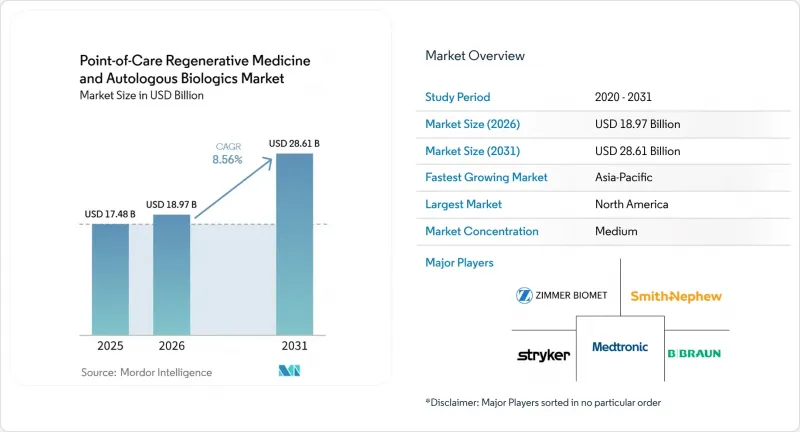
This report is Segmented by Product Type (Platelet-Rich Plasma Systems Concentration, Bone Marrow Concentration Systems, and More), Application (Orthopedics and Sports Medicine, Wound Care, and More), End User (Hospitals, and More), and Geography (North America, Europe, Asia-Pacific, and More). The Market Forecasts are Provided in Terms of Value (USD).
Global Point-of-Care Regenerative Medicine and Autologous Biologics Market Trends and Insights
Growing Demand for Same-Day Orthobiologic Procedures
The Point-of-Care Regenerative Medicine & Autologous Biologics Market is seeing stronger demand for same-day autologous treatments in orthopedic care. Hospitals and insurers are pressuring providers to reduce repeat visits and lower total episode costs, supporting single-session biologic use when workflows allow. A 2025 multicenter retrospective study published in the Journal of Experimental Orthopedics is expected to report a mean KOOS total improvement of 26.2 points at 20.5 months for one-stage minced cartilage autograft combined with PRP, strengthening the clinical case for a same-day model. Training infrastructure also supports adoption, as surgeons often standardize on the systems and preparation methods they first learn in practical settings.
Rising Shift Toward Closed-System Point-of-Care Processing
Closed-system centrifugation is becoming a baseline expectation in the Point-of-Care Regenerative Medicine & Autologous Biologics Market, especially in accredited outpatient settings. Providers increasingly prefer systems that keep blood or marrow within a controlled pathway, as contamination risk and handling variability have direct clinical and liability implications. EmCyte Corporation's PurePRP SupraPhysiologic platform reflects this buyer preference, offering a fully closed circuit and more than 8x baseline platelet concentration through a double-spin method. Group purchasing organizations are accelerating this shift, as many hospital buyers now treat closed architecture as a procurement requirement rather than a premium option.
Variable Clinical Evidence Across Indications and Products
Clinical evidence in the Point-of-Care Regenerative Medicine & Autologous Biologics Market varies widely across indications, preparation methods, and patient groups. The international guideline landscape remains limited and fragmented, reflecting an uneven evidence base across products and use cases. A 2025 randomized controlled trial found no long-term superiority of bone marrow aspirate concentrate over PRP in knee osteoarthritis, challenging the premium positioning of some higher-cost systems. When comparative efficacy remains unclear, formulary committees and payers prioritize cost control over premium adoption, creating price pressure for vendors without strong head-to-head clinical data.
Other drivers and restraints analyzed in the detailed report include:
- Expanding Clinical Use in Orthopedics and Sports Medicine
- Reimbursement Pull From Outpatient and ASC Settings
- Regulatory Ambiguity Around Minimal Manipulation and Homologous Use
For complete list of drivers and restraints, kindly check the Table Of Contents.
Segment Analysis
Platelet-rich plasma (PRP) systems are expected to hold 34.55% of the Point-of-Care Regenerative Medicine & Autologous Biologics Market share by product type in 2025, supported by broad adoption across orthopedics, wound care, aesthetics, and dentistry. No other product category offers a comparable procedural range across surgical and clinic-based settings. This versatility keeps PRP systems central to the market, particularly where providers require familiar, lower-complexity biologic workflows. The regulatory pipeline is also expected to remain active through 2025 and 2026, with FDA CBER approvals covering products such as the ENDORET Kit in October 2025 and the Precise Cell Concentration System in February 2026.
Bone marrow concentration systems are the fastest-growing product segment, with the Point-of-Care Regenerative Medicine & Autologous Biologics Market size for this segment projected to expand at an 11.02% CAGR through 2031. Demand is driven by spinal fusion augmentation and complex joint procedures, where providers seek higher progenitor cell concentrations than PRP alone can typically deliver. Adipose-derived cell processing systems are gaining traction in wound care and aesthetic medicine through closed, enzyme-free mechanical systems that preserve stromal tissue architecture. Platelet-rich fibrin (PRF) systems remain smaller in revenue terms but are becoming more relevant in dentistry and oral surgery, while ISO 13485-compliant manufacturing is now a baseline requirement in regulated markets.
Complete Report Scope:
- By Product Type
- Platelet-Rich Plasma Systems
- Bone Marrow Concentration Systems
- Adipose-Derived Cell Processing Systems
- Platelet-Rich Fibrin Systems
- Other Autologous Biologic Concentration Systems
- By Application
- Orthopedics and Sports Medicine
- Wound Care
- Aesthetic Medicine
- Dentistry and Oral Surgery
- Cardiovascular and Vascular Applications
- Neurology and Other Applications
- By End User
- Hospitals
- Specialty and Ambulatory Surgery Centers
- Orthopedic and Sports Medicine Clinics
- Aesthetic Clinics
- Dental Clinics
- Academic and Research Centers
- By Geography
- North America
- United States
- Canada
- Mexico
- Europe
- Germany
- United Kingdom
- France
- Italy
- Spain
- Rest of Europe
- Asia-Pacific
- China
- India
- Japan
- Australia
- South Korea
- Rest of Asia-Pacific
- Middle East and Africa
- GCC
- South Africa
- Rest of Middle East and Africa
- South America
- Brazil
- Argentina
- Rest of South America
- North America
Geography Analysis
North America is expected to account for 39.45% of the Point-of-Care Regenerative Medicine & Autologous Biologics Market share in 2025, making it the largest regional block. The region benefits from high orthopedic procedure volumes, a mature ambulatory surgical center (ASC) base, and an active FDA clearance environment for autologous biologic systems. The CMS 2026 rule is also expected to expand the outpatient procedure base and add USD 450 million in Medicare ASC expenditures, supporting near-term demand for orthopedic and related biologic procedures. The United States remains the leading adoption market for premium closed-system PRP and bone marrow concentration platforms, while Canada and Mexico are advancing gradually through hospital procurement programs and cross-border technology transfer.
Europe remains strategically important in the Point-of-Care Regenerative Medicine & Autologous Biologics Market, although regulatory and reimbursement conditions remain complex. Germany and the United Kingdom lead regional adoption, while France is expanding PRP use in chronic wound care through newer hospital-based programs. The distinction between the EU advanced therapy medicinal product framework and the medical device route continues to favor mechanically processed autologous systems over enzymatically isolated SVF platforms. Italy and Spain support steady demand through private aesthetic medicine ecosystems, where adoption depends less on insurance coverage.
Asia-Pacific is the fastest-growing region, with the Point-of-Care Regenerative Medicine & Autologous Biologics Market size in this geography projected to expand at a CAGR of 12.45% through 2031. Japan has developed a structured regulatory pathway for autologous blood product procedures under its Regenerative Medicine Safety Act, supporting kit standardization while increasing compliance requirements. South Korea is expected to add momentum with Miracell's April 2026 U.S. FDA 510(k) clearance for its SMART M-CELL system, while China and India remain the region's largest volume-driven growth engines, and the Middle East, Africa, and South America contribute through hospital upgrades, private-pay aesthetic care, and medical tourism in major urban centers.
- APEX Biologix, LLC
- Arthrex
- B. Braun
- Bioventus Inc.
- Bone Biologics Corporation
- Celling Biosciences, Inc.
- EmCyte
- Johnson & Johnson
- Jointechlabs, Inc.
- Kuros Biosciences AG
- Medtronic
- Organogenesis
- Orthocell Ltd.
- Regen Lab SA
- Royal Biologics, Inc.
- Smiths Group
- Stryker
- Terumo
- Vericel
- Xtant Medical Holdings, Inc.
- Zimmer Biomet
Additional Benefits:
- The market estimate (ME) sheet in Excel format
- 3 months of analyst support
TABLE OF CONTENTS
1 INTRODUCTION
- 1.1 Study Assumptions and Market Definition
- 1.2 Scope of the Study
2 RESEARCH METHODOLOGY
3 EXECUTIVE SUMMARY
4 MARKET LANDSCAPE
- 4.1 Market Overview
- 4.2 Market Drivers
- 4.2.1 Growing Demand for Same-Day Orthobiologic Procedures
- 4.2.2 Rising Shift Toward Closed-System Point-of-Care Processing
- 4.2.3 Expanding Clinical Use in Orthopedics and Sports Medicine
- 4.2.4 Broader Adoption in Wound Care and Aesthetic Medicine
- 4.2.5 Reimbursement Pull From Outpatient and ASC Settings
- 4.2.6 Integration of Digital Workflow Tracking and Standardized Kit Protocols
- 4.3 Market Restraints
- 4.3.1 Variable Clinical Evidence Across Indications and Products
- 4.3.2 Regulatory Ambiguity Around Minimal Manipulation and Homologous Use
- 4.3.3 Physician Skill Dependence and Procedure Variability
- 4.3.4 Under-Reported Reimbursement Friction for Multi-Use Kits and Ancillary Supplies
- 4.4 Value/Supply-Chain Analysis
- 4.5 Regulatory Landscape
- 4.6 Technological Outlook
- 4.7 Porter's Five Forces Analysis
- 4.7.1 Threat of New Entrants
- 4.7.2 Bargaining Power of Suppliers
- 4.7.3 Bargaining Power of Buyers
- 4.7.4 Threat of Substitutes
- 4.7.5 Intensity of Competitive Rivalry
5 MARKET SIZE AND GROWTH FORECASTS (VALUE, USD)
- 5.1 By Product Type
- 5.1.1 Platelet-Rich Plasma Systems
- 5.1.2 Bone Marrow Concentration Systems
- 5.1.3 Adipose-Derived Cell Processing Systems
- 5.1.4 Platelet-Rich Fibrin Systems
- 5.1.5 Other Autologous Biologic Concentration Systems
- 5.2 By Application
- 5.2.1 Orthopedics and Sports Medicine
- 5.2.2 Wound Care
- 5.2.3 Aesthetic Medicine
- 5.2.4 Dentistry and Oral Surgery
- 5.2.5 Cardiovascular and Vascular Applications
- 5.2.6 Neurology and Other Applications
- 5.3 By End User
- 5.3.1 Hospitals
- 5.3.2 Specialty and Ambulatory Surgery Centers
- 5.3.3 Orthopedic and Sports Medicine Clinics
- 5.3.4 Aesthetic Clinics
- 5.3.5 Dental Clinics
- 5.3.6 Academic and Research Centers
- 5.4 By Geography
- 5.4.1 North America
- 5.4.1.1 United States
- 5.4.1.2 Canada
- 5.4.1.3 Mexico
- 5.4.2 Europe
- 5.4.2.1 Germany
- 5.4.2.2 United Kingdom
- 5.4.2.3 France
- 5.4.2.4 Italy
- 5.4.2.5 Spain
- 5.4.2.6 Rest of Europe
- 5.4.3 Asia-Pacific
- 5.4.3.1 China
- 5.4.3.2 India
- 5.4.3.3 Japan
- 5.4.3.4 Australia
- 5.4.3.5 South Korea
- 5.4.3.6 Rest of Asia-Pacific
- 5.4.4 Middle East and Africa
- 5.4.4.1 GCC
- 5.4.4.2 South Africa
- 5.4.4.3 Rest of Middle East and Africa
- 5.4.5 South America
- 5.4.5.1 Brazil
- 5.4.5.2 Argentina
- 5.4.5.3 Rest of South America
- 5.4.1 North America
6 COMPETITIVE LANDSCAPE
- 6.1 Market Concentration
- 6.2 Market Share Analysis
- 6.3 Company Profiles (includes Global Level Overview, Market Level Overview, Core Segments, Financials as available, Strategic Information, Market Rank/Share, Products and Services, Recent Developments)
- 6.3.1 APEX Biologix, LLC
- 6.3.2 Arthrex, Inc.
- 6.3.3 B. Braun SE
- 6.3.4 Bioventus Inc.
- 6.3.5 Bone Biologics Corporation
- 6.3.6 Celling Biosciences, Inc.
- 6.3.7 EmCyte Corporation
- 6.3.8 Johnson & Johnson
- 6.3.9 Jointechlabs, Inc.
- 6.3.10 Kuros Biosciences AG
- 6.3.11 Medtronic plc
- 6.3.12 Organogenesis Holdings Inc.
- 6.3.13 Orthocell Ltd.
- 6.3.14 Regen Lab SA
- 6.3.15 Royal Biologics, Inc.
- 6.3.16 Smith and Nephew plc
- 6.3.17 Stryker Corporation
- 6.3.18 Terumo Corporation
- 6.3.19 Vericel Corporation
- 6.3.20 Xtant Medical Holdings, Inc.
- 6.3.21 Zimmer Biomet Holdings, Inc.
7 MARKET OPPORTUNITIES AND FUTURE OUTLOOK
- 7.1 White-Space and Unmet-Need Assessment

