PUBLISHER: Mordor Intelligence | PRODUCT CODE: 2099432

PUBLISHER: Mordor Intelligence | PRODUCT CODE: 2099432
Platelet-Rich Fibrin (PRF) - Market Share Analysis, Industry Trends & Statistics, Growth Forecasts (2026 - 2031)
According to Mordor Intelligence, the platelet-Rich fibrin market size is projected to expand from USD 476.38 million in 2025 and USD 525.45 million in 2026 to USD 857.85 million by 2031, registering a CAGR of 10.30% between 2026 to 2031.
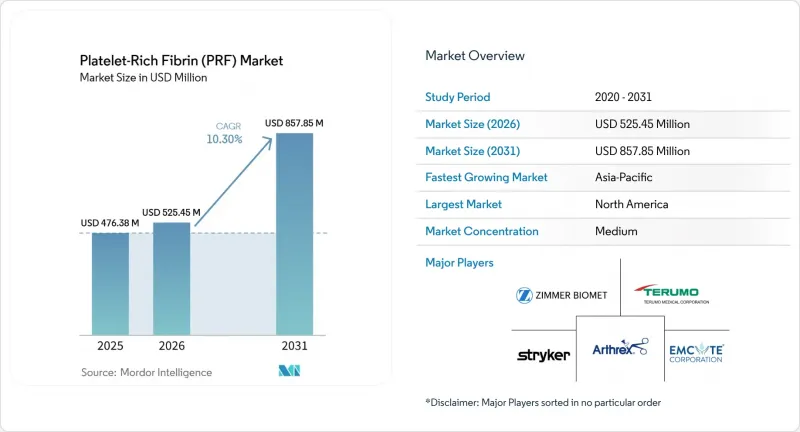
This report is Segmented by Product Type (Pure PRF, Leukocyte-Rich PRF, Injectable PRF, Advanced PRF), Component (Centrifuges, and More), Application (Dentistry, Orthopedics, Wound Healing, Plastic Surgery, Maxillofacial, Others), End User (Hospitals, Dental Clinics, Ascs, Academic Institutes), and Geography (North America, Europe, and More). The Market Forecasts are Provided in Terms of Value (USD).
Global Platelet-Rich Fibrin (PRF) Market Trends and Insights
Rising Demand for Autologous Regenerative Therapies in Dental Surgery
Dental applications remain the clearest volume driver for the Platelet-Rich Fibrin market, as a single procedure can support both bone regeneration and soft tissue closure. This dual benefit gives PRF a practical advantage in implant site preparation and socket preservation, where clinicians prioritize simpler workflows and lower biologic costs. A 2026 randomized controlled trial is expected to show that injectable PRF combined with xenograft improves early wound closure within two weeks compared with xenograft alone, supporting adoption in high-volume dental settings. As evidence quality improves, the Platelet-Rich Fibrin market is expanding from specialist oral surgeons into larger general dental networks with higher procedure volumes.
Expanding Use in Soft Tissue Healing and Wound Closure Protocols
Wound care is becoming a stronger growth avenue for the Platelet-Rich Fibrin market, as regulatory progress is expected to align clinical use more closely with reimbursement. In April 2026, Royal Biologics is expected to receive FDA clearance for Fibrinet PRF Wound Matrix for exuding cutaneous wounds, including diabetic and venous ulcers. This clearance would be significant because CMS NCD 270.3 links Medicare coverage to platelet therapies prepared with FDA-cleared devices for wound management, addressing a key adoption barrier in the United States. Royal Biologics reported that 92% of treated wounds achieved at least a 50% size reduction, 57% achieved complete closure at 12 weeks, and the mean healing time was 6.75 weeks.
Lack of Global Standardization in Centrifugation Protocols
The Platelet-Rich Fibrin market continues to face a major structural limitation due to the absence of an internationally accepted centrifugation standard. Published protocols vary significantly in centrifugal force, spin duration, tube material, and blood volume, which can lead to different biological performance among products with the same label. A 2026 review reports that centrifugation speed and relative centrifugal force can materially affect PRF's regenerative potential, contributing to inconsistent clinical outcomes. This variability limits cross-study comparisons and slows payer confidence, especially as providers expand PRF use beyond core dental indications.
Other drivers and restraints analyzed in the detailed report include:
- Growing Shift Toward Outpatient, Minimally Invasive Biologic Procedures
- Standardized PRF Kits and Closed Systems Improving Procedural Reproducibility
- Variable Clinical Outcomes Across Indications and Operators
For complete list of drivers and restraints, kindly check the Table Of Contents.
Segment Analysis
Pure Platelet-Rich Fibrin is expected to hold the largest product share, at 31.60%, in 2025, supported by its long clinical use in dental implantology, socket preservation, and periodontal regeneration. Its membrane format remains familiar to oral surgeons and continues to support adoption in established surgical workflows. Leukocyte-Rich Platelet-Rich Fibrin maintains relevance in complex wound management and burn-related procedures, while Advanced Platelet-Rich Fibrin is gaining traction in maxillofacial reconstruction due to its stronger fibrin architecture and improved handling properties.
Injectable PRF is projected to be the fastest-growing product type, registering an 11.32% CAGR from 2026 to 2031, as the Platelet-Rich Fibrin market expands beyond membrane-based surgery. Demand is increasing in orthopedic joint injections, facial rejuvenation, and hair restoration, where fluid delivery better fits clinical requirements. A 2026 randomized study in BMC Oral Health reported better early wound healing with injectable PRF in socket preservation, supporting faster adoption in high-volume dental practices.
PRF kits and consumables are expected to account for 44.21% of the Platelet-Rich Fibrin market size in 2025, reflecting the category's recurring revenue structure. Centrifuges are typically one-time capital purchases, while tubes, preparation kits, and related consumables scale directly with procedure volume. This model encourages manufacturers to build proprietary closed systems that connect consumables with specific devices and strengthen customer retention.
Accessories and ancillary supplies generate lower revenue, but their relevance is increasing as PRF use expands into surgical settings that require varied application formats. Centrifuges and processing systems are projected to grow at a 10.88% CAGR from 2026 to 2031, indicating continued scope for installation growth and technology upgrades in the Platelet-Rich Fibrin market.
Complete Report Scope:
- By Product Type
- Pure Platelet-Rich Fibrin
- Leukocyte-Rich Platelet-Rich Fibrin
- Injectable Platelet-Rich Fibrin
- Advanced Platelet-Rich Fibrin
- By Component
- Centrifuges and Processing Systems
- PRF Kits and Consumables
- Accessories and Ancillary Supplies
- By Application
- Dentistry and Oral Surgery
- Orthopedics and Sports Medicine
- Wound Healing and Reconstruction
- Plastic and Aesthetic Surgery
- Maxillofacial and Craniofacial Surgery
- Other PRF Applications
- By End User
- Hospitals and Clinics
- Dental Clinics
- Ambulatory Surgical Centers
- Academic and Research Institutes
- By Geography
- North America
- United States
- Canada
- Mexico
- Europe
- Germany
- United Kingdom
- France
- Italy
- Spain
- Rest of Europe
- Asia-Pacific
- China
- India
- Japan
- Australia
- South Korea
- Rest of Asia-Pacific
- Middle East and Africa
- GCC
- South Africa
- Rest of Middle East and Africa
- South America
- Brazil
- Argentina
- Rest of South America
- North America
Geography Analysis
North America is expected to hold a 39.95% share in 2025 and remain the largest regional Platelet-Rich Fibrin market by value. The United States drives regional demand through a strong network of private dental and orthopedic practices, mature device adoption, and improving reimbursement clarity for selected wound care applications. The anticipated April 2026 FDA clearance for Fibrinet(R) PRF Wound Matrix is significant as it would align PRF use more directly with the CMS NCD 270.3 coverage framework for wound management. Canada and Mexico add smaller but growing demand, with Mexico also benefiting from medical travel for lower-cost dental and aesthetic procedures.
Europe continues to account for a meaningful share of the Platelet-Rich Fibrin market, supported by an established dental surgery base and stricter supplier standards under the MDR environment. Higher evidence requirements are shifting share toward manufacturers that can demonstrate documented and reproducible device performance. This strengthens the position of closed-system suppliers, particularly where clinical teams prioritize easier compliance and controlled preparation. Europe also remains relevant for newer aesthetic applications, with devices such as Exprecell(TM) available across the EU, the UK, and Switzerland for autologous PRP and Fluid-PRF preparation.
Asia-Pacific is projected to grow at a CAGR of 12.56% from 2026 to 2031, making it the fastest-growing regional Platelet-Rich Fibrin market. Growth is supported by expanding private dental capacity, rising acceptance of outpatient biologic procedures, and wider use of minimally invasive aesthetics. Demand also favors injectable formats across dermatology, cosmetic surgery, and chairside dental workflows. The Middle East and Africa remains an emerging opportunity, while South America, led by Brazil, is positioned for volume growth as kit availability and distribution improve.
- Apex Biologix
- Arthrex
- Beckton Dickinson
- BIOTRONIK SE and Co. KG
- Curasan AG
- Dentsply Sirona
- EmCyte
- Envista
- Geistlich Pharma
- Henry Schein
- Straumann Group
- Johnson & Johnson
- Medtronic
- Osstem Implant Co., Ltd.
- Regen Lab SA
- Royal Biologics, Inc.
- Stryker
- Terumo
- Vivostat
- Zimmer Biomet
Additional Benefits:
- The market estimate (ME) sheet in Excel format
- 3 months of analyst support
TABLE OF CONTENTS
1 INTRODUCTION
- 1.1 Study Assumptions and Market Definition
- 1.2 Scope of the Study
2 RESEARCH METHODOLOGY
3 EXECUTIVE SUMMARY
4 MARKET LANDSCAPE
- 4.1 Market Overview
- 4.2 Market Drivers
- 4.2.1 Rising Demand for Autologous Regenerative Therapies in Dental Surgery
- 4.2.2 Expanding Use in Soft Tissue Healing and Wound Closure Protocols
- 4.2.3 Growing Shift Toward Outpatient, Minimally Invasive Biologic Procedures
- 4.2.4 Standardized PRF Kits and Closed Systems Improving Procedural Reproducibility
- 4.2.5 New Aesthetic and Hair Restoration Use Cases Extending Addressable Demand
- 4.2.6 Regulatory Momentum for Point-of-Care Biologic Devices in Mature Markets
- 4.3 Market Restraints
- 4.3.1 Lack of Global Standardization in Centrifugation Protocols
- 4.3.2 Variable Clinical Outcomes Across Indications and Operators
- 4.3.3 Reimbursement Gaps for PRF Procedures Outside Core Dental Uses
- 4.3.4 Limited High-Quality Long-Term Evidence in Non-Dental Indications
- 4.4 Value/Supply-Chain Analysis
- 4.5 Regulatory Landscape
- 4.6 Technological Outlook
- 4.7 Porter's Five Forces Analysis
- 4.7.1 Bargaining Power of Suppliers
- 4.7.2 Bargaining Power of Buyers
- 4.7.3 Threat of New Entrants
- 4.7.4 Threat of Substitutes
- 4.7.5 Competitive Rivalry
5 MARKET SIZE AND GROWTH FORECASTS (VALUE, USD)
- 5.1 By Product Type
- 5.1.1 Pure Platelet-Rich Fibrin
- 5.1.2 Leukocyte-Rich Platelet-Rich Fibrin
- 5.1.3 Injectable Platelet-Rich Fibrin
- 5.1.4 Advanced Platelet-Rich Fibrin
- 5.2 By Component
- 5.2.1 Centrifuges and Processing Systems
- 5.2.2 PRF Kits and Consumables
- 5.2.3 Accessories and Ancillary Supplies
- 5.3 By Application
- 5.3.1 Dentistry and Oral Surgery
- 5.3.2 Orthopedics and Sports Medicine
- 5.3.3 Wound Healing and Reconstruction
- 5.3.4 Plastic and Aesthetic Surgery
- 5.3.5 Maxillofacial and Craniofacial Surgery
- 5.3.6 Other PRF Applications
- 5.4 By End User
- 5.4.1 Hospitals and Clinics
- 5.4.2 Dental Clinics
- 5.4.3 Ambulatory Surgical Centers
- 5.4.4 Academic and Research Institutes
- 5.5 By Geography
- 5.5.1 North America
- 5.5.1.1 United States
- 5.5.1.2 Canada
- 5.5.1.3 Mexico
- 5.5.2 Europe
- 5.5.2.1 Germany
- 5.5.2.2 United Kingdom
- 5.5.2.3 France
- 5.5.2.4 Italy
- 5.5.2.5 Spain
- 5.5.2.6 Rest of Europe
- 5.5.3 Asia-Pacific
- 5.5.3.1 China
- 5.5.3.2 India
- 5.5.3.3 Japan
- 5.5.3.4 Australia
- 5.5.3.5 South Korea
- 5.5.3.6 Rest of Asia-Pacific
- 5.5.4 Middle East and Africa
- 5.5.4.1 GCC
- 5.5.4.2 South Africa
- 5.5.4.3 Rest of Middle East and Africa
- 5.5.5 South America
- 5.5.5.1 Brazil
- 5.5.5.2 Argentina
- 5.5.5.3 Rest of South America
- 5.5.1 North America
6 COMPETITIVE LANDSCAPE
- 6.1 Market Concentration
- 6.2 Market Share Analysis
- 6.3 Company Profiles (includes Global Level Overview, Market Level Overview, Core Segments, Financials as available, Strategic Information, Market Rank/Share, Products and Services, Recent Developments)
- 6.3.1 Apex Biologix
- 6.3.2 Arthrex, Inc.
- 6.3.3 Becton, Dickinson and Company
- 6.3.4 BIOTRONIK SE and Co. KG
- 6.3.5 Curasan AG
- 6.3.6 Dentsply Sirona Inc.
- 6.3.7 EmCyte Corporation
- 6.3.8 Envista Holdings Corporation
- 6.3.9 Geistlich Pharma AG
- 6.3.10 Henry Schein, Inc.
- 6.3.11 Institut Straumann AG
- 6.3.12 Johnson and Johnson Services, Inc.
- 6.3.13 Medtronic plc
- 6.3.14 Osstem Implant Co., Ltd.
- 6.3.15 Regen Lab SA
- 6.3.16 Royal Biologics, Inc.
- 6.3.17 Stryker Corporation
- 6.3.18 Terumo Corporation
- 6.3.19 Vivostat A/S
- 6.3.20 Zimmer Biomet Holdings, Inc.
7 MARKET OPPORTUNITIES AND FUTURE OUTLOOK
- 7.1 White-space and Unmet-Need Assessment

