PUBLISHER: Mordor Intelligence | PRODUCT CODE: 2113983

PUBLISHER: Mordor Intelligence | PRODUCT CODE: 2113983
Platelet Rich Plasma - Market Share Analysis, Industry Trends & Statistics, Growth Forecasts (2026 - 2031)
According to Mordor Intelligence, the platelet rich plasma market size was valued at USD 0.73 billion in 2025 and estimated to grow from USD 0.82 billion in 2026 to reach USD 1.44 billion by 2031, at a CAGR of 11.96% during the forecast period (2026-2031).
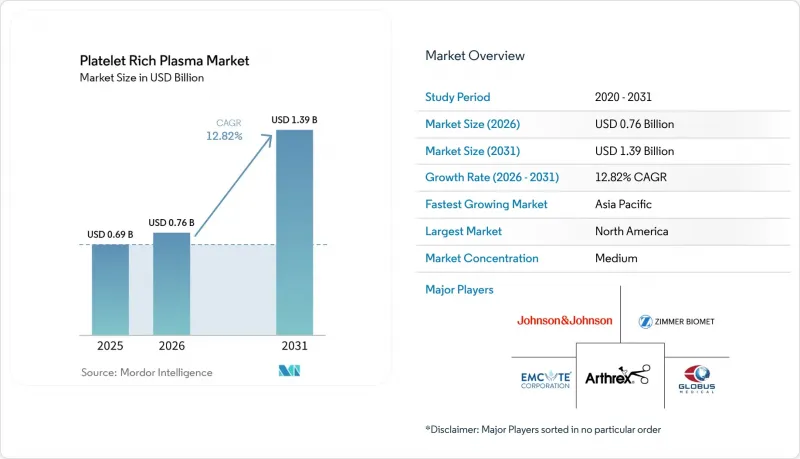
This report is Segmented by Plasma Type (Pure PRP, Leukocyte-Rich PRP, Leukocyte-Rich Fibrin, and More), Application (Orthopedics & Sports Medicine, Neurology & Spine, and More), End User (Hospitals, Specialty & Ambulatory Clinics, and Research Institutes), Origin (Autologous PRP, and More), and Geography (North America, Europe, and More). The Market Forecasts are Provided in Terms of Value (USD).
Global Platelet Rich Plasma Market Trends and Insights
Rising Incidence of Sports Injuries & Orthopedic Disorders
Elite and amateur athletes increasingly select PRP as a first-line intervention for tendon and ligament trauma, with National Football League data showing a 15% uptick in regenerative therapy usage over traditional surgery in 2024. Standard protocols involve three injections across six weeks, yielding faster return-to-play timelines and lower reinjury risk compared with lengthy physical therapy. Sports governing bodies continue to approve PRP while banning synthetic growth factors, preserving competitive integrity and steering demand toward autologous options. Weekend athletes mirror this shift, pursuing minimally invasive relief for chronic overuse injuries. Together, these trends enlarge the platelet rich plasma market by funneling a wider patient spectrum into orthopedic clinics that now view biologics as cost-effective adjuncts to conventional care.
Growing Cosmetic & Aesthetic Procedures Volume
Aesthetic medicine has embedded PRP into microneedling, laser resurfacing, and "vampire facial" protocols, with the American Society of Plastic Surgeons reporting a 47% surge in PRP-based cosmetic sessions in 2024. Younger consumers opt for preventive skin rejuvenation, while hair-restoration seekers embrace autologous options over synthetic implants. Social media and celebrity endorsements have scaled consumer awareness, enabling medical spas to expand beyond metropolitan hubs. Premium pricing remains acceptable because PRP avoids foreign fillers and provides a "natural" outcome narrative. Regulatory oversight, however, varies across markets, signaling future harmonization needs to safeguard treatment consistency and practitioner accreditation.
Lack of Standardized Preparation Protocols
Systematic reviews have cataloged more than 40 preparation methods, each producing different platelet counts and growth-factor profiles, undercutting reproducibility and payer acceptance. Equipment disparities, staff training gaps, and inconsistent leukocyte filtration compound variability, especially in smaller or resource-constrained clinics. The FDA and international societies promote harmonized guidelines, yet global implementation trails regulatory intent. Until protocols converge, insurers label many PRP applications investigational, and peer-reviewed studies struggle to aggregate comparable outcome data. This ambiguity dampens referral confidence and slows broad clinical adoption, restraining the platelet rich plasma market in several regions.
Other drivers and restraints analyzed in the detailed report include:
- Technological Advances in PRP Preparation Systems
- Aging Population Driving Chronic Musculoskeletal Cases
- High Out-of-Pocket Cost & Weak Reimbursement
For complete list of drivers and restraints, kindly check the Table Of Contents.
Segment Analysis
In 2025, Pure PRP captured 45.02% of the platelet rich plasma market, translating to USD 0.33 billion. However, the platelet rich plasma market size for Leukocyte-Rich Fibrin is projected to expand at an 17.92% CAGR between 2026 and 2031 as clinicians leverage its dense fibrin matrix for sustained growth-factor release. Orthopedic specialists favor leukocyte-poor formulations to minimize inflammation, whereas oral surgeons adopt L-PRF to bolster bone graft stability. Equipment makers respond with programmable centrifuges that toggle white-cell content on demand, encouraging precision medicine protocols. Emerging alternatives like advanced PRF and injectable-PRF fit niche applications, enhancing segment depth and fueling incremental revenue for system suppliers.
Across hospitals and dental offices, comparative studies from the International Association of Oral and Maxillofacial Surgeons document higher bone-to-implant contact rates using L-PRF than conventional graft material. The data prompt insurers in select European markets to pilot partial reimbursement, signalling mainstream acceptance. Meanwhile, autologous platelet lysate and plasma gel derivatives reach dermatology and wound-care niches, diversifying clinician toolkits. Collectively, the plasma-type spectrum broadens therapeutic flexibility and keeps innovation pipelines active, thus underpinning sustained growth in the platelet rich plasma market.
Orthopedic sports medicine held 40.01% of platelet rich plasma market share in 2025, equal to USD 0.29 billion. Yet cosmetic and dermatological interventions are accelerating at a 17.52% CAGR to 2031, supported by medical-spa proliferation and consumer appetite for minimally invasive anti-aging options. The platelet rich plasma market size for aesthetic procedures is expected to double by 2031 as younger demographics seek preventive skin quality improvements and hair-loss solutions. Dental and oral-maxillofacial indications follow, driven by PRP's role in implant osseointegration and periodontal regeneration.
In ophthalmology, autologous PRP eye drops gain traction for severe dry-eye syndrome and corneal surface repair, receiving clinical-practice endorsement from the American Academy of Ophthalmology. Wound-care teams employ PRP dressings to accelerate postsurgical healing and chronic ulcer closure, expanding payer discussions around hospital cost avoidance. Neurology and spine specialties remain exploratory yet promising, with early trials assessing PRP injections for discogenic pain. Application diversity cushions revenue streams and shields the platelet rich plasma market from specialty-specific slowdowns.
Complete Report Scope:
- By Plasma Type
- Pure PRP (P-PRP)
- Leukocyte-Rich PRP (L-PRP)
- Pure Platelet-Rich Fibrin (P-PRF)
- Leukocyte-Rich Fibrin (L-PRF)
- Other / Advanced Variants (A-PRF, i-PRF)
- By Application
- Orthopedics & Sports Medicine
- Cosmetic Surgery & Dermatology
- Dentistry & Oral-Maxillofacial
- Neurology & Spine
- Cardiology
- Ophthalmology
- Wound Care & Others
- By End User
- Hospitals
- Specialty & Ambulatory Clinics
- Research Institutes
- By Origin
- Autologous PRP
- Allogeneic PRP
- Homologous PRP
- Geography
- North America
- United States
- Canada
- Mexico
- Europe
- Germany
- United Kingdom
- France
- Italy
- Spain
- Rest of Europe
- Asia-Pacific
- China
- Japan
- India
- Australia
- South Korea
- Rest of Asia-Pacific
- Middle East and Africa
- GCC
- South Africa
- Rest of Middle East and Africa
- South America
- Brazil
- Argentina
- Rest of South America
- North America
Geography Analysis
North America generated USD 0.29 billion in platelet rich plasma market revenue in 2025 and preserved a 39.21% lead by leveraging robust clinical research networks, payer familiarity with biologics, and early FDA guidance. United States providers bundle PRP with arthroscopic procedures, advancing insurer acceptance, while Canada's single-payer system selectively covers knee-osteoarthritis injections. Mexico's cross-border clinics attract global patients seeking lower-cost packages that combine sports-injury repair and cosmetic enhancements, illustrating medical tourism's effect on regional demand.
Asia-Pacific's platelet rich plasma market is forecast to grow at 15.55% CAGR, the fastest worldwide. China's 2024-2030 regenerative-medicine roadmap earmarks funding for PRP research centers, accelerating technology transfer and local device manufacturing. Japan's super-aged society embraces PRP to delay hip and knee replacements, aligning with government efforts to contain elder-care expenditures. South Korea's aesthetics sector integrates PRP into popular K-beauty regimens, while India's multispecialty hospitals bundle orthopedic PRP packages for inbound medical tourists, strengthening foreign-exchange revenue and driving domestic adoption.
Europe maintains steady momentum, benefiting from harmonized EMA guidelines and multiple large-scale randomized controlled trials led by German and U.K. centers. Partial reimbursement for specific orthopedic and dental indications in Germany and Italy improves affordability. France and Spain record heightened cosmetic uptake, supported by stringent practitioner training mandates that enhance consumer trust. Middle East & Africa remain nascent yet attractive; Gulf Cooperation Council hospitals import premium centrifuges to capitalize on rising wellness tourism, and South Africa's private clinics pilot PRP protocols in sports-injury rehabilitation.
- AdiStem Ltd.
- Apex Biologix
- Arthrex
- Celling Biosciences
- Cesca Therapeutics
- Johnson & Johnson
- Dr PRP USA
- EmCyte Corp.
- Exactech
- Glofinn
- Harvest Technologies
- ISTO Biologics
- Juventix Regenerative
- Nuo Therapeutics
- Regen Lab SA
- Royal Biologics
- Stryker
- T-Biotechnology
- Terumo
- Zimmer Biomet
Additional Benefits:
- The market estimate (ME) sheet in Excel format
- 3 months of analyst support
TABLE OF CONTENTS
1 Introduction
- 1.1 Study Assumptions & Market Definition
- 1.2 Scope of the Study
2 Research Methodology
3 Executive Summary
4 Market Landscape
- 4.1 Market Overview
- 4.2 Market Drivers
- 4.2.1 Rising Incidence of Sports Injuries & Orthopedic Disorders
- 4.2.2 Growing Cosmetic & Aesthetic Procedures Volume
- 4.2.3 Technological Advances in PRP Preparation Systems
- 4.2.4 Aging Population Driving Chronic Musculoskeletal Cases
- 4.2.5 Surge In PRP + Adjunct Combo Protocols (PRF, Exosomes, PRF+PRF)
- 4.2.6 Hospital Shift to In-Office Autologous Regenerative Care
- 4.3 Market Restraints
- 4.3.1 Lack of Standardised Preparation Protocols
- 4.3.2 High Out-Of-Pocket Cost & Weak Reimbursement
- 4.3.3 Growing Evidence-Based Scrutiny of PRP Clinics
- 4.3.4 Competing Cell-Free Biologics Cannibalising Demand
- 4.4 Supply-Chain Analysis
- 4.5 Regulatory Landscape
- 4.6 Technological Outlook
- 4.7 Porter's Five Forces
- 4.7.1 Threat of New Entrants
- 4.7.2 Bargaining Power of Buyers
- 4.7.3 Bargaining Power of Suppliers
- 4.7.4 Threat of Substitutes
- 4.7.5 Competitive Rivalry
5 Market Size & Growth Forecasts (Value, USD)
- 5.1 By Plasma Type
- 5.1.1 Pure PRP (P-PRP)
- 5.1.2 Leukocyte-Rich PRP (L-PRP)
- 5.1.3 Pure Platelet-Rich Fibrin (P-PRF)
- 5.1.4 Leukocyte-Rich Fibrin (L-PRF)
- 5.1.5 Other / Advanced Variants (A-PRF, i-PRF)
- 5.2 By Application
- 5.2.1 Orthopedics & Sports Medicine
- 5.2.2 Cosmetic Surgery & Dermatology
- 5.2.3 Dentistry & Oral-Maxillofacial
- 5.2.4 Neurology & Spine
- 5.2.5 Cardiology
- 5.2.6 Ophthalmology
- 5.2.7 Wound Care & Others
- 5.3 By End User
- 5.3.1 Hospitals
- 5.3.2 Specialty & Ambulatory Clinics
- 5.3.3 Research Institutes
- 5.4 By Origin
- 5.4.1 Autologous PRP
- 5.4.2 Allogeneic PRP
- 5.4.3 Homologous PRP
- 5.5 Geography
- 5.5.1 North America
- 5.5.1.1 United States
- 5.5.1.2 Canada
- 5.5.1.3 Mexico
- 5.5.2 Europe
- 5.5.2.1 Germany
- 5.5.2.2 United Kingdom
- 5.5.2.3 France
- 5.5.2.4 Italy
- 5.5.2.5 Spain
- 5.5.2.6 Rest of Europe
- 5.5.3 Asia-Pacific
- 5.5.3.1 China
- 5.5.3.2 Japan
- 5.5.3.3 India
- 5.5.3.4 Australia
- 5.5.3.5 South Korea
- 5.5.3.6 Rest of Asia-Pacific
- 5.5.4 Middle East and Africa
- 5.5.4.1 GCC
- 5.5.4.2 South Africa
- 5.5.4.3 Rest of Middle East and Africa
- 5.5.5 South America
- 5.5.5.1 Brazil
- 5.5.5.2 Argentina
- 5.5.5.3 Rest of South America
- 5.5.1 North America
6 Competitive Landscape
- 6.1 Market Concentration
- 6.2 Market Share Analysis
- 6.3 Company Profiles (includes Global level Overview, Market level overview, Core Segments, Financials as available, Strategic Information, Market Rank/Share, Products & Services, Recent Developments)
- 6.3.1 AdiStem Ltd.
- 6.3.2 Apex Biologix
- 6.3.3 Arthrex
- 6.3.4 Celling Biosciences
- 6.3.5 Cesca Therapeutics
- 6.3.6 Johnson & Johnson (DePuy Synthes)
- 6.3.7 Dr PRP USA
- 6.3.8 EmCyte Corp.
- 6.3.9 Exactech
- 6.3.10 Glofinn Oy
- 6.3.11 Harvest Technologies
- 6.3.12 ISTO Biologics
- 6.3.13 Juventix Regenerative
- 6.3.14 Nuo Therapeutics
- 6.3.15 Regen Lab SA
- 6.3.16 Royal Biologics
- 6.3.17 Stryker Corp.
- 6.3.18 T-Biotechnology
- 6.3.19 Terumo Corporation
- 6.3.20 Zimmer Biomet
7 Market Opportunities & Future Outlook
- 7.1 White-space & Unmet-need Assessment

