PUBLISHER: Mordor Intelligence | PRODUCT CODE: 2099433

PUBLISHER: Mordor Intelligence | PRODUCT CODE: 2099433
Sports Medicine Biologics - Market Share Analysis, Industry Trends & Statistics, Growth Forecasts (2026 - 2031)
According to Mordor Intelligence, the sports medicine biologics market size was valued at USD 1.79 billion in 2025 and is estimated to grow from USD 1.88 billion in 2026 to reach USD 2.43 billion by 2031, at a CAGR of 5.25% during the forecast period (2026-2031).
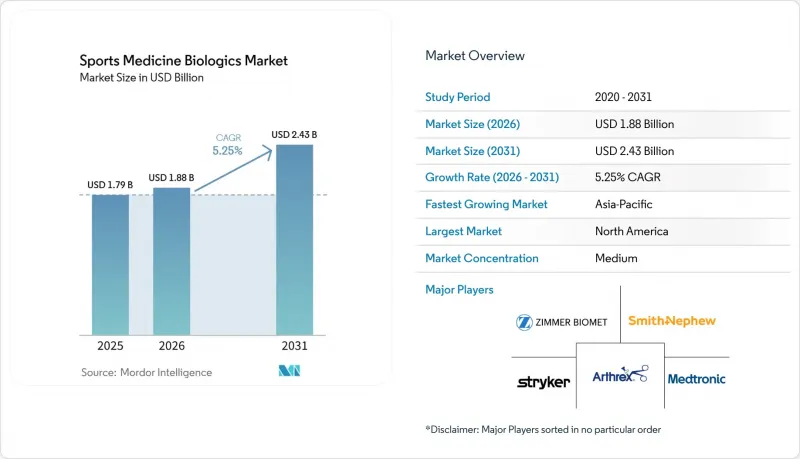
This report is Segmented by Product Type (PRP Products, Bone Graft Substitutes, Bmps, Stem Cell-Based Products, and More), Application (Knee, Shoulder, Foot and Ankle, Hip and Groin, and More), End User (Hospitals, Ascs, Specialty Orthopedic Clinics, and More), and Geography (North America, Europe, Asia-Pacific, and More). The Market Forecasts are Provided in Terms of Value (USD).
Global Sports Medicine Biologics Market Trends and Insights
Rising Sports Injury Burden and Repeat Procedure Demand
The global prevalence of musculoskeletal disorders rose by 71% between 1990 and 2024, and osteoarthritis is expected to remain the largest contributor through 2050, supporting a strong long-term addressable pool for the sports medicine biologics market. In the United States, sports-related injuries among adults over 65 are projected to reach 111,225 annually by 2040, up 119% from 2024, while the supply of sports medicine physicians is expected to rise by only 19.7% over the same period. This supply-demand gap supports office-based biologic treatment, as physicians can manage more patients in clinical settings than through surgery-intensive care pathways. The CDC burden cited in the source material places the annual cost of osteoarthritis in the United States at USD 137 billion and notes that 32.5 million adults are affected, reinforcing interest in biologic care before joint replacement.Quality and tissue-handling requirements under FDA 21 CFR Part 1271 also raise operating standards, helping established suppliers defend their share in the sports medicine biologics market.
Shift Toward Faster Recovery and Reduced Downtime
Elite sports teams and organized rehabilitation programs are increasingly using autologous biologics, as faster return to activity now carries measurable competitive and financial value. NFL data cited for the 2025 regular season indicate a 25% decline in ACL tears, but cartilage repair demand remained firm as the injury mix shifted toward chronic degenerative and osteochondral conditions that still require intervention. A 2025 network meta-analysis of 23 randomized controlled trials found that leukocyte-poor PRP with high platelet concentration delivered the strongest WOMAC function and stiffness outcomes at 12 to 18 months, supporting more standardized treatment protocols.
Payer Reluctance Toward Nonstandardized Biologic Therapies
Insurance coverage remains the most immediate volume constraint for the sports medicine biologics market, particularly for PRP-based procedures. The Federal Employee Program Blue and other major payers classify PRP as investigational across orthopedic applications, including knee osteoarthritis, Achilles tendinopathy, lateral epicondylitis, and rotator cuff repair augmentation, limiting access for a large insured patient base. The key challenge is the absence of a standardized PRP product definition, as platelet concentration, leukocyte content, injection volume, and activation method vary across studies and clinical practices. A 2025 network meta-analysis is expected to confirm that these protocol differences produce materially different outcomes, reinforcing the payer view that PRP is not one consistent therapy. When reimbursement remains uncertain, practices find it harder to sustain repeat low-cost procedures, even as clinical interest remains high.
Other drivers and restraints analyzed in the detailed report include:
- Expansion of Arthroscopy-Linked Biologic Adjacent Procedures
- Surge in Outpatient and ASC-Based Orthopedic Care
- Regulatory Scrutiny On Cell-Based And Human Tissue Products
For complete list of drivers and restraints, kindly check the Table Of Contents.
Segment Analysis
Bone graft substitutes captured 28.58% of the sports medicine biologics market share in 2025, making them the largest product category in the sports medicine biologics industry. Their leadership is supported by broad use in osteochondral lesion repair, bone void filling after ligament reconstruction, and reinforcement at tendon-to-bone fixation sites. Kuros Biosciences demonstrated scalability in this category, with its MagnetOs platform reaching 100,000 cumulative surgeries globally and generating USD 146.1 million in 2025 revenue, up 71.7% year over year. Stem cell-based products are forecast to grow at a CAGR of 6.20% through 2031, making them the fastest-growing product group in the sports medicine biologics market. This growth is supported by late-stage regulatory progress, as developers move closer to commercial decisions in major knee repair and osteoarthritis programs. MEDIPOST secured FDA agreement in June 2026 for a single pivotal Phase 3 study for CARTISTEM in the United States and Canada and is backing the strategy with USD 140 million for cGMP scale-up.
Complete Report Scope:
- By Product Type
- Platelet-Rich Plasma Products
- Bone Graft Substitutes
- Bone Morphogenetic Proteins
- Stem Cell-Based Products
- Viscosupplementation Products
- Amniotic And Placental Tissue Products
- Hyaluronic Acid Injections
- Others
- By Application
- Knee
- Shoulder
- Foot And Ankle
- Hip And Groin
- Elbow And Wrist
- Others
- By End User
- Hospitals
- Ambulatory Surgical Centers
- Specialty Orthopedic Clinics
- Sports Medicine Centers
- Others
- By Geography
- North America
- United States
- Canada
- Mexico
- Europe
- Germany
- United Kingdom
- France
- Italy
- Spain
- Rest of Europe
- Asia-Pacific
- China
- India
- Japan
- Australia
- South Korea
- Rest of Asia-Pacific
- Middle East and Africa
- GCC
- South Africa
- Rest of Middle East and Africa
- South America
- Brazil
- Argentina
- Rest of South America
- North America
Geography Analysis
North America is expected to account for 40.30% of global revenue in 2025, maintaining its position as the largest regional block in the sports medicine biologics market. Extensive ambulatory surgical infrastructure, high sports participation, and an established device pathway support the commercialization of preparation systems and adjacent biologic tools. Reimbursement progress can materially improve market access, with Smith & Nephew's expected 2025 Category 1 CPT code for CartiHeal AGILI-C showing how payment clarity can support procedure uptake. However, payer resistance remains the primary constraint, as major coverage policies continue to classify PRP as investigational for many orthopedic uses. Canada and Mexico remain smaller contributors, but both markets can expand as outpatient orthopedic infrastructure and reimbursement pathways develop further.
In Europe, Germany, the United Kingdom, and France anchor demand, while Germany remains a key clinical adoption center for cartilage biologics used in larger chondral defects. EU MDR requirements and the EMA ATMP framework increase entry costs for manufacturers, slowing some launches while protecting companies with compliant systems already in place. The United Kingdom adds further complexity, as separate MHRA oversight increases compliance requirements for pan-European strategies.
Asia-Pacific is projected to grow at a CAGR of 7.45% through 2031, making it the fastest-growing regional segment in the sports medicine biologics market. Growth is supported by expanding private sports clinics, rising orthopedic procedure volumes, and Japan's relatively open regulatory environment for regenerative medicine pathways compared to many Western markets. MEDIPOST is expected to complete Phase 3 work for CARTISTEM in Japan in 2025 and plans to file for approval in Japan in H2 2026, with approval targeted for 2027. South Korea also remains important as a development and export base for advanced point-of-care systems, with Miracell expected to receive FDA 510(k) clearance in April 2026 for SMART M-CELL after earlier deployment across 40 countries. The Middle East and Africa, and South America, remain smaller markets today, but private hospital investment and broader orthopedic build-out keep them relevant to the long-term expansion of the sports medicine biologics market.
- AlloSource
- Anika Therapeutics
- Arthrex
- Bioventus Inc.
- Breg
- Conmed
- DJO Global
- Enovis Corporation
- Integra LifeSciences
- Johnson & Johnson
- Kuros Biosciences AG
- LifeNet Health
- Medtronic
- MTF Biologics
- Organogenesis
- Orthofix
- Smiths Group
- Stryker
- Vericel
- Zimmer Biomet
Additional Benefits:
- The market estimate (ME) sheet in Excel format
- 3 months of analyst support
TABLE OF CONTENTS
1 INTRODUCTION
- 1.1 Study Assumptions and Market Definition
- 1.2 Scope of the Study
2 RESEARCH METHODOLOGY
3 EXECUTIVE SUMMARY
4 MARKET LANDSCAPE
- 4.1 Market Overview
- 4.2 Market Drivers
- 4.2.1 Rising Sports Injury Burden and Repeat Procedure Demand
- 4.2.2 Shift Toward Faster Recovery and Reduced Downtime
- 4.2.3 Expansion of Arthroscopy-Linked Biologic Adjacent Procedures
- 4.2.4 Surge in Outpatient And ASC-Based Orthopedic Care
- 4.2.5 Growth In Surgeon-Preferred Point-of-Care Biologic Preparation Systems
- 4.3 Market Restraints
- 4.3.1 Payer Reluctance Toward Nonstandardized Biologic Therapies
- 4.3.2 Regulatory Scrutiny on Cell-Based and Human Tissue Products
- 4.3.3 Inconsistent Clinical Evidence Across Product Classes
- 4.4 Supply/Value Chain Analysis
- 4.5 Regulatory Landscape
- 4.6 Technological Outlook
- 4.7 Porter's Five Forces Analysis
- 4.7.1 Bargaining Power Of Suppliers
- 4.7.2 Bargaining Power Of Buyers
- 4.7.3 Threat Of New Entrants
- 4.7.4 Threat Of Substitutes
- 4.7.5 Industry Rivalry
5 MARKET SIZE AND GROWTH FORECASTS (VALUE, USD)
- 5.1 By Product Type
- 5.1.1 Platelet-Rich Plasma Products
- 5.1.2 Bone Graft Substitutes
- 5.1.3 Bone Morphogenetic Proteins
- 5.1.4 Stem Cell-Based Products
- 5.1.5 Viscosupplementation Products
- 5.1.6 Amniotic And Placental Tissue Products
- 5.1.7 Hyaluronic Acid Injections
- 5.1.8 Others
- 5.2 By Application
- 5.2.1 Knee
- 5.2.2 Shoulder
- 5.2.3 Foot And Ankle
- 5.2.4 Hip And Groin
- 5.2.5 Elbow And Wrist
- 5.2.6 Others
- 5.3 By End User
- 5.3.1 Hospitals
- 5.3.2 Ambulatory Surgical Centers
- 5.3.3 Specialty Orthopedic Clinics
- 5.3.4 Sports Medicine Centers
- 5.3.5 Others
- 5.4 By Geography
- 5.4.1 North America
- 5.4.1.1 United States
- 5.4.1.2 Canada
- 5.4.1.3 Mexico
- 5.4.2 Europe
- 5.4.2.1 Germany
- 5.4.2.2 United Kingdom
- 5.4.2.3 France
- 5.4.2.4 Italy
- 5.4.2.5 Spain
- 5.4.2.6 Rest of Europe
- 5.4.3 Asia-Pacific
- 5.4.3.1 China
- 5.4.3.2 India
- 5.4.3.3 Japan
- 5.4.3.4 Australia
- 5.4.3.5 South Korea
- 5.4.3.6 Rest of Asia-Pacific
- 5.4.4 Middle East and Africa
- 5.4.4.1 GCC
- 5.4.4.2 South Africa
- 5.4.4.3 Rest of Middle East and Africa
- 5.4.5 South America
- 5.4.5.1 Brazil
- 5.4.5.2 Argentina
- 5.4.5.3 Rest of South America
- 5.4.1 North America
6 COMPETITIVE LANDSCAPE
- 6.1 Market Concentration
- 6.2 Market Share Analysis
- 6.3 Company Profiles (includes Global Level Overview, Market Level Overview, Core Segments, Financials as available, Strategic Information, Market Rank/Share, Products and Services, Recent Developments)
- 6.3.1 AlloSource
- 6.3.2 Anika Therapeutics, Inc.
- 6.3.3 Arthrex, Inc.
- 6.3.4 Bioventus Inc.
- 6.3.5 Breg, Inc.
- 6.3.6 CONMED Corporation
- 6.3.7 DJO, LLC
- 6.3.8 Enovis Corporation
- 6.3.9 Integra LifeSciences Holdings Corporation
- 6.3.10 Johnson & Johnson
- 6.3.11 Kuros Biosciences AG
- 6.3.12 LifeNet Health, Inc.
- 6.3.13 Medtronic plc
- 6.3.14 MTF Biologics
- 6.3.15 Organogenesis Holdings Inc.
- 6.3.16 Orthofix Medical Inc.
- 6.3.17 Smith & Nephew plc
- 6.3.18 Stryker Corporation
- 6.3.19 Vericel Corporation
- 6.3.20 Zimmer Biomet Holdings, Inc.
7 MARKET OPPORTUNITIES AND FUTURE OUTLOOK
- 7.1 White-Space and Unmet-Need Assessment

