PUBLISHER: Mordor Intelligence | PRODUCT CODE: 2120830

PUBLISHER: Mordor Intelligence | PRODUCT CODE: 2120830
Sports Medicine - Market Share Analysis, Industry Trends & Statistics, Growth Forecasts (2026 - 2031)
According to Mordor Intelligence, the sports medicine market size is projected to be USD 7.27 billion in 2025, USD 7.74 billion in 2026, and reach USD 10.76 billion by 2031, growing at a CAGR of 6.81% from 2026 to 2031.
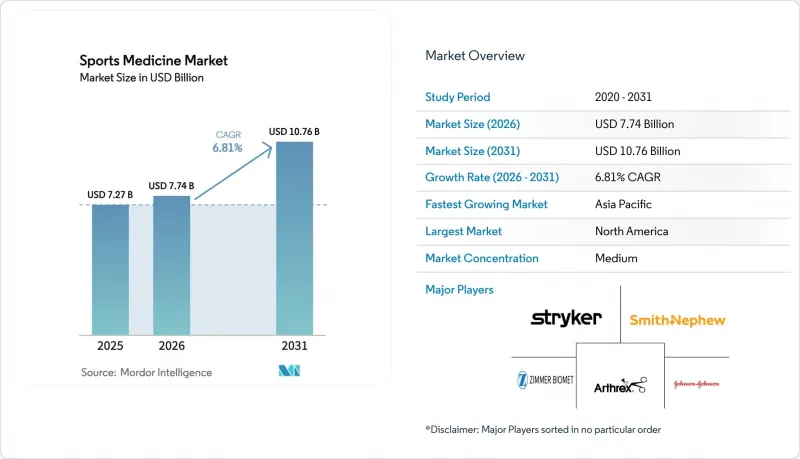
This report is Segmented by Product Type (Orthopedic Implants, and More), Application (Knee, Shoulder, Foot & Ankle, Hip & Groin, Elbow, Hand & Wrist, Spine, and Other Injuries), End User (Hospitals, Ascs, Home Care, and Other End Users), and Geography (North America, Europe, Asia-Pacific, Middle East and Africa, and South America). Market Forecasts are in Value (USD).
Global Sports Medicine Market Trends and Insights
Escalating Burden of Musculoskeletal and Sports-Related Injuries
More than 1.71 billion people lived with musculoskeletal conditions in 2024, making it the leading cause of disability worldwide. Sports participation contributes to injury prevalence, with approximately 252,000 anterior cruciate ligament reconstructions performed annually in the United States, and female athletes facing up to an eight-fold higher risk due to biomechanical and hormonal factors. Chronic pain affected 24.3% of American adults in 2024, ensuring a steady flow of orthopedic consultations, imaging, and interventions. Deferred demand emerges as adolescent sports injuries often require surgical care decades later, underscoring the durable volume pipeline. Across income strata, unmet clinical needs remain high, ensuring baseline growth even when reimbursement policies fluctuate.
Shift Toward Minimally Invasive Arthroscopic Procedures
Arthroscopy now dominates soft-tissue repair because sub-centimeter incisions reduce the risk of infection, shorten recovery time, and support same-day discharge. Johnson & Johnson MedTech added real-time analytics to arthroscopic towers in 2024, converting instrument motion data into training feedback that shortens learning curves. Zimmer Biomet's ROSA Shoulder, cleared by the FDA in 2024, cuts operative time by 15% and improves implant positioning accuracy, making reverse total shoulder arthroplasty suitable for outpatient settings. CMS increased ambulatory surgery center payments by 2.6% for 2025, closing the gap with hospital outpatient departments and incentivizing the migration of procedures. Payers endorse bundled reimbursement because arthroscopy reports low complication rates, aligning cost control with patient outcomes. The technology shift prompts manufacturers to update their product mixes to include visualization systems, single-use shavers, and sterile-packed implant kits.
High Costs and Reimbursement Uncertainty
Bundled payment models cap episode spending and penalize institutions for post-operative complications, forcing aggressive implant price negotiations and standardization around lower-cost systems. Private insurers adopt reference-based pricing, limiting reimbursement irrespective of brand, eroding manufacturer leverage over premium features. Prior authorization delays for platelet-rich plasma and stem-cell injections discourage small practices that lack dedicated billing staff, thereby constraining the volume of biologics. Japan's biennial reimbursement reviews cut specific arthroscopy rates in 2024, illustrating international volatility that complicates revenue forecasting. Ambulatory surgery centers operate on slim margins, demanding flexible consignment and risk-sharing terms from suppliers. These dynamics prompt device makers to validate their superiority through registries and real-world evidence, thereby increasing the cost of market access.
Other drivers and restraints analyzed in the detailed report include:
- Advances in Regenerative and Biologic Therapies
- Rising Investments in Professional Leagues and Fitness Infrastructure
- Proliferation of Low-Cost Counterfeit Bracing Devices Online
For complete list of drivers and restraints, kindly check the Table Of Contents.
Segment Analysis
Orthopedic implants contributed the largest 35.54% revenue share of the sports medicine market in 2025 because surgeons remain reliant on screws, plates, and suture anchors for durable mechanical fixation. Nevertheless, orthobiologics secured the steepest growth trajectory, aided by expanding clinical proof points and higher reimbursement adoption. The sports medicine market size for regenerative orthobiologics is projected to rise from USD 1.2 billion to USD 2.3 billion over the forecast period, highlighting the pivot toward biologically driven repair. Hospitals and outpatient centers are integrating point-of-care preparation systems for PRP and bone-marrow concentrates, reducing procedure times while maintaining sterility. Larger device firms are adding biologic grafts, collagen scaffolds, and synthetic extenders to their implant lines, confirming that future portfolio competitiveness hinges on blending metal fixation with biologic augmentation.
Surgeon education remains a crucial enabler because technique variation can hamper outcome reproducibility. Leading academic centers now include orthobiologic modules in fellowship curricula, emphasizing patient selection and standardized injection protocols. Simultaneously, healthcare payers analyze registries to confirm long-term cost offsets from faster return-to-sport and reduced re-operations. Such data, once mature, will clarify reimbursement pathways and further accelerate orthobiologic penetration across the sports medicine market.
Complete Report Scope:
- By Product Type
- Orthopedic Implants
- Arthroscopy Devices
- Orthobiologics
- Braces & Supports
- Bandages & Tapes
- Other Product Types
- By Application
- Knee Injuries
- Shoulder Injuries
- Foot & Ankle Injuries
- Hip & Groin Injuries
- Elbow Injuries
- Hand & Wrist Injuries
- Spine Injuries
- Other Injuries
- By End User
- Hospitals
- Ambulatory Surgical Centers
- Home Care Settings
- Other End User
- Geography
- North America
- United States
- Canada
- Mexico
- Europe
- Germany
- United Kingdom
- France
- Italy
- Spain
- Rest Of Europe
- Asia-Pacific
- China
- Japan
- India
- South Korea
- Australia
- Rest Of Asia-Pacific
- Middle East And Africa
- GCC
- South Africa
- Rest Of Middle East And Africa
- South America
- Brazil
- Argentina
- Rest Of South America
- North America
Geography Analysis
North America remained the most significant regional contributor, accounting for 40.32% of the market in 2025. The National Football League's collaboration with Amazon Web Services underscores a data-driven approach to injury prevention that reverberates across collegiate and youth programs, boosting demand for predictive analytics. CMS continues to refine bundled payment models, promoting price transparency and encouraging implant suppliers to validate clinical value. Dense ASC networks and widespread private insurance coverage facilitate the rapid adoption of outpatient services. Corporate wellness initiatives that include onsite physiotherapy further enlarge the addressable patient base because early-stage injuries receive immediate evaluation and referral.
Asia-Pacific advances at a 7.65% CAGR to 2031. China funds neighborhood rehabilitation centers under the Healthy China 2030 initiative, encouraging early intervention and expanding public access to orthopedic care. Japan, with nearly one-third of its population aged 65 years or older, sustains demand for joint preservation but faces reimbursement cuts that prompt hospitals to adopt cost-effective implants. India's expanding middle class fuels health club memberships, heightening overuse injuries and increasing private orthopedic practice revenue. Regulatory environments differ: China's fast-track approvals aid domestic innovation, while Japan's Pharmaceuticals and Medical Devices Agency maintains rigorous evidence thresholds that favor companies with multinational clinical operations.
Europe experiences uneven growth due to the costs of complying with the Medical Device Regulation and public budget constraints. Large systems in Germany and France deploy robotic surgery but must justify the premium expense of implants under capped reimbursement. The Middle East invests in orthopedic centers to capitalize on medical tourism, while Brazil's private hospitals in Sao Paulo and Rio de Janeiro adopt minimally invasive arthroscopy, despite currency fluctuations. Combined, these regions present a mosaic of reimbursement policies and infrastructure maturity that influence product launch sequences and pricing strategies.
- Anika Therapeutics
- Arthrex
- Breg
- Conmed
- Enovis Corporation (DJO Global)
- Integra LifeSciences
- Johnson & Johnson
- Karl Storz
- Medtronic
- Mueller Sports Medicine
- Performance Health Holding Inc.
- Smith+Nephew Plc
- Stryker
- Zimmer Biomet
Additional Benefits:
- The market estimate (ME) sheet in Excel format
- 3 months of analyst support
TABLE OF CONTENTS
1 Introduction
- 1.1 Study Assumptions & Market Definition
- 1.2 Scope of the Study
2 Research Methodology
3 Executive Summary
4 Market Landscape
- 4.1 Market Overview
- 4.2 Market Drivers
- 4.2.1 Escalating Burden of Musculoskeletal and Sports-Related Injuries
- 4.2.2 Shift Toward Minimally Invasive Arthroscopic Procedures
- 4.2.3 Advances in Regenerative and Biologic Therapies
- 4.2.4 Rising Investments in Professional Leagues and Fitness Infrastructure
- 4.2.5 Ambulatory Surgery Center Expansion Accelerating Outpatient Procedures
- 4.2.6 AI-Powered Motion Analysis and Predictive Injury Prevention Tools
- 4.3 Market Restraints
- 4.3.1 High Costs and Reimbursement Uncertainty
- 4.3.2 Stringent Region-Specific Regulatory Requirements
- 4.3.3 Limited Adoption of Digital Rehabilitation Among Aging Cohorts
- 4.3.4 Proliferation of Low-Cost Counterfeit Bracing Devices Online
- 4.4 Value / Supply-Chain Analysis
- 4.5 Regulatory Landscape
- 4.6 Technological Outlook
- 4.7 Porter's Five Forces
- 4.7.1 Threat Of New Entrants
- 4.7.2 Bargaining Power Of Buyers
- 4.7.3 Bargaining Power Of Suppliers
- 4.7.4 Threat Of Substitute Products
- 4.7.5 Intensity Of Competitive Rivalry
5 Market Size & Growth Forecasts (Value, USD)
- 5.1 By Product Type
- 5.1.1 Orthopedic Implants
- 5.1.2 Arthroscopy Devices
- 5.1.3 Orthobiologics
- 5.1.4 Braces & Supports
- 5.1.5 Bandages & Tapes
- 5.1.6 Other Product Types
- 5.2 By Application
- 5.2.1 Knee Injuries
- 5.2.2 Shoulder Injuries
- 5.2.3 Foot & Ankle Injuries
- 5.2.4 Hip & Groin Injuries
- 5.2.5 Elbow Injuries
- 5.2.6 Hand & Wrist Injuries
- 5.2.7 Spine Injuries
- 5.2.8 Other Injuries
- 5.3 By End User
- 5.3.1 Hospitals
- 5.3.2 Ambulatory Surgical Centers
- 5.3.3 Home Care Settings
- 5.3.4 Other End User
- 5.4 Geography
- 5.4.1 North America
- 5.4.1.1 United States
- 5.4.1.2 Canada
- 5.4.1.3 Mexico
- 5.4.2 Europe
- 5.4.2.1 Germany
- 5.4.2.2 United Kingdom
- 5.4.2.3 France
- 5.4.2.4 Italy
- 5.4.2.5 Spain
- 5.4.2.6 Rest Of Europe
- 5.4.3 Asia-Pacific
- 5.4.3.1 China
- 5.4.3.2 Japan
- 5.4.3.3 India
- 5.4.3.4 South Korea
- 5.4.3.5 Australia
- 5.4.3.6 Rest Of Asia-Pacific
- 5.4.4 Middle East And Africa
- 5.4.4.1 GCC
- 5.4.4.2 South Africa
- 5.4.4.3 Rest Of Middle East And Africa
- 5.4.5 South America
- 5.4.5.1 Brazil
- 5.4.5.2 Argentina
- 5.4.5.3 Rest Of South America
- 5.4.1 North America
6 Competitive Landscape
- 6.1 Market Concentration
- 6.2 Market Share Analysis
- 6.3 Company Profiles (includes Global-level Overview, Market-level Overview, Core Segments, Financials as available, Strategic Information, Market Rank/Share, Products & Services, Recent Developments)
- 6.3.1 Anika Therapeutics Inc.
- 6.3.2 Arthrex Inc.
- 6.3.3 Breg Inc.
- 6.3.4 CONMED Corporation
- 6.3.5 Enovis Corporation (DJO Global)
- 6.3.6 Integra LifeSciences Corporation
- 6.3.7 Johnson & Johnson Services Inc.
- 6.3.8 KARL STORZ SE & Co. KG
- 6.3.9 Medtronic Plc
- 6.3.10 Mueller Sports Medicine Inc.
- 6.3.11 Performance Health Holding Inc.
- 6.3.12 Smith+Nephew Plc
- 6.3.13 Stryker Corporation
- 6.3.14 Zimmer Biomet Holdings Inc.
7 Market Opportunities & Future Outlook
- 7.1 White-Space & Unmet-Need Assessment

