
PUBLISHER: Mordor Intelligence | PRODUCT CODE: 2099444

PUBLISHER: Mordor Intelligence | PRODUCT CODE: 2099444
Asia-Pacific Commercial Aircraft - Market Share Analysis, Industry Trends & Statistics, Growth Forecasts (2026 - 2031)
According to Mordor Intelligence, the Asia-Pacific commercial aircraft market size is expected to grow from USD 87.98 billion in 2025 to USD 92.62 billion in 2026, and is forecasted to reach USD 118.35 billion by 2031 at a 5.03% CAGR over 2026-2031.
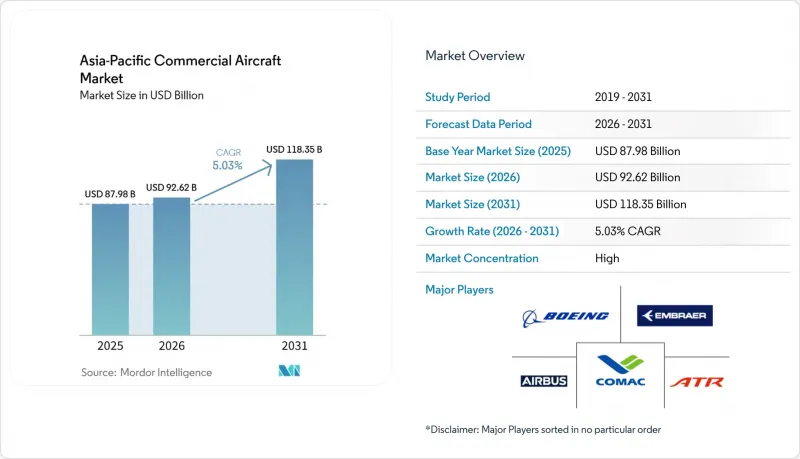
This report is Segmented by Aircraft Type (Narrowbody, Widebody, and Regional Jets), Application (Passenger and Freighter), Propulsion Type (Turbofan and Turboprop), Component (Airframe Structures, Aero-Engines, and More), and Geography (China, India, Japan, South Korea, Australia, Thailand, Indonesia, and More). The Market Forecasts are Provided in Terms of Value (USD).
Asia-Pacific Commercial Aircraft Market Trends and Insights
Rapid LCC-Led Fleet Expansion
LCCs ordered 800 single-aisle aircraft between 2024 and 2025, accounting for 68% of the regional backlog, as their unit-cost advantage enables them to profit at load factors as low as 72%. IndiGo's 500-jet order, VietJet's 200-unit deal, and Cebu Pacific's 100-aircraft commitment underscore a pivot toward point-to-point networks that bypass congested hubs. Fuel-efficient A320neo-family aircraft deliver a 15% reduction in fuel burn, enabling 8-12% lower average fares on sub-three-hour routes. Airport slots remain available in many Tier 2 Asian cities, allowing carriers to expand without incurring high congestion fees. The strategy lifts secondary-airport traffic and attracts private investment into regional terminals. Consequently, the Asia-Pacific commercial aircraft market is experiencing strong demand for narrowbodies that align with LCC economics.
Replacement Need for Fuel-Efficient Narrowbodies
More than 1,800 CFM56- and V2500-powered narrowbodies in China, Japan, and South Korea averaged 14.3 years of age in 2025, pushing maintenance reserves above residual values. China Southern retired 38 B737-800 aircraft in 2025 and cut unit fuel burn by 13% after switching to locally built C919 jets. Japan Airlines ordered 21 A321neo aircraft in 2026, citing a 19% lower trip cost versus B767-300ERs on 1,000-kilometer legs. Mid-life B737-800 and A320ceo jets are entering conversion lines, extending service life by up to 15 years and supporting freighter growth. Replacement cycles, therefore, funnel narrowbody orders toward next-generation platforms and sustain aftermarket demand for conversions.
Persistent Global Supply-Chain Bottlenecks
Pratt & Whitney's geared-turbofan recall grounded 637 regional aircraft across 2024-2025 for inspections averaging 95 days, delaying 180 Asia-Pacific deliveries slated for 2026. Boeing capped B737 MAX output at 38 units per month due to fuselage quality issues, prompting carriers to extend leases at rates 18-22% above pre-recall levels. Airbus trimmed A320neo output by 6% amid titanium shortages after sanctions hit Russian supply lines. These bottlenecks compress airlines' fleet-planning horizons and restrain near-term growth in the Asia-Pacific commercial aircraft market.
Other drivers and restraints analyzed in the detailed report include:
- Accelerated Airport-Infrastructure Build-Out
- Scale-Up of China's Domestic OEM Capacity
- Certification Delays for New Aircraft Programs
For complete list of drivers and restraints, kindly check the Table Of Contents.
Segment Analysis
Narrowbody models accounted for 72.78% of the Asia-Pacific commercial aircraft market share in 2025, reflecting their economics in 800- to 3,500-kilometer sectors. The Asia-Pacific commercial aircraft market for regional jets is projected to expand at a 7.37% CAGR, outpacing the overall market, as 100- to 150-seat models profitably serve routes with 90-110 daily passengers at upgraded secondary airports, where airport fees are lower. IndiGo's order for 50 ATR 72-600s to launch 28 UDAN routes underscores the attractiveness of rightsized aircraft on thin city pairs.
Regional jets are gaining traction as carriers introduce twice-daily frequencies on 800- to 1,200-kilometer sectors, previously served only four times a week by 50-seat turboprops. Embraer delivered 34 E195-E2 aircraft to Asia-Pacific customers in 2025, including 12 to Colorful Guizhou Airlines, whose break-even load factor dropped to 68% thanks to a 17.30% fuel-burn edge over legacy E-Jets. Turboprop interest is also reviving in Southeast Asia, where ATR has secured 78 orders for operations on runways up to 1,400 meters in length at minimal ground-support costs. Widebody deliveries declined by 9% in 2025 as airlines prioritized faster asset turnover on single-aisle aircraft, signaling that long-haul growth will lag behind regional-route expansion through 2031.
Passenger configurations held a 94.89% share in 2025; however, the Asia-Pacific commercial aircraft freighter market is growing at an 8.81% CAGR, driven by e-commerce, which now treats air cargo as a core distribution layer. Alibaba's Cainiao arm expanded its dedicated fleet from eight to 14 units in 2025 and aims to reach 25 by 2027, utilizing B737-800 and A321 converted freighters that carry payloads of 23-27 tons at 35% lower costs than widebody freighters on intra-Asia lanes.
Retailers are bypassing forwarders and contracting directly with airlines for guaranteed capacity, which commands an 18-25% premium. Lessors exploit arbitrage in passenger-to-freighter conversions, investing USD 4-6 million to earn unlevered returns of over 14% over a 12-year life. Combination passenger-freighter use remains niche because cabin-cargo rules limit flexibility, allowing dedicated freighters to capture most incremental cargo demand in the Asia-Pacific commercial aircraft market.
Complete Report Scope:
- By Aircraft Type
- Narrowbody
- Widebody
- Regional Jets
- By Application
- Passenger
- Freighter
- By Propulsion Type
- Turbofan
- Turboprop
- By Component
- Airframe Structures
- Aero-Engines
- Avionics and Flight Control
- Cabin Interior and IFEC
- Other Components
- By Geography
- China
- India
- Japan
- South Korea
- Australia
- Thailand
- Indonesia
- Rest of Asia-Pacific
List of Companies Covered in this Report:
- Airbus SE
- The Boeing Company
- Embraer S.A.
- Commercial Aircraft Corporation of China, Ltd.
- Mitsubishi Heavy Industries, Ltd.
- United Aircraft Corporation
- Avions de Transport Regional GIE
- De Havilland Aircraft of Canada Limited
- GE Aerospace (General Electric Company)
- Rolls-Royce Holdings plc
- Safran SA
Additional Benefits:
- The market estimate (ME) sheet in Excel format
- 3 months of analyst support
TABLE OF CONTENTS
1 INTRODUCTION
- 1.1 Study Assumptions and Market Definition
- 1.2 Scope of the Study
2 RESEARCH METHODOLOGY
3 EXECUTIVE SUMMARY
4 MARKET LANDSCAPE
- 4.1 Market Overview
- 4.2 Market Drivers
- 4.2.1 Rapid LCC-led fleet expansion
- 4.2.2 Replacement need for fuel-efficient narrowbodies
- 4.2.3 Accelerated airport-infrastructure build-out
- 4.2.4 Scale-up of China's domestic OEM capacity
- 4.2.5 Engine final-assembly localization incentives
- 4.2.6 Digital MRO ecosystem adoption
- 4.3 Market Restraints
- 4.3.1 Persistent global supply-chain bottlenecks
- 4.3.2 Certification delays for new aircraft programs
- 4.3.3 Rising SAF-compliance cost pressure
- 4.3.4 Skilled labour shortage in aero-manufacturing hubs
- 4.4 Value Chain Analysis
- 4.5 Regulatory Outlook
- 4.6 Technological Outlook
- 4.7 Porter's Five Forces Analysis
- 4.7.1 Bargaining Power of Suppliers
- 4.7.2 Bargaining Power of Buyers/Consumers
- 4.7.3 Threat of New Entrants
- 4.7.4 Threat of Substitute Products
- 4.7.5 Intensity of Competitive Rivalry
5 MARKET SIZE AND GROWTH FORECASTS (VALUE)
- 5.1 By Aircraft Type
- 5.1.1 Narrowbody
- 5.1.2 Widebody
- 5.1.3 Regional Jets
- 5.2 By Application
- 5.2.1 Passenger
- 5.2.2 Freighter
- 5.3 By Propulsion Type
- 5.3.1 Turbofan
- 5.3.2 Turboprop
- 5.4 By Component
- 5.4.1 Airframe Structures
- 5.4.2 Aero-Engines
- 5.4.3 Avionics and Flight Control
- 5.4.4 Cabin Interior and IFEC
- 5.4.5 Other Components
- 5.5 By Geography
- 5.5.1 China
- 5.5.2 India
- 5.5.3 Japan
- 5.5.4 South Korea
- 5.5.5 Australia
- 5.5.6 Thailand
- 5.5.7 Indonesia
- 5.5.8 Rest of Asia-Pacific
6 COMPETITIVE LANDSCAPE
- 6.1 Market Concentration
- 6.2 Strategic Moves
- 6.3 Market Share Analysis
- 6.4 Company Profiles (includes Global level Overview, Market level overview, Core Segments, Financials as available, Strategic Information, Market Rank/Share for key companies, Products and Services, and Recent Developments)
- 6.4.1 Airbus SE
- 6.4.2 The Boeing Company
- 6.4.3 Embraer S.A.
- 6.4.4 Commercial Aircraft Corporation of China, Ltd.
- 6.4.5 Mitsubishi Heavy Industries, Ltd.
- 6.4.6 United Aircraft Corporation
- 6.4.7 Avions de Transport Regional GIE
- 6.4.8 De Havilland Aircraft of Canada Limited
- 6.4.9 GE Aerospace (General Electric Company)
- 6.4.10 Rolls-Royce Holdings plc
- 6.4.11 Safran SA
7 MARKET OPPORTUNITIES AND FUTURE OUTLOOK
- 7.1 White-space and Unmet-need Assessment

