PUBLISHER: Mordor Intelligence | PRODUCT CODE: 2116631

PUBLISHER: Mordor Intelligence | PRODUCT CODE: 2116631
Europe Commercial Aircraft - Market Share Analysis, Industry Trends & Statistics, Growth Forecasts (2026 - 2031)
According to Mordor Intelligence, the Europe commercial aircraft market size is expected to grow from USD 70.77 billion in 2025 to USD 75.14 billion in 2026 and is forecasted to reach USD 99.65 billion by 2031 at a 5.81% CAGR over 2026-2031.
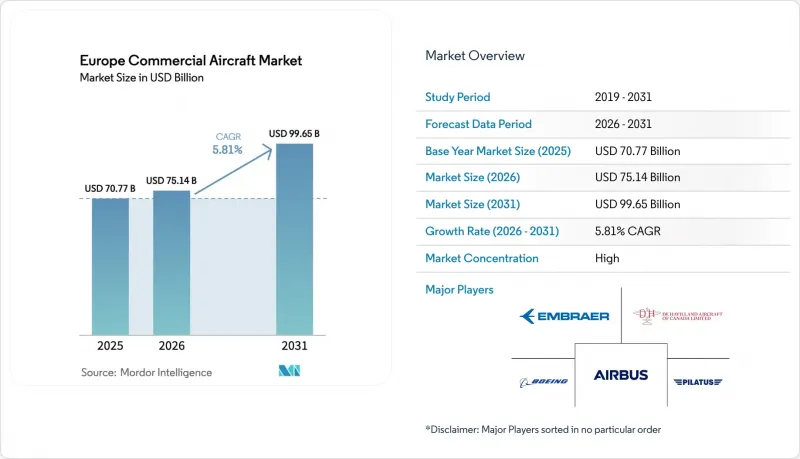
This report is Segmented by Aircraft Type (Narrowbody, Widebody, and Regional Jets), Application (Passenger and Freighter), Propulsion Type (Turbofan and Turboprop), Component (Airframe Structures, Aero-Engines, Avionics and Flight Control, Cabin Interior and IFEC, and More), and Geography (United Kingdom, Germany, France, Italy, and More). The Market Forecasts are Provided in Terms of Value (USD).
Europe Commercial Aircraft Market Trends and Insights
Surging Demand for Fuel-Efficient Narrow-Body Aircraft Driven by LCC Expansion
LCCs continue to refresh their fleets with high-density A320neo and B737-8-200 jets that shave 3-4% off seat-mile costs and meet Stage 5 acoustic limits. Ryanair is scaling back deliveries, Wizz Air has postponed part of its backlog to ease balance-sheet strain, and easyJet is concentrating on fleet renewal at constrained airports, illustrating divergent strategies built around the same efficiency imperative. Order books show replacement rather than net growth, because retiring CFM56-powered single-aisles avoids USD 2-3 million retrofit expense per airframe. Slot access, not seat count, now determines route viability, so carriers configure 180-200 seat cabins to maximize departures where movements are capped.
Fleet Replacement Cycle Accelerated by EU Stage 5 CO2 and Noise Caps from 2028
The 2024 CS-36 Amendment 6 introduces stricter cumulative noise standards and a new CO2 metric for future type designs, pushing operators to retire legacy fleets sooner. Lufthansa has removed its A340-600s, replacing them with quieter A350-900s, while British Airways has ordered additional B787-10s to phase out its older B777-200ERs. Central and Eastern carriers face higher compliance costs, prompting LOT and Tarom to adopt sale-leaseback arrangements for A220 and E2 jets. Residual values of mid-life classics have dipped, yet lease extensions remain prevalent because delivery slots for new aircraft are scarce. Regulatory pressure, therefore, accelerates replacement demand and adds 1.5 percentage points to market growth in the near term.
Persistent Tier-2/3 Supply-Chain Bottlenecks Prolonging Delivery Lead-Times
Cabin-monument, landing-gear, and wiring-harness shortages held Airbus deliveries to 766 units in 2024, just below its 770-aircraft target. The B737 MAX line remains capped at 38 jets a month as Spirit AeroSystems integration and FAA oversight slow ramp-up. Grounded A320neo-family aircraft awaiting GTF disk replacements exacerbates the shortage, pushing new-aircraft lead times past 7 years for specific variants. Airlines must extend leases on older jets at premium rates, eroding the economic case for renewal and dragging the market CAGR down by 0.8 percentage points until supply stabilizes.
Other drivers and restraints analyzed in the detailed report include:
- Intra-European Regional Connectivity Subsidies Under TEN-T and PSO Schemes
- Growing E-Commerce Boosting Demand for Dedicated Narrow-Body Freighters and P2F Conversions
- Escalating SAF-Blend Mandates Increasing Operating Costs on Marginal Routes
For complete list of drivers and restraints, kindly check the Table Of Contents.
Segment Analysis
Narrowbodies held 74.67% of the Europe commercial aircraft market share in 2025 and are forecast to post a 6.13% CAGR to 2031, anchored by Ryanair's 737-8-200 program and easyJet's A320neo intake. Airlines pursue 180-200-seat layouts to squeeze more revenue per slot at congested hubs, yet many arrivals replace aging classics rather than adding net capacity. Widebodies retain their critical long-haul relevance, as illustrated by British Airways' B787-10 orders, which cut trip costs by 25% compared to four-engine forerunners.
Turboprops account for a small base but are growing faster at 8.78% as operators like Wideroe and Olympic Air expand connectivity under PSO contracts. ATR's 42-600S STOL capability enables operations on runways under 1,000 meters, expanding viable networks without requiring expensive infrastructure projects. Regional jets maintain a niche on thin, mid-range routes, though scope clauses and pilot scarcity temper uptake. Aircraft selection now hinges on airport constraints and compliance costs rather than raw traffic demand.
Passenger aircraft still comprise 94.48% of Europe commercial aircraft market size in 2025, yet their 5.81% CAGR lags the dedicated freighter segment's 9.93% advance. DHL Express and Amazon Air anchor this cargo build-out, installing B757-200F and A330-300P2F capacity at Leipzig/Halle to guarantee overnight loops free from curfews.
Conversion slots remain sold out through 2027, pushing lessors to earmark mid-life A320s and B737-800s for cargo earlier than planned. Passenger network carriers delay expansion, focusing on utilization and ancillaries rather than headcount growth, a contrast that widens the performance gap between applications. Cargo demand now reflects a structural shift in logistics rather than a temporary pandemic spike.
Complete Report Scope:
- By Aircraft Type
- Narrowbody
- Widebody
- Regional Jets
- By Application
- Passenger
- Freighter
- By Propulsion Type
- Turbofan
- Turboprop
- By Component
- Airframe Structures
- Aero-Engines
- Avionics and Flight Control
- Cabin Interior and IFEC
- Other Components
- By Geography
- Europe
- United Kingdom
- Germany
- France
- Italy
- Spain
- Netherlands
- Russia
- Poland
- Rest of Europe
- Europe
List of Companies Covered in this Report:
- Airbus SE
- Avions de Transport Regional GIE
- The Boeing Company
- Embraer S.A.
- Textron Inc.
- Pilatus Aircraft Ltd.
- De Havilland Aircraft of Canada Limited
- United Aircraft Corporation
Additional Benefits:
- The market estimate (ME) sheet in Excel format
- 3 months of analyst support
TABLE OF CONTENTS
1 INTRODUCTION
- 1.1 Study Assumptions and Market Definition
- 1.2 Scope of the Study
2 RESEARCH METHODOLOGY
3 EXECUTIVE SUMMARY
4 MARKET LANDSCAPE
- 4.1 Market Overview
- 4.2 Market Drivers
- 4.2.1 Surging demand for fuel-efficient narrowbody aircraft driven by LCC expansion
- 4.2.2 Fleet replacement cycle accelerated by EU Stage 5 CO2 and noise caps from 2028
- 4.2.3 Intra-European regional-connectivity subsidies under TEN-T and PSO schemes
- 4.2.4 Growing e-commerce boosting demand for dedicated narrow-body freighters and P2F conversions
- 4.2.5 EU Clean Aviation funding catalyzing hydrogen-powered short-haul programs (e.g., ZEROe)
- 4.2.6 Airline push toward digital twins and predictive maintenance to maximise fleet uptime
- 4.3 Market Restraints
- 4.3.1 Persistent tier-2/3 supply-chain bottlenecks prolonging delivery lead-times
- 4.3.2 Escalating SAF-blend mandates increasing operating costs on marginal routes
- 4.3.3 High capital intensity amid rising interest rates limiting fleet-renewal budgets
- 4.3.4 Air-traffic-management capacity constraints and slot scarcity at primary hubs
- 4.4 Value Chain Analysis
- 4.5 Regulatory Outlook
- 4.6 Technological Outlook
- 4.7 Porter's Five Forces Analysis
- 4.7.1 Bargaining Power of Suppliers
- 4.7.2 Bargaining Power of Buyers/Consumers
- 4.7.3 Threat of New Entrants
- 4.7.4 Threat of Substitute Products
- 4.7.5 Intensity of Competitive Rivalry
- 4.8 Capacity and Order Backlog Analysis
5 MARKET SIZE AND GROWTH FORECASTS (VALUE)
- 5.1 By Aircraft Type
- 5.1.1 Narrowbody
- 5.1.2 Widebody
- 5.1.3 Regional Jets
- 5.2 By Application
- 5.2.1 Passenger
- 5.2.2 Freighter
- 5.3 By Propulsion Type
- 5.3.1 Turbofan
- 5.3.2 Turboprop
- 5.4 By Component
- 5.4.1 Airframe Structures
- 5.4.2 Aero-Engines
- 5.4.3 Avionics and Flight Control
- 5.4.4 Cabin Interior and IFEC
- 5.4.5 Other Components
- 5.5 By Geography
- 5.5.1 Europe
- 5.5.1.1 United Kingdom
- 5.5.1.2 Germany
- 5.5.1.3 France
- 5.5.1.4 Italy
- 5.5.1.5 Spain
- 5.5.1.6 Netherlands
- 5.5.1.7 Russia
- 5.5.1.8 Poland
- 5.5.1.9 Rest of Europe
- 5.5.1 Europe
6 COMPETITIVE LANDSCAPE
- 6.1 Market Concentration
- 6.2 Strategic Moves
- 6.3 Market Share Analysis
- 6.4 Company Profiles (includes Global level Overview, Market level overview, Core Segments, Financials as available, Strategic Information, Market Rank/Share for key companies, Products and Services, and Recent Developments)
- 6.4.1 Airbus SE
- 6.4.2 Avions de Transport Regional GIE
- 6.4.3 The Boeing Company
- 6.4.4 Embraer S.A.
- 6.4.5 Textron Inc.
- 6.4.6 Pilatus Aircraft Ltd.
- 6.4.7 De Havilland Aircraft of Canada Limited
- 6.4.8 United Aircraft Corporation
7 MARKET OPPORTUNITIES AND FUTURE OUTLOOK
- 7.1 White-space and Unmet-need Assessment

